“Your father isn’t a hero, sweetie. He’s just a soldier. And he’s certainly not coming today.”
Mrs. Vance’s voice dripped with sarcasm. She hated it when kids “exaggerated” for attention.
Little Tabitha stood by the chalkboard, clutching her poster board. It was covered in glitter and photos of a German Shepherd. She looked small. Defeated.
“He leads a K9 unit,” Tabitha whispered, her voice trembling. “He promised he’d be here.”
“Enough lies,” the teacher snapped, uncapping her red marker. “Sit down. That’s a failing grade for making things up. Stories like that don’t come from families like yours.”
The other kids laughed. That harsh, stinging laugh of fourth graders. Tabitha looked at her shoes, crushed. She began to walk back to her desk, the shame burning her cheeks.
Mrs. Vance turned her back to the class to write the date on the whiteboard. “We don’t tell tall tales in this classroom.”
That’s when the hallway grew unnaturally quiet.
The laughter stopped instantly. The kids in the back row pushed their chairs back, eyes wide, staring at the open door.
A shadow fell over the teacher’s shoulder.
Then, a low, rumbling growl vibrated through the floorboards. It sounded like a wolf.
Mrs. Vance spun around, furious. “Who brought a mutt into my – ”
She froze. Her red marker hit the floor.
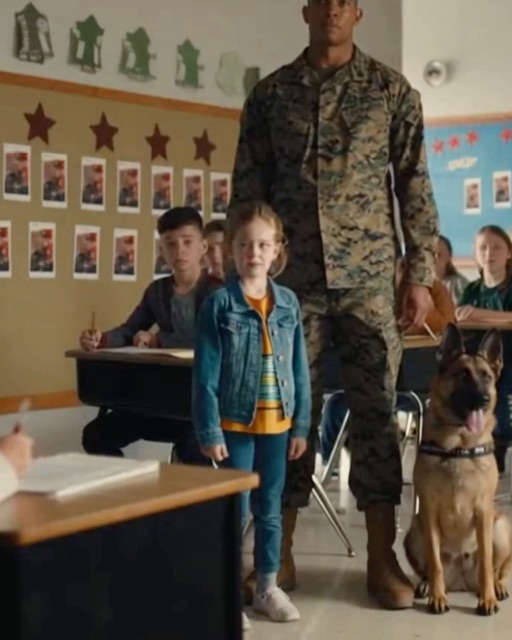
A man stood there. He was six-foot-two, wearing full combat gear, dust still on his boots. And sitting perfectly still beside him was a 90-pound Belgian Malinois with eyes locked on the teacher’s throat.
The man didn’t yell. He didn’t scream. He just walked past the stunned teacher, knelt down, and hugged Tabitha.
Then he stood up, towering over Mrs. Vance. He reached into his vest and pulled out a folded piece of paper.
“My daughter doesn’t lie,” he said, his voice terrifyingly calm. “But you might want to read this before you enter that grade.”
Mrs. Vance opened the letter with shaking hands. She read the first line, and the color drained from her face. It wasn’t just a note from a parent. It was a direct order from the School Superintendent, and it ended with “…your full and immediate cooperation is not a request.”
The paper trembled in her hand. It detailed a last-minute, district-wide assembly scheduled for that very afternoon. The keynote speaker was to be Sergeant Major Thomas Croft. His presentation was titled “Service, Sacrifice, and the Four-Legged Soldier.”
Her eyes darted from the official letterhead to the man standing before her. This was him. This was Sergeant Major Thomas Croft.
The Belgian Malinois, whose name was Ranger, let out a soft whine, nuzzling into Tabitha’s hand. The girl’s tears had stopped, replaced by a look of pure adoration for her father.
“My flight was delayed,” Sergeant Major Croft explained, his voice low enough that only Mrs. Vance could hear it clearly. “I promised my daughter I would be here for her presentation. It seems I’ve arrived just in time to give one of my own.”
Mrs. Vance couldn’t form words. Her mouth opened and closed like a fish. The authority she wielded in her little classroom kingdom had vanished in an instant.
“Mrs. Vance,” Croft continued, his gaze unyielding. “My daughter’s project. Is she still able to present it?”
The entire class was silent, watching the drama unfold. The teacher, usually so commanding, now looked as small and defeated as Tabitha had moments before.
She nodded weakly, unable to meet his eyes. “Yes. Of course.”
Thomas Croft gave a slight nod, then turned his attention back to his daughter. “Go on, Tabs. Show them what you’ve got.”
With a newfound confidence, Tabitha walked back to the front of the class. She held up her poster board, its glitter now seeming to shine brighter than before.
“This is Ranger,” she began, her voice clear and proud. “He’s my dad’s partner. He’s not just a dog. He’s a Marine, just like my dad.”
She pointed to a picture of the dog in a specialized harness. “He can find things that people can’t. He saved three people from a collapsed building last year.”
She pointed to another photo, this one of Ranger getting a medal pinned to his collar by a general. “He’s a hero. And so is my dad.”
For the next five minutes, Tabitha spoke with a passion Mrs. Vance had never seen from the quiet, timid girl. She didn’t just talk about the dog; she talked about loyalty, about trusting your partner, and about coming home safe.
When she finished, the classroom was silent for a beat. Then, a single student, a boy named Samuel in the back, started to clap. Soon, the entire class joined in, a thunderous applause that filled the room.
Sergeant Major Croft’s stern expression softened into a proud smile. He had watched the entire presentation, his hand resting on Ranger’s head.
Mrs. Vance felt a hot, unfamiliar shame creep up her neck. It wasn’t just about being proven wrong. It was a deeper, more acidic feeling. It was the recognition of her own cruelty.
Later that morning, she was summoned to the principal’s office. Mr. Harrison, a kind man with tired eyes, sat behind his desk. Sergeant Major Croft was already there, sitting in a chair, Ranger lying patiently at his feet.
“Eleanor,” Mr. Harrison began, his tone gentle but firm. “Please, sit down.”
She did, avoiding the Sergeant Major’s gaze.
“The Superintendent was very clear,” Mr. Harrison said. “Sergeant Major Croft is a decorated veteran, a community hero. When he offered to speak at the school, we were honored to make it happen, even on short notice. I don’t understand what happened in your classroom.”
Mrs. Vance clutched her purse. The bitterness that had been her constant companion for years rose up in her throat.
“With all due respect, Mr. Harrison,” she said, her voice tight, “I don’t believe in glorifying the military in front of impressionable children. It’s a life of… broken promises.”
She finally looked at Thomas Croft, her eyes filled with a resentment he couldn’t possibly understand. “These men go away. They make grand gestures and talk about honor, and they leave families to pick up the pieces. They are not heroes.”
Thomas Croft remained silent, his expression unreadable. He simply studied her face as if trying to solve a puzzle.
Mr. Harrison sighed. “Eleanor, your personal feelings cannot interfere with your duties as an educator, or with the respect we owe to parents, especially those who serve our country. You will escort your class to the auditorium at one o’clock. Is that understood?”
“Yes,” she mumbled, defeated.
The assembly was a school-wide event. The gymnasium buzzed with the energy of hundreds of children. Mrs. Vance sat in the back with her fourth graders, feeling like a ghost at a feast.
When Sergeant Major Croft walked onto the stage with Ranger, a hush fell over the crowd. He didn’t talk about battles or enemies. He spoke about teamwork. He spoke about the incredible bond between a handler and his K9.
He told them how Ranger learned to trust him, and how he, in turn, had to trust Ranger’s instincts completely. He told a story about being lost on a training exercise in the mountains, and how Ranger found his way back, leading him to safety.
He brought Tabitha onto the stage. Together, they demonstrated a few of Ranger’s skills. Tabitha would hide a specially scented cloth, and Ranger would find it in seconds, his tail wagging furiously as the children cheered.
Tabitha was no longer the shy girl from the classroom. On that stage, next to her father and his heroic dog, she was radiant. She was a part of their team.
Mrs. Vance watched, a painful knot tightening in her chest. Every word of praise for the Sergeant Major felt like a personal indictment. She saw her own past reflected in his uniform, in his calm demeanor, in the very idea of him.
After the assembly, as the students filed out, buzzing with excitement, Mrs. Vance knew she couldn’t let it go. She saw Thomas Croft near the side exit, speaking with the principal. She marched over, her resolve hardening with every step.
“Sergeant Major,” she said, her voice sharp. He turned, his calm eyes meeting hers. Mr. Harrison excused himself, sensing a private conversation was needed.
“I need you to understand something,” she began, her voice low and trembling with suppressed emotion. “You can stand on that stage and play the hero. You can fool these children and their parents. But I know the truth about men like you.”
He just listened, his head tilted slightly. Ranger sat at his side, ever watchful.
“I was married to a Marine,” she spat, the words tasting like poison. “He wore that uniform. He made those same promises. He spoke of honor and duty.”
Her voice broke. “And then he was gone. Kicked out. A dishonorable discharge. He left me with nothing but debt and shame. He ruined my life. That uniform… it doesn’t represent heroes to me. It represents lies.”
Thomas Croft’s expression finally changed. A flicker of recognition, of sorrow, crossed his face. “What was your husband’s name?” he asked softly.
“Why?” she scoffed. “So you can look him up and see another failure produced by your glorious Corps?”
“What was his name, ma’am?” he repeated, his voice gentle but insistent.
“Mark,” she whispered, the name a painful ghost on her lips. “His name was Mark Vance.”
Thomas Croft closed his eyes for a moment. When he opened them, the look he gave her was one of profound pity.
“I knew Mark Vance,” he said quietly. “I was his commanding officer.”
The world seemed to tilt under Mrs. Vance’s feet. This couldn’t be. The man her daughter’s teacher had humiliated was the very same man connected to the deepest wound of her life.
“You?” she breathed, horrified. “You were the one who signed his discharge papers. You’re the one who ruined him. You ruined us!”
“No, ma’am,” Thomas said, his voice laced with a sadness that cut through her anger. “Mark did that himself. And I did everything in my power to save him from a far worse fate.”
Her mind reeled. “What are you talking about? He told me it was a misunderstanding. Some missing equipment from the supply depot. He said his CO had a personal grudge.”
“The ‘missing equipment’ was night-vision goggles and tactical gear being sold on the black market,” Thomas explained, his voice flat and factual. “It wasn’t a misunderstanding. It was a federal crime. He was facing a court-martial and a long prison sentence.”
He took a step closer. “Mark was a good Marine, once. But he got in over his head with some bad people. He made a terrible mistake. I spoke to the investigators. I spoke to the battalion commander. I called in every favor I had.”
He looked her directly in the eye. “I got the charges reduced to conduct unbecoming. The dishonorable discharge was the price, but it kept him out of a military prison, Eleanor. I did it because he told me about his wife and his future back home. I did it to protect you from the public humiliation of a trial.”
The air left Mrs. Vance’s lungs. The story she had clung to for a decade, the narrative of her victimhood at the hands of a cruel, faceless military system, crumbled into dust. The villain she had imagined wasn’t a villain at all.
“He never told me,” she whispered, her legs feeling weak.
“Men like Mark rarely do,” Thomas said, his voice softening. “Shame is a powerful thing. It’s easier to blame the system than to face the man in the mirror.”
He paused, letting the truth settle. “The military isn’t perfect. No organization is. But most of us just try to do our jobs, to protect our country, and to look out for the men and women standing beside us. And sometimes, that means protecting their families, too. Even from the truth.”
Tears streamed down Eleanor Vance’s face. Tears of anger, of grief, of a decade of misplaced bitterness. She looked at this man, this hero her student was so proud of, and saw not a symbol of her pain, but the man who had, in his own way, tried to shield her from it.
Tabitha came running over, hugging her dad’s leg. “Dad, can we get ice cream? Samuel said Ranger was the coolest dog in the whole world!”
Thomas smiled, ruffling her hair. “In a minute, sweetheart.” He looked back at Mrs. Vance. “My daughter thinks I’m a hero because I come home. That’s all that matters to her. That I keep my promise.”
The next Monday, when the children entered the classroom, something was different. The bulletin board at the back of the room, which had previously held spelling bee winners, was now covered in red, white, and blue.
In the center was a large poster titled “Our Community Heroes.” There was a picture of a firefighter, a nurse, and a police officer. And right in the middle was a large, glossy photo of Sergeant Major Thomas Croft and Ranger.
Mrs. Vance stood at the front of the room. She looked tired, but her eyes were clear for the first time in years.
“Good morning, class,” she said. “Before we begin, I have something to say.”
She looked directly at Tabitha. “I owe you, and your father, an apology. I was wrong. Your father is a hero. Your presentation was excellent, and you have earned an A-plus.”
She didn’t stop there. “I have been unfair in my judgments,” she told the class. “Sometimes, we think we know the whole story about someone, but we only know one tiny piece of it. It’s our job to listen, to learn, and to be kind.”
From that day on, Room 204 was a different place. Mrs. Vance started a new class project: a letter-writing campaign for deployed soldiers. She invited other parents in uniform to speak. She learned to see the world not through the lens of her own past pain, but through the hopeful eyes of her students.
She had spent a decade holding onto a story that protected her pride but poisoned her spirit. Sergeant Major Croft, in his quiet strength, hadn’t just defended his daughter’s honor; he had offered Eleanor Vance a truth that, while painful, finally set her free. The greatest lessons, she realized, are not about being right, but about having the courage to admit when you are wrong.