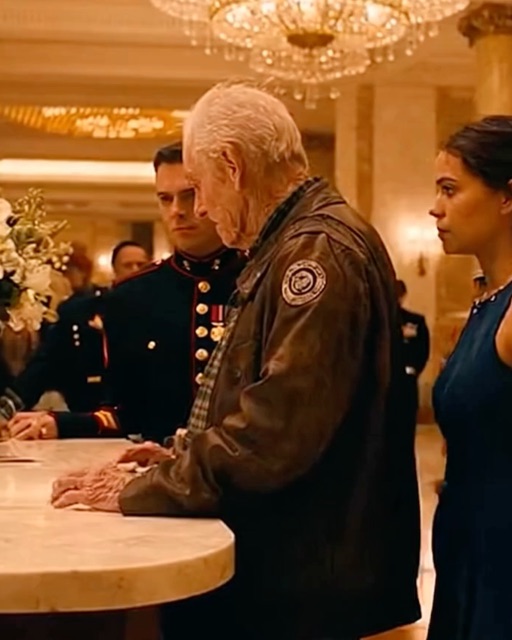
“Get this bum out of my lobby,” Captain Trent sneered, adjusting his pristine dress blues. “This is a Marine Corps ball, not a soup kitchen.”
He was shouting at an 86-year-old man standing quietly by the entrance. The man, Frank, wore a faded leather jacket that had seen better days. It was cracked, worn, and smelled of old tobacco.
Frank’s granddaughter, Brenda, stepped in front of him. “He has an invitation,” she said, her voice shaking. “General Morrison invited him personally.”
Trent laughed. A cruel, barking sound. He snatched the paper from her hand and didn’t even read it. “General Morrison doesn’t invite senile old men in ragged coats to the event of the year.”
He crumpled the invitation and threw it on the floor.
The lobby went silent. Young Marines in the back snickered. Frank didn’t say a word. He just stared at Trent with eyes that were cold, hard, and terrifyingly calm.
“You’re blocking the entrance for real heroes,” Trent spat, reaching out to shove the old man toward the door. “Go back to the nursing home, pops.”
That’s when General Morrison walked in. He saw the crumpled paper. He saw Trent’s hand on the old man’s jacket.
The General’s face went purple. He didn’t walk – he marched. He stopped inches from Trent’s face.
“Captain,” Morrison whispered, a sound more dangerous than a scream. “Do you know whose jacket you’re touching?”
Trent smirked, confident. “Some washout, sir?”
“No,” Morrison said, slowly saluting the old man. “You’re touching the ‘Iron Viper.’ And the only reason you’re alive to wear that uniform is because of what he did in ’68.”
Trent looked confused. He glanced down at the old man’s tattered sleeve.
But when he saw the small, black patch hidden under the collar, his knees actually buckled.
The patch was no bigger than a quarter. It was simple, unadorned black fabric, with a single coiled snake stitched in dark gray thread. It was almost invisible against the worn leather.
It wasn’t a unit patch. It wasn’t a rank insignia. It was something else entirely. Something spoken of only in whispers, a ghost story told by old timers to scare new recruits.
The Iron Vipers weren’t real. They couldn’t be. They were a myth.
Trent’s mind raced, trying to process the impossible. His arrogance evaporated, replaced by a cold, creeping dread that started in his gut and spread through his limbs.
General Morrison’s voice cut through the silence like a razor. “My office. Now.” He then turned to Frank. His entire demeanor softened.
“Master Sergeant,” the General said, his voice thick with a respect that bordered on reverence. “My sincerest apologies. This will be dealt with.”
Frank just gave a slight, almost imperceptible nod. His eyes, however, never left Trent.
Brenda, who had been holding her breath, finally let it out. She watched as Captain Trent, the man who seemed so powerful moments ago, turned and walked like a prisoner to his own execution. He looked smaller now, his perfect uniform suddenly seeming like a costume.
The young Marines who had been snickering were now rigid as statues. Their eyes were wide, fixed on the old man in the tattered jacket. The joke was over.
Brenda gently took her grandfather’s arm. “Grandpa, are you okay?”
He looked down at her and for the first time that evening, a small, gentle smile touched his lips. “I’ve been through worse, kiddo.”
Inside the General’s temporary office, a quiet room off the main ballroom, Trent stood at attention. He felt sweat trickle down his back, cold and uncomfortable.
Morrison didn’t sit down. He paced behind his desk like a caged lion.
“You like history, Captain?” Morrison asked, his voice deceptively calm.
“Sir, yes, sir,” Trent managed to choke out.
“Then let me give you a lesson you won’t find in any book,” the General said, stopping to stare directly at Trent. “Because the men who wrote this chapter in blood made sure it was never published.”
He pointed a finger at Trent’s chest. “In 1968, during the Tet Offensive, a command outpost at Khe Sanh was about to be completely overrun. All communication was lost. We thought everyone was gone.”
“It was a strategic command center. Losing it would have meant losing the entire northern sector. We’re talking about thousands of lives, Captain. Thousands.”
Morrison leaned forward on his desk, his knuckles white. “For three days, we heard nothing but static. We were preparing a counter-offensive, basically a suicide mission to retake a pile of rubble and bodies.”
“On the fourth day, the radio crackled to life. It was a single, coded message: ‘The snake is coiled.’ That was it.”
Trent’s blood ran cold. He knew that phrase. It was part of the legend.
“When reinforcements finally broke through,” Morrison continued, “they didn’t find a massacre. They found twelve men, alive. They were standing over the bodies of more than three hundred enemy soldiers.”
“Twelve men held off three battalions. For three days. With dwindling ammunition and no support.”
The General walked around the desk until he was standing in front of Trent again.
“Those twelve men were a unit so secret, they were officially denied by the Pentagon. They were called MACV-SOG, but that was just a cover. Among themselves, they were the Vipers.”
“Their job was to go where no one else could. To do what no one else would. They didn’t get medals paraded in front of cameras. They didn’t get ticker-tape parades.”
“When their service was done, their records were sealed. They were given a handshake in a dark room and told to forget everything. Their reward was simply being alive.”
Morrison’s eyes narrowed. “The man leading that defense, the man who personally held the breach for six straight hours with a machine gun propped on a pile of his own fallen comrades… they called him the Iron Viper.”
The General let the words hang in the air.
“That man is Frank Peterson. Master Sergeant Frank Peterson. He refused a battlefield commission three times because he said he belonged with the enlisted men.”
Trent felt dizzy. The room seemed to be tilting.
“The invitation you crumpled up?” Morrison’s voice was low and dangerous. “I didn’t send that as a courtesy. I sent it as a request. I was hoping he would honor us with his presence. I have been trying to get him to come to one of these for ten years.”
“That jacket you so casually dismissed? It’s the same one he was wearing when he pulled my own father out of a burning helicopter in ’66. He saved my father’s life. He’s the reason I exist.”
Trent’s legs felt weak. He thought he might be sick.
“You judged a man by his coat,” Morrison said, his voice laced with contempt. “You, a peacetime Captain, who has never heard a shot fired in anger, stood in judgment of a man who has seen more hell in one afternoon than you will see in a thousand lifetimes.”
Trent wanted the floor to swallow him whole. “Sir… I… I didn’t know.”
“That’s the point!” Morrison roared, his control finally snapping. “You’re not supposed to know! You are supposed to show respect to your elders regardless! You are supposed to see a man of that age and show him the deference he has earned by living a long life! You wear the uniform of a leader, but you have the character of a bully.”
The General took a deep breath, composing himself. “There’s more you should know, Captain. Something that might hit a little closer to home for you.”
He picked up a file from his desk and opened it. “I did some digging when I learned Frank was finally coming tonight. I looked into the official report from that stand at Khe Sanh. The few names that weren’t redacted.”
He pulled out a single sheet of paper.
“The young lieutenant commanding the outpost, the one who was wounded on the first day and who Frank protected for the next three? The officer whose life was saved by the Vipers?”
Morrison looked up, his eyes locking with Trent’s.
“His name was Lieutenant Colonel Robert Trent.”
The name hit Captain Trent like a physical blow. Robert Trent. His grandfather.
His grandfather was his hero, the reason he joined the Marines. He had grown up on stories of his grandfather’s service, his bravery. But the stories were always vague about Khe Sanh. His grandfather would just get a haunted look in his eyes and say, “I was just one of the lucky ones.” He never said who made him lucky.
All the pride, the arrogance, the self-importance that Trent had built his entire identity around, crumbled into dust. He had just insulted and assaulted the very man who had saved his own family’s legacy. The man responsible for his own existence.
“My… my grandfather,” Trent whispered, his voice cracking.
“Yes,” Morrison said softly. “Your grandfather. He owed his life to that ‘bum’ in the lobby.”
Trent stood there, utterly broken. The weight of his actions, of his disgusting hubris, crushed him. He saw it all in a flash: his sneer, the crumpled invitation, the shove. He had desecrated a living monument, a hero to whom he owed an unpayable debt.
“What… what do I do, sir?” he asked, his voice pleading.
Morrison looked at him, his expression hard but with a flicker of something else. “That’s not for me to decide. Your career is likely over, Captain. I will see to that. But your honor? That’s something you have to earn back yourself. And it starts out there.”
He gestured toward the door. “Go fix this.”
Trent nodded, his eyes stinging with tears he refused to let fall. He turned, his movements stiff and robotic, and walked out of the office.
The lobby was still quiet. Everyone was watching, waiting. Brenda stood protectively by her grandfather’s side. Frank himself was just standing there, patient as a mountain.
Trent walked across the marble floor, each step an eternity. He didn’t stop until he was directly in front of Frank. The young Marines tensed. Brenda put a hand on her grandfather’s chest.
But Trent didn’t say a word. Instead, he dropped to one knee. Then the other. In his perfect, immaculate dress blues, Captain Trent knelt on the floor before the old man in the faded leather jacket.
He bowed his head, his polished shoes and crisp trousers a stark contrast to the dusty floor. “Master Sergeant Peterson,” he said, his voice choked with shame. “I am Captain Trent. I am the grandson of Robert Trent.”
A soft gasp went through the crowd. Brenda looked from Trent to her grandfather, her eyes wide with confusion.
“My actions were inexcusable,” Trent continued, his voice shaking. “They were a disgrace to my uniform, to the Corps, and to the memory of my own grandfather. I had no right. Sir, I am… I am so sorry.”
He looked up, and for the first time, Frank saw not a bully, but a broken man. “I am begging your forgiveness.”
Frank looked down at the kneeling Captain for a long moment. His expression was unreadable. The entire lobby held its collective breath.
Then, he reached out a hand, gnarled and scarred by time, and placed it on Trent’s shoulder.
“Get up, son,” Frank said, his voice quiet but firm. “There’s no need for that.”
Trent looked up, his eyes filled with disbelief.
“My generation fought so that your generation wouldn’t have to see what we saw,” Frank said. “We became ghosts so you could stand in the sun. If you live a life of peace, it means we did our job.”
He squeezed Trent’s shoulder gently. “We all make mistakes. Pride is a heavy coat to wear. The measure of a man isn’t whether he falls. It’s how he gets back up.”
Slowly, Trent rose to his feet. He was still a head taller than Frank, but he had never felt smaller in his life.
“Now,” Frank said, a twinkle in his eye. “I believe we’re late for a party.”
But Trent wasn’t done. He turned to face the entire lobby. His voice, now clear and strong, boomed through the hall.
“Attention!” he commanded. Every Marine, from the youngest private to the colonels by the door, snapped to perfect, rigid attention.
“Before you tonight,” Trent announced, his voice ringing with newfound sincerity, “is not just a guest. This is Master Sergeant Frank Peterson, United States Marine Corps, retired. But his service was never retired.”
He looked at the crowd, making eye contact with the young Marines who had laughed earlier.
“This man is a living legend. He is a hero in the truest sense of the word. He and the men he served with are the foundation upon which this modern Corps is built. We stand in the shadow of giants like him.”
He then turned back to Frank. He executed the sharpest, most profound salute of his entire life. “It is my honor, sir, to escort you into the ball.”
Frank looked at Trent, then at his granddaughter, and finally at the room full of silent, respectful Marines. He gave a small nod. “I’d like that, Captain.”
As Trent and Brenda walked on either side of Frank into the grand ballroom, a spontaneous wave of applause erupted, starting with General Morrison and spreading through the entire room. The Marines, one by one, began to salute the old man in the leather jacket. They weren’t saluting a guest. They were saluting a piece of their own history, a hero they never knew they had.
Later that evening, sitting at the General’s table, Brenda looked at her grandfather. “You never told me,” she said softly. “You never told me any of it.”
Frank took a sip of water. “The things worth bragging about are rarely the things you’ve done with your hands,” he said. “They’re the people you’ve loved, the family you’ve raised.”
He smiled at her. “Besides, the loudest guy in the room is usually the one with the least to say. I was never much for talking.”
Captain Trent spent the rest of the night ensuring Frank was treated with the honor he deserved. He introduced him to every officer, sharing the story of his grandfather. It was his penance, and his privilege. He knew his career was over, but for the first time, he felt like he was truly earning his uniform.
The real lesson of that night wasn’t just about a secret patch or a forgotten battle. It was a reminder that heroes don’t always wear uniforms. Sometimes they wear old leather jackets. Sometimes their medals aren’t on their chests, but are hidden in the quiet, steady beat of a humble heart. True strength isn’t in a loud voice or a perfect salute, but in the silent courage to do what’s right, and the humility to recognize the greatness in others, no matter how they are dressed.