The sign on the kennel door read: CAUTION: AGGRESSIVE K-9. DO NOT APPROACH.
Inside, a German Shepherd named Shadow was pressed against the back wall. He was covered in mud, his ribs showing through his coat. The shelter staff gave him a wide berth.
“He’s a wash-out,” the kennel master told me, spitting on the ground. “Ruined three handlers. Bit a guy’s arm to the bone. He’s being put down tomorrow.”
I looked into the cage. Shadow didn’t look like a killer. He looked terrified. He flinched every time the metal gate clanged shut.
I ignored the warning and walked right up to the bars.
“Officer, don’t!” the staff member yelled.
I knelt down. “It’s okay, boy,” I whispered.
Shadow stopped shaking. He looked at me with eyes that were ancient and exhausted. Then, he did something that silenced the room. He crawled forward on his belly and slid his paw through the bars, resting it gently on my boot.
He wasn’t attacking. He was begging for help.
I took him home that night.
For the first week, Shadow was a ghost. He wouldn’t eat if I was in the room. But the real problem started when I put on my uniform. The moment he heard the Velcro of my vest or the click of my radio, he would scramble into the bathtub and whine, burying his head under a towel.
This wasn’t aggression. It was trauma.
I decided to pull his old service file from the archive. It was thin – suspiciously thin. Most of the incident reports were redacted. But stuck to the back of the folder, glued down by something sticky, was a crumpled Polaroid photo and a handwritten note from a rookie who had quit the force months ago.
I peeled the photo off.
My stomach dropped. The photo showed Shadow cowering in a corner of a patrol car. But it was what was in the background of the photo – and the three words written on the back—that made me reach for my phone to call Internal Affairs immediately.
I realized Shadow wasn’t a bad dog. He was the only witness to… a murder.
The man in the background, blurry but unmistakable, was Marcus Thorne. He was a mid-level dealer who had vanished three months ago. The official story was that he’d skipped bail and fled to Mexico.
On the back of the Polaroid, scribbled in shaky penmanship, were three words. “Miller did it.”
Sergeant Miller. My blood ran cold. He was a twenty-year veteran, a legend in the precinct. He was also the last handler listed in Shadow’s file before the dog was sent to the shelter.
My call to Internal Affairs was met with a wall of cold skepticism.
“Officer Reed, you’re basing an accusation against a decorated sergeant on a note from a disgraced rookie and the behavior of a dangerous dog?” the inspector on the phone said, his voice dripping with condescension.
I tried to explain. The redacted files, the dog’s specific triggers, the photo.
“Let me be clear,” the inspector cut in. “Drop this. You’re a good cop with a bright future. Don’t throw it away on a hunch. Consider this an official warning.”
The line went dead.
I looked at Shadow, who was sleeping at my feet, his leg twitching in some troubled dream. They wanted me to drop it. To put my career first. But looking at this broken animal, I knew I couldn’t. He had trusted me. He had reached out his paw when the whole world had given up on him.
I owed him this. I had to be his voice.
I started my own investigation, quiet and off the books. My first step was to find the rookie who wrote that note. His name was Thomas Peterson. He’d quit without notice, and his address on file was an old one.
While I searched for Peterson, I worked with Shadow. I spent hours just sitting on the floor with him, not talking, just being present. I moved his food bowl closer to me, bit by bit, day by day.
One evening, I was cleaning my service weapon on the coffee table. The distinct smell of gun oil filled the room. Shadow, who had been dozing, shot up and started barking frantically at the back door. It wasn’t a scared whine; it was a desperate, panicked warning.
Another piece of the puzzle clicked into place.
A few days later, I found him. Peterson was working as a line cook in a greasy spoon diner two hours out of town. He’d lost weight and had dark circles under his eyes.
When he saw me approach his apartment after his shift, he almost slammed the door in my face.
“I’m not a cop anymore,” he stammered. “I don’t know anything.”
“I have the photo, Peterson,” I said softly, holding it up. “And I have the dog.”
His face went pale. He let me in. His apartment was bare, just a mattress on the floor and a stack of books. He sat on the edge of the mattress, his head in his hands.
“You don’t understand,” he whispered. “Miller is a monster. He’ll kill me.”
I sat down, giving him space. “Tell me what happened. Help me understand what he did to you, and to that dog.”
Peterson finally looked up, his eyes filled with a fear I recognized from Shadow’s kennel.
He told me everything. Miller had been his training officer. He was cruel and controlling, especially with Shadow. He used pain to “train” the dog, but Shadow never became the aggressive weapon Miller wanted. He was too gentle, too smart. Miller called him useless.
The night Marcus Thorne disappeared, Miller had picked up Peterson for a routine patrol. But it wasn’t routine. They met Thorne in an abandoned industrial park on the edge of the city.
“Miller told me to stay in the car with Shadow,” Peterson said, his voice shaking. “He went to talk to Thorne by the old cannery warehouse. I saw an envelope pass from Thorne to Miller. Then they started arguing. It got loud.”
Peterson said he heard a single, muffled pop. It sounded like a car backfiring.
A few minutes later, Miller came back to the car alone. He was calm. Too calm. He had a small smudge of dirt on his cheek.
“Thorne decided to take a long vacation,” Miller had said, not looking at Peterson. “He’s gone. We were never here. You understand me, rookie?”
Peterson was terrified. He just nodded. On the drive back, Miller cleaned his service weapon in the front seat. The smell of gun oil filled the car. That’s when Peterson, trying to look anywhere but at his sergeant, snapped the quick, blurry photo with a disposable camera he had in his bag.
He quit the next day. He knew Miller was watching him. He ran, hoping the note and photo would be enough to protect him if Miller ever came for him.
His story confirmed my suspicions. But we had no body, no weapon, and no evidence besides the word of a scared ex-cop and the trauma of a dog. It wasn’t enough.
We needed more. We needed to know what Shadow knew.
I started paying closer attention to his triggers. It wasn’t just my uniform. It was the smell of cheap cigars, the kind Miller always smoked. It was the jingle of my keys on a specific type of metal clip. It was the sound of tires on gravel.
Each trigger was a memory from that night.
I took a huge risk. I put a leash on Shadow and drove us out to the industrial park Peterson had described. The moment we turned onto the gravel access road, Shadow started to whine.
My heart pounded in my chest. He remembered.
I parked the car near the old cannery warehouse and opened the door. Shadow refused to get out. He was pressing himself into the seat, trembling.
“It’s okay, boy,” I said, my voice gentle. “I’m here. We’re together.”
Slowly, hesitantly, he put his paws on the ground. He kept his belly low, his nose twitching, sniffing the air. He led me away from the warehouse, toward a dense patch of overgrown woods nearby.
He stopped at a large, old oak tree and started to dig frantically at its base, tearing at the dirt and roots with his paws.
I knelt beside him and started clearing away the loose earth. My fingers hit something hard and metallic. It was a lockbox.
I pried it open. Inside, wrapped in plastic, were stacks of cash and a small, burner phone. This was Thorne’s. Miller must have missed it when he buried the body. This was real evidence.
My own phone buzzed. It was a text from a trusted friend back at the precinct. “Miller just clocked out. Said he was ‘tying up loose ends.’ Watch your back.”
A chill went down my spine. He knew. He must have been watching me, watching Peterson. He knew we were getting close.
I looked at Shadow, who was now standing guard, a low growl rumbling in his chest. He was looking past me, toward the warehouse.
I turned. Sergeant Miller was standing there, about fifty feet away, his service weapon drawn and pointed right at me.
“You should have listened, Reed,” Miller said, his voice dangerously calm as he walked closer. “You and that worthless mutt. You should have just let it go.”
My hand instinctively went to my own holster, but I was too slow. He was a veteran, and I was caught off guard.
“Don’t even think about it,” he snarled. “Give me the box.”
I stood up slowly, putting myself between Miller and Shadow. “It’s over, Miller. I know what you did.”
He laughed, a harsh, ugly sound. “You know nothing. Thorne was a scumbag. I just cleaned up the city. A public service. And I took a little retirement bonus for my trouble.”
He gestured with the gun. “He’s under the new concrete patch in the cannery floor. Him and the rest of my money. Now, give me the box, and maybe I’ll just let you walk away.”
I knew he was lying. He couldn’t leave any witnesses, human or canine.
Shadow was a wreck beside me, shaking and whining, the trauma of that night flooding back. He saw the man who had hurt him, smelled the same cigar smoke clinging to his jacket, heard the same cold voice.
I tossed the lockbox a few feet to his left, trying to create a distraction. “You won’t get away with this.”
“I already have,” Miller said, his eyes narrowing as he kept his gun trained on my chest.
As he took a step toward the box, he made a fatal mistake. He glanced down for just a second.
In that instant, everything changed.
Shadow saw it. He saw the threat to me, the only person who had ever shown him kindness. The fear in his eyes was replaced by a fire I had never seen before. It wasn’t aggression. It was loyalty. It was love.
With a roar that seemed to come from the very soul of him, Shadow launched himself forward. He didn’t go for Miller’s arm or his leg. He went for the gun. His jaws clamped down on Miller’s wrist with incredible force.
Miller screamed in pain and surprise, the gun clattering to the ground.
The sound of the weapon hitting the gravel broke my paralysis. I lunged, tackling Miller to the ground. We struggled, and his years of experience showed. He was strong, wiry, and desperate.
But I wasn’t just fighting for myself. I was fighting for Shadow, for Peterson, for the truth.
Suddenly, the sound of sirens cut through the air, growing closer and closer.
Before I’d driven out here, I had left a sealed envelope with my partner, detailing everything Peterson had told me. I’d told him to open it and call for backup at this location if he didn’t hear from me in ninety minutes.
Miller heard the sirens too. The fight went out of him. He knew it was over.
I cuffed him as the first patrol cars skidded to a halt on the gravel road.
Internal Affairs was there. They had been secretly monitoring Miller after my initial call had, despite their official stance, raised a red flag. My partner’s call had sent them into high gear.
As they led a defeated Miller away, I turned to Shadow. He was sitting quietly, his tongue lolling out, looking up at me. He limped over and nudged his head against my hand.
He wasn’t a “wash-out.” He wasn’t a “monster.” He was a hero.
The aftermath was swift. Miller confessed to everything. Marcus Thorne’s body and the rest of the stolen money were recovered from the warehouse floor. Peterson testified against him, his voice clear and steady, his fear finally gone.
Shadow was officially, and very publicly, cleared of all wrongdoing. He was given a commendation for his bravery, which he accepted by licking the Police Chief’s face.
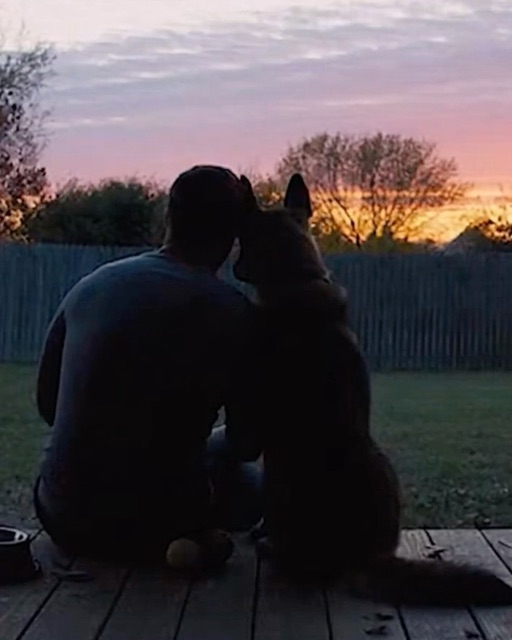
He was honorably retired from the K-9 unit. His new, permanent assignment was as my partner. My best friend.
He still sleeps at the foot of my bed. He doesn’t scramble into the bathtub at the sound of my uniform anymore. Instead, he waits patiently by the door for me to come home. The ghosts in his eyes are gone, replaced by a soft, steady light.
Sometimes I look at him and think about how close he came to being just another statistic, a problem dog put down in a cold, lonely shelter. They saw a monster, but all I saw was a soul begging for a second chance.
We often misjudge the silent, the scared, and the broken. We label them based on their scars without ever trying to understand their story. But sometimes, the ones who have been through the worst have the most to teach us about courage, loyalty, and the incredible power of a little kindness. Shadow wasn’t just a witness to a crime; he was a testament to the truth that no one is beyond saving. You just have to be willing to look past the caution signs and see the paw reaching out for help.