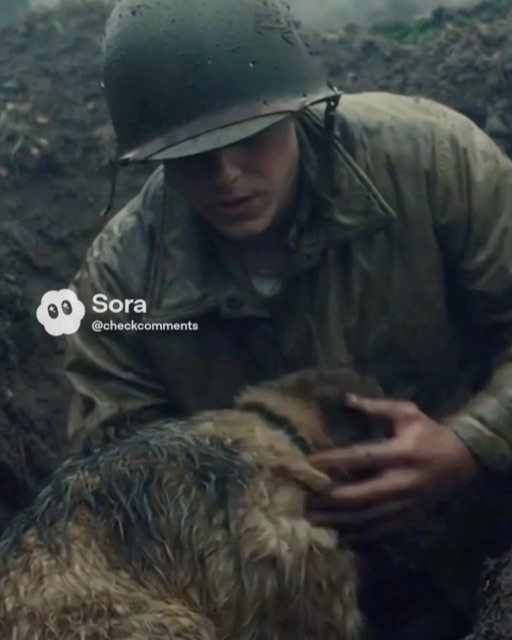
“I buried him under the oak tree while the shelling stopped,” Earl whispered, his hands shaking as he held the old photo. “I didn’t have a coffin. Just a torn Army jacket and a note tucked in his collar.”
Whisper wasn’t just a stray. He was the reason Earl and his squad were alive. When the radios died in 1944, the dog ran through hellfire to deliver the coordinates. He saved them all. But on his last run, he didn’t make it back whole.
Earl left him there in the French mud. He tried to forget.
Until last Tuesday.
A letter arrived at his cabin in North Carolina. No return address. Just a photo of that exact oak tree, now huge and covered in moss. And on the back, four words that made Earl’s blood run cold:
“He was a good soldier.”
Earl grabbed his cane and called Sam, the only other man alive who remembered the dog. “We have to go back,” Earl said.
They flew to France. They drove through the familiar fields of Bayeux until they found the treeline.
Earl’s heart pounded against his ribs. The tree was there.
But as they got closer, Sam grabbed Earl’s arm. “Look,” he pointed. “On the trunk.”
Someone had been tending the grave. And nailed to the bark was a weathered wooden tag that hadn’t been there in 1944.
Earl stepped forward, wiping the rain from his eyes. He leaned in close to read the carving.
He expected a name. He expected a date.
But when he read what was actually carved into the wood, he dropped his cane and fell to his knees sobbing.
The single word, etched deep into the grain, was “Forgiven.”
Sam rushed to his side, his own eyes welling up. “Earl, what is it? What does that mean?”
But Earl couldn’t speak. Sixty years of tightly packed grief, of guilt for leaving his friend behind, came pouring out of him. He had carried the weight of that muddy field every single day. He had felt like a deserter, abandoning the one soul who had given everything for him.
That word, “Forgiven,” was a key unlocking a prison he hadn’t even realized he was in.
After a few long moments, Sam helped his friend to his feet. They stood in silence, the quiet of the French countryside a stark contrast to the chaos Earl remembered.
“Who would do this, Sam?” Earl finally managed to ask, his voice raw.
“I don’t know, buddy,” Sam said, patting his back. “But someone knew. Someone knew what this place meant to you.”
They knew they couldn’t leave. Not yet. The mystery was too deep, the pull of that single word too strong.
They drove to the nearest village, a small cluster of stone houses and a single church spire pointing to the gray sky. It was a place that seemed untouched by time, where the memory of the war was still etched into the ancient walls.
They found a small bistro named “Le Chêne Ancien” – The Old Oak. A woman with kind eyes and flour on her apron greeted them from behind the counter.
Earl, feeling a surge of desperate hope, pulled out the crumpled photo of the tree. He pointed to it, his hand trembling.
“Excuse me, ma’am,” he said, his voice thick with emotion. “Do you know this tree?”
The woman, whose name was Anouk, looked at the photo and a slow smile spread across her face. “Mais oui,” she said softly. “Of course. That is the Soldier’s Oak. It is a very special place.”
Earl and Sam exchanged a look. “The Soldier’s Oak?” Sam asked.
Anouk nodded, wiping her hands on her apron. “It is a local story. A legend. About a brave American soldier and his dog.”
Earl felt his breath catch in his throat.
“My family,” Anouk continued, “we have been the caretakers of that place. For a very long time.”
The weight of the moment was immense. Here, in this tiny bistro, thousands of miles from his home, was the answer.
“Who sent us the letter?” Earl asked, his voice barely a whisper. “Who carved that word?”
Anouk’s expression softened. “For that, you must speak to my mother. She is the one who remembers.”
She led them through the back of the bistro into a small, cozy living space. An elderly woman sat in a comfortable chair by a window, a blanket over her lap. Her eyes were faded blue but sharp and intelligent.
“Maman,” Anouk said gently. “These men have come to ask about the oak.”
The old woman, Colette, looked at Earl and Sam. Her gaze lingered on Earl, and for a moment, he felt as if she was seeing right through the sixty years to the heartbroken boy he had been.
“You are the soldier,” she said, her voice thin but clear. “You are the one who buried his friend.”
It wasn’t a question. It was a statement.
Earl could only nod, his throat tight with unshed tears.
Colette gestured for them to sit. “I was a little girl then,” she began. “Hiding in the cellar with my family while the world exploded outside. The fighting was terrible that day.”
She paused, lost in the memory. “When the shelling stopped for a moment, I crept to the window. I saw you. A young man, so sad, digging with his bare hands under the big oak.”
Earl could see it too. The mud, the smoke, the overwhelming sense of loss.
“I saw you wrap the dog in your jacket,” Colette said. “And I saw you tuck a piece of paper into his collar before you covered him.”
Earl’s heart hammered in his chest. The note. He’d almost forgotten the note. He’d poured all his grief into it, a final, secret goodbye.
“After you left, and the battle moved on, my father went out to check our land. He found the grave,” Colette continued. “But he was not the only one there.”
She looked at Earl, her eyes holding his. “There was another soldier hiding in the ditch nearby. Not an American.”
Sam leaned forward. “A German?”
Colette nodded slowly. “He was just a boy. Younger than you, I think. He was wounded, and terrified. He had seen the whole thing.”
This was the first twist, a detail so unbelievable that Earl struggled to process it. An enemy soldier had been his silent witness.
“My father,” Colette said, a flicker of pride in her eyes, “was a good man. He saw not a uniform, but a frightened child. He brought the German boy to our cellar and my mother tended to his wounds. We hid him.”
They hid him from the Americans who were advancing and from the Germans who were retreating. They saved his life.
“When he was strong enough,” Colette went on, “the first thing he did was go back to that oak tree. He told my father he had to know what the American soldier had written. He felt it was important.”
She closed her eyes for a moment. “He dug up the note. My father translated it for him.”
Earl held his breath. He could barely remember what he’d written in his grief-stricken haze.
Colette opened her eyes and recited the words as if she’d heard them yesterday.
“His name was Whisper,” she said softly. “He was more than a dog. He was my friend. He saved us all. I’m sorry I couldn’t save you. I’ll never forget.”
Tears streamed freely down Earl’s face now. He had kept his promise. He had never forgotten.
“That German boy… his name was Klaus,” Colette said. “He told my father that in the middle of all that hate, seeing you, his enemy, show such love for an animal… it changed him. It reminded him that you were all just men, not monsters.”
The story began to unfold, a tapestry woven across decades.
Klaus survived the war. He returned home to Germany, but he never forgot the French family who saved him, or the American soldier who showed him humanity.
Every year, on the anniversary of that day, he would travel from his home in Germany back to their village. He would visit Colette’s family, and then he would go to the oak tree.
He would clear the leaves. He would make sure the small mound was undisturbed. It became his pilgrimage.
“He taught his own children about it,” Colette said, a faint smile on her lips. “The story of the American soldier and his dog became a story in their family, too. A lesson about kindness in dark times.”
“But the tag,” Sam interjected gently. “The word ‘Forgiven’. Where did that come from?”
“That was much later,” Colette explained. “Perhaps twenty years ago. Klaus was an old man himself by then. He told me he was worried. He said he felt the American soldier must still carry a great sadness.”
Earl nodded, unable to speak. Klaus had been right.
“He said he wanted to leave a message for you,” Colette said, her gaze fixed on Earl. “In case you ever came back. He didn’t want you to feel guilt. He wanted you to feel peace.”
So Klaus, the German soldier whose life was changed by a single act of love, carved the tag himself. It wasn’t a message from God or the universe. It was a message from one old soldier to another. A message of grace, an offering of peace.
“He was forgiving you,” Colette whispered, “on behalf of the world you fought in. He was telling you that you did enough. That you could let the burden go.”
This was the real message from the grave. Not a supernatural sign, but something far more powerful: a message of human connection, passed down through an enemy, a stranger, a child.
“What happened to Klaus?” Earl asked, his voice trembling.
“He passed away three years ago,” Anouk said softly, stepping back into the room. “But his family continues the tradition. His grandson comes now.”
“So, the letter…” Sam started.
“It must have been the grandson,” Anouk finished. “Klaus always kept the note you wrote. He had your name from it, from your signature. He tried for years to find you, but it was impossible back then. With the internet, his grandson, Lukas, must have finally found you.”
He had sent the picture and the simple message, “He was a good soldier,” to fulfill his grandfather’s final wish: to close the circle.
Anouk looked at Earl’s tear-streaked face. She disappeared for a moment and came back with a cordless phone. “My mother has his family’s number in Germany,” she said. “Perhaps you would like to speak with him.”
A few minutes later, Earl was holding the phone to his ear, listening to the voice of a young man speaking clear, slightly accented English. It was Lukas, Klaus’s grandson.
He told Earl how his grandfather had told him the story of the American and his dog countless times. It was the defining moment of his grandfather’s life. It taught him that even in the horror of war, decency and love could survive.
“My grandfather never saw you as an enemy, Mr. Thompson,” Lukas said, his voice filled with emotion. “He saw you as the man who taught him how to be human again. Tending to that grave was his way of saying thank you. For everything.”
The weight of sixty years lifted completely from Earl’s shoulders. The guilt he had carried for leaving Whisper behind was replaced by an overwhelming sense of peace and connection. His simple act of love for his dog had not been lost in the mud. It had blossomed. It had saved another man, created a legacy in another family, and built a bridge between former enemies.
Before they left France, Earl and Sam went back to the oak tree one last time. The air felt different now, lighter.
Earl knelt down, not in sorrow, but in gratitude. He reached into his wallet and pulled out a small, laminated photo of a scruffy-looking terrier mix, taken just before they shipped out. It was the only other picture of Whisper he had.
He carefully propped the photo against the weathered wooden tag, right under the word “Forgiven.”
Whisper was home. And after sixty long years, so was Earl.
The real message was not that the grave had sent something back. It was that the love he had put into it had never truly been buried at all. It had rippled out, touching lives he never knew, crossing borders he never imagined, and finally, after a lifetime, it had found its way back to him, bringing with it the one thing he needed most: peace. A single act of kindness is never wasted. It can echo through generations, a quiet testament to the best parts of who we are, proving that what we choose to do in our darkest moments is what truly defines our light.