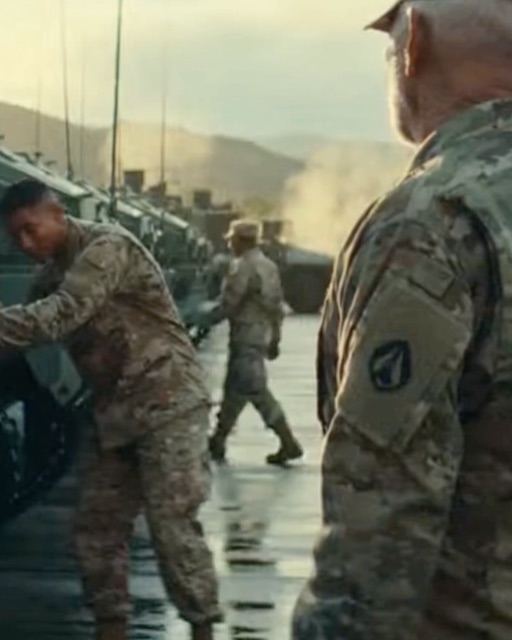
Diesel fumes hung low over the motor pool as soldiers rushed through morning checks. At the far end of the line stood a retired infantryman. Old patrol cap. Faded combat patch. Nobody paid him much attention.
Just another veteran visiting base.
Until he walked straight to an armored vehicle and placed his hand on the scarred metal like he was greeting an old friend.
A specialist laughed. “Sir, that thing’s older than me.”
The veteran didn’t look at him. “It brought six Americans home when it should’ve brought none.”
The laughter stopped.
He walked around the vehicle, tracing welded repairs, old blast marks under layers of paint. He’d ridden in that truck when it was still sand-colored and half-broken overseas.
Then he stopped near the rear door.
Scratched into the metal beneath fresh paint were initials. His. And beside them, a second set that should not have existed.
A young lieutenant asked if he was all right.
“Who restored this vehicle?”
“Base maintenance and museum staff.”
“Then they missed something.”
He crouched with visible pain, reached under the step, and pulled loose a thin plate of replacement metal.
Behind it was a narrow cavity.
Inside sat a waterproof map case. Dusty. Sealed. Hidden for decades.
Every soldier in that motor pool had stopped working now.
He opened the case and removed a folded sketch, an old flag patch, and a cassette recorder no bigger than his palm.
The lieutenant whispered, “What is that?”
The veteran stared at the recorder like it was a ghost. “It’s the last thing my squad leader had before the vehicle rolled back in without him.”
“But he was killed.”
The old infantryman lifted the recorder.
A red indicator light blinked once.
Still charged.
He pressed play. Static. Then breathing. Then a voice that had been declared dead for thirty-one years.
“If you’re hearing this, they told you I didn’t make it. They’re wrong. I’m still here. And I know what really happened that night.”
The veteran’s hands started shaking. Because that voice wasn’t just alive.
It was coming from a number he recognized on the lieutenant’s radio log from that morning.
The old soldier, Marcus Cole, felt the world tilt on its axis. He looked from the tiny recorder to the young Lieutenant Peterson, whose face was a mask of confusion.
“That number,” Marcus said, his own voice raspy. “On your log. Who was it?”
Lieutenant Peterson fumbled with his clipboard. “Standard morning check-in, sir. An automated signal from a remote comms tower we use for training exercises.”
The recorded voice continued, low and strained. “They’ll say it was the enemy. They’ll say it was a glorious last stand. Don’t believe them.”
A click, then the tape went silent.
The air in the motor pool was thick enough to chew. The smell of diesel and hot metal was replaced by the cold scent of a story that had refused to stay buried.
Marcus unfolded the sketch from the map case. It was a crude drawing of their last known position, a dusty crossroads in a country that had long since changed its name.
He recognized the handwriting instantly. It belonged to his squad leader, Sergeant Daniel Sullivan.
Daniel had drawn this map the night before the ambush, planning their patrol routes. But there was something new on it.
A set of grid coordinates, circled in faded ink, far from their intended path.
“Sir,” Lieutenant Peterson said, finding his voice. “We need to report this.”
Marcus just nodded, his mind a maelstrom of fractured memories. The deafening roar of the ambush, the scream of metal, Daniel’s last order to fall back to the vehicle.
He remembered seeing Daniel, laying down suppressive fire, a lone figure against the muzzle flashes. Then a second, colossal explosion that lit up the night sky and shook the ground beneath their armored truck.
The official report was swift and clinical. Sergeant Daniel Sullivan, killed in action. Body unrecoverable. An enemy munitions cache had been struck by a stray round. Case closed.
For thirty-one years, Marcus had carried that version of the story. It was a heavy, ugly thing, but it was all he had.
Now, a ghost was telling him it was all a lie.
Within the hour, Marcus and the lieutenant were in the base commander’s office. The map case and its contents sat on a polished mahogany desk like an unexploded bomb.
A captain from the Judge Advocate General’s office was brought in. Her name was Eva Rostova, and she had sharp, intelligent eyes that missed nothing.
She listened to the story without interruption, her expression unreadable. She played the tape again, her focus absolute.
“The radio log confirms it,” Peterson added. “The transmission came at 0600 this morning. It was a digital broadcast of this exact audio file.”
“So someone wanted this found,” Rostova said, more to herself than to them. “They knew you were coming today, Mr. Cole.”
Marcus flinched. He had only decided to visit the base last week, a sudden nostalgic impulse. How could anyone have known?
“Who else was in your squad?” Rostova asked, her gaze fixed on him.
“Six of us made it back in the truck,” Marcus recalled. “There was me, Hector, Sam, and a few others. And Daniel, of course. He stayed behind.”
“And the second set of initials you found?”
Marcus’s mind worked slowly, digging through decades of dust. “M.C. for Marcus Cole. And D.S. for Daniel Sullivan. He carved them himself as a joke, said the truck was our home now.”
“But you said there was another set.”
Marcus closed his eyes, picturing the scarred metal. “R.T. I never knew who that was.”
Captain Rostova made a note. “We’ll run the rosters for your unit. See if we can find an R.T.”
The gears of the military bureaucracy began to turn, slowly at first, then with gathering force. Rostova was methodical, relentless. She treated the thirty-one-year-old mystery not as a ghost story, but as an active case.
She pulled the original after-action reports, the casualty files, the unit manifests. And there, buried in the personnel list for support staff, she found him.
Specialist Robert Thorne. A communications tech assigned to the tactical operations center that night.
“R.T.,” she said, showing the file to Marcus in a sterile interview room.
Marcus stared at the grainy photograph. He remembered a quiet, skinny kid who always seemed to be hunched over a radio set, a phantom in the background of their war.
“He was on duty,” Marcus murmured. “He would have heard everything.”
Finding Robert Thorne was the next challenge. He’d been honorably discharged a year after the incident, citing severe post-traumatic stress. He had fallen off the grid, living a quiet life in rural Ohio.
It took two days for a military police liaison to find him.
The man they found was a shadow. Old, frail, with eyes that held the same haunted look Marcus saw in his own mirror every morning.
At first, Thorne denied everything. He claimed he didn’t remember that night, that it was all a blur of static and shouting.
But when Rostova played the tape, he broke.
Tears streamed down his weathered face as he listened to Daniel Sullivan’s voice.
“I sent it,” he whispered, his body trembling. “I was the one who broadcast the recording this morning.”
Marcus felt a surge of anger. “Why? Why now, after all this time?”
“I didn’t have it until a month ago,” Thorne confessed. “It arrived in the mail. No return address. Just the tape, a note with your name on it, and the date you were scheduled to visit the base museum.”
The note had one simple instruction: “Make sure he hears it.”
The real story then came pouring out of him, a torrent of guilt held back for three decades.
That night, Thorne was listening to the battle chatter from the command tent. He heard Daniel’s call for his squad to fall back. He heard the desperation in his voice as he held the line.
Then he heard another voice. A new voice, breaking in on a command channel.
It was their company commander, a young, ambitious captain named Jennings.
Thorne heard Jennings call in an air strike. The coordinates he gave were rushed, frantic. They were wrong.
They were the exact coordinates of Daniel Sullivan’s position.
“I heard the pilot question the call,” Thorne choked out. “He said the grid was too close to friendly forces. But Jennings overruled him. He screamed to drop the ordnance immediately.”
The “secondary explosion” wasn’t an enemy ammo dump. It was a five-hundred-pound bomb from an American A-10 Warthog.
In the stunned silence that followed, Thorne heard Jennings come back on the radio, his voice cold and commanding.
“That was an enemy munitions cache,” Jennings had declared. “Sergeant Sullivan was caught in the blast. Make a note of it.”
It was a direct order. It was a lie.
Jennings had covered his tracks masterfully. He intimidated the young pilot, doctored the reports, and threatened the handful of people who knew the truth, including the terrified radio operator in the command tent.
Robert Thorne was twenty years old. He was scared. He stayed silent.
The guilt, he said, had eaten him alive ever since.
“Captain Jennings,” Rostova said, her voice dangerously quiet. “Where is he now?”
A search of military records provided the sickening answer.
Captain Jennings hadn’t just avoided a court-martial. He had thrived. He’d built a career on his fabricated battlefield decisiveness, rising through the ranks.
He was now retired General Wallace Jennings, a celebrated war hero, a highly paid consultant for the Department of Defense, and a frequent guest on news channels.
He had built a legacy on top of Daniel Sullivan’s grave.
The mysterious package sent to Thorne was the final piece of the puzzle. It had been sent by the son of another soldier, a forward observer who had been wounded that night and medically discharged.
The observer had suspected the truth and spent the rest of his life quietly gathering what little proof he could. Before he died, he made his son promise to see that the truth came out.
The son, a tech expert, had found Marcus’s planned visit to the base on a veterans’ forum. He orchestrated the entire reveal, a final, desperate act to honor his father’s wish and a fallen sergeant’s memory.
Armed with Thorne’s sworn testimony, the observer’s research, and the physical evidence from the armored vehicle, Captain Rostova moved.
General Jennings was not invited to a quiet office. He was subpoenaed to give testimony at a formal hearing.
He walked in, immaculate in a tailored suit, radiating confidence and authority. He greeted the panel of officers with the easy charm of a man who had never known failure.
He dismissed the inquiry as a waste of time, a misunderstanding based on the confused memories of old soldiers.
“It was a chaotic night,” Jennings said smoothly. “Sergeant Sullivan was a hero. He was lost to enemy action. It was a tragedy, but war is full of tragedies.”
Then, Captain Rostova played the tape.
For the first time, a flicker of uncertainty crossed Jennings’ face.
She presented Robert Thorne’s testimony. Jennings scoffed, calling him an unreliable witness with a history of mental health issues.
Then Rostova produced the final piece of evidence. The hand-drawn map.
“The coordinates Sergeant Sullivan circled on this map,” Rostova said, her voice echoing in the silent room. “They don’t point to an enemy position. We sent a geological survey team to the site.”
She placed a thick report on the table.
“They found residue consistent with American-made ordnance. Specifically, the type used by an A-10 Warthog. There was no evidence of a munitions cache.”
She looked directly at Jennings. “The blast crater was exactly where Sergeant Sullivan made his last stand. The truth wasn’t just buried in your reports, General. It was buried in the dirt.”
The color drained from Wallace Jennings’ face. The confident facade crumbled, revealing the craven young captain who had sacrificed a good man to save his own career.
His empire of lies, thirty-one years in the making, collapsed in a single moment.
The conclusion was swift. Jennings was stripped of his rank, his pension, his medals. His name was disgraced. The media, which had once celebrated him, now eviscerated him.
But for Marcus Cole, it was never about revenge.
He stood on that same military base a few months later, under a clear blue sky. He was not alone. The surviving members of his squad stood with him, old men with straight backs and somber eyes.
A new plaque was being dedicated. Daniel Sullivan’s name was read aloud, his file officially amended.
He was no longer just another soldier killed in action. He was honored with a posthumous Silver Star for his valor, with a citation that told the true story of his sacrifice. It noted his final act was to save his men, even when the greatest danger came not from the front, but from behind.
After the ceremony, Marcus walked back to the motor pool. The old armored vehicle was no longer in the line. It had been moved to a place of honor outside the base museum.
He placed his hand on the scarred metal, on the spot where the initials were carved. D.S. and M.C. And now he knew, R.T. had earned his place there too.
He thought about the cassette tape, the map, the initials scratched into steel. They weren’t just relics of the past. They were promises.
Promises that the truth, no matter how deep it is buried, will always fight its way to the surface. It may take a day, or it may take a lifetime, but honor demands an honest accounting.
The real memorial to a soldier isn’t just a name carved in stone. It’s the truth of their story, told completely and remembered correctly, ensuring that the legacy of their sacrifice is never forgotten, and never a lie.