
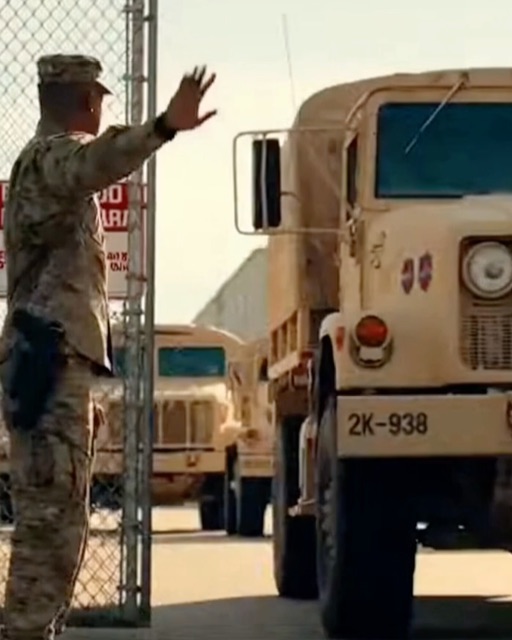
Wrong bumper code. Wrong unit crest. Right dent in the left rear panel.
I dropped my coffee and ran.
Twenty-three years in the Army, eight deployments, and my knees are shot. But when I saw that truck roll through the main gate, something in my chest locked up like a seized engine.
I knew that vehicle.
I watched it burn in 2007.
A younger soldier shouted after me from the visitor center, but I was already cutting through the side gate, one hand on my cap, lungs screaming. The convoy had stopped near the logistics yard. Engines idling. Brakes hissing. Soldiers jumping down like nothing was wrong.
A lieutenant got in my face. “What are you doing?”
I shoved past him and slapped both hands against the truck’s steel side. Right there. Near the rear hatch. Where the weld marks were barely visible under fresh paint.
“Open this compartment,” I said.
He looked at me like I’d lost my mind. “There’s no compartment there.”
I hit the metal again. “There used to be.”
A mechanic came over with tools. The bolts were rusted but they gave. The panel peeled back with a groan.
Inside: a sealed aid pouch, an old rifle sling, and a plastic-wrapped convoy manifest dated sixteen years ago.
I grabbed the manifest first.
Names. Dates. Routes. And one line, handwritten in red ink across the bottom:
TRUCK REASSIGNED BEFORE RETURN / CREW STATUS CHANGED
The lieutenant leaned in. “Changed how?”
I couldn’t answer.
Because one of the crewmen listed on that manifest was officially killed in action. I was at his memorial. I handed his mother the folded flag.
And his name had just appeared on the active vehicle reassignment record.
Dated last week.
Then someone shouted from the cab.
“Sir – there’s a radio in here powering on by itself.”
The static crackled once. Then a voice came through. Calm. Familiar.
It said my name.
“Sergeant Miller.”
My blood went cold. It was the voice of Corporal Daniel Peterson. The kid we all called Danny.
The lieutenant, whose name tag read Evans, stared at the radio, then at me. His face was pale.
“That’s impossible,” he whispered.
The voice spoke again, a little distorted by the static, but clear as a bell. “If you’re hearing this, the package is active.”
Then, a string of numbers. “Zero-niner. Tango. Four-seven.”
A hiss of static, and then silence. The radio’s green light blinked off.
The whole logistics yard had gone quiet. A small crowd of soldiers had gathered, drawn by the commotion.
A full bird Colonel pushed through the crowd. His name was Hayes, and he looked like he chewed on rocks for breakfast.
“What in the hell is going on here, Lieutenant?” Hayes demanded, his eyes fixed on the open panel.
Evans, to his credit, stood straight. “Sir, this retired Sergeant identified a vehicle discrepancy. We found a hidden compartment.”
Hayes looked at me, sizing me up. “You’re Marcus Miller.”
I just nodded, my mind still reeling from hearing Danny’s voice.
“I read your file when you processed out,” he said. “Good record. Now tell me why you’re causing a scene on my base.”
I handed him the manifest. “Corporal Daniel Peterson was in my squad, sir. He was declared KIA in ’07. I was there.”
I pointed to the manifest. “That’s his name. And that’s his voice we just heard on that radio.”
Colonel Hayes took the manifest, his expression unreadable. He looked at the truck, then back at the paper.
“This vehicle was part of a transfer from the reserve depot,” he said slowly. “It was scheduled for decommissioning.”
“Someone reassigned it last week,” I countered. “Using Peterson’s name.”
Hayes was silent for a long moment. He handed the manifest back to Lieutenant Evans.
“Seal this area,” he ordered. “No one in or out. Take Sergeant Miller and these items to my office. Now.”
His office was sterile and impersonal, all polished wood and framed commendations. He sat behind his desk and steepled his fingers, staring at the aid pouch, the sling, and the manifest I’d laid out.
“This is a ghost story, Sergeant,” Hayes said, his tone flat. “A glitch in the system. A prerecorded message on an old frequency.”
“With all due respect, sir,” I said, my voice tight, “I knew that kid. I knew his voice.”
“People can be mistaken.”
“The reassignment record from last week isn’t a mistake,” I pushed back. “The dent in the panel isn’t a mistake. Someone wanted this truck to be found. They wanted me to find it.”
He leaned forward, his gaze intense. “And why would you think that?”
“Because I retired here. I live ten minutes from this base. I come in twice a week for my VA appointments. My routine is predictable.”
It was a long shot, a gut feeling, but the pieces fit in a way that scared me.
Hayes picked up the sealed aid pouch. It was standard issue, faded green canvas. He carefully broke the old seal and emptied its contents on his desk.
Bandages, antiseptic wipes, a roll of medical tape. Standard stuff.
But I saw something else. Tucked inside the paper wrapper of a compression bandage was a tiny, folded piece of paper, no bigger than a postage stamp.
I pointed. “There, sir.”
Hayes used tweezers to pull it out and unfold it. On it was a sequence of letters and numbers, written in pencil. It wasn’t the same as what the radio said. It was a different code.
“Gibberish,” Hayes muttered, though he looked at it for a long time.
“No, sir,” Lieutenant Evans said quietly from the corner. He’d been silent the whole time. “That’s a book cipher.”
We both looked at him. The young lieutenant suddenly seemed much older.
“You need a key text,” Evans explained. “A specific book, page number, line number, and word number. Without the book, it’s meaningless.”
“And I suppose you know which book?” Hayes asked, a hint of sarcasm in his voice.
“The Soldier’s Manual of Common Tasks,” I said, the realization hitting me like a physical blow. “The one we were all issued back then.”
Danny had been obsessed with it. He’d highlighted passages, made notes in the margins. He used to say it had the answer to everything.
Colonel Hayes sent Evans to the base library. He came back twenty minutes later with a dusty, dog-eared copy from 2006.
We spread it open on the desk. The first set of numbers on the paper corresponded to a page. The next to a line. The last to a word.
We pieced it together, word by word. It was slow, tedious work.
“ALBRIGHT.”
“COVER.”
“DEAL.”
“SURVIVOR.”
“TRUST.”
“MILLER.”
The final message was chilling. “ALBRIGHT COVER. DEAL GONE WRONG. I AM A SURVIVOR. TRUST MILLER.”
Albright. The name hit me hard. General Thomas Albright. He was our battalion commander back in ’07. A real hard-charger, always gunning for his next star. He was a four-star general now, sitting in a cushy Pentagon office.
“This is… an accusation against a serving general,” Hayes said, his voice a low growl. “You understand the implications of this, Sergeant?”
“I understand that my soldier, a kid I thought was dead for sixteen years, might be alive,” I shot back. “And he’s in trouble.”
My hands were shaking. Danny was alive. All this time, he was alive. The memorial, the folded flag, the tearful conversation with his mother – it was all based on a lie.
The question was, why?
I needed to make a call. I looked at Hayes. “I need to contact an old friend. Sergeant Major Wallace. He works in personnel records at Fort Knox.”
Hayes considered it, his jaw tight. He was at a crossroads. He could bury this, dismiss me as a crazy old vet, and avoid a career-ending nightmare. Or he could pull the thread and see what unraveled.
“Make the call,” he said, pushing his office phone toward me. “On speaker.”
I dialed Wallace’s number from memory. He picked up on the second ring.
“Wallace.”
“It’s Miller,” I said.
There was a pause. “Marcus? Man, it’s been a long time. What can I do for you?”
“I need a favor, a big one. And it needs to be off the books.”
I explained the situation as concisely as I could. The truck, the manifest, Peterson’s name on a new reassignment order.
Wallace was silent for a full minute. “You’re playing with fire, Marcus. A KIA’s file is sealed tighter than a drum.”
“I know,” I said. “But that seal was broken last week when someone reactivated his name. I need to know who did it. From where.”
“This is my pension you’re asking me to risk,” he grumbled. But he was a good man. We’d been through too much together for him to say no. “Give me an hour.”
The hour was the longest of my life. Hayes, Evans, and I sat in silence, the unspoken weight of it all pressing down on us. The possibility that a decorated soldier was left behind, his death faked, to cover up something for a high-ranking officer. It was unthinkable.
It was treason.
Wallace called back in fifty-two minutes.
“Okay, Marcus,” he said, his voice low and hurried. “This is bad. The reassignment order for the truck is real. It was triggered automatically by an encrypted, time-delayed signal from a secure server.”
“A dead man’s switch,” Evans murmured.
“Exactly,” Wallace confirmed. “The signal was sent last week. But it was created and scheduled sixteen years ago.”
My heart hammered against my ribs. Danny had planned this. He had set this all up before he disappeared.
“Who created it, Wallace?” I asked.
“The electronic signature belongs to Corporal Daniel Peterson. But the authorization code to allow the creation of a time-delayed order… that came from then-Lieutenant Colonel Albright.”
The room felt like it had lost all its air.
Albright hadn’t just covered something up. He was directly involved from the very beginning.
“There’s more,” Wallace said. “The truck wasn’t the only thing in the order. The signal also triggered a transfer from a long-term evidence locker at the depot.”
“What was it?” Hayes demanded, leaning into the phone.
“A personal effects box. Belonging to Corporal Peterson. It was never sent to his next of kin. It was logged as ‘held for ongoing investigation’ and then buried in the system. It’s on a transport to your base right now. It should be at the main depot in twenty minutes.”
After the call, Hayes stood up and walked to the window, looking out over the base.
“If what this implies is true,” he said, not turning around, “then General Albright used a mission as a cover to eliminate a soldier who knew something. He faked his death and buried him.”
“But Danny survived,” I said. “And he’s been in hiding ever since, waiting for this truck to show up, waiting for me to find it.”
The second message, the one from the radio, suddenly clicked. “Zero-niner. Tango. Four-seven.”
“Evans,” I said. “Those are coordinates, right?”
“They could be, Sergeant,” he replied, already pulling up a map on the Colonel’s computer.
While Evans worked, a runner brought Peterson’s personal effects box to the office. It was a simple cardboard box, sealed with yellowed tape.
Hayes cut it open with a penknife.
Inside were the usual things. A few worn paperbacks, letters from his mom, a cheap digital camera.
I picked up the camera and turned it on. The battery was dead. Evans found a universal charger in a desk drawer and we plugged it in.
While it charged, Evans pinpointed the coordinates from the radio message.
“They’re not in a combat zone,” he said, frowning at the screen. “They’re in the US. A remote area in the Allegheny Mountains, Pennsylvania.”
A safe house? A place to hide?
The camera’s charging light turned green. I switched it on. The screen flickered to life.
There was only one video file on it. The date stamp was from the day before Danny “died.”
I hit play.
Danny’s face filled the small screen. He looked so young. He was in his bunk, whispering to the camera.
“Sergeant Miller,” he started, his eyes wide with fear. “If you’re seeing this, it means I didn’t make it back. Or, at least, they’re saying I didn’t.”
He took a deep breath. “Colonel Albright is dirty. He’s been selling our weapons and equipment… NVGs, radios, even a crate of Javelins. I saw the transaction. I got proof.”
He held up a small memory card. “It’s all on here. The buyers, the bank accounts. He found out I knew. He’s sending our squad on a ‘special reconnaissance mission’ tomorrow. But there’s no mission, Sarge. It’s a kill box. He’s going to get rid of us and blame it on an ambush.”
He looked away from the camera, his voice breaking. “I’m so sorry. I tried to go to someone else, but he has eyes everywhere. This is my only way out. I set something up. A message in a bottle. It might take years, but I’m sending it to the only person I trust to see it through.”
He looked back at the camera, right into my eyes. “The truck. Number 734. Remember the dent from that jack-knifed trailer? Find the truck, Sarge. Find it, and find me. Don’t let him get away with it.”
The video ended.
Colonel Hayes stood rigid, his face like granite. The proof was right there, in our hands. A sixteen-year-old crime, laid bare by a ghost in a machine.
“General Albright is attending a conference at the War College this week,” Hayes said, his voice cold as steel. “It’s only a few hours from those coordinates in Pennsylvania.”
The final pieces fell into place. Danny wasn’t just hiding. He was waiting.
He had waited sixteen years for his evidence to surface, for his moment to finally confront the man who took his life away. The signal he’d set up wasn’t just to expose the truth; it was to let us know it was time.
“He’s going after Albright,” I said.
“We need to get to those coordinates,” Hayes stated. “And we need to get there before he does something he can’t take back.”
There was no official channel for this. Hayes made a choice. He was a Colonel, but he was about to go up against a four-star General. He was putting his entire career on the line.
He made two quiet phone calls. An hour later, a black, unmarked helicopter was waiting for us on the tarmac.
It was just the three of us: me, Hayes, and Evans. As we flew, the landscape changing from urban sprawl to dense, green forest, I couldn’t help but think about the promise every soldier makes. To never leave a fallen comrade.
For sixteen years, I thought I had. I thought we all had.
We landed in a small clearing a few miles from the coordinates and hiked the rest of the way in. We found a small, rundown cabin hidden deep in the woods.
Smoke was curling from the chimney.
Hayes held up a hand, signaling for us to stop. He drew his sidearm. I was unarmed, a civilian, but my instincts screamed at me.
I moved ahead of them. “Let me go first,” I said. “He trusts me.”
Hayes hesitated, then nodded.
I walked to the door and knocked. “Danny? It’s Sergeant Miller. It’s Marcus.”
There was a long silence from inside. Then the sound of a bolt being drawn back.
The door creaked open.
The man standing there was older, leaner, with a beard threaded with gray and eyes that had seen too much. But it was him. It was Daniel Peterson.
He looked at me, and for a second, all the years fell away. He was just a scared Corporal again.
“Sarge,” he breathed, his voice thick with emotion.
He pulled me into a hug, and I could feel the tension of sixteen years of hiding, of loneliness, of waiting, just melt away from his shoulders.
Behind me, Colonel Hayes and Lieutenant Evans lowered their weapons.
We sat in that small cabin for hours while Danny told us everything. He’d survived the ambush Albright had set up, badly wounded, and was found by locals who helped him. He knew he could never go back. He’d be declared a deserter or worse, silenced for good.
So he created a new identity. He waited. He monitored Albright’s career, watching the man who destroyed his life get promoted again and again. He set up the time-delayed message as his only hope that, one day, the truth would come out.
“I wasn’t going to hurt him,” Danny said, looking at Hayes. “I was just going to face him. Give him the evidence I’ve collected over the years and let him know that I was alive. That he didn’t win.”
Colonel Hayes made a call. He didn’t call the Military Police. He called the Inspector General’s office. He laid out the entire story, from the truck to the video to the man sitting right in front of him.
The fallout was swift and silent. There was no public scandal. General Albright was quietly taken into custody from his conference. The official story was that he retired for “health reasons.” But within the circles that mattered, the truth was known. He was stripped of his rank and honors and would spend the rest of his life in a military prison.
Danny was brought back, not as a prisoner, but as a cooperating witness. His KIA status was reversed. His record was cleared. He was honorably discharged, with sixteen years of back pay.
The most important reunion happened a month later. I drove Danny to a small house in Ohio. His mother answered the door.
She saw him, and her hands flew to her mouth. The folded flag I had given her all those years ago sat in a display case on her mantelpiece.
To see her hold her son, to see that monument of grief replaced by a living, breathing miracle—it was the single greatest moment of my life.
Sometimes, the wounds we carry are not our own. They belong to the ones we were forced to leave behind. We tell ourselves we did everything we could, that we honored their memory. But the truth is, the deepest loyalties are not bound by time or even by death. They are a promise that echoes in silence, waiting for the moment to be fulfilled. A good soldier never truly leaves another behind, no matter how long it takes to find the way back home.



