
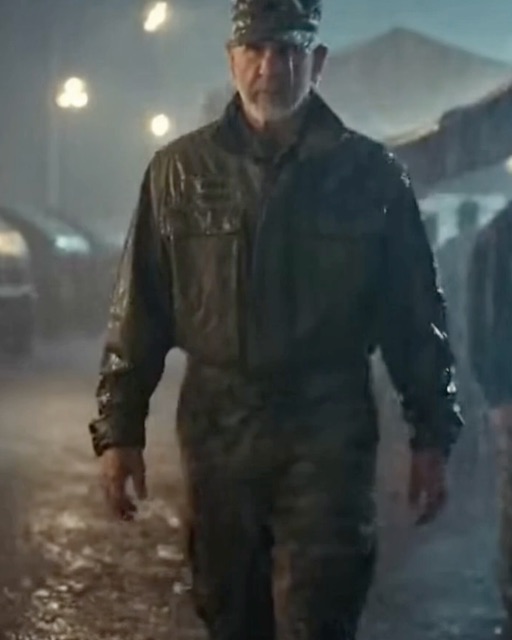
The rain was coming down in sheets, turning our field mess into a knee-deep mud pit. We were exhausted, holding up poncho flaps just to keep the warming trays from flooding.
Standing in the middle of it all was an old man in a frayed, soaked raincoat.
He hadn’t said a word. He just stood in the freezing wind, quietly handing out hot plates so our tired NCOs could eat first.
Then Captain Travis walked up. He’d been sitting in his heated Humvee all morning. He took one look at the old man and sneered.
“Who let this stray dog on my site?” Travis barked, shoving past a young specialist. “Get this civilian out of the chow line. Now.”
The old man didn’t flinch. He just kept ladling stew. “These boys are cold, Captain. The truth of the Army is in the wet line, not your truck.”
My stomach dropped as Travis smacked the ladle out of the old man’s hand. It clattered into the mud. “I’m having the MPs drag you off my – ”
“I wouldn’t do that, Captain,” a voice boomed over the rain.
We all froze. It was General Hayes, the Base Commander. He marched straight past Travis, who immediately snapped to rigid attention.
The General didn’t even look at the Captain. He stopped in front of the old man, completely ignoring the mud soaking his own boots.
The General swallowed hard, his face suddenly pale, and said something that made every soldier’s jaw hit the floor.
“Sergeant Major Peterson. I… I thought you were stateside, recovering.”
The world seemed to stop. The rain, the wind, the shivering in my bones – it all faded into a dull hum.
Sergeant Major. That title echoed in the silence between raindrops. Not just any Sergeant Major. Peterson.
Even a green private like me knew that name. It was whispered in training, spoken with reverence by drill sergeants. A ghost. A legend from conflicts most of us only read about in history books.
The old man, Sergeant Major Peterson, just offered a weak, tired smile. “Recovery is a state of mind, General. And my mind feels better when I see our soldiers getting a hot meal.”
General Hayes’s eyes flickered down to the ladle lying in the muck. His expression hardened into something colder and sharper than the winter wind.
He bent down slowly, his knees cracking. He picked up the soiled ladle, his polished boots sinking into the same mud we’d been standing in all day.
Without a word, he wiped it clean on his own uniform pants, a long, deliberate smear of brown across the crisp camouflage.
He then held it out to Sergeant Major Peterson. “Your station, Sergeant Major.”
Peterson took it with a grateful nod.
Only then did General Hayes turn his gaze to Captain Travis. It wasn’t a yell. It was worse. It was a quiet, surgical coldness.
“Captain,” the General said, his voice barely a whisper but carrying over the entire area. “You’ve been in a warm vehicle for four hours.”
Travis’s face was the color of chalk. He started to stammer, “Sir, I… I didn’t know who he was. He has no markings, no uniform…”
“Do you need a uniform to recognize a man serving your soldiers?” the General cut him off. “Do you need a rank insignia to see honor?”
The question hung in the air, heavy and suffocating.
“My command tent. In two minutes,” General Hayes commanded. He then turned to me and a few other privates. “Get this man a warm coat and some coffee. Find him the driest seat available.”
We practically tripped over ourselves to comply. Captain Travis stood frozen for a moment, his perfect posture the only thing holding him together. Then, he did a shaky about-face and trudged through the mud toward the command post, his humiliation a visible weight on his shoulders.
We got the Sergeant Major settled under a makeshift shelter. Someone handed him a steaming mug, and his wrinkled hands wrapped around it, trembling slightly.
“Thank you, son,” he said to me, his voice raspy.
“It’s an honor, Sergeant Major,” I mumbled, still star-struck.
He just shook his head. “The honor is in the work, not the name.”
For the next hour, a strange energy filled the camp. The story spread like wildfire. Soldiers who had already eaten came back out into the rain, not for more food, but just to get a glimpse of the legend.
They didn’t crowd him. They just stood at a respectful distance, nodding as they passed. It was a silent, powerful tribute.
I learned later, through the ever-reliable soldier grapevine, just who Sergeant Major Arthur Peterson was. He was a Medal of Honor recipient. He’d earned it decades ago by dragging half his platoon out of a burning kill zone, going back in time and time again until a mortar round nearly took his leg off.
He was supposed to be in a V.A. hospital, undergoing his fifth or sixth surgery on that same leg. But he’d apparently signed himself out, caught a bus, and found his way to our forward training area.
Why? Nobody knew.
Later that evening, the rain finally let up. I was tasked with cleaning the warming trays, scraping congealed stew into a bin. It was a miserable job.
“Need a hand with that?”
I turned to see Sergeant Major Peterson standing there, holding a scraper. He’d found a dry field jacket somewhere.
“No, Sergeant Major! I got it. You should be resting.”
He ignored me, grabbing a tray and starting to scrape alongside me. We worked in silence for a few minutes.
“That Captain,” he finally said, not looking at me. “He’s got a fire in his belly. Just pointed in the wrong direction.”
I didn’t know what to say. I just grunted in agreement.
“You see a lot of them,” Peterson continued. “Officers who think the rank makes the man. They study maps, tactics, logistics. They forget to study people.”
He paused, looking out over the muddy field where soldiers were now trying to string up some lights.
“An army is a heart. The soldiers are the blood. The NCOs are the veins and arteries that carry it. The officers… they’re supposed to be the brain, telling the heart where and when to beat. But if the brain forgets the blood, the whole body dies.”
His words were simple, but they landed with the force of a gut punch. It was the most profound lesson on leadership I’d ever received.
“Why are you here, Sergeant Major?” I finally asked, my curiosity getting the better of me. “If you don’t mind me asking.”
He gave a small, sad smile. “I’m looking for a ghost.”
Before I could ask what he meant, an aide appeared. “Sergeant Major. General Hayes requests your presence.”
Peterson handed me his scraper. “Finish up, son. Good work today.” He then walked off with the aide, his limp more pronounced now that the adrenaline of the day had worn off.
Inside the General’s command tent, the air was thick with tension. Captain Travis was standing at attention, his face still pale. He looked like he had been standing there for hours.
General Hayes was behind a makeshift desk, his face grim. When Sergeant Major Peterson entered, the General stood up.
“Arthur,” Hayes said, his voice softening. “You shouldn’t have to deal with this.”
“It’s alright, Bill,” Peterson replied, waving a hand. He pulled up a folding chair and sat down, wincing as he took the weight off his bad leg. He looked at the young Captain.
“What’s your full name, son?” Peterson asked gently.
“Captain Robert Travis, sir,” he answered, his voice tight.
Peterson’s eyes seemed to look right through him. “I knew a Travis once. Daniel Travis. A fine Captain. One of the best I ever served with.”
Captain Travis flinched, a flicker of something—pain, anger, surprise—crossing his face. “He was my father.”
The tent fell silent.
General Hayes leaned forward, his elbows on his desk. He hadn’t known this.
“Your father,” Peterson said, his voice now a low, somber hum. “He taught me something. We were pinned down. Rations were low. The nights were cold. Your father, an officer, took the first watch every single night. He said the men needed their sleep more than he did. He ate last, every single time.”
Tears welled in Captain Travis’s eyes, but he fought them back, his jaw clenched.
“He never asked a man to do something he wouldn’t do first,” Peterson continued. “The day he… the day we lost him, he was at the front of the charge. He was leading, not pushing from behind.”
Peterson leaned forward in his chair, his gaze locking with the young Captain’s.
“I was the one who pulled him out of the line of fire. I held him in my arms.”
This was the twist. The ghost he was looking for. It wasn’t just a memory; it was the son of the man he fought beside, the man he watched die.
“He made me promise him something,” Peterson said, his voice cracking with an emotion decades old. “He said, ‘Artie, if you ever see my boy… tell him to be a good man. Not just a good soldier. A good man.’”
A single tear finally escaped and traced a path down Captain Travis’s cheek. His rigid, arrogant shell completely dissolved, revealing a young man drowning in the shadow of a father he barely knew.
“I never knew him,” Travis choked out. “He died when I was two. All I have are stories. A box of medals. The pressure… to live up to him. I thought… I thought being tough, being demanding… I thought that’s what he would have wanted.”
“Your father wasn’t tough, son,” Peterson said softly. “He was strong. There’s a difference. Toughness is a wall you build around yourself. Strength is what you use to hold others up.”
Silence descended again, thicker this time, filled with the weight of a life, a legacy, and a profound misunderstanding.
General Hayes finally spoke. “Captain, your conduct today was inexcusable. It was a failure of leadership, respect, and basic human decency. I have your transfer orders right here.”
Travis visibly deflated, expecting the worst. A dishonorable discharge. The end of his career.
“You’re being reassigned,” the General continued, his tone flat. “To the Quartermaster Corps. You’ll be in charge of inventory at the main supply depot back at Fort Hood. You will spend the next year counting blankets, sorting boots, and signing invoices for rations.”
It wasn’t a punishment that would end his career. It was a lesson.
“You will learn, from the ground up, what it takes to keep a soldier warm and fed. You will learn the name of every specialist and every sergeant who works for you. You will not command them; you will serve them. Maybe then,” the General said, locking eyes with him, “you’ll understand what your father’s legacy really is. Dismissed.”
Captain Travis stood there for a moment, his shoulders slumped. He looked at Peterson. “Thank you, Sergeant Major,” he whispered, his voice hoarse. Then he turned and left the tent.
The next morning, Captain Travis was gone. A quiet, unassuming Lieutenant took his place. The mood in the camp was lighter, more focused.
Sergeant Major Peterson stayed for two more days. He didn’t give any speeches or hold any official sessions. He just walked among us.
He showed a private how to properly clean his rifle. He helped the cooks peel potatoes. He sat with a homesick young soldier and just listened. He led by doing, by being present.
On the day he was leaving, I saw him standing by a Humvee, ready to be driven back to the base. I walked over.
“Sergeant Major,” I said, “what you did for Captain Travis… giving him a chance.”
He looked at me, his eyes clear and kind. “Everyone deserves a chance to find the right path, son. Sometimes they just need a better map. His father gave him a legacy; he just couldn’t read it properly.”
He clapped me on the shoulder. “Be strong, not tough,” he said. And then he got in the vehicle and was gone.
I never saw Sergeant Major Arthur Peterson again, but his lesson has been the compass for my entire life.
It taught me that true authority doesn’t come from a rank on your collar or the power you wield. It comes from the respect you earn. It’s found in small acts of service: picking up a ladle, sharing a coffee, or listening to someone’s troubles.
Leadership isn’t about being in charge. It’s about taking care of those in your charge. That is the truth of the Army, and the truth of life. It’s a lesson learned not in a heated truck, but out in the rain, in the mud, right alongside everyone else.



