“You’re in the wrong place, sweetheart.”
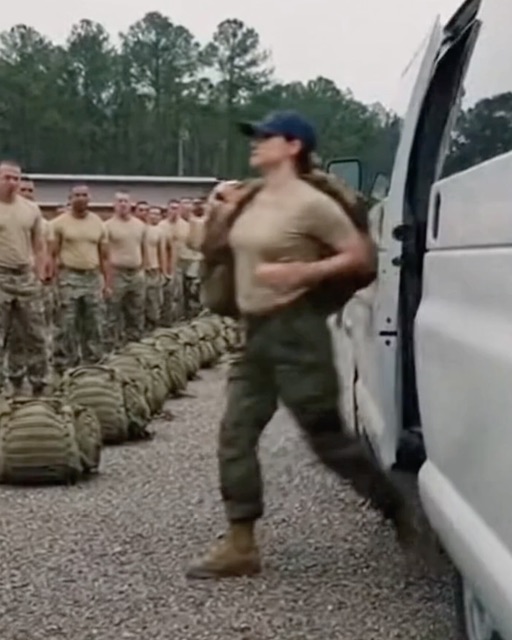
The laughter rippled through the Fort Bragg staging lot. Twenty-seven massive, battle-hardened candidates dropped their heavy rucks in the gravel and stared at the newcomer.
Her name was Kelsey. She was 5’3”, lean, and entirely too quiet.
Sergeant First Class Todd Vance marched over, his face flushed with immediate irritation. He was a strict, old-school instructor who didn’t tolerate jokes in his selection pipeline.
“Name and unit,” he barked, scanning her like he was already done with the conversation.
“Mitchell. U.S. Navy.”
Vance sneered. “Navy? What are you, medical? Admin? This pipeline breaks men who have trained for a decade. Pack your bags.”
My stomach knotted as I watched from the formation. I expected her to flinch. To argue.
Instead, she just handed him a sealed manila packet.
Vance ripped it open. His smirk quickly shifted into a heavy scowl. “Half of this is blacked out. What is this garbage?”
“It’s classified,” Kelsey said evenly.
That set the other guys off. A massive candidate next to me spat in the dirt. “Fck off, little girl,” he growled.
Vance shoved the packet back at her chest. “Get off my lot before I have military police drag you out for trespassing.”
Kelsey didn’t blink. She calmly reached into her cargo pocket, pulled out a secure satellite phone, and dialed a single number.
“Sir,” she said, her voice ice-cold. “Mitchell. They are denying access.”
She hung up.
Vance stepped forward, veins popping in his neck, about to start screaming.
But before he could get a single word out, the heavy, encrypted radio on his tactical vest sparked to life.
It wasn’t standard dispatch. The override chime meant it was the Base Commander.
“Vance,” the voice crackled, echoing across the silent lot. “Confirm you have a Petty Officer Mitchell on site.”
Vance hit the comms, looking smug. “Affirmative, sir. I was just removing the trespasser.”
“Stand down immediately,” the Commander’s voice snapped, sounding genuinely panicked. “Do not touch her.”
The entire lot went dead silent. My blood ran cold.
“She isn’t a candidate,” the Commander continued, his voice echoing through the speaker for all twenty-seven of us to hear. “And if you look at the clearance seal on the back of her file, you’ll see exactly who she really works for.”
Vance, confused, fumbled with the packet she still held out to him. He flipped it over.
His face went from red to a pasty white. He looked up at her, not with anger, but with something that looked a lot like fear.
“Petty Officer Mitchell is your final exam,” the Commander’s voice stated, cold as iron. “She is Red Cell. Her job is to test this pipeline for weaknesses. She has full authority to be there. You will treat her as a candidate in every physical evolution. You will give her a ruck, a rifle, and a spot in the formation. Is that understood, Sergeant?”
Vance could only stammer a choked, “Yes, sir.”
He handed the file back to her as if it were a venomous snake. He turned to the formation, his face a mask of raw fury and humiliation.
“You heard the man! Get her a ruck!”
Two guys scrambled to the supply shed. They came back with a standard pack, the same one we all carried, weighing a good sixty pounds with gear.
The guy next to me, the one who’d told her to fck off, was named Donovan. He was a mountain of a man, a former college football player who’d been in the Rangers for six years. He smirked as they brought the ruck over.
“Let’s see the little sailor handle this,” he muttered, just loud enough for me to hear.
Kelsey walked over to the ruck. She didn’t struggle. She didn’t ask for help. She just expertly swung it onto her small frame, cinched the straps tight, and stood there, looking like the pack was a part of her.
She stared straight ahead, her expression unreadable.
For the next ten weeks, that was the expression we all came to know.
The first event was the five-mile run in boots. Donovan and a few of his buddies set a blistering pace, trying to smoke her out on day one.
I watched her, expecting her to fall back. She was small. Her stride was shorter. It was simple physics.
But she never fell back. She just tucked in behind the lead group, her breathing steady, her feet pounding the pavement in a relentless rhythm. She didn’t look tired. She didn’t look stressed. She just ran.
We finished, and while most of us were gasping for air, she was stretching quietly by the water truck.
Donovan glared at her, sweat pouring down his face. “Lucky first day,” he grumbled to his friends.
It wasn’t luck.
The next day was the obstacle course. We hit “The Weaver,” a series of inclined logs you have to go over and under. It was a beast, designed to test upper body strength.
Donovan powered through it like an animal. He was all muscle and aggression.
Kelsey got to it, and I saw Vance watching, a small, hopeful sneer on his face. He was waiting for her to fail.
She didn’t use brute force. She used momentum and technique, swinging her body like a pendulum, using her legs to hook the logs and propel herself. She was fluid and efficient, like a gymnast.
She finished the course in the top third of the class. Vance just shook his head and walked away without a word.
The hostility didn’t stop. It got worse.
During the log drills, where teams of six have to carry a massive, water-logged telephone pole, Donovan’s team always seemed to have Kelsey. He’d position her in the middle, then subtly have his buddies on the ends shift the weight, trying to crush her.
The first time they did it, I saw her knees buckle. The log dipped.
“Pick it up, Mitchell!” Vance screamed, his voice filled with satisfaction.
But she didn’t quit. She drove her legs into the sand, her face a grimace of pure effort, and pushed the log back up. Her arms trembled, but she held it. She held it for the entire two-mile run on the beach.
When they finally dropped it, she stumbled away, her shoulders raw and red. She didn’t complain. She just drank her water and got ready for the next thing.
I started to see it then. Her strength wasn’t in her muscles. It was somewhere deeper.
I was just an Army staff sergeant trying to get through the course like everyone else. My name is Marcus. I’d always believed that strength and size were what mattered most out here. But watching her, I wasn’t so sure anymore.
I started talking to her during the rare moments of downtime. It was never much. Just a “good job” or “you holding up?”
She’d just nod. “We all are,” she’d say. She never singled herself out.
One night, during land navigation, we were paired up. It was a miserable, rainy night in the swamps of North Carolina. The objective was to find five markers scattered over ten square kilometers of hostile terrain.
Donovan had made a crack earlier. “Hope you can read a map, Marcus. Don’t let the sailor get you lost.”
We set off into the darkness. The rain was relentless. The map was getting soaked, and the compass was tricky to read in the low light.
“We should head for that ridge first,” I said, pointing to a high point on the map. “It’s the safest route, avoids the worst of the swamp.”
Kelsey shook her head, her eyes scanning the terrain. “Too slow. The direct route is through the swamp. It’s shorter.”
“It’s also more dangerous,” I argued. “We could get bogged down.”
“The mission is speed,” she said, her voice calm but firm. “Not safety. They’re testing our willingness to take calculated risks.”
Something in her tone made me trust her. We went into the swamp.
It was hell. The water was waist-deep in places, and the mud sucked at our boots. But she was incredible. She moved through it like she was born in it, reading the subtle signs of the terrain, finding solid ground where I only saw murky water.
We were the first team back, hours before anyone else. Vance looked at our punch card, his expression one of disbelief. He checked it three times.
“How?” he finally asked, his voice low.
“We took the direct route, Sergeant,” Kelsey said simply.
He just stared at her, then walked away.
The final phase of the selection was a week-long field exercise. The scenario was a hostage rescue deep in the Uwharrie National Forest. We were split into two teams. My team had Kelsey. Donovan’s team was our opposition.
Our mission was to infiltrate, locate the “hostage,” and extract them without being detected.
The weather had been bad all week, and a hurricane was churning off the coast. The instructors told us the storm was projected to stay offshore, but that we should be prepared for heavy rain and wind.
They weren’t wrong.
By the second day, the forest was a river. The wind howled through the trees, snapping branches. Radio communication with the instructors became intermittent, then failed completely.
We were on our own.
We found the hostage location, an old abandoned cabin. Donovan’s team had set up a solid defense. They were dug in, waiting for us.
“We can’t go in direct,” I whispered to the team, huddled under a rock ledge. “They’ll see us coming a mile away.”
Kelsey was studying the cabin and the surrounding terrain. “There’s a ravine behind the cabin,” she said, pointing. “It’s steep, probably flooded. But if we can get down it, we can come up behind them.”
It was a crazy idea. The ravine was more of a cliff, and with the rain, it would be a waterfall of mud and rock.
But it was our only shot.
We made our way to the edge of the ravine. It was worse than I thought. A torrent of brown water was raging at the bottom.
“This is suicide,” one of the guys said.
“It’s the mission,” Kelsey replied, already pulling rope from her pack. She wasn’t asking. She was leading.
We rappelled down one by one, the mud trying to pull us off the rock face. Kelsey went last, securing the line for everyone else.
We were at the bottom, soaked and freezing, when we heard the scream.
It wasn’t a simulated sound. It was real. It was a sound of pure agony.
It came from the direction of the cabin.
We moved fast, forgetting the exercise, our rifles at the ready.
We found Donovan. He was pinned. A massive oak tree, weakened by the wind and rain, had fallen. It had crashed right through the roof of the cabin where his team had been taking shelter.
Donovan’s leg was trapped under a massive branch, bent at an unnatural angle. The rest of his team was trying desperately to move it, but it was too heavy. One of them, a good soldier named Peterson, had a nasty gash on his head and was clearly in shock.
The exercise was over. This was real.
“It’s no use!” Donovan yelled through gritted teeth, his face pale with pain. “We can’t budge it!”
Panic was setting in. We were cut off, with two serious casualties, and the storm was getting worse.
Everyone looked around, waiting for an instructor to appear, to call it off, to take control. No one came.
Then Kelsey stepped forward.
“Everyone, calm down!” she ordered. Her voice cut through the wind and the panic. It was the voice of someone who had been here before.
She dropped to her knees beside Donovan, her hands immediately going to his leg. “Marcus, get the medkit. Check on Peterson, stop the bleeding.”
I did as I was told, my training kicking in.
Kelsey assessed Donovan’s leg. “It’s a compound fracture. We need to stabilize it and get this weight off him now, or he’s going to lose it.”
“We can’t lift it!” one of Donovan’s guys yelled.
“We’re not going to lift it,” Kelsey said, her eyes scanning the wreckage. “We’re going to use a lever.”
Her mind was working like a machine. She saw things we didn’t. She pointed to a smaller, sturdy log nearby. “Get that. And I need all the rope we have.”
We scrambled to follow her orders. She directed us to wedge the smaller log under the massive branch, creating a fulcrum. We tied the ropes together and looped them over the end of our makeshift lever.
“It’s about physics, not strength,” she explained, her voice steady and reassuring. “We’re going to pull down, not lift up.”
It was brilliant. Simple.
“On my count,” she commanded. “Three… two… one… PULL!”
Ten of us threw our entire weight onto the ropes. The log groaned. The massive branch creaked, then lifted. It only moved a few inches, but it was enough.
Two other guys pulled Donovan free. He cried out in pain, but he was out.
Kelsey was already working on him, cutting away his pants leg, applying a tourniquet, and fashioning a splint from broken pieces of the cabin wall and medical tape. Her movements were precise and economical. This wasn’t just basic first aid. This was advanced trauma care.
She saved his leg. She probably saved his life.
With Donovan and Peterson stabilized, she took charge of the rest of us. She got a fire going, organized shelters, and rationed our remaining food. She turned a disaster into a survivable situation.
For twelve hours, she led us. She never rested, never complained. She was a quiet, unshakable force of nature.
The next morning, the storm broke. A rescue helicopter found us.
When we got back to base, the whole story came out. The Base Commander was there to meet us. So was Sergeant Vance.
Donovan was on a stretcher, pumped full of morphine, but he was conscious. He called me over.
“Tell her… tell her I’m sorry,” he whispered, his eyes filled with tears of shame and gratitude. “I was an idiot.”
I walked over to where Kelsey was standing, giving a report to the Commander. She looked small and tired, covered in mud, but she stood tall.
Vance walked up to her. He looked her right in the eye.
“Petty Officer Mitchell,” he said, his voice thick with emotion. “I have never been so wrong about a soldier in my entire career. What you did out there… it was the finest display of leadership I have ever witnessed. It was an honor to have you in my course.”
He stuck out his hand. She shook it.
Later, the Commander gathered the rest of us who were left.
“Petty Officer Mitchell’s file isn’t just Red Cell,” he explained. “Her actual designation is Naval Special Warfare. She’s a pararescueman. Her entire job is to drop into the worst situations on earth and bring people back. The physical part of this course was just her warm-up.”
A silence fell over the room. We had been tested by the best, and we hadn’t even known it.
“She was also here for another reason,” the Commander continued. “She was here to find a certain type of soldier. Not the biggest, or the strongest, but the most adaptable. The ones who don’t let their ego get in the way of the mission.”
He looked around the room. His eyes landed on me.
“Marcus,” he said. “You’re on her list. Pack your bags. You have a new assignment.”
I looked over at Kelsey. She gave me a small, almost imperceptible nod. A nod of respect.
I learned the most important lesson of my life in those ten weeks. Strength isn’t about the size of your muscles or the loudness of your voice. It’s about the quiet resilience in your spirit. It’s about the courage to do what’s right when everything goes wrong, and the humility to see the value in others, especially those the world is so quick to underestimate. True strength is measured not by the weight you can lift, but by the people you can lift up when they fall.