
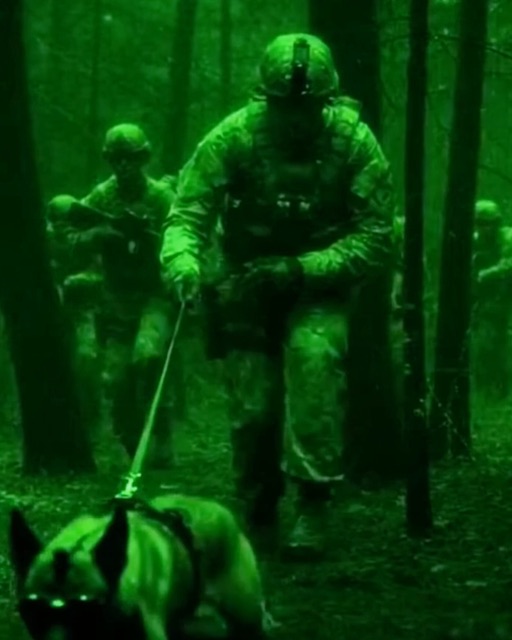
We’d been pushing through the blackout woods for what felt like forever, rain finally easing up just enough to make the silence hit harder.
My squad – me, the handler, and our Belgian Malinois, Rex – moved like ghosts under night vision goggles. Everything glowed that eerie green: dripping branches, mud-sucking boots, rifles held tight.
Rex led point, his own set of canine nods strapped on, ears perked, body low and locked in. I’d worked with him for three years in the Army. He didn’t just detect threats; he felt them in his bones before the tech or our eyes caught up.
I stayed right on his six, one hand light on the lead, the other ready on my M4. The squad leader, Sgt. Harlan, signaled us forward through the dense tree line we’d only mapped once in daylight. Storm had turned the ground to soup. Every step was a whisper.
Then Rex stopped dead.
Not a hesitation. A full freeze.
The lead snapped taut in my grip. My heart slammed once, hard.
Behind us, the squad halted like a chain reaction—knees hitting mud, weapons out to cover angles. No words. Just that trained silence.
Rex didn’t bark. Didn’t whine. He just stared ahead, unblinking through his goggles, body rigid as rebar.
That chest-tight feeling hit me. A dog that alerts loud, you handle. A dog that goes statue-still in pitch black? He’s locked on something that could end us all.
Sgt. Harlan crawled up low. “What’s he got, Corporal?”
I didn’t answer yet. Rex wasn’t eyeing the trail. His gaze was up—slightly off the path, into the branches.
I followed his line, sweeping my nods slow. Nothing but wet trunks and green-washed leaves. Lightning cracked distant, flashing the woods silver for a split second.
That’s when it gleamed: a thin wire, chest-high, strung taut between two trees. Tripwire. Invisible till that storm lit it sideways.
My breath caught. Harlan’s fist clenched. The whole patrol froze deeper, backs to the wire.
Rex had saved our asses—spotted the IED setup before we marched right into it.
I whispered a quick “good boy” to keep him steady, started hand-signaling the squad to peel back slow. One step. Two. No noise. The wire waited like a snake in the dark.
But then Rex shifted.
Subtle—shoulders bunching, head tilting left.
I felt it through the lead. Harlan caught it too. “Talk to me.”
He wasn’t on the wire anymore. He was scanning deeper, past the trap, into the black underbrush.
Something else. Moving.
I pivoted with him, nods cutting through the drip and shadows—and Rex went board-stiff, a low growl rumbling from his chest.
There, in the green glow: a shape slipping toward us. No light sig. No outline like ours. Just… wrong.
The squad tightened up, breaths held.
That growl said it all—we weren’t alone out here.
But when I zoomed my nods on what Rex was fixed on, my blood turned to ice.
It wasn’t enemy. It was one of ours… and he was pointing his rifle right at me.
Time just stretched out, thin and brittle. Every drop of rain hanging in the air seemed to freeze in place.
It was a soldier in our own uniform, no doubt about it. The cut of the gear, the shape of the helmet—it was all familiar, all friendly.
But the rifle wasn’t slung. It was at the ready, stock pressed into the shoulder, muzzle aimed dead center on my chest.
My first thought was a mistake. Friendly fire. Someone got turned around, spooked by the storm.
I raised my hand slowly, palm open. A universal sign. “Hold your fire,” I whispered into my comms, my voice cracking. “We’ve got a friendly, disoriented.”
Silence on the net. No response.
Harlan crawled closer, his own rifle now trained on the figure. “Identify yourself,” he commanded, his voice a low growl that cut through the night.
Nothing. The soldier didn’t move a muscle. He just stood there, a green ghost in our optics.
Rex’s growl deepened. It wasn’t the aggressive bark he used for a direct threat. This was different. It was a sound of deep uncertainty, of something being profoundly wrong.
He wasn’t straining at the lead to attack. He was pulling back slightly, trying to get me to move away.
That’s when I noticed it. The stillness. It wasn’t the practiced stillness of a trained soldier holding a position.
It was the absolute, unbreathing stillness of a mannequin.
My eyes scanned his form again, zooming in with the NVGs. His posture was too perfect. His head was at a slight, unnatural angle.
There was no rise and fall of a chest. No slight shift of weight from one foot to the other.
“Sarge,” I breathed into the mic, my throat dry as dust. “Something’s not right with him. He’s not moving. At all.”
Harlan saw it too. He didn’t need to ask for clarification. We’d seen enough in our time to recognize when the world was tilted off its axis.
“Cover,” he ordered. The squad melted back behind trees, weapons trained on the silent soldier and the darkness surrounding him.
I stayed put, anchored by Rex’s unwavering stare. My dog was still locked on, but his focus was starting to drift. He kept glancing into the thicket just beyond the soldier.
He knew. He knew the soldier wasn’t the real danger. He was just the bait.
And that’s when the trap revealed itself.
It was a faint sound, almost lost under the drip of water from the leaves. A soft click.
The sound of a safety being switched off.
Rex exploded. Not with a bark, but with a lunge. He didn’t lunge at the soldier. He lunged to my left, dragging me with him.
The lead ripped through my hand as I stumbled, my training taking over. I hit the mud, rolling behind the thick base of an ancient oak tree.
The night erupted.
Muzzle flashes stitched the darkness from the underbrush Rex had been staring at. The air filled with the angry buzz of hornets.
The crack of incoming rounds was deafening, splintering the bark of the tree I was now using for cover.
The silent soldier jerked violently, his body riddled with the shots of his own side. He crumpled to the ground, a puppet with its strings cut.
They hadn’t been aiming at him. They had been aiming at where we would have been if we’d moved closer to investigate him.
It was a two-layered ambush. The tripwire to slow us, funnel us. The dead soldier to draw us in, make us hesitate.
They wanted us to bunch up around him, confused and vulnerable. Rex had denied them that.
“Contact left!” Harlan yelled over the comms, his rifle already barking back into the darkness. “Lay down suppression!”
Our squad answered as one. The woods lit up with the green-tinged strobes of our own muzzle flashes. Rex was beside me, flat on the ground, but his head was up, ears twitching, pinpointing every sound.
He’d let out a sharp bark, and I’d adjust my fire toward the sound he’d identified. He was our compass in the chaos.
The firefight felt like it lasted a lifetime, but it was probably over in less than two minutes. The return fire from the ambushers became sporadic, then stopped completely.
Silence crashed back in, heavier than before, ringing in my ears. The only sound was our own ragged breathing and the steady drip, drip, drip of the rain.
“Sound off,” Harlan ordered.
One by one, the squad checked in. We were all okay. Shaken, muddy, but in one piece.
We stayed in position for another ten minutes, scanning the trees, waiting for any sign of movement. There was none.
Slowly, carefully, we advanced. We cleared the area where the shots had come from. We found two of them, their fight over for good.
Then, we moved to the fallen soldier they had used as bait.
I approached with Rex at my side, his body still tense. The soldier lay in a heap, his uniform soaked in rain and mud.
Harlan knelt beside him. It was a kid, maybe nineteen or twenty. His face was pale and empty under the green glow of our nods.
“Check his tags,” Harlan said, his voice grim.
I reached for the chain around the soldier’s neck, my fingers fumbling. I pulled the tags free and read the name.
Private Steven Miller.
The name didn’t ring a bell. I looked at Harlan. He shook his head. He wasn’t one of ours. Different unit, different company entirely.
“He was reported missing last week,” one of the guys, Peters, said quietly. “Patrol got hit about ten klicks north of here. They never found him.”
My stomach turned. They hadn’t just killed him. They had taken him, held him, and then used his body as a prop in a sick play. A final, deep disrespect.
“We’re not leaving him here,” Harlan said. It wasn’t a question. It was a statement of fact.
We rigged a makeshift stretcher and carried him with us on the long, quiet walk back to the extraction point. Every step felt heavy, not just with Miller’s weight, but with the weight of what had been done to him.
Rex walked quietly beside me, leaning against my leg every so often. He knew. He could feel the sadness that had settled over all of us.
Back at the base, the whole story came out. Miller’s unit confirmed he was their missing man. The brass was furious about the enemy’s tactics, but in this war, new lows were always being found.
Miller was processed, another casualty report to be filed. But for me, it didn’t feel over.
That night, I couldn’t sleep. I kept seeing his face, that blank stare in the green light.
I went to check on Rex. He was sleeping in his kennel, but he stirred as I approached, his tail giving a soft thump-thump against the floor. I sat with him for a while, just running my hand over his back.
“You did good, boy,” I whispered. “You did real good.”
A few days later, I was tasked with gathering Miller’s personal effects to be sent back with him. It was a standard, grim procedure.
As I went through his pockets, I found a small, waterproof pouch. Inside was a worn leather wallet.
Tucked into one of the flaps was a photo, its edges soft with wear. It was of Miller, smiling, with his arm around a young girl with the same bright eyes. His sister, I guessed.
Behind the photo was a letter, folded into a tiny square. It was written on cheap paper, the ink slightly smeared. It wasn’t sealed. It felt like he’d been carrying it around, maybe reading it over and over.
My hands shook as I unfolded it. I knew I shouldn’t read it, but I felt compelled.
It was from the girl in the photo. Her name was Sarah.
The letter was full of simple things. News about her classes at community college, a funny story about her part-time job at a diner, how she was trying to fix the leaky faucet in their small apartment.
At the end, she wrote, “Please just stay safe, Stevie. You’re all I’ve got. Come home.”
Something broke inside me then. This wasn’t just a fallen soldier. This was Stevie. The only thing a girl named Sarah had in the whole world.
And he wasn’t coming home.
Months passed. Our tour ended. We came back to a world that felt loud and strange.
But I never forgot Private Miller. I never forgot that letter.
I kept the photo. I don’t know why. It just felt wrong to let it get lost in a box of his belongings.
I tried to move on. I spent time with my family. I took Rex for long runs in parks where the only things hiding in the trees were squirrels.
But the image of Sarah, waiting for a brother who would never return, haunted me.
One day, I looked up the address on the envelope. It was for an apartment in a small town a few states away.
I knew it was crazy. I knew it wasn’t my place. But I had to go.
I drove for six hours with Rex in the passenger seat. I found the apartment building, a modest brick walk-up. I almost turned around a dozen times.
What was I going to say? How could I possibly make anything better?
But I thought of Harlan’s words in the forest. “We’re not leaving him here.” It felt like I’d be leaving a piece of him behind if I didn’t do this.
I knocked on the door. A young woman opened it. It was her. Sarah. She had the same eyes as the photo.
She looked tired, lost. When she saw my uniform, a flicker of hope crossed her face, and it was the most painful thing I’d ever seen.
“Can I help you?” she asked, her voice quiet.
“My name is Corporal Evans,” I said. “I served with your brother.” It wasn’t the whole truth, but it was the only way I could start.
Over the next hour, I sat in her small, neat living room and told her about Steven. I didn’t tell her the horrific details of how we found him.
I told her that his final post, his final watch, had alerted my squad to danger. I told her that because of where he was, my dog was able to warn us of an ambush, and that he saved our lives.
I told her that, in his own way, her brother was a hero to the very end, still protecting his fellow soldiers.
Tears streamed down her face, but for the first time, she smiled. A real, watery smile. “He always wanted to be a hero,” she whispered.
She told me her story. How they’d lost their parents young. How Steven had joined the army to provide for her, to give her a chance at a better life. How she’d been struggling since he was gone, buried in paperwork and bills she didn’t understand.
It turned out his military life insurance had been held up. Because he was listed as MIA for a time before being confirmed KIA, the claim was tied up in red tape. She was about to be evicted.
That’s when it all clicked. My squad recovering his body wasn’t just about respect. It was the crucial step that changed his official status. It was the key.
I spent the next two days on the phone. I called Harlan. I called every contact I had. I explained the situation. The weight of a full squad leaning on the bureaucracy worked wonders.
The paperwork was pushed through. The benefits, including the life insurance, were released. Sarah wasn’t going to be evicted. She was going to be okay.
Before I left, I gave her the photo. “I think he’d want you to have this,” I said.
She took it, her fingers tracing her brother’s smiling face. “Thank you,” she said, looking at me, then down at Rex, who was sitting patiently at my feet. “For bringing him home.”
Driving back, with Rex sleeping soundly beside me, I finally understood.
That night in the woods, under the green glow of my goggles, I thought Rex had saved my life. And he did.
But his stare into the darkness did more than that. It led us down a path that went far beyond that muddy forest. It led to a forgotten soldier, to a promise in a letter, and to a sister who just needed someone to fight for her.
We go into the service to protect our country, to stand for something bigger than ourselves. But sometimes, the biggest mission is the one you don’t see coming. It’s the one that reminds you that behind every uniform is a human being, a story. A Stevie.
Loyalty isn’t just about protecting the man to your left and right. It’s about honoring the memory of those who have fallen, and it’s about making sure the ones they loved are not left behind. That, I learned, is the truest way to bring a soldier all the way home.



