
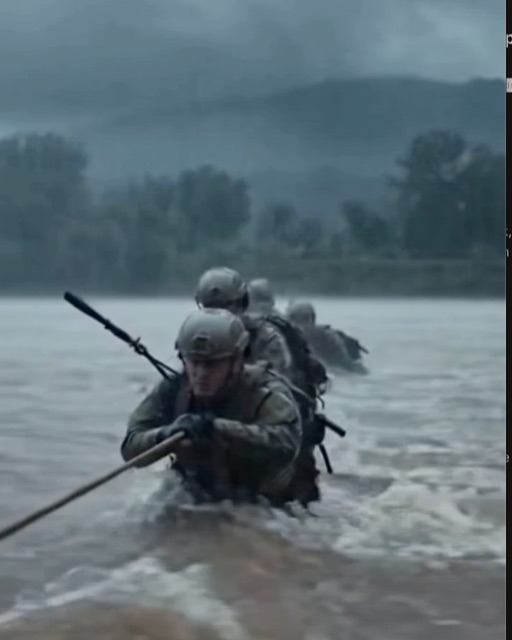
The river crossing had looked difficult in the daylight brief.
In the storm, it looked mean.
Brown water shoved hard against the guide line. Rain hammered helmets and sleeves. The banks were slick, the footing uncertain, and every soldier in that platoon knew that once the crossing started, hesitation would be worse than fear.
The platoon leader sent first squad in.
They made the line.
Weapons high. Hands on rope. Distance maintained.
Then the current hit the center file harder than anyone expected.
One soldier slipped sideways. The man behind him slammed shoulder-first into his ruck. The third man lost his footing trying to stay upright. In two seconds, the crossing became a knot of bodies fighting water instead of soldiers fighting to maintain shape.
The platoon sergeant was already in the river.
“Hold the rope! Open the interval! Stop fighting the current!”
He grabbed the front soldier by the harness and physically rotated him back into line while the squad leader behind them shoved the file wider and the platoon leader redirected the next element off the bank.
The line almost recovered.
Then one specialist shouted that his boot was stuck.
He pitched sideways as the current grabbed his hips.
The soldier behind him tried to hold him up and nearly got pulled with him.
The whole center of the crossing bent wrong.
And then the platoon sergeant did something that made every man on both banks stop breathing.
He let go of the guide rope.
Fully let go.
Went sideways into the brown water with nothing holding him to anything except the decision he’d already made. He jammed both arms beneath the trapped soldier to stop him from getting rolled downstream.
The river hammered all of them.
The squad leader didn’t hesitate. Lunged in behind.
Another soldier locked onto the sergeant’s gear.
Then another.
Then another.
And suddenly it wasn’t one man drowning in a bad moment. It was a platoon turning itself into a chain. Not because someone gave an order. Because one man let go of his own safety first, and every soldier behind him understood what that meant without a single word being spoken.
The trapped boot came free.
The line re-formed.
The crossing held.
On the far bank, soldiers climbed out soaked and breathing steam, checking weapons, checking one another, resetting for the next element without being told twice. Nobody celebrated. Nobody had to.
The trapped specialist started apologizing.
The platoon sergeant cut him off mid-sentence.
“You stayed on the rope.”
“Yes, sergeant.”
“Then you did your job. Reset.”
And like that, the Army went right back to work in the rain.
But here’s the part that got me. The part I keep thinking about at 2 AM when I can’t sleep.
I asked one of the younger soldiers later what went through his head when he saw the platoon sergeant let go of that rope and throw himself into the current.
He stared at the mud on his boots for a long time.
Then he looked up and said something that hit me harder than anything I’ve heard in years. He said…
“Because that’s the second time I’ve seen him let go of the rope.”
I just stood there, the rain dripping off the brim of my patrol cap.
The words didn’t compute.
The kid, a Private named Collins, was barely out of training. This was his first field exercise with the platoon.
He’d never been on a deployment. He’d certainly never been in a situation like that river crossing.
“What do you mean, the second time?” I asked.
Collins swallowed hard, his eyes fixed on something a thousand yards away.
“I mean he did it before.”
He wouldn’t say another word. Just shook his head and walked off to clean his rifle, leaving me with a question that felt heavier than my rucksack.
Our platoon sergeant was a man named Sergeant First Class Miller.
He was the kind of NCO they make movies about. Quiet, hard as granite, and you knew without a doubt he could walk through fire if it meant getting one of his soldiers out the other side.
He never talked about his past. We knew he’d been in the service for almost fifteen years, with multiple tours. That was it.
His personnel file was a string of commendations with all the interesting parts redacted. He was a ghost who showed up, did his job flawlessly, and kept the rest of himself locked away.
That night, after the field exercise was over and we were back in the barracks, I found Miller by himself, cleaning mud out of a machine gun link by link.
“Sergeant,” I started, trying to sound casual.
He didn’t look up. “Sir.”
“That was a hell of a thing you did back at the river.”
He just grunted, his focus entirely on the brass and steel in his hands.
“You didn’t hesitate.”
“No time for it, sir.”
I took a breath. “Collins said something to me. He said he’d seen you do that before.”
The rhythmic click of the links stopped.
Sergeant Miller slowly placed the link he was holding on the cleaning mat. He still didn’t look at me, but the whole temperature of the room seemed to drop.
“The private needs to keep his mouth shut and his eyes on his own lane.”
His voice was flat. Devoid of emotion. But it was the kind of flat that covers a deep, dangerous hole.
“Is there something I need to know, Sergeant?” I pressed, gentler this time.
He finally looked up, and his eyes were old. Far older than the forty years he’d been on this earth.
“No, sir,” he said. “There’s nothing you need to know.”
The conversation was over. He turned back to his work, and I was dismissed without a word being said.
But I knew he was lying.
The next day, I found Private Collins sitting on his bunk, writing a letter.
I sat down across from him. He immediately stiffened up, like he was expecting to get chewed out.
“At ease, Collins,” I said. “I’m not here to get you in trouble.”
He relaxed, but only slightly.
“I need you to tell me what you meant yesterday,” I said. “About Sergeant Miller.”
Collins looked down at the letter in his hands. He ran his thumb over the name written on the envelope.
“It wasn’t my story to tell, sir.”
“It is if it affects this platoon,” I countered. “And whatever is going on between you and the Sergeant, it’s affecting this platoon.”
He was silent for a full minute. I could see the conflict in his face.
“My brother,” he finally said, his voice barely a whisper. “He was in Sergeant Miller’s squad. In Afghanistan.”
Suddenly, the pieces started clicking into place.
“His name was Corporal Daniel Collins,” he continued. “He was killed three years ago.”
I remembered the name from Miller’s file. A standard casualty report. Hostile action. Nothing out of the ordinary, at least on paper.
“I’m sorry,” I said, and I meant it.
Collins just nodded, his jaw tight.
“A week after we got the news,” he said, “a package showed up at my mom’s house. It was from Sergeant Miller. No note. Just my brother’s things. His watch, his favorite book, a picture of our family he kept.”
He paused. “And a letter. One my brother wrote for me, just in case.”
He held up the letter he’d been looking at. It was worn, the creases soft from being opened and closed a hundred times.
“In the letter, Danny told me what happened. He told me about the man who was with him at the end. He told me about Sergeant Miller.”
He took a shaky breath and began to tell me the real story.
It wasn’t a river crossing. It was a narrow alley in a village known for ambushes.
They were on patrol, clearing a route. Miller was on point. Danny was right behind him.
They used a line, just like in the river. A lifeline. Each man responsible for the one in front and the one behind.
A pressure plate IED was triggered. A secondary charge. They were in the kill zone.
Danny said in his letter that everyone froze for a fraction of a second. The moment between the click and the bang.
In that moment, Sergeant Miller didn’t try to save himself. He didn’t dive for cover.
He let go of his own safety. He shoved my brother backward, out of the main blast radius. He threw him clear.
He let go of the rope.
The blast still caught Danny. It was too close, too powerful. But the shove… the shove gave him a few extra seconds.
Miller was wounded, too. Shrapnel in his leg and side. But he crawled back to my brother. He stayed with him.
Danny wrote that Miller held his hand. That he talked to him. Told him he was a good soldier. Told him he was not alone.
My brother died in that alley, but he didn’t die by himself.
Collins finished his story, and the barracks was silent except for the hum of the overhead lights.
“He saved my brother,” Collins said, his voice thick with emotion. “No, he didn’t. Not in the way that matters. But he tried. He gave up his own life for a chance to save him.”
“Why did you join?” I asked. “Why this unit?”
“When I read that letter,” he said, “I knew I had to. I had to meet the man my brother wrote about. I had to understand.”
He looked at me, his young face full of a resolve that was chilling.
“And yesterday, at that river,” he said, “I understood. When he let go of that rope for that Specialist… I wasn’t seeing a Sergeant. I was seeing the man who held my brother’s hand.”
“He doesn’t know who you are, does he?”
Collins shook his head. “No, sir. I just have the same last name. He’s never made the connection.”
And that’s when the first twist hit me. This wasn’t about a young private being in awe of his sergeant. This was a pilgrimage. A silent, personal mission to stand side-by-side with the man who was the last person to see his brother alive.
But there was another twist coming. One I couldn’t have imagined.
A few weeks later, we were in a different kind of training. A live-fire exercise. Things were moving fast.
There was a moment of confusion. A miscommunication between squads.
One of the new privates got disoriented and moved into the wrong sector. Right into the line of fire.
“Cease fire! Cease fire!” I yelled into the radio.
But the noise was deafening. The commands were swallowed by the chaos.
I saw Miller see it. His head snapped around, and he saw the private, frozen in the open.
And then I saw Collins. He was closer.
Without a thought, Collins dropped his weapon and sprinted. He tackled the new private, driving him hard into the dirt behind a low berm, just as a burst of automatic fire stitched the air where they had been.
It was over in three seconds.
When the dust settled, everyone was safe. The new private was shaking. Collins was helping him up, brushing him off, his face calm and steady.
Later that evening, the entire platoon was gathered. I had just finished chewing out the team leaders for the breakdown in communication.
Then Sergeant Miller stepped forward.
He walked straight to Collins, who immediately straightened to attention.
Miller looked at him. Really looked at him, as if for the first time.
“I know who you are,” Miller said. His voice was quiet, but it carried across the entire assembly area.
Collins just nodded. “Yes, Sergeant.”
“Your brother, Daniel,” Miller said, his voice cracking just slightly on the name. “He was the best soldier I ever knew.”
“He said the same about you, Sergeant,” Collins replied, his own voice steady.
Miller’s face, a mask of hard discipline for as long as I had known him, seemed to crumble. The guilt he’d been carrying for three years was written in the lines around his eyes. A guilt he never deserved.
“I should have saved him,” Miller whispered. It was a confession.
And this is where the final, most important twist happened. The one that changed everything.
Collins shook his head. “You’re wrong, Sergeant.”
He reached into his pocket and pulled out that worn, folded letter. He didn’t hand it to Miller. He just held it.
“My brother told me everything in this letter,” Collins said, his voice now strong and clear for everyone to hear. “He told me you didn’t just shove him. You tried to take his place.”
The platoon was dead silent.
“Danny wrote that he felt the pressure plate click under his own boot,” Collins explained. “He knew. He knew he had seconds. He wrote that when you shoved him, you were actually trying to step on the plate yourself. To take the full blast.”
Tears were now openly streaming down Sergeant Miller’s face. He stood there, this man who was a rock for all of us, and just let them fall.
“He wrote that you let go of the rope to save him,” Collins continued. “But he said he cut it. He said he pushed you away just as you pushed him. He made a choice, Sergeant. He chose to save his squad. He chose to save you.”
Miller had spent three years believing he had failed. That his actions had been a fraction of a second too late.
The truth was, his actions had inspired a young Corporal to make the ultimate sacrifice, knowing his sergeant was trying to do the same for him. It wasn’t a failure. It was the deepest form of loyalty two soldiers can share.
Collins folded the letter and put it back in his pocket.
“You didn’t fail him, Sergeant,” he said. “You honored him. And by letting go of that rope at the river… you honored him again. You showed that kid, and all of us, what it really means to be a leader.”
He paused, then added, “That’s why I’m here. To serve with a man like that. To be a man like my brother.”
Sergeant Miller didn’t say a word. He just stepped forward and wrapped his arms around Private Collins. In front of the entire platoon, the ghost of a man and the brother of a hero held each other.
And in that moment, the weight of the past three years finally lifted. It wasn’t forgotten. But it was finally shared.
Leadership, I learned, isn’t about always holding on tight. It’s not about strength or control. Sometimes, it’s about letting go.
It’s about letting go of your own safety for someone else. It’s about letting go of your pride to admit you need help. And sometimes, it’s about helping someone else let go of a burden they were never meant to carry alone.
The strongest lines aren’t made of rope. They’re forged from the silent, selfless acts that bind us together when the water is rising and there’s no other way across.



