
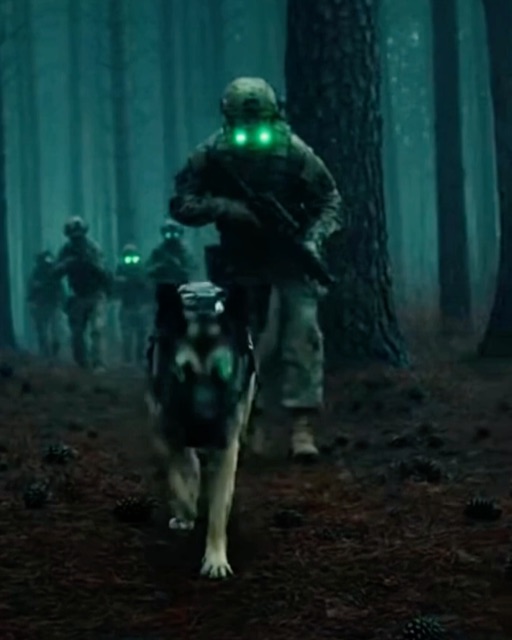
We were pushing through the pine break after a heavy rain, the whole patrol silent except for the crunch of boots on wet needles. I’m the handler for Rex, our German Shepherd with those green-glowing night vision goggles strapped on. He’s saved our asses more times than I can count – spotting IEDs, rerouting us from ambushes – but tonight felt different. The woods were too still, like the air was holding its breath.
I gave the signal to halt when Rex stopped dead. Not his usual alert bark or stiff posture. He just lowered his head, paws shifting, those green eyes locked on something in the trees ahead. My fist went up, and the squad froze behind me.
Squad leader crept up, whispering, “What’s he got, Ramirez?”
I swallowed hard, watching Rex. “Something he respects. Big time.”
We scanned the nods—nothing but fog and trunks. Then Rex shifted left, staring up. I followed his gaze. Wind rustled the branches, and there it was: a massive deadfall, cracked and hanging right over our path, ready to drop from the storm.
Leader started signaling the pullback, one guy at a time. Relief hit, but then Rex changed. His body went rigid, ears perked low—past the tree, toward the saddle.
My heart slammed. He wasn’t on the deadfall anymore.
Leader hissed, “What now?”
I turned with Rex, peering into the dark pines. Shapes—moving, multiple—closing on the exact route we’d almost taken.
Platoon sergeant slid up beside us, checked his nods, and his voice dropped to ice: “That ain’t ours.”
I gripped my rifle tighter, pulse roaring in my ears. The shapes were getting closer, and Rex’s growl started low. But when I made out the first figure’s outline, I realized they weren’t just shadows.
They were people.
My brain tried to process it. Not soldiers. Their movements were clumsy, ragged. One was small, impossibly small.
Sarge didn’t hesitate. “Potential hostiles. Could be a trap. Get ready to engage.”
The order was standard, the right call by the book. But Rex wasn’t reacting by the book. His growl had stopped. He whined, a low, nervous sound I’d only heard a few times during training when he was confused.
He was looking past the first figure, a tall man, and focused on something behind him.
“Hold,” I whispered into my comms, my voice tight. “Something’s not right.”
“Ramirez, we have movement,” Sarge shot back, his voice a blade of impatience.
“I know, Sarge. But look at Rex.” My dog, a trained weapon of war, was now sitting. He just sat down on the wet pine needles, his head cocked, his tail giving a single, uncertain thump against the ground.
The figures stumbled into a small clearing, lit by a sliver of moon breaking through the clouds. My blood didn’t just run cold; it froze solid in my veins.
It was a man, a woman, and a child. A little girl, no older than seven or eight, clutching her mother’s hand. They were soaked, shivering, their clothes torn. They looked exhausted, hunted.
And then I saw what Rex had been keying on. Trailing just behind them, nearly invisible in the gloom, was another animal.
A dog. A huge, shaggy beast, dark as the night itself. It was limping badly, but its head was high, its eyes fixed on us with a weariness that mirrored the family’s. It was a protector, not an aggressor.
Rex whined again. He understood. He saw a fellow guardian, a brother in arms, just trying to get his family to safety.
“They’re civilians, Sarge,” I said, my voice barely a whisper. “Just a family.”
“Could be a shield,” Sarge countered, his logic cold and hard as steel. “Insurgents use them all the time. We stick to the mission.”
The mission was to recon the saddle for an enemy mortar position. We were supposed to be ghosts, unseen and unheard. Engaging, or even helping, would compromise everything.
The man saw us then. He stopped, pushing the woman and child behind him. He raised his empty hands slowly, his face a mask of pure, unadulterated terror.
My heart ached. I’d seen that look before, too many times.
Squad Leader Dawson moved up beside me. “Your call, Ramirez. What’s your dog telling you?”
All eyes were on me. On Rex. The entire squad trusted my dog more than they trusted their own eyes sometimes.
I looked down at him. He met my gaze, then looked back at the family, and let out a soft “woof.” It wasn’t an alert. It was a greeting.
“He says they’re okay,” I said, my voice firm. “They’re not a threat.”
Sarge let out a frustrated sigh over the comms but didn’t argue further. The word of a handler about his dog was something you didn’t question lightly in the field.
Dawson gave a quiet hand signal. “Alright. Ramirez, you’re on point. We approach, slow and easy. I want safeties on, but fingers ready.”
I gave Rex’s leash a little slack, and he trotted forward, not with aggression, but with a calm purpose. My rifle was lowered, but not slung.
As we got closer, the other dog let out a low growl. Rex stopped, sat again, and whined. It was the most incredible thing I’d ever seen. It was like he was speaking to him, saying, “We’re not here to hurt you. We’re here to help.”
The other dog seemed to understand. His growl subsided into a tired huff, and he nudged the little girl’s hand with his wet nose.
I knelt down twenty feet away. “It’s okay,” I said, my voice soft. “We’re not going to hurt you.”
The man spoke in a language I didn’t understand, his words tumbling out in a desperate rush. He pointed a trembling finger back the way they came, then at his wife’s leg.
I shifted my gaze. Her pant leg was dark with more than just rain. It was blood.
Our medic, a quiet guy named Peterson, moved forward without being asked. He slung his rifle and opened his pack. “Let me see,” he said gently.
The woman flinched, but her husband nodded, a silent plea in his eyes.
Sarge’s voice came over the radio, sharp and low. “We’re losing time. We patch her up and send them on their way. We can’t take them with us.”
“Where are they gonna go, Sarge?” I asked, my voice rising. “Back there? They’re running from something.”
Just then, the little girl, who hadn’t made a sound, started to cry. It wasn’t a loud wail, but a series of quiet, hiccuping sobs that cut through the silence of the woods worse than any gunshot.
Rex stood up and walked slowly toward her. He stopped a few feet away and laid down, putting his head on his paws. The big, shaggy dog watched him, then nudged the girl’s hand again. She looked from her dog to mine, her sobs quieting.
This was it. A crossroads. We could follow the mission parameters, be good soldiers, and leave them to their fate. Or we could be good men.
“Dawson,” I said, looking at my squad leader. “We can’t leave them.”
Dawson chewed his lip, the gears turning in his head. He was a good leader because he knew the rules, but he also knew when they didn’t apply. “Sarge, they’re coming with us. We’ll move slow, but we’ll get them to the evac point.”
“Negative, Dawson,” Sarge’s voice was final. “That’s a direct contravention of op orders. We leave them.”
An argument was about to break out, a bad thing in hostile territory. But then the man spoke again, this time in broken English.
“Soldiers,” he said, pointing back into the darkness. “Many soldiers. There.” He pointed to the saddle, our objective. “Mortars. Big guns.”
My blood ran cold for the third time that night. He was confirming our intel.
“They came to our village,” the man continued, his voice cracking. “Took everything. We ran.”
This changed the calculus. They weren’t just civilians; they were witnesses. Their intel was fresh, vital.
Dawson looked at Sarge. “See? They have intel. It’s now part of the mission to get them back for debriefing. It’s a justifiable risk.”
There was a long silence on the comms. I could almost hear Sarge weighing the risk against the reward, the letter of the law against the spirit of the mission.
Finally, a single, clipped word came through. “Fine. But you’re responsible for them, Dawson. This goes sideways, it’s on you.”
“Understood,” Dawson replied.
Peterson was already working on the woman’s leg. It was a nasty gash, but he cleaned and bandaged it expertly. The rest of us formed a tight perimeter, our eyes scanning the oppressive dark.
The journey back was grueling. The woman, Elara, leaned heavily on her husband, Ismail. Their daughter, little Safia, walked between them, her hand never leaving the shaggy fur of her dog, whose name we learned was Barun.
Rex walked point with me, but his focus was different. He was constantly checking back, making sure our new charges were keeping up. He and Barun seemed to have a silent understanding, two old warriors from different worlds, united by a common duty.
We were moving at a crawl, every snapped twig sounding like a gunshot. The minutes stretched into hours. We were exposed, vulnerable.
Then it happened.
Rex froze again. This time, there was no hesitation, no respect. A low, vicious growl rumbled in his chest, the hair on his back standing up like a brush. Barun, despite his limp, stood over Safia, his own growl a deep thunder.
I dropped to one knee, bringing my rifle up. “Contact,” I hissed into the mic. “Front.”
Dawson moved everyone into cover behind a thicket of fallen logs. Ismail pulled his family down, shielding them with his own body.
Through my night vision, I saw them. A patrol, just like ours, but not ours. Six of them, moving with confidence, sweeping the area. They were the men Ismail had warned us about. They were hunting.
They were less than fifty yards out, coming straight for us. There was no way to hide. We were outmanned, and we had civilians to protect.
“Sarge,” Dawson whispered into his comms. “We’ve made contact with the enemy patrol. We’re compromised.”
Sarge’s reply was instant. “Engage and break contact. Fall back to secondary rally point. Do not get pinned down.”
Easier said than done.
The lead enemy soldier stopped, lifting a hand. He’d heard something. He pointed his rifle in our direction.
Time seemed to slow down. I could hear my own breathing, the drip of water from a leaf, the frantic beat of my heart.
This was where it all went wrong. This was the “sideways” Sarge had warned us about.
But then, something unexpected happened. Safia, the little girl, let out a small, terrified whimper.
It was enough. A muzzle flashed in the dark, and a round snapped over our heads, smacking into a tree.
The forest erupted.
We returned fire, the sound deafening. Peterson and another guy, Miller, laid down suppressing fire while Dawson tried to figure out a way to pull us back.
“They’re trying to flank us on the right!” someone yelled.
We were caught. Pinned down. And in the middle of it all was a terrified family. I looked over at Ismail, who was covering his daughter’s head, his body shaking. This was our fault. We had brought this on them.
Then, Rex did something he was trained never to do without a direct command. He broke from my side.
“Rex, no!” I yelled, but it was too late.
He shot out from our cover, a black blur against the green tint of my goggles. He wasn’t charging them. He was running parallel to their line, drawing their fire, creating a diversion.
As if on cue, Barun surged forward too, the big, shaggy dog moving with a speed that defied his injury. He ran in the opposite direction, a deep, fearsome bark echoing through the trees.
The two dogs, one a highly trained military asset and the other a simple family protector, were working together. They were chaos incarnate, two ghosts in the dark, pulling the enemy’s attention, making them think we were in multiple positions.
“Now!” Dawson screamed. “Fall back! Go!”
We scrambled, pulling the family with us. I laid down cover fire, my eyes scanning the trees for Rex. My heart was in my throat. I had sent my partner, my best friend, on a suicide run.
We pulled back a hundred yards, then two hundred, crashing through the undergrowth. Behind us, the firing became sporadic. The enemy was confused, disoriented by the phantom attack of the dogs.
We found a deep ravine and slid down into it, pressing ourselves against the cold, wet earth. We waited, listening.
For a minute that felt like a lifetime, there was only the sound of our own ragged breathing.
Then, a rustle in the leaves above. I raised my rifle, my hands shaking. A dark shape appeared at the edge of the ravine.
It was Rex.
He scrambled down, his side bleeding from a graze, but he was alive. He came right to me, licking my face, his tail thumping against my pack.
A moment later, Barun appeared, limping heavily, and collapsed next to Safia, laying his head in her lap.
We had made it. They had saved us.
The rest of the night was a blur. We made it to the evac point just as the sun was threatening to rise. A chopper was waiting, its rotors whipping the trees into a frenzy.
We loaded the family on first. Ismail turned to me, his eyes full of tears. He grabbed my hand and said the only English words he seemed to know besides the warning.
“Thank you,” he said, over and over. “Thank you.”
Safia came over and wrapped her small arms around Rex’s neck. He nuzzled her, a soft whine escaping his throat.
Back at base, the debrief was intense. Sarge was there, his face an unreadable mask. Dawson laid it all out: the deadfall, the family, the intel, the firefight, the dogs.
When he finished, the commander looked at us, his eyes lingering on me. “You disobeyed a direct order, Sergeant Dawson. You put your mission and your men at risk for three civilians and a dog.”
The room was silent. I braced for the worst.
“You also brought back actionable intelligence that confirmed the location of an enemy mortar position that has been harassing our forward bases for weeks,” the commander continued, his tone shifting. “Intel that led to their neutralization by an airstrike less than an hour ago. You saved lives. More lives than were in your squad.”
He stood up. “Sometimes, the mission isn’t just what’s written on a piece of paper. Sometimes, it’s about making the hard call on the ground. You chose to be human. You chose right.”
He looked at me. “And Ramirez. Your dog is a credit to his training. And to you.”
Relief washed over me so powerfully I felt dizzy.
A week later, I was cleaning Rex’s gear when a translator from the base brought me a small, folded piece of paper. It was from Ismail and his family. They were safe at a refugee camp, getting the medical help they needed.
The note was short, translated into simple English. It thanked us for their lives. At the bottom was a child’s drawing. It showed two stick figures, a man in a uniform and a little girl. Between them were two dogs, one sleek and pointed, the other big and shaggy. They were standing side by side, their tails wagging.
I taped that drawing to the inside of my locker.
I learned something important out there in those dark, wet woods. We train our soldiers, and our dogs, to be weapons, to follow orders, to see the world in terms of threats and objectives. But we can never train the heart out of them.
Rex didn’t just see a potential threat that night. He saw a family in need, and he saw a fellow protector doing his job. He reminded me that our true mission, the one that matters more than any other, is to look out for each other. It doesn’t matter what uniform you wear, or what language you speak, or even what species you are. Compassion is a universal language. And sometimes, the most heroic thing you can do is listen to the quiet wisdom of a loyal friend.



