
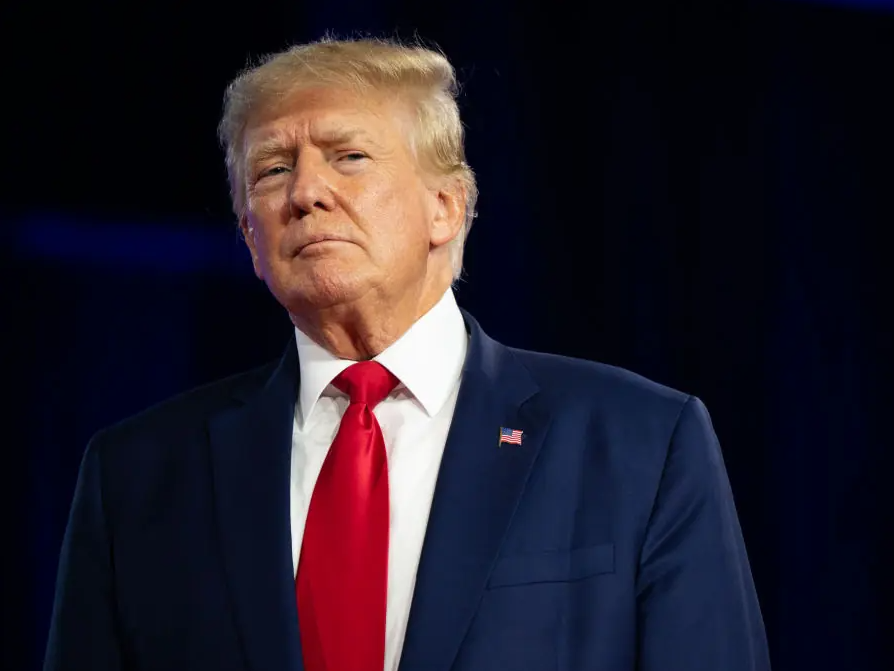
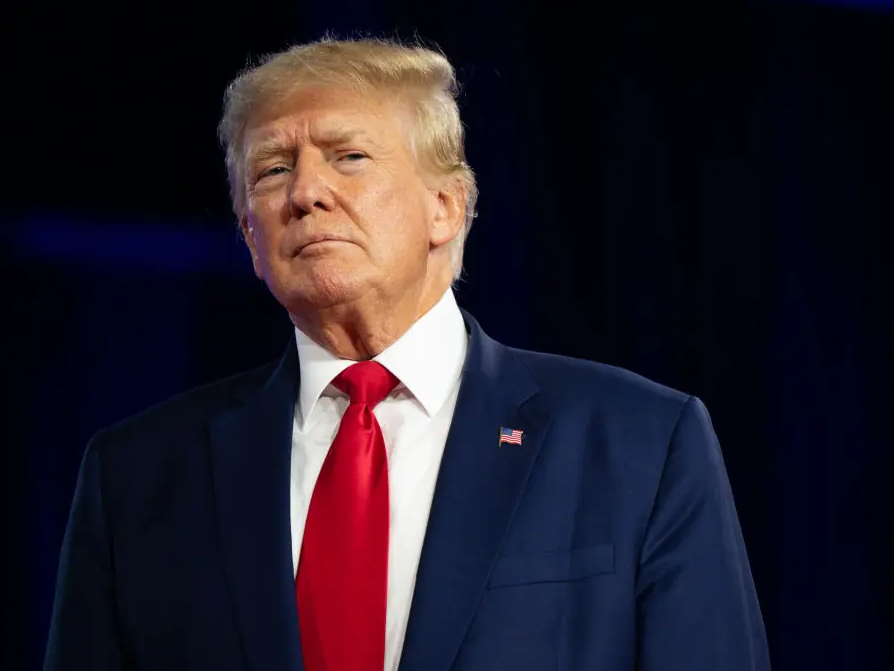
A prominent conservative voice has urged Vice President JD Vance to look at a rare and extraordinary option within the U.S. Constitution that could remove President Donald Trump from office. The suggestion comes as criticism builds over the administration’s handling of rising tensions with Iran and airstrikes carried out in coordination with Israel.

President Trump, first elected as the 45th president, returned to the White House after winning re-election in 2024 and is now serving as the nation’s 47th president. His comeback has continued to fuel sharp debate across the country. Supporters see it as a return to policies they favor; critics argue his approach at home and abroad remains polarizing.
Trump’s time in national politics has already been historically notable. He is the first U.S. president to be impeached twice, with proceedings in 2019 and again in 2021. Now, the latest flashpoint is his decision to coordinate U.S. military action with Israel targeting Iran. That step has drawn increasingly intense scrutiny and concern, both in Washington and among the public, particularly as the human cost in the region has risen.
What exactly did Scott McConnell say, and why does it matter?
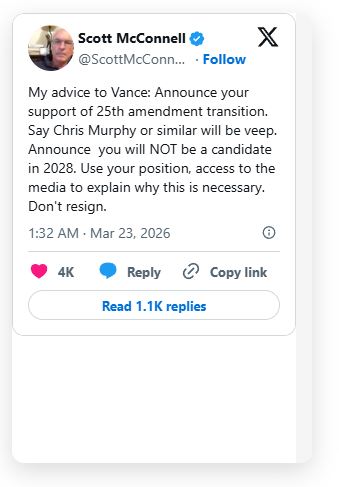
Scott McConnell, co-founder of The American Conservative magazine, posted on the platform X to encourage Vice President JD Vance to consider invoking the 25th Amendment. It is worth noting that Scott McConnell is a conservative commentator and writer, not to be confused with Senate Republican leader Mitch McConnell. Scott McConnell’s remarks were directed at the vice president’s constitutional role in cases where a president might be deemed unable to carry out the duties of the office.
In a concise message, he urged Vance to back a 25th Amendment transition. He framed it as a clear public stance, the kind that would put the country’s stability above political considerations. His suggestion, in short, was for Vance to be open about the process and to explain to Americans why he thought such a step might be necessary in light of the rapidly evolving situation with Iran.
McConnell expanded on the idea by floating a possible plan that would include naming a vice-presidential partner acceptable to skeptics of further military escalation. He pointed to Senator Chris Murphy as a potential choice for vice president under such a transition, describing him as an anti-war figure who is intelligent and not overly tied to the culture wars. He also proposed that Vance make clear he would not run in 2028, arguing that such a promise would emphasize the move as a stabilizing step, rather than a political power grab. He urged Vance not to resign but to use his platform to speak plainly about why he believed this course might be in the nation’s best interest.
To underscore his reasoning, McConnell highlighted Murphy’s record as a lawmaker skeptical of expansive military interventions, suggesting that a figure with those views could help dial down tensions, reassure nervous allies, and open channels for diplomacy. Although he did not cite Trump’s Iran moves in that particular post, McConnell has long argued for restraint in the Middle East and has warned against the U.S. being drawn deeper into conflict there.
McConnell’s continued criticism and the Rubio angle
In a follow-up message, McConnell broadened his suggestion to include Senator Marco Rubio, positing that Rubio could help shepherd negotiations, push for a ceasefire, and even remain a strong Republican figure afterward. The idea, again, was framed as a way to prevent a prolonged and bloody conflict, while keeping key conservative voices engaged in shaping what comes next.
He later posted sharper criticism of the administration’s decision-making, accusing Israeli Prime Minister Benjamin Netanyahu of providing misleading intelligence and asserting that President Trump accepted it over the views of U.S. agencies. In that commentary, McConnell warned that reckless steps based on poor information can lead to tragic outcomes, especially for civilians in the region. His language was blunt, reflecting deep frustration with what he saw as a rush toward more violence rather than a deliberate path to de-escalation.
Since the latest round of strikes and reprisals began, estimates suggest that more than 3,000 people have been killed, with over 1,000 believed to be civilians. Figures vary by source and are difficult to verify in real time, especially amid fast-moving events and limited access for independent observers. Even so, the reports point to a heavy human toll and widespread fear of what might follow if diplomacy fails.
President Trump recently said there were strong ongoing talks with Iran aimed at a ceasefire or reduction in hostilities. Iranian officials, however, publicly pushed back on those claims, indicating that negotiations were either less substantive than advertised or not proceeding as the White House suggested. That gap between statements and on-the-ground reality has only fueled more questions, prompting voices like McConnell’s to call for a dramatically different approach.
What is the 25th Amendment, and how would it work here?
The 25th Amendment to the U.S. Constitution lays out what happens if a president dies, resigns, is removed, or becomes unable to perform the duties of the office. It was ratified in 1967 after the Kennedy assassination, when gaps in presidential succession rules became a serious national concern.
There are several parts to the amendment. The one getting attention in this discussion is Section 4. In plain terms, Section 4 lets the vice president, together with a majority of the cabinet’s principal officers, declare that the president is unable to discharge the powers and duties of the office. If that happens, the vice president becomes acting president immediately. The president can contest that declaration, and if he does, he resumes power unless the vice president and the cabinet reassert their claim within a set time frame. If they do reassert it, the issue then goes to Congress, where it takes a two-thirds vote in both chambers to keep the vice president as acting president.
This part of the amendment has never been used to remove a sitting president who refused to step aside. That is one reason McConnell’s proposal is so striking. It is not a routine procedure and would almost certainly trigger intense political and legal fights. The process is deliberately complex because it is meant for the rarest of emergencies, not for policy disputes or ordinary political differences.
Has the 25th Amendment ever been used before?
Parts of the 25th Amendment have been used, but not Section 4 in the way McConnell suggests. Section 3, which allows a president to voluntarily hand over power for a short time due to a temporary condition—like undergoing anesthesia for a medical procedure—has been used a handful of times. That happened when presidents needed sedation for colonoscopies or surgeries and then reclaimed the office shortly afterward once they were able to resume duties.
Section 2, which covers filling a vacant vice presidency, was used in the 1970s when Vice President Spiro Agnew resigned and Gerald Ford was nominated and confirmed to replace him. Later, when President Richard Nixon resigned, Ford became president and nominated Nelson Rockefeller to be vice president, again using the 25th’s procedures. Those episodes showed how the amendment can ensure continuity during turbulent times.
But Section 4—the involuntary transfer of power from a resisting president—remains untested. There have been moments when advisers discussed it, including after President Ronald Reagan was shot in 1981 and during later concerns about his health. Yet it was not invoked to strip authority from a president who objected. The political threshold is high because leaders are understandably cautious about using a tool that could be seen as overruling the electorate’s choice outside of clear incapacity.
Why bring up Chris Murphy and Marco Rubio?
McConnell’s references to Senators Chris Murphy and Marco Rubio seem designed to highlight a bipartisan path. Murphy, a Democrat from Connecticut, has been an outspoken advocate of restraint in foreign policy and has criticized open-ended military operations that lack a diplomatic strategy. Rubio, a Republican from Florida, is a national-security-minded lawmaker who also has broad recognition and influence within his party.
By mentioning both names, McConnell signaled a possible coalition that spans ideological lines. In his view, that kind of partnership could reassure the public and allies that any transition is not about gaining political advantage but about keeping the country safe and steady. Whether such a coalition could actually form is a different question, given the deep polarization in Washington and the loyalty many Republicans maintain to President Trump.
Why is Section 4 so controversial?
Section 4’s controversy lies in its power and ambiguity. It is intended for cases where a president cannot do the job—for example, after a major medical event or another condition that clearly renders the president unable to function. Yet the Constitution does not define inability in detail, leaving a lot of room for interpretation. Using it in the middle of a heated foreign policy crisis, without obvious medical incapacity, would challenge long-standing political norms and raise questions about the boundaries between incapacity and disagreement over judgment.
There is also the practical obstacle course. The vice president would need a majority of cabinet officers to sign on. Those cabinet members usually owe their positions to the president and might be reluctant to take such a step. Even if they did, the president could object, forcing the question to Congress. At that point, it would take a supermajority in both the House and the Senate to keep the vice president as acting president. Reaching that threshold is extraordinarily difficult in modern politics.
The stakes in the Middle East and the domestic reaction
The call to consider the 25th Amendment is tied to fears that the United States could slide into a broader war. With casualties already high in the region and emotions running hot, critics argue that every decision needs to be measured, backed by reliable intelligence, and aimed at avoiding civilian harm. Supporters of the administration’s stance say that confronting aggressive actions is necessary to deter worse outcomes and that standing firmly with allies is part of maintaining stability.
Inside the United States, these developments have reopened old arguments about the scope of presidential power in wartime, congressional oversight, and how much latitude the White House should have to take military action without a full public debate. For Americans watching from home, especially those who remember previous conflicts in the Middle East, the sense of déjà vu can be unsettling. The uncertainty often leads to a desire for clear explanations and a steady hand.
What would happen if the 25th Amendment were invoked now?
If Vice President Vance and a majority of cabinet members invoked Section 4, he would immediately become acting president. That shift would likely prompt urgent statements from world leaders, cautious reactions from financial markets, and close scrutiny of the U.S. military posture overseas. The president would almost certainly dispute the move, setting a rapid series of deadlines in motion for official letters, counter-letters, and ultimately congressional votes.
Throughout that period, the acting president would hold the powers of the office, while Congress weighed whether to sustain the transfer. The world would be watching every signal for clues about America’s direction and reliability. Allies would seek reassurance; adversaries might test boundaries. Domestically, demonstrations and legal challenges could follow, as Americans debated whether the standard for incapacity had been met and whether the process was being used properly.
How likely is any of this to happen?
Most constitutional scholars would say the bar for invoking Section 4 is extremely high. It is intended for situations where the president truly cannot do the job, rather than circumstances where officials disagree with his judgment or policies. Because the required majorities—first in the cabinet and then potentially in Congress—are so demanding, political realities make such a move rare. That is why McConnell’s proposal registers as unusual and newsworthy. It highlights the level of anxiety among some conservative thinkers about the current path, but it does not mean such a move is imminent.
For now, the practical conversation in Washington is centered on immediate goals: de-escalating the crisis, protecting civilians, keeping American forces safe, and avoiding a spiraling conflict. Whether that is best achieved by more pressure, more diplomacy, or some combination of both remains hotly debated. As the White House and its critics make their cases, the 25th Amendment question sits in the background as a constitutional backstop that few expect to see pulled—yet some, like McConnell, are now openly discussing.
Where do things stand with Iran talks?
The mixed signals on negotiations have added to the confusion. Public statements from the administration have suggested that serious conversations are underway. Iranian officials have dismissed those descriptions, indicating either a significant gap in expectations or a breakdown in back-channel efforts. Historically, progress in such cases is quiet and incremental. It often takes shuttle diplomacy, patience, and a willingness by each side to accept steps that do not look like victory but that stop the bloodshed and build confidence.
In the meantime, the human stakes remain real and immediate. Each day without a reduction in violence risks more civilian casualties, more displacement, and a harder road back to stability. That urgency is part of why voices across the political spectrum—hawks and doves alike—are pressing for clarity about objectives, timelines, and the intelligence guiding decisions.
What older Americans may want to watch for
For many Americans in their fifties and sixties, this moment echoes earlier periods of uncertainty. You may recall how sudden events overseas can ripple through daily life at home—affecting gas prices, markets, travel plans, and even the tone of our civic conversations. In the coming days, the clearest signs to watch will be whether the number of strikes increases or decreases, whether outside mediators report progress on ceasefire terms, and whether leaders on all sides are using language that points toward restraint instead of escalation.
It can be helpful to look for statements from multiple official sources, including U.S. agencies, allied governments, and reputable international monitors. Differences in those accounts do not always mean someone is being dishonest; they can also reflect limited visibility in a fast-moving crisis. Still, when claims are sharply at odds, it is prudent to wait for more corroboration before drawing firm conclusions.
The bottom line
Scott McConnell’s public plea to Vice President JD Vance to consider a 25th Amendment transition is a striking development in a tense and fluid moment. It underscores how unsettled some observers feel about the course of U.S. policy toward Iran and the broader Middle East right now. At the same time, the move he proposes has never been carried out against a president who insists he is able to serve, and the constitutional and political hurdles are extremely high.
As events unfold, the core questions for leaders will likely remain the same: how to prevent wider war, how to protect civilians, and how to make decisions based on sound intelligence. For the rest of us, staying informed with clear, reliable updates can help cut through the noise. However this debate progresses—whether through diplomacy, congressional oversight, or continued public scrutiny—the hope is for cooler heads to prevail and for a path that spares more lives while keeping the United States steady and secure.



