
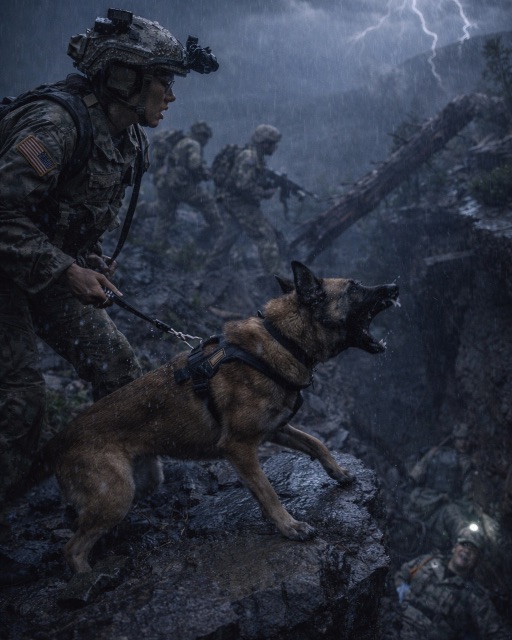
The patrol climbed into the lightning.
I’m a K9 handler for an Army reconnaissance patrol. We were trying to reach an observation shelf above the valley when the sky opened up, turning the ridgeline into flashes of silver and black. My Malinois and I were soaked to the bone, moving low.
Then my dog stopped dead on the hill.
I froze with him. The entire patrol halted in sequence.
Our squad leader, Clifford, moved up beside me. “What does he have?”
I didn’t answer right away. I watched the angle of my dog’s head, the intense stillness through his shoulders, and the way his paws had locked into the wet rock.
“He’s not on scent,” I whispered over the thunder. “He’s on movement.”
Lightning flashed again. My dog pivoted six inches left and barked violently toward a low shelf of broken stone below our route.
Clifford and I crept to the edge and looked down.
Wedged below the shelf was a soldier. His radio was smashed, his ankle twisted, and his reflective panel was pinned under heavy runoff debris. It had to be the guy from our advance team who missed his check-in thirty minutes ago.
Clifford started climbing down. Then, lightning hit close enough to stun the whole ridge white.
A dead sapling split and crashed across the path between us. The rock shelf under the trapped soldier violently shifted. He was going to slide off the mountain.
I dropped to my knees in the mud, cutting my dog’s lead loose from a snagged branch, and scrambled down the steep drop. The rescue wasn’t later. It was now.
I grabbed the back of the soldier’s tactical vest and hauled him up just as the rock slab crumbled into the black valley below.
I collapsed backward, gasping for air. But my dog didn’t calm down. He lunged forward, barking so violently I had to physically tackle him away from the man we just saved.
I yelled a command and reached over to pull the soldier’s heavy helmet off to check him for injuries. But when the next bolt of lightning illuminated his face, my blood ran absolutely cold.
He wasn’t from our advance team. And he wasn’t a stranger. The man wearing our uniform was Alistair Finch.
Alistair Finch, my oldest friend.
Alistair Finch, the man who had been dishonorably discharged two years ago for selling operational secrets.
My breath caught in my throat. My dog, Buster, must have sensed my shock because his barks turned into a deep, guttural growl. He knew before I did. He knew something was fundamentally wrong.
Clifford slid down the muddy bank to join us, his face a mask of concern. “Is he okay? Who is he?”
I couldn’t form the words. I just stared at Alistair’s pale, rain-streaked face. The face of the boy I grew up with, the man who stood beside me when I enlisted. The face of a traitor.
“It’s Finch,” I finally choked out.
Clifford’s eyes widened. He knew the name. Everyone in our unit knew the name. “That’s not possible. What is he doing here?”
Before I could answer, Alistair groaned, his eyelids fluttering. He coughed, spitting out muddy water. His eyes found mine, and for a second, I saw a flash of the old Alistair, the one I used to know. Fear. Desperation.
“Sam,” he rasped, his voice thin and weak. “You have to listen to me.”
Buster strained against my grip, his teeth bared. He wasn’t buying it for a second.
“Quiet, boy,” I murmured, my voice shaking.
Clifford was all business. He knelt, his hand expertly checking Alistair for weapons while our comms specialist, Harris, made his way carefully down the slope.
“He’s clean,” Clifford announced, though his tone was laced with suspicion. “But his pack is gone. And this uniform… it’s real, but the patches are wrong for this sector.”
“The advance team,” I said, the pieces clicking into a terrifying picture. “The guy who missed check-in. Where is he?”
Alistair tried to sit up, wincing as pain shot through his twisted ankle. “He’s alive. I swear. I… I borrowed his gear.”
“Borrowed?” Clifford scoffed, his voice sharp as broken glass. “You don’t just borrow a uniform and a radio in a classified zone, Finch. You start talking. Now.”
The storm raged on, each thunderclap like an accusation. Alistair looked at me, his eyes pleading. “They set me up, Sam. The whole thing was a setup.”
I wanted to believe him. A part of me, the part that remembered building forts in the woods and sharing secrets under the stars, desperately wanted to believe him. But the evidence, the court-martial, the disgrace… it was all there.
“They said I sold intel,” Alistair continued, his words coming in a rush. “But I didn’t. I stumbled onto something. Something big. They’re using this recon mission as cover.”
“Cover for what?” Clifford demanded, unmoved.
“A handoff,” Alistair said, his gaze flicking nervously up the ridge. “Near the observation shelf. They’re selling targeting data. Live satellite feeds.”
My mind reeled. It sounded like something out of a spy movie, too fantastic to be real. But the look in Alistair’s eyes was one of pure, animal terror.
And he was here, in the middle of nowhere, wearing a uniform he shouldn’t have.
“Who are ‘they’?” I asked, my grip on Buster’s collar tightening.
“I don’t know for sure,” he admitted. “It’s someone high up. Someone on the inside. They framed me to get me out of the way. I’ve spent the last two years trying to find proof, trying to figure out their next move. This was it.”
Harris, our quiet comms guy, finally reached us. “Sir, I can’t raise command. The storm’s scrambling everything. We’re on our own.”
Clifford swore under his breath. He looked from Alistair’s desperate face to my conflicted one, then up the dark, treacherous mountain. We were caught. We had a mission to complete, a potential traitor in our midst, and no contact with the outside world.
“We’re not leaving him here to die,” Clifford said, his voice a low growl of command. “But he’s a prisoner. We splint his ankle and we get him up the ridge. He doesn’t say another word unless I ask him a direct question. Understood?”
I nodded, my throat too tight to speak.
We worked quickly, using a rifle barrel and tactical straps to immobilize Alistair’s leg. Every time I touched him, Buster would whine, a low, unhappy sound in the back of his throat. He trusted my judgment less than he trusted the stranger.
The climb was hell.
The mud was slick, the rocks were treacherous, and Alistair was a dead weight between me and another soldier, Williams. Clifford took the lead, his focus absolute. The storm seemed to be a living thing, fighting us for every inch of ground.
Alistair was mostly silent, his face tight with pain. But as we neared the shelf, a new kind of tension settled over him. His head was on a constant swivel, his eyes scanning the darkness.
We finally crested the ridge and found the small, natural rock overhang that was our designated observation point. It offered minimal shelter, but it was better than nothing.
Clifford immediately set up a defensive perimeter. “Harris, keep trying that radio. Williams, you’re on watch. Sam, you’re with me and our guest.”
We huddled under the overhang, the wind whipping rain into our faces. Buster laid at my feet, but he wasn’t resting. His body was a coiled spring, his head up, ears twitching, his low growl a constant hum beneath the roar of the storm. He was staring, unblinking, at Alistair.
“Alright, Finch,” Clifford said, his voice dangerously soft. “The mission is to observe and report. We saw your little tumble. What else is up here?”
Alistair licked his chapped lips. “They’re supposed to meet here. At the peak of the storm. They use the radio interference as cover.”
“And the advance team soldier?” I asked, unable to stop myself.
“I found his stash point,” Alistair said, looking at me. “He was scouting ahead. I used a nerve pinch. He’s unconscious, not hurt. I hid him in a small cave about two hundred yards back down the trail. I promise, Sam. I didn’t hurt him.”
His use of my name felt like a punch to the gut. It was a plea to the boy he knew, not the soldier I had become.
Suddenly, Harris cursed. “Sir, I’ve got something. It’s not command. It’s a scrambled, short-range signal. Coming from somewhere close.”
Clifford’s head snapped up. “On screen.”
Harris turned his small, ruggedized tablet around. A single blinking dot appeared on the topographical map, less than half a mile away, moving slowly toward our position.
“That’s them,” Alistair whispered, his voice trembling. “That has to be them.”
My heart hammered against my ribs. If Alistair was lying, he had just led us into a trap. If he was telling the truth, we were about to walk into a firefight we were not equipped for.
“Okay,” Clifford said, his mind working fast. “We have two choices. We can pull back and try to avoid contact, or we can see this through. If he’s telling the truth, we’re the only ones who can stop this.”
He looked at me. He wasn’t just asking for my opinion as a soldier. He was asking if I trusted the man I had just pulled off a cliff.
I looked down at Buster. My dog, my partner, who had never been wrong. His eyes were still fixed on Alistair, the growl unwavering. But something had changed. His focus wasn’t just on Alistair anymore. His head was now angled toward the trail, his nostrils flaring, sampling the wind. He was sensing the approaching threat.
He still didn’t trust Alistair. But he absolutely believed the danger was real.
“My dog says the threat is real, sir,” I said, my voice steady. “He’s alerting to their approach.”
Clifford gave a grim nod. “Alright. We hold our ground. We observe. No engagement unless absolutely necessary.”
The next twenty minutes were the longest of my life. The rain began to lessen, but the wind was still a physical force. The blinking dot on Harris’s screen grew closer and closer.
Then, we heard it. The crunch of boots on gravel.
Two figures emerged from the swirling mist, clad in dark, non-military tactical gear. They moved with professional efficiency, sweeping the area with night-vision goggles. They stopped just yards from our hiding spot, clearly waiting.
My hand rested on Buster’s head, a silent command to stay quiet. I could feel the tremors running through his body.
A few minutes later, a third figure appeared. This one, to my horror, was wearing our uniform. He was moving from our direction, from the rear of our position. He walked right up to the other two.
My blood ran cold. It was Harris.
Harris, our quiet, dependable comms specialist. He was holding his comms pack.
“You’re late,” one of the dark figures said, his voice clipped and harsh.
“I had to make sure they were settled,” Harris replied, his voice betraying no emotion. “They have an unexpected guest. Alistair Finch.”
The name hung in the air. The first man stiffened. “Finch is here? How?”
“He fell. They rescued him. Doesn’t matter. They’re all huddled under the south overhang. They believe the storm has our comms jammed.” Harris tapped the pack he was carrying. “But this little booster I have says otherwise. The data stream is ready. Once I link up, you’ll have everything.”
It was all true. Alistair hadn’t been lying. He had stumbled onto a conspiracy, and the traitor was one of our own. He’d been feeding them our position the whole time.
Clifford looked at me, his eyes wide with fury and a sliver of apology for his doubt. He held up three fingers, then slowly counted down.
Three.
Two.
One.
“Now!” Clifford roared, opening fire. Williams, positioned on the other side, did the same.
The night exploded in chaos. One of the dark-clad men went down immediately. The other scrambled for cover, returning fire. But my focus was on Harris.
Harris spun around, pulling his sidearm, his face a snarl of pure panic and rage. He wasn’t aiming at Clifford. He was aiming straight at Alistair. The witness.
He was going to silence him for good.
Everything happened in a fraction of a second.
I saw the muzzle of Harris’s pistol align with Alistair’s head.
I yelled, “Buster, get him!”
It was the command we had trained for a thousand times, but never used in a situation this real.
Buster exploded from my side like a furry missile. He wasn’t a dog anymore; he was a weapon, all teeth and muscle and righteous fury. He hit Harris square in the chest, the force of the impact throwing the traitor backward off his feet. The pistol discharged, the bullet zinging harmlessly into the rock wall.
As Harris and Buster tumbled to the ground in a maelstrom of barking and shouting, the remaining hostile operative saw his chance. He swung his rifle toward me.
Before he could pull the trigger, a rock, the size of a fist, flew through the air and struck him hard on the side of the head. He staggered, his aim thrown off.
I looked over. Alistair, propped up on one elbow, his face a mask of pained determination, had thrown it. He had used the only weapon he had to save my life.
That split second was all Clifford needed. A controlled burst of fire, and the second man was down.
The silence that followed was deafening, broken only by Buster’s vicious growls and Harris’s pained screams.
We secured Harris, his betrayal hanging heavy and bitter in the damp air. We called it in on his “boosted” radio. This time, command answered loud and clear.
Help was on the way.
As the first light of dawn broke through the clouds, painting the valley in soft shades of grey and pink, we sat in silence. Medics were tending to Alistair’s leg. He was leaning against a rock, exhausted but alive.
Buster finally seemed to relax. He walked over to me, nudged his head into my hand, then walked slowly over to Alistair. He sniffed his outstretched hand once, twice, and then gave it a soft lick.
The growl was gone. The threat was neutralized. The man was no longer a lie.
I walked over and sat down next to my old friend. For a long time, we didn’t say anything. The shared history, the years of pain and misunderstanding, felt too large for words.
“I’m sorry, Sam,” he finally said, his voice raw. “I’m sorry for all of it. For how it must have looked.”
“You saved my life up here, Alistair,” I replied, my own voice thick with emotion. “After I almost didn’t believe you.”
“Your dog knew,” he said with a weak smile, looking at Buster. “He knew something was wrong from the start. Just took the humans a while to catch up.”
The investigation that followed was long and complicated. Alistair’s testimony, backed by the data we recovered from Harris, blew open a deep-rooted espionage ring. He was publicly exonerated, his name and honor fully restored. They even offered him a civilian consultant role, a chance to use his hard-won knowledge to help protect the very institution that had wronged him.
It was a rewarding conclusion, a karmic balancing of the scales.
But for me, the lesson wasn’t about conspiracies or traitors. It was simpler than that. It was about trust. We are trained to trust our gear, our intelligence, and our orders. But on that mountain, in the heart of that storm, none of that mattered. What mattered was the primal, unspoken instinct of a loyal partner.
Sometimes, the truth isn’t in a briefing or a radio transmission. It’s in a low growl, a sudden stillness, and the unwavering conviction of a friend who sees the storm long before it ever starts to rain. You just have to be wise enough to listen.



