
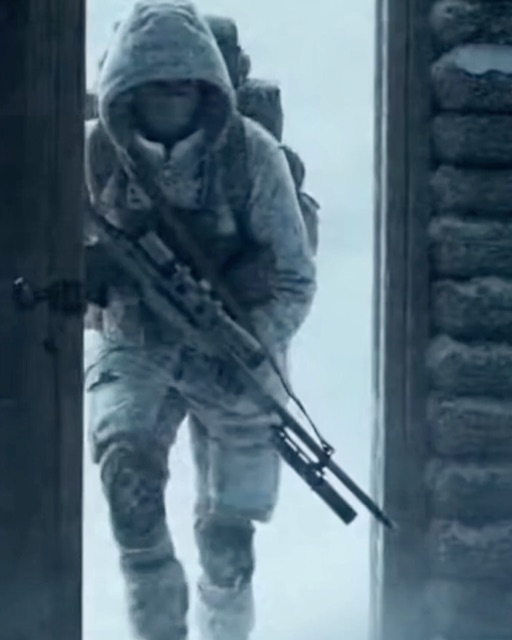
“Stop trying,” the lieutenant snapped, like he was doing me a favor. “No shot lands past sixteen hundred in this. Accept it.”
I closed my notebook. “Copy.” I zipped my pack.
We were crammed in a stone shepherd’s hut that smelled like wet wool and fear. Two guys couldn’t feel their feet. A team on the ridge had us locked. The wind howled so hard it felt like the mountain was breathing.
They laughed when I laid out my dope card. “Cute math,” someone muttered. “She thinks she can bend physics.” My jaw clenched. I don’t argue with egos. I argue with numbers.
I’d already done more than they realized – set the stove baffle so it wouldn’t backdraft, strung a makeshift antenna from stripped comms wire and a broken ski pole, mapped the gusts by how the snow snakes curled at the doorframe. They didn’t see it. They didn’t want to.
So I stopped.
I shouldered my pack, popped the latch, and let the storm slam the warmth out of the room.
The radio crackled once. Then went to static.
Inside, someone coughed, hard – stove flame turned lazy yellow without the baffle set right. The lieutenant’s voice hit my earpiece, tinny and shaking now. “Hey—hey, come on. Don’t be like that. We need you to—hey. Hey!”
I lay prone ten meters out, snow biting my cheeks, lungs burning. My heartbeat thudded in my ears. I dialed, held, waited for the gust to break. The world narrowed to crosshairs and breath.
“Please,” the lieutenant begged, voice breaking. “Come back. We’re sorry. Just—just tell us what to do.”
The wind dropped for a blink. My scope cleared—and the face behind the rifle on the ridge made my blood run cold.
It wasn’t a stranger’s face, hardened by a foreign conflict. It was a face I knew better than my own reflection some days.
Sergeant Major Retired Marcus Thorne.
The man who taught me how to read wind like a language. The man who could put a round in a teacup at two thousand yards and then lecture you for an hour on the Coriolis effect.
My mentor.
My mind refused to process it. Thorne wasn’t active. He’d retired two years ago, bought a cabin somewhere quiet, and swore off the business for good.
He was supposed to be fishing. Instead, he was here, on the opposing side, looking right at me.
He wasn’t looking at the hut. His scope was aimed at my position. He knew. Of course, he knew.
Thorne taught me to find a sniper’s hide, and I had used his own lessons to find him.
My finger rested on the trigger, a cold, dead weight. The numbers on my dope card screamed at me. A perfect solution. A clean shot.
But this wasn’t physics. This was Marcus Thorne.
The lieutenant’s voice was a desperate buzz in my ear. “Target acquired? Do you have the target? Take the shot!”
I ignored him. Thorne’s position was perfect, but his behavior was all wrong.
He had a clear line of sight to the hut’s only window. He could have taken out Lieutenant Rawlings the moment we got here. He hadn’t.
He could have taken me out the second I belly-crawled out of the door. He hadn’t fired.
This wasn’t a sniper duel. This was something else. It was a message.
I remembered one of his first lessons, out on a dusty range back in the States. “The battlefield tells a story,” he’d said, his voice like gravel. “Most people only read the headlines. A real operator reads the fine print.”
What was the fine print here?
My gaze drifted from Thorne, back to the hut. Rawlings was supposed to be a calm, collected officer. Now, he was just a panicked voice on the radio. He wasn’t afraid of being shot. He was afraid of something else.
He was afraid of failure. But failure of what, exactly?
This was a simple recon mission, or so the briefing said. Observe and report on enemy movements. Do not engage. But Rawlings had pushed us forward, right into this trap, obsessed with reaching this specific grid coordinate. This hut.
Thorne shifted on the ridge. A tiny movement, almost imperceptible. He adjusted his scope, not toward me, but a few feet to my left.
Then a single round cracked through the air.
It didn’t hit me. It didn’t hit the hut. It slammed into the snowbank beside me, kicking up a plume of white.
It was a signal. A period at the end of a sentence I hadn’t read yet.
My blood ran even colder. That wasn’t a miss. Thorne never missed.
He was communicating.
“He missed!” yelled one of the guys in the hut, Corporal Davies. “He missed you!”
Rawlings sounded frantic. “What are you waiting for? He’s reloading! Take him out now!”
I didn’t move. I didn’t breathe. I was back on the training range, Thorne’s words echoing in my head.
“Sometimes the best shot,” he’d once told me after I’d aced a particularly difficult qualification, “is the one you don’t take.”
Why would he want me to hold my fire? He was controlling the situation. Pinning us, but not eliminating us. He was keeping us here for a reason.
Keeping Rawlings here.
The pieces started to click into place, sharp and painful. The rushed briefing. The classified nature of a simple recon op. Rawlings’s unusual desperation to reach this worthless pile of stones on a frozen mountain.
This wasn’t a military operation. It was a transaction.
And it had gone wrong.
I keyed my mic, my voice low and steady. “Rawlings. What’s in the hut?”
Silence. Then, “What kind of stupid question is that? Just do your job!”
“You heard me,” I said, my eyes still locked on Thorne’s position. “This isn’t about recon. He’s not trying to kill us. He’s trapping you. What did you come here for?”
Another soldier, Miller, spoke up, his voice wary. “Sir, what’s she talking about?”
“Shut up, both of you!” Rawlings shrieked. The authority in his voice was gone, replaced by pure, uncut panic.
I made a decision. I trusted the man who trained me more than the man who was leading me.
I crawled back toward the hut, my rifle held tight. The wind whipped at my back, trying to push me away.
When I slid back through the door, the three men inside stared at me. Davies and Miller looked confused, their faces pale with cold and fear.
Rawlings looked cornered. His eyes were wide, darting around the small space like a trapped animal.
“What are you doing?” he demanded. “Get back out there!”
I ignored him, my gaze sweeping the interior of the hut. It was just one room. A broken table, a rusty stove, a pile of damp sheepskins in the corner. Nothing.
“What did you lose, Lieutenant?” I asked, my voice dangerously quiet.
He took a step toward me, his hand dropping to the pistol on his hip. “That’s an order, Specialist.”
Davies, the one who couldn’t feel his feet, shifted uncomfortably. “Sir… maybe we should just listen.”
“Stay out of this, Corporal!” Rawlings snapped.
My eyes fell to the floor. The stones were old, uneven. But near the stove, one was different. It was newer, cleaner, with edges that didn’t fit the worn pattern of the others.
I knelt down, sliding the tip of my knife into the seam. It popped up easily.
Beneath it was a small, hollowed-out space. Inside sat a dull grey, waterproof case, no bigger than my hand.
I picked it up. It was heavy for its size.
Rawlings lunged for it. “That’s military property! Give it to me!”
I held it out of his reach. “I don’t think so. This isn’t military property, is it? This is your retirement plan.”
His face crumpled. The lie was gone. All that was left was raw, ugly greed.
“You have no idea what you’re messing with,” he hissed. “Thorne was my partner. We were supposed to retrieve this together. It’s a drive. Stolen intel from our own side. Worth millions.”
Miller cursed under his breath. Davies just stared, his mouth hanging open. We were pawns in an illegal arms deal. Or an intelligence deal. Worse.
“He set me up,” Rawlings continued, his voice rising with hysteria. “He was going to cut me out, take it all for himself. So I brought you all along as my insurance policy. A military unit under fire. He wouldn’t risk an international incident.”
“Looks like you miscalculated,” I said calmly, tucking the drive into a secure pocket of my vest. “Thorne doesn’t care about incidents. He cares about traitors.”
Rawlings’s face twisted in rage. He drew his sidearm.
“Give it to me,” he said, his hand shaking. “I’m walking out of here with that drive, or none of us are walking out of here.”
He pointed the pistol not at me, but at Davies, the most vulnerable man in the room.
My heart hammered against my ribs. This was the moment. The fine print.
Thorne had taught me to shoot. But he’d also taught me to think.
“You’re right,” I said, raising my hands slowly. “You win.”
Rawlings’s eyes lit up with triumph. “I knew you’d see it my way. Now, the drive.”
“Okay,” I said, reaching slowly into my vest. “But before I give it to you, I have a question.”
“What?” he spat impatiently.
“The stove,” I said, nodding toward it. “I fixed the baffle so it would burn clean. You undid it. Why?”
He looked at me like I was insane. “What does that have to do with anything? I was cold! I opened it all the way up!”
“Right,” I said. “You let more air in. But you forgot about the chimney.”
His brow furrowed in confusion.
“It’s blocked,” I said softly. “Snow and ice. When I was outside, I saw it. There’s almost no smoke coming out. Just a trickle.”
The flame in the stove was still a lazy, sick yellow. I could smell it now, a faint, metallic odor in the air.
Carbon monoxide. Colorless. Odorless. Deadly.
I’d been breathing clean, frozen air for the last twenty minutes. They’d been breathing poison.
Davies’s eyes were glassy. Miller was already slurring his words when he tried to speak.
Rawlings’s face went from confusion to dawning horror. He swayed on his feet, the pistol wavering in his hand.
“You… you knew,” he stammered.
“I know how a stove works,” I corrected him. “And I know a man who puts his own greed above the lives of his soldiers is a man who doesn’t pay attention to details.”
He tried to raise the pistol again, to aim it at me, but his limbs wouldn’t obey. He was sluggish, clumsy. His own arrogance had poisoned him.
He collapsed to his knees, gasping for air that wouldn’t help. The pistol clattered to the stone floor.
I moved quickly. I kicked the door wide open, letting the freezing, life-giving wind pour into the hut.
“Miller! Davies! Get to the door!” I yelled, grabbing them both and dragging them into the fresh air. They stumbled out, coughing and gagging.
I went back inside for Rawlings. He was barely conscious, but I hauled him out, too. He was my prisoner now. He was my evidence.
Once everyone was out, I keyed my radio to a private channel Thorne and I had used in training drills. A channel no one else would even know existed.
I sent a single, coded burst of clicks. A pattern he would recognize.
Asset secured. Situation contained. Awaiting instructions.
A moment later, a reply came back. Not in clicks, but in his voice, rough and clear.
“Route is clear to the southwest extraction point. Go now. I’ll clean up here.”
There was a pause.
“Good work, kid,” he said.
Then the channel went silent.
I looked up at the ridge. The spot where he had been was empty. He was gone, a ghost in the storm.
He had never been the enemy. He had been my overwatch all along. He’d known Rawlings was dirty and had set a trap to expose him, but he couldn’t do it officially. He trusted me to figure it out. He trusted me to make the right call.
“What… what now?” Davies asked, his teeth chattering.
“Now,” I said, looking at the two soldiers who had mocked me just an hour ago, “we go home.”
The trek down the mountain was brutal, but we moved with a purpose we hadn’t had before. I took point. Miller and Davies followed without question, helping me with Rawlings, who was now just dead weight.
The scorn was gone from their eyes. In its place was a deep, quiet respect that was worth more than any medal.
When we reached the extraction point, the debrief was a whirlwind. I bypassed the entire local chain of command. I handed the drive and a zip-tied Lieutenant Rawlings to the military police who met our chopper.
I told them everything.
The investigation was swift and far-reaching. Rawlings wasn’t just a lone actor; he was part of a network selling classified intel. The drive I recovered led to a dozen arrests, including some high-ranking officers nobody ever suspected. They called it one of the most significant internal security breaches in a decade.
I was offered a promotion, a commendation, a spot in a top-tier special projects unit. I accepted.
They didn’t call me a “diversity hire” anymore. They called me by my name.
A week later, a small package arrived at my new billet. There was no return address.
Inside was a simple, hand-tied fishing fly and a small, folded note.
I opened it. There were only eight words, written in a familiar, precise script.
“The mission is the mission. Until it isn’t.”
I smiled. He was out there somewhere, fishing, just like he said he would be.
I learned something vital on that mountain, something more important than how to calculate windage or hold my breath. I learned that labels are just noise. People will try to put you in a box, to define you by their own limited vision. But the only definition that matters is the one you forge for yourself in the fire. Your integrity, your skills, your judgment—that’s who you are. True respect isn’t given. It’s earned, often when no one is watching. And sometimes, the most important orders are the ones you give yourself.



