
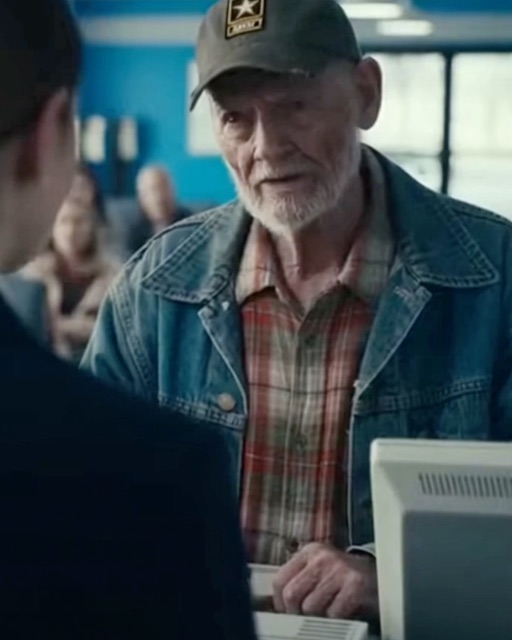
I walked in to withdraw tuition for my grandson. That’s it. The man in the sharp suit behind the desk – nameplate said Brent Malloy – picked up my discharge papers with two fingers like they were dirty and laughed.
“Nice prop,” he smirked, loud enough for the whole lobby. “Security, escort him out. We don’t tolerate fraud.”
My ears rang. My palms went cold. I didn’t argue. I picked up my brass challenge coin, felt the weight, and sat on the wooden bench by the ficus.
“Sir, you’ll need to leave,” the guard muttered, hovering. People stared. A mom pulled her toddler closer. A teller looked away.
I nodded once. “I’m not going anywhere.”
Because sixty seconds earlier, I’d already made the only call that mattered.
Brent strutted for the performance. “You want to play soldier, Grandpa? Play it outside.” He tossed my papers back; they fluttered like wounded birds under the ATM.
I didn’t move. I just flipped the coin in my palm and watched the automatic doors.
Then the air changed. The lobby got… quiet. The guard’s radio crackled and then died. A black sedan stopped so close the bumper kissed the curb. Two men stepped in – no nonsense, eyes scanning. Not local cops. Not rent-a-cops.
Brent puffed up. “Can I help you, gentlemen?”
They didn’t look at him. One of them looked at me. He gave the smallest nod I’ve ever seen. My heart thumped once, hard.
Brent’s phone lit up on the counter. He glanced down, saw the caller ID, and his smile snapped off like a light.
He swallowed. “H-hello?”
A beat. Then he went very still. “Yes, sir.”
The doors parted again. The room straightened by instinct. Shoes clicked. A man in a dark suit walked in, sleeves razor-pressed, a small pin on his lapel that made my blood run cold and Brent’s face go chalk-white.
He didn’t look at the crowd. He looked at me. “Sergeant,” he said. “Stay seated.”
Then he turned to Brent, laid a leather folder on the counter, and spoke in a voice that could cut glass. “You just made the last mistake of your banking career.”
Brent tried to laugh. It came out like a cough. “S-sir, I—this is a misunderstanding—”
“It won’t be,” the man said, opening the folder. “Because as of this minute, you’re answering to…”
He flipped the ID, and when Brent read the first line, his knees actually buckled.
It read: “Department of the Treasury – Office of Inspector General.”
The man in the suit, Agent Harrison, didn’t raise his voice. He didn’t need to. Every word landed like a hammer blow in the dead silent lobby.
“Mr. Malloy, we’ve been monitoring this branch for six months.”
He tapped a page inside the folder. “We started with a pattern of unusually high fees on the accounts of elderly customers.”
Brent shook his head, a slick sheen of sweat on his forehead. “Standard practice… board approved…”
“Then we noticed a trend of loan applications from veterans being denied for trivial reasons, while high-risk, unvetted corporate accounts were pushed through.”
The teller who’d looked away before was now staring, her mouth a perfect ‘o’. The security guard had taken a slow, deliberate step away from the manager’s desk.
“But the piece de resistance, Brent,” Harrison continued, his voice dropping to a conversational murmur that was somehow more terrifying. “Was your penchant for money laundering.”
He pulled out a single sheet of paper. It was a wire transfer confirmation. “This one is our favorite. A transfer of two hundred thousand dollars to an offshore account, authorized by you, from a holding company that doesn’t exist.”
Brent looked like a man watching his life burn down from the inside out. He leaned on the counter for support, his knuckles white.
“That’s… that’s a forgery. I’ve been framed.”
Harrison gave a thin, cold smile. “We have your digital signature. We have the phone calls you made to set it up. We have your branch assistant, a lovely young woman named Sarah, who decided cooperating with the federal government was a better career move than loyalty to you.”
Brent’s eyes darted around the room, looking for an ally, an escape, anything. He found only the judgmental stares of the customers he served. The mother with the toddler now held her child up, as if to show her what a real bad guy looked like.
Harrison slid my discharge papers, the ones Brent had tossed on the floor, across the polished counter. One of the agents had retrieved them for me.
“Let’s talk about these,” Harrison said. “You called them a prop. Fraud.”
He tapped my name. “Sergeant Arthur Coleman. Twenty-two years of service. Bronze Star with Valor. Two Purple Hearts.”
He looked from the paper to me, then back to Brent. His expression was pure ice.
“This man survived two tours in places you only see in movies, Mr. Malloy. He led a team on a mission that is still classified to this day. His signature is on file with the Department of Defense as a signatory for emergency fund requisitions.”
The silence in the lobby was so complete I could hear the hum of the fluorescent lights overhead.
“He called a single number on his phone,” Harrison went on. “That number is a direct line to a joint task force at the Pentagon, a line reserved for retired operators in distress. It gets flagged at the highest levels. My office got the alert sixty seconds later.”
He leaned in closer to Brent. “The system works. It’s for protecting national assets. And you, Mr. Malloy, decided to call one of them a fake.”
Brent made a small, choking sound. He was finished. He was less than nothing.
“You didn’t just disrespect a man,” Harrison concluded, his voice resonating with finality. “You disrespected the very institution that allows you to sit in this chair and play with other people’s money. You are the fraud.”
With a simple nod from Harrison, the two other agents stepped forward. One of them pulled out a pair of handcuffs. The metallic click echoed in the vast room.
They didn’t rough him up. They were professional, quiet. They put his hands behind his back and read him his rights in a low, formal tone.
Brent Malloy, the man in the sharp suit who had laughed at me, was escorted out of his own bank, his head bowed in shame. He didn’t look at anyone, least of all me. The automatic doors slid shut behind him, leaving a void where his arrogance used to be.
The lobby started to breathe again. People began to murmur, whispering to each other, their phones suddenly out and recording the empty manager’s desk.
Harrison walked over to my bench. He knelt down on one knee, a gesture of respect that felt so profound it nearly brought tears to my eyes.
“Sergeant Coleman. I’m deeply sorry you had to experience that.”
I just shook my head, finding my voice for the first time in what felt like an hour. “Just came to get my grandson’s tuition.”
He smiled, a genuine, warm expression that changed his entire face. “I’m aware. Let’s get that taken care of.”
He stood and addressed the entire bank. “This branch is temporarily under the management of the U.S. Treasury. All customer assets are secure. Please form an orderly line. Ms. Gable,” he said, looking at the stunned teller, “please assist Sergeant Coleman with his withdrawal.”
The young woman, Ms. Gable, hurried over. Her hands were shaking slightly. “Sir, I… I am so, so sorry. I didn’t know what to do.”
“It’s alright, son,” I said, using the word out of habit. “You were just doing your job.”
As she processed the withdrawal, Harrison stood beside me.
“There’s a bit more to this story, Sergeant, if you have a moment.”
I nodded, curious.
“Mr. Malloy wasn’t just a common thief. He was targeting people like you specifically. He ran credit checks and saw accounts with military pensions. He assumed older vets were less tech-savvy, easier to cheat with hidden fees and bad loan terms.”
My stomach tightened. It wasn’t just me he’d insulted. It was a strategy.
“Your phone call… it wasn’t just a distress signal,” Harrison explained. “It was the final piece of the puzzle. We had all the financial evidence, but we needed an overt act. We needed to demonstrate his character, his flagrant disregard for the very people he should have been protecting. His public humiliation of a decorated veteran, on camera… that closes the case airtight. He’ll go away for a very long time.”
It was a strange feeling. I hadn’t intended to be a hero or a key witness. I had just been trying to protect my dignity.
Suddenly, the doors opened again. It was my grandson, Michael. He must have gotten worried when I didn’t answer his texts.
“Grandpa? I got your message. Are you okay? What’s going on?”
He looked around at the federal agents, the hushed crowd, and his eyes widened with concern.
I stood up and put my arm around his shoulder. “Everything’s fine, son. Just a little hiccup at the bank.”
Just then, another person walked in. This time, it was a woman in an even sharper suit than Brent’s. She radiated an authority that made even Harrison stand a little straighter.
“Agent Harrison,” she said with a nod. “I’m Eleanor Albright, the Regional Director for the entire district. I came as soon as I heard.”
She turned to me, her expression one of deep, sincere regret.
“Mr. Coleman. Sergeant. On behalf of this entire institution, I want to offer you our most profound and humble apology. What happened here today is an unforgivable stain on our reputation.”
I was tired. I just wanted to go home. “Apology accepted, ma’am.”
“It’s not enough,” she said firmly. “Words are not enough.”
She turned to Michael. “You’re his grandson?”
Michael nodded, looking intimidated. “Yes, ma’am. Michael.”
“And you’re here for tuition money?” she asked.
“Yes, for my engineering degree,” he said.
Ms. Albright looked me straight in the eye. “This bank was founded over a century ago by a veteran of the First World War. His principle was to serve the community that serves the country. Mr. Malloy spat on that legacy.”
She took a deep breath. “We will be making a formal donation to a veteran’s charity of your choice. But for you, personally… we would be honored if you would allow us to cover the full cost of your grandson’s four-year degree.”
Michael and I just stared at her. The entire lobby seemed to gasp as one.
“Ma’am, you don’t have to do that,” I said, flabbergasted.
“We don’t,” she agreed. “But it’s the right thing to do. It’s the only way to begin to right this wrong. Please, allow us.”
I looked at Michael. His eyes were shining. This would change his life. It meant he could focus on his studies without worrying about debt, without working two jobs to make ends meet. It was a gift I could never have given him on my own.
I swallowed the lump in my throat and nodded. “Thank you.”
Later that evening, Michael and I sat on my porch. The cashier’s check for his first semester lay on the table, the one I had originally come to withdraw. The school would be getting a wire transfer for the rest directly from the bank’s corporate office.
“Grandpa,” Michael said, looking at the challenge coin I was quietly turning over in my hand. “Who did you call?”
I smiled and thought about the man on the other end of that line. Not a general or an admiral. Just a quiet man who used to be my radio operator, now working a dull-sounding logistics job at the Pentagon. A friend. A brother. A promise made in a dusty trench half a world away that we’d always have each other’s backs.
“Just an old friend, Michael,” I said. “Someone who remembers.”
He nodded, understanding that some stories were not his to know. He looked out at the setting sun, a new, unburdened future stretching out before him.
I realized the day hadn’t been about the money or the humiliation. It wasn’t even about Brent Malloy getting what he deserved. It was about the quiet bonds that hold the world together, the promises kept long after they were made.
It was a lesson that true wealth isn’t what you have in the bank. It’s the respect you’ve earned, the integrity you carry inside you. It doesn’t need a sharp suit or a loud voice to be seen. Sometimes, all it needs is to sit quietly on a bench, feel the weight of a coin in your palm, and trust that the right people will always show up.



