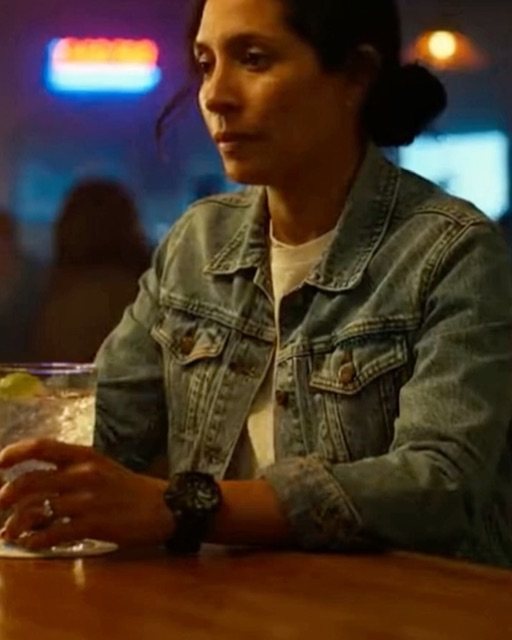
“Women like you don’t last out there,” he said, palm heavy, thumb digging into my jacket like he owned it.
My blood ran cold – but my voice didn’t shake. “Take your hand off me.”
He laughed. “Relax, I’m being friendly.”
“I’m asking once.”
He squeezed. The room shifted. Cole, the bartender, glanced up, jaw tight. The other Marines snickered, egging their buddy on.
I didn’t raise my voice. I didn’t stand. I reached into my pocket, felt the edge of a leather sleeve I hadn’t wanted to touch tonight, and pulled out a single card.
I set it face down between us and slid it across the wood.
“Read it,” I said quietly.
He smirked, flipped it with two fingers – still cocky. Then his eyes landed on the photo. The color drained like someone had pulled a plug.
His buddies went silent. Cole saw the seal and looked away, like he’d just seen the barrel of a gun.
The Marine’s grip disappeared. He actually took a step back. “Ma’am, I—”
“Don’t,” I said. “Not here.”
He swallowed hard. “I didn’t know—”
“You didn’t ask.”
His jaw worked. The cockiness was gone, replaced by a very sober kind of panic. He glanced at the hologram, then at me, then at the back of the bar like he was searching for an exit no one else could see.
I tapped the bottom line on the card with my nail. “Now. Tell me your commanding officer’s name.”
He blinked. “Why?”
“Because you’re going to call him.”
His hand trembled over his phone. He looked at the insignia again, and I watched his mouth form a word I hadn’t allowed in public for years.
That’s when the door opened behind him.
Boots on tile. A hush. Someone said my last name like a question—then like a warning.
I turned toward the mirror behind the bottles, and when I saw who had just walked in wearing that uniform, my heart slammed once and stopped mid-beat.
It was a ghost in dress blues. Not my ghost, but one that walked beside him for twenty years.
General Harrison. He looked older, the lines around his eyes deeper, but the authority radiating from him was the same. It could silence a room without a word.
He was my husband’s best friend. He was the man who had handed me the folded flag.
His eyes found mine in the reflection. There was no surprise in them, only a tired sort of recognition.
The young Marine, Peterson, turned slowly, sensing the shift in the atmosphere. He saw the two stars on Harrison’s shoulder and looked like he might faint.
“General,” Peterson stammered, snapping to a clumsy version of attention.
Harrison’s gaze didn’t leave mine. “Mrs. Vance,” he said, his voice a low rumble.
It had been three years since I’d heard my married name said with that kind of respect. It felt foreign.
I just nodded, unable to speak.
Harrison finally looked down at Peterson, his expression hardening into granite. He took in the scene—the card on the bar, my rigid posture, the Marine’s terrified face.
“What seems to be the problem here, son?” Harrison asked, the question carrying the weight of a court-martial.
Peterson opened and closed his mouth. His friends were trying to shrink into the wood paneling.
“He was just leaving,” I said, finding my voice. My tone was flat.
Harrison raised an eyebrow, a silent question directed at me. I gave a slight shake of my head. Not here. Not like this.
He understood. He turned his full attention back to the young man. “I believe Mrs. Vance is correct.”
“Sir, yes, sir,” Peterson choked out.
He and his friends practically fell over each other getting out the door, the bell above it jingling their panicked retreat.
The bar was silent again, but the air was thick with everything unsaid.
General Harrison walked to the bar and took the stool beside me. He looked at the card, at the smiling face of his friend, my Michael.
“I’m sorry you had to use that, Anna,” he said softly.
Cole the bartender appeared with a glass of water for me and a short glass of bourbon for the General. He placed them down without a word, a silent act of solidarity.
“I didn’t want to,” I admitted. “But he wouldn’t listen.”
Harrison took a slow sip of his drink. “Some men only learn respect when they’re staring it in the face.”
We sat in silence for a moment. It wasn’t uncomfortable. It was the quiet of shared grief, of a history too heavy for small talk.
“What are you doing here, Thomas?” I finally asked. “This town isn’t exactly on the Pentagon’s travel itinerary.”
He swirled the amber liquid in his glass. “I was in the area. Heard you’d settled down here.”
I knew it was a lie. A kind one, but a lie nonetheless. General Thomas Harrison didn’t just find himself ‘in the area.’
“Who told you?” I asked.
He gestured with his chin toward the bartender. “Cole here used to be one of Michael’s best. Recon. He reaches out to me now and then. Lets me know you’re okay.”
I looked at Cole, who was wiping down the far end of the bar, pretending not to listen. He’d been nothing but kind since I’d moved here six months ago, always having my favorite tea ready, always asking if I needed anything.
I never knew he was one of Michael’s men. I felt a flush of warmth, of being protected when I hadn’t even known it.
“He worries,” Harrison continued. “Said you’ve been keeping to yourself. Too much.”
“I like the quiet,” I said, my standard defense.
“There’s quiet, Anna, and then there’s hiding.”
His words struck a nerve because they were true. I had come to this forgotten town to disappear, to just be Anna, not the widow of the great General Michael Vance.
“That kid,” Harrison said, changing the subject. “Peterson. He’s got a powerful father.”
I looked at him. “What does that have to do with anything?”
“His father is Senator Peterson. Sits on the Armed Services Committee.”
A cold knot formed in my stomach. This was more than a random encounter.
“The senator and Michael… they didn’t see eye to eye,” Harrison said carefully.
That was the understatement of the century. Michael had believed the senator was dirty, steering lucrative defense contracts to his friends in exchange for kickbacks. He was building a case.
He told me about it in hushed tones late at night. He said it was dangerous.
Then he was deployed on a mission that was supposed to be routine. A simple peacekeeping operation. His convoy was hit by an IED that was far too sophisticated for local insurgents.
The official report was a tragedy. A terrible loss. A dead end.
I never believed it. Michael never believed in coincidences.
“What are you telling me, Thomas?” I asked, my voice barely a whisper.
“I’m telling you I don’t think tonight was an accident. I think you were being tested. Prodded.”
The bar suddenly felt too small, the walls closing in. The kid’s smirking face flashed in my mind. It wasn’t just drunken arrogance. It was targeted.
“They want to know if you’re a threat,” Harrison said, confirming my fears. “They want to know if Michael left you anything.”
“Left me anything? He left me memories and a box of medals.” My voice cracked.
“He left more than that, Anna. Michael was meticulous. He kept records of everything. A private file. His ‘insurance policy,’ he called it.”
I shook my head. “I went through all of his things. There was nothing like that.”
“Are you sure?” he pressed gently. “Think. Did he ever give you anything to hold onto? Something that seemed out of place?”
I searched my memory, sifting through the last few conversations we had before he left. It was all a blur of ‘I love yous’ and ‘be safes.’
Nothing.
“I don’t know, Thomas. I don’t remember.”
He sighed, the sound heavy with disappointment. “The Senator is making a move. He’s trying to get a new weapons system approved, one that Michael proved was faulty and dangerous. It’s made by a company he has a major stake in.”
“It’s always about money,” I said bitterly.
“It’s about more than that. If this system gets deployed, people will die. Our people.”
He let that sink in. He was talking about Michael’s legacy. He was talking about preventing more widows like me.
“I want to help,” I said, the words surprising even myself. “But I don’t have anything.”
Cole walked over, placing a fresh napkin on the bar. He didn’t look at us.
“With all due respect, General,” Cole said to Harrison, his voice low. “Maybe you’re asking the wrong question.”
Harrison turned to him. “What do you mean, Sergeant?”
“You’re asking what the General left her,” Cole said, finally looking at me. “Maybe you should be asking what he taught her.”
My mind raced. Michael was a brilliant strategist. He thought in layers, in contingencies. He never put all his eggs in one basket.
He wouldn’t have left a simple file. It would be too obvious.
What had he taught me? He taught me to play chess. He taught me to see the whole board, not just the next move.
He taught me about ciphers and codes, games we used to play to keep our minds sharp.
And he always said the same thing before he deployed.
“The key is in the keepsake,” I whispered, the memory hitting me like a physical blow.
Harrison leaned forward. “What was that?”
“The key is in the keepsake.” It was his little sign-off. I always thought it was just a sweet, rhyming phrase he’d made up.
“What keepsake, Anna? What did he give you?”
My hand went to my neck, to the simple silver locket I always wore. I never took it off. It was the last thing he gave me.
I fumbled with the clasp, my fingers trembling. I opened it. Inside were two tiny pictures: one of me on our wedding day, and one of him in his uniform, smiling.
It looked perfectly normal.
“There’s nothing here,” I said, defeated.
Cole pointed a steady finger at the locket. “The General was old school, ma’am. He believed in things you can touch. Things that last.”
He tapped the edge of the tiny picture of Michael.
I looked closer. The photo was mounted on a thin piece of metal. It wasn’t paper.
Using my nail, I carefully pried at the edge. It lifted.
Beneath it was not a hollow space, but another metal plate, etched with a microscopic grid of numbers and letters.
It was a key. Not a physical one, but a digital one. A cryptographic key.
“What is it?” Harrison breathed, his eyes wide.
“It’s one half of a pair,” I said, the knowledge flooding back from all those ‘games’ Michael and I used to play. “A one-time pad cipher. Useless without the other half.”
“Which is?”
I thought hard. The key is in the keepsake. Not keepsakes, plural. Just one. He wouldn’t have split it up. He would have hidden it in plain sight.
My eyes scanned the bar, then landed on my own reflection in the mirror.
Then I knew.
“Cole,” I said. “Is your wifi password still the same?”
Cole nodded slowly, a small smile playing on his lips. “Never had a reason to change it, ma’am.”
I pulled out my phone. My hands were steady now. The fear was gone, replaced by a cold, clear sense of purpose.
I connected to the bar’s network. Then I opened a secure browser and typed in a web address from memory, one Michael had made me memorize years ago.
A simple login screen appeared. It asked for a single key.
I held the phone’s camera over the locket, letting it scan the alphanumeric code. The screen flickered, and then a new page loaded.
It was Michael’s insurance policy.
It was all there. Bank statements, encrypted emails, recorded phone calls with the Senator. Timelines, shell corporations, evidence of faulty materials being knowingly used in military contracts.
It was a detailed map of Senator Peterson’s corruption, and it was devastating.
Harrison stared at the screen over my shoulder. “My God, Anna. He did it.”
“He never started a fight he couldn’t finish,” I said, my voice thick with pride.
A plan began to form, swift and sharp. We couldn’t just leak this. That would be messy, and the Senator would spin it, bury it.
We had to present it. We had to make it undeniable.
The next forty-eight hours were a blur. Harrison made calls, pulling in favors from people he trusted, people loyal to Michael’s memory.
Cole, it turned out, was far more than a former recon sergeant. He was a tech genius, one of the best a clandestine unit had ever produced. He made secure copies and authenticated every piece of data.
I provided the context, the human element. I cross-referenced the files with Michael’s old journals and letters, adding notes and explanations that only I could provide.
The final piece was the presentation. It had to be done on our terms.
Harrison arranged a ‘briefing’ on the Hill. He used his influence to get Senator Peterson and the other key members of the Armed Services Committee into a secure room in the Capitol building.
He told them it was a matter of urgent national security. He didn’t lie.
I walked into that room wearing a simple black dress and my husband’s locket. I wasn’t a grieving widow anymore. I was his final mission.
Senator Peterson saw me and his face paled slightly, but he quickly masked it with a dismissive sneer. His son, the young Marine, was not there. He had already been quietly reassigned to a remote arctic base pending a formal inquiry.
Harrison began the briefing. He didn’t raise his voice. He simply laid out the facts, his tone cold and professional.
Then he turned the floor over to me.
All eyes were on me. I saw doubt and pity in some of them. The Senator just looked bored.
I didn’t speak. I just turned to the large screen behind me. Cole, working remotely from his bar, activated the display.
The first thing on the screen was a picture of my husband, smiling in his uniform.
“General Michael Vance believed in three things,” I began, my voice clear and strong. “God, country, and the integrity of the men and women who serve it.”
Then, I showed them everything.
The screen filled with bank records. Audio files of the Senator’s voice played over the speakers, clear as a bell, discussing kickbacks. Emails detailed the deliberate cover-up of the faulty equipment.
With every new piece of evidence, the color drained further from the Senator’s face. His colleagues shifted in their chairs, moving away from him as if his corruption were contagious.
The final piece of evidence was an engineer’s report that Michael had commissioned in secret. It proved, unequivocally, that the IED that killed my husband’s convoy was made with components from the same company the Senator was championing. It wasn’t just corruption. It was murder.
The room was utterly silent.
I looked directly at Senator Peterson. The sneer was gone. He looked like a trapped animal.
“My husband died protecting his country,” I said, my voice ringing with a power I didn’t know I possessed. “You, Senator, tried to profit from it. You will not tarnish his name to line your pockets.”
It was over. There was no spinning this, no burying it.
The fallout was immediate and absolute. The Senator was stripped of his committee assignments and faced a full-blown federal investigation. His career was over. His name was mud.
The faulty weapons system was scrapped. The corrupt contracts were canceled.
But that wasn’t the real victory.
A few weeks later, I stood with Harrison and Cole at the dedication of a new wing of the veteran’s hospital, named The General Michael Vance Center for Integrity and Leadership.
I didn’t go back to my quiet life. I had found a new purpose.
Using Michael’s name and the platform I now had, I started a foundation. We worked to expose corruption and support the families of those who had been wronged by the system. Cole left his bar and became my chief of operations.
My strength wasn’t in a card or a rank. It had been inside me all along, instilled by a man who taught me that the most important battles are fought for those who can no longer fight for themselves.
Sometimes, the quietest voices are the ones that carry the most weight. You just have to find the right moment to speak, and the right truth to tell. Honor isn’t about the uniform you wear; it’s about the legacy you leave behind.