“Is this a joke? A girl is giving us orders now?” Gary sneered, his massive arms crossed over his chest.
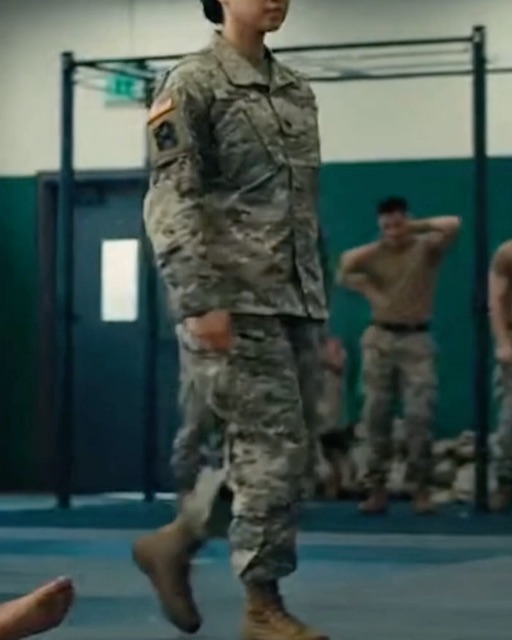
I had just been assigned to train the most notoriously undisciplined unit on the base. I’m 5’4″ with my boots on. They were towering walls of muscle who had already decided I was weak.
The outgoing commander introduced me and immediately walked out. The second the heavy gym doors clicked shut, the disrespect started. Some laughed. Others deliberately turned their backs and went back to dropping barbells.
I grabbed my water bottle to take a sip and assess the room. Before I could even unscrew the cap, Gary – a 240-pound wall of ego – snatched it right out of my hands.
He popped the top and poured the ice-cold water directly over my head.
The gym went dead silent, then erupted into howling laughter.
The water soaked my uniform, dripping down my neck. My blood ran cold, but my expression didn’t change.
“What’s wrong, sweetheart? Can’t handle command?” he mocked, shoving my shoulder hard.
He didn’t even see my hands move.
In a fraction of a second, the laughter was cut short by a sickening pop. Gary slammed into the mat face-first. All the air left his lungs in a sharp gasp. My knee was driven deep into his spine, and his right arm was twisted impossibly high behind his back.
The entire platoon froze.
Gary whimpered, his cheek scraping the dirty rubber floor. “Please!” he choked out, his arrogance replaced by pure, breathless terror. “Stop!”
I leaned down to whisper in his ear. As I did, my soaked sleeve slid up, exposing the faded black tattoo on my inner forearm.
Gary’s eyes locked onto the ink. All the color instantly drained from his face. He stopped struggling. Because looking at that specific symbol, he finally realized I wasn’t just a regular transfer. He realized I was one of them.
The tattoo was simple, a stylized ghost superimposed over a single, jagged lightning bolt.
It was the unofficial mark of the 7th Special Operations Group. The Ghosts.
They were a unit that didn’t officially exist. They were the people they sent in when missions went sideways, the cleaners, the shadows that fixed the messes no one else could.
I eased the pressure on his arm, but kept him pinned. “We have a lot of work to do,” I said, my voice low and steady, carrying across the silent gym.
I stood up and released him. Gary scrambled to his feet, clutching his shoulder, his eyes wide with a mixture of pain and something else. It looked like awe.
He didn’t say a word. He just stared at my arm, then at my face, as if seeing me for the first time.
The rest of the platoon, a group of thirty men who had been laughing moments before, were now standing at terrified attention. The clanging of weights was gone. The only sound was the drip of water from my hair onto the rubber mat.
“The workout starts in five,” I announced to the room. “Full gear, ten-mile run. Go.”
No one questioned it. They moved, a chaotic scramble of bodies grabbing their packs and rifles. They moved faster than they probably had in years.
Gary was the last to move. He just stood there, his chest heaving. “Ma’am,” he stammered. “I… I’m sorry.”
I looked him dead in the eye. “Apologies are words, Sergeant. Actions are what matter. Now get your gear.”
He nodded, a flicker of profound understanding in his eyes, and ran to join the others.
That first day was brutal. I ran them into the ground. I didn’t yell, I didn’t scream. I just set the pace, leading from the front, and never once showed a sign of fatigue.
For the next two weeks, that was our life. Dawn until dusk, it was non-stop training. Physical conditioning that made grown men weep. Tactical drills that fried their brains. Weapon maintenance until their hands were raw.
I broke them down completely. I stripped away their arrogance, their laziness, their indiscipline.
But I never broke their spirit. For every ounce of energy I demanded from them, I gave back two.
If a soldier fell behind on a run, I’d circle back and run beside him. If someone struggled to reassemble their rifle blindfolded, I’d sit with them after hours, guiding their hands in the dark until they got it right.
They started to change. The defiant smirks were replaced with tired but focused expressions. The lazy chatter was replaced with questions about tactics and strategy.
They stopped seeing me as a woman. They started seeing me as their commander.
Gary changed the most. He went from being the biggest problem to my most reliable man. He was the first to arrive, the last to leave. He pushed himself harder than anyone, his actions a constant, silent apology for that first day.
He never mentioned the tattoo again, and neither did I. It was an unspoken thing, a quiet understanding that hung in the air.
About a month into my command, I was finishing my report late one night in the small, cinder-block office attached to the barracks.
I heard a soft knock on the door. “Come in.”
It was Gary. He stood in the doorway, holding two cups of what smelled like cheap, burnt coffee. He looked nervous.
“Ma’am. Figured you might be working late.”
I nodded toward the empty chair. “Sit down, Sergeant.”
He handed me a cup and sat, his huge frame seeming to shrink in the small chair. We sat in silence for a moment, the only sound the hum of the old computer.
“You can ask, you know,” I said finally, not looking up from my screen.
He cleared his throat. “My brother, Mark. He was in the Rangers. Three years ago, in the Kandahar Valley.”
I stopped typing. I knew the story. Everyone in certain circles did. Ambush. A patrol of twelve men, pinned down, communications cut. Only one man made it out alive.
“His whole squad was gone,” Gary continued, his voice thick with emotion. “He was wounded, hiding in a ditch, bleeding out. He said he was ready to die.”
He paused, taking a shaky breath. “Then, out of nowhere, they showed up. Two of them. He said they moved like smoke. They took out the entire enemy position in less than a minute.”
He looked down at his hands. “One of them patched him up. Carried him two miles on his back to the extraction point. Mark said he’d never seen anything like it. This soldier… he was a legend. A ghost.”
Gary finally looked up, his eyes meeting mine. “Mark saw the tattoo. On the soldier’s forearm, when his sleeve rode up as he was applying the tourniquet. My brother has talked about that man every single day for three years. He’s the reason Mark is alive. He’s the reason I can still see my big brother.”
Tears were welling in his eyes now. “When I saw it on you… Ma’am, I wasn’t just disrespecting a new commander. I was spitting on the memory of the man who saved my family. I am so, so sorry.”
I finally turned my full attention to him. I took a slow sip of the coffee. It was terrible, but I didn’t mind.
“The soldier who saved your brother,” I said softly. “His name was Sergeant Daniels. David Daniels.”
Gary’s face lit up with recognition. “Yes! That was him! Mark said he’d never forget the name.”
He leaned forward, his voice filled with awe. “You knew him?”
This was the hard part. The part I rarely spoke of.
“He was my partner,” I said. “He was my mentor. He taught me everything I know. How to move, how to shoot, how to lead.”
I pulled up my own sleeve, the one he hadn’t seen, on my other arm. Just above my wrist was a thin, jagged scar.
“We were on a mission a year after he saved your brother. Things went wrong, just like they did for Mark’s unit. I was the one pinned down. I was the one bleeding out.”
The memory was as fresh as if it were yesterday. The dust, the noise, the sharp, blinding pain.
“David could have gotten out,” I whispered. “He had a clear path to extraction. But he came back for me. He came back, and he didn’t make it.”
The office was silent again. Gary just stared at me, his mouth slightly agape. The hero he and his brother had built up in their minds had a story that didn’t end in glory.
“I don’t wear this tattoo because I think I’m a hero, Gary,” I said, pointing to the ghost on my forearm. “I wear it for him. To remember the standard he set. To honor the sacrifice he made for me.”
I leaned back in my chair. “The reason I took this post, training a unit everyone else had given up on, is because of him. He believed that every soldier deserved a leader who would prepare them, who would fight for them, who would never, ever leave them behind. I am here to be the leader he was.”
Gary was speechless. He wiped a tear from his eye with the back of his massive hand. He finally understood. My strength wasn’t just my own. It was a legacy. A debt I was trying to repay.
“Ma’am,” he said, his voice cracking. “Thank you. For telling me.”
From that night on, something shifted permanently in the unit. Gary must have told the others the story, not the details about my past, but the part about leadership and sacrifice.
They weren’t just following my orders anymore. They were trying to live up to an ideal. They became a team. The Spartans, a name they’d been given as a joke, started to feel earned.
Six months later, we were deployed. We were stationed in a dusty, forgotten outpost, running routine patrols. It was quiet. Too quiet.
The call came over the radio in the dead of night. A logistics convoy, lightly armed, had missed its checkpoint. It had been ambushed in a narrow canyon ten miles out.
My blood ran cold. It was the same scenario. The same trap.
We were the closest unit. Command told us to stand by for a Quick Reaction Force, but I knew. I knew there wasn’t time. Those soldiers in the canyon were running out of it.
I looked at my men. Their faces were grim, but ready. There was no fear in their eyes. There was only resolve.
“Gear up,” I said. “We’re going in.”
We moved fast and silent, just like I had trained them. We reached the ridge overlooking the canyon. Below, it was chaos. Two burning trucks, the convoy pinned down behind them, taking heavy fire from enemy fighters entrenched on the high ground opposite us.
It was a perfect kill box.
Gary was at my side, binoculars pressed to his eyes. “Ma’am, they’re sitting ducks. If we go down the main path, we’ll be walking into the same meat grinder.”
He was right. But Daniels had taught me to see the battlefield differently. Not as a set of obstacles, but as a set of opportunities.
“They’re focused on the convoy,” I said. “Their flank is exposed. Thomas, you take three men and lay down suppressing fire on their forward position. Draw their attention. Gary, you’re with me. We’re going to climb.”
Gary looked at the sheer rock face to the enemy’s left. It was a treacherous, almost vertical climb. It was insane.
But he didn’t question me. He just nodded. “Yes, Ma’am.”
While Thomas and his team opened up, creating a deafening diversion, the rest of us began the climb. Our fingers and boots scrambled for purchase on the loose rock. My lungs burned. My muscles screamed.
But we moved as one. When a soldier slipped, a hand was there to steady him. We communicated with hand signals, a silent, deadly machine ascending the cliff face.
We reached the top, undetected. We were directly behind the enemy line. They were so focused on the firefight below they never knew what hit them.
We moved through their position with cold, brutal efficiency. It was over in ninety seconds.
Silence fell over the canyon, broken only by the crackle of the burning trucks.
We rappelled down and secured the convoy. There were wounded, but thanks to our speed, everyone was alive.
As the medics worked, the convoy’s captain, a young lieutenant, came over to me. He was in shock, his face pale.
“Who… who are you?” he asked, looking at my quiet, professional soldiers. “We were told this area was just manned by a reserve platoon.”
I looked over at my men. The Spartans. The undisciplined washouts nobody had wanted. They stood tall, their duty done. Gary caught my eye and gave me a slow, proud nod.
I turned back to the lieutenant. “We’re the unit that’s here,” I said simply.
Back at the base, the story of the canyon rescue spread like wildfire. The unit that was once the laughingstock of the base was now spoken of with respect.
My tour ended a few months later. On my last day, the men were all gathered in the gym where it had all started. It was clean now. Organized. A place of work, not a clubhouse.
Gary stepped forward. He was no longer the arrogant bully I had met. He was a leader.
“Ma’am,” he said, his voice clear and strong. “On behalf of the entire platoon, we wanted to give you something.”
He and Thomas unveiled a plaque. On it was the emblem of the Ghost Division, the stylized ghost and the lightning bolt.
Below it, an inscription read: “Strength Is Not The Size Of The Soldier, But The Size Of Their Heart. Thank You For Showing Us The Way.”
My eyes welled up. I thought of Sergeant Daniels. I thought of his sacrifice.
I realized then that leadership wasn’t about being the strongest or the toughest person in the room. It’s about seeing the potential in others and giving them a reason to believe in themselves. True strength isn’t something you take; it’s something you build in the people around you. My debt to David wasn’t just paid; it was invested in thirty good men who would carry that legacy forward. And that was a reward greater than any medal.