
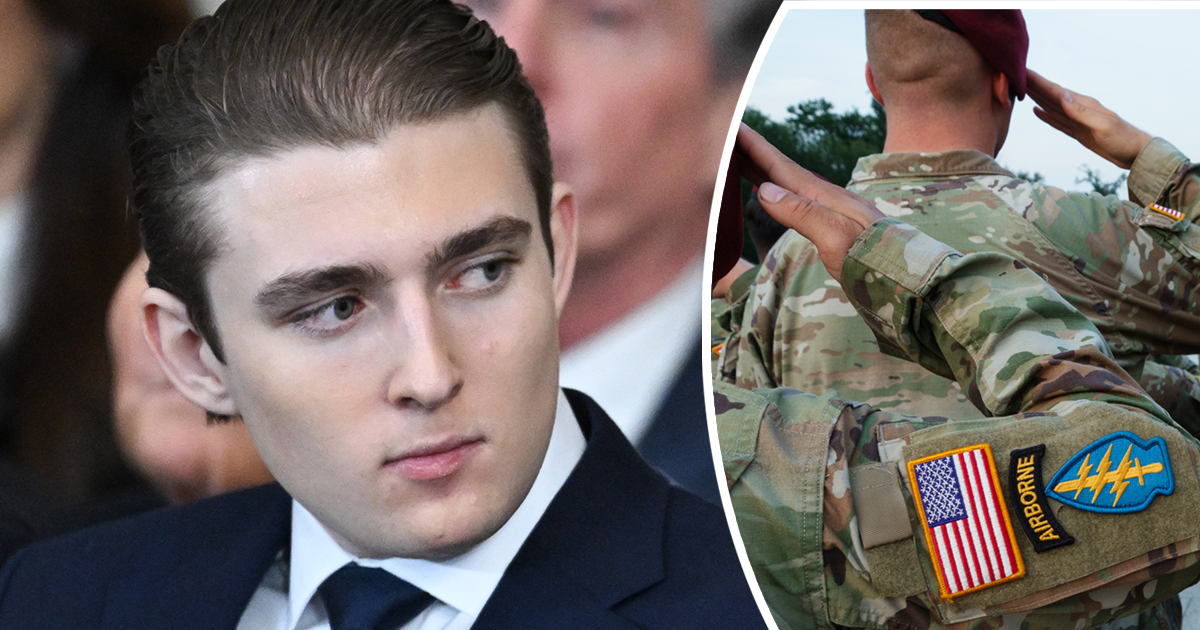
Barron Trump is beginning to build a life of his own. The youngest son of Donald Trump is studying at Stern Business School’s Washington, D.C., campus, focusing on classes and campus routines much like many young adults his age. At the same time, his father, now back in the White House after last year’s election, has been pursuing an assertive approach abroad. Following strikes in Iran, a familiar public debate has reappeared online, with a notable number of social media users calling for Barron to enlist in the United States Army.
The American military has long held a special place in national life. Even so, not every family has a direct connection to service. Donald Trump has often praised the troops, but he did not serve in the military himself. Reports have also noted that, on his paternal side, there has not been military service for several generations. That family history, combined with recent events in Iran, has prompted a wave of pointed commentary about whether Barron should be the one to change that record.
The friction is not only about family biography. It is also about timing and symbolism. After the United States carried out strikes on three nuclear-related sites in Iran on June 22 last year, reactions ranged from support to sharp criticism. Some lawmakers called the strikes unconstitutional. Others argued they were necessary. Against that backdrop, a straightforward but emotional challenge emerged online: if leaders praise military service and steer the nation into conflict, should their children volunteer to serve first?
It is an age-old question in American politics, and one that always stirs strong feelings. For some critics, the unease goes back to the Vietnam era and the draft. Donald Trump received multiple deferments while in college and later a medical deferment for bone spurs. He has said, as reported by the New York Times, that the heel spurs “healed up” over time and that he did not undergo surgery. Like many public figures from that generation, his relationship to the draft still colors how some people view his words about the military today.
Over the years, neither Donald Trump nor any of his children has served in uniform. Service members and veterans have occasionally voiced frustration about that, especially when policy decisions put troops in harm’s way. Today, the focus has turned to Barron, with some voices insisting that he should be the first Trump to wear the uniform.
Social media calls for Barron Trump to enlist
The tone on social platforms after the 2025 Iran strikes was immediate and intense. On X, the platform once known as Twitter, several users argued that Barron should step forward. One user predicted that none of the Trump men would be anywhere near the fighting, even suggesting that Barron would miraculously share his father’s old medical waiver. Another post said, “If Trump decides the USA should get involved in a ground war in Iran, I assume Barron will be enlisting since the Trump family has so much love and support for our troops. Be a patriot!” Others took the idea further, proposing that the president’s son should go first, before any other family bears the burden, a view they framed as a matter of basic fairness.
These comments were not all measured. Some included personal barbs and sweeping generalizations. But underneath the heat was a common theme: the belief that leaders who value service should demonstrate that commitment through their own families. Whether one agrees or disagrees, it is a sentiment that tends to flare during times of military action, especially when the commander in chief has no personal history of service.
For older Americans who lived through the draft era or who have family members in uniform, this debate can feel familiar and deeply personal. Many recall that the country has wrestled with the gap between those who fight and those who do not for decades. With the United States military now an all-volunteer force, the question becomes even more charged: if service is voluntary, who bears the brunt of the risks when leaders make fateful decisions?
TV commentary intensifies the debate
Television commentary soon added to the controversy. On the U.S. network MS NOW, anchor Lawrence O’Donnell criticized Barron Trump for not enlisting after turning 20. He argued that, upon reaching that milestone, Barron could have gone straight to a recruiting station in support of his father’s policies. O’Donnell went further by invoking history, noting that President Franklin D. Roosevelt’s four sons served during World War II. He also referenced Queen Elizabeth II, who wore a uniform and trained as a driver and mechanic during World War II while her father was still king.
O’Donnell framed his point with a sharp rhetorical comparison, asking whether Barron could, for example, drive an ambulance for the Army the way the then 18-year-old Princess Elizabeth did in the war effort. He then suggested that being a Trump meant being “more spoiled than an English princess on her way to becoming queen,” a line intended to emphasize what he views as a failure to match words with deeds.
Not everyone will agree with that framing, and many will find it too personal. Still, television segments like this often give voice to a broader frustration that surfaces whenever the nation exercises military power: a sense that those who make the call should share in its costs, not just its applause.
A longer American conversation about service
The United States ended conscription in 1973, moving to an all-volunteer force. That decision changed how the country thinks about service. In earlier eras, nearly every community had direct exposure to the draft, and most families either sent someone to serve or knew someone who did. Today, the share of families with an active-duty member is far smaller. For some, that distance breeds gratitude and admiration. For others, it breeds worry that the sacrifices of military life are falling on the shoulders of just a few.
That worry sometimes gets channeled into proposals that the children of national leaders should serve automatically, or at least be the first to volunteer if a conflict arises. Supporters say it would guarantee that the powerful have skin in the game. Opponents counter that service is a calling, not a punishment, and that the military should never be used to settle political scores or make symbolic points. They also note that the armed forces need people with the right motivations and qualifications in the right roles, not reluctant recruits pressed into duty by public anger.
However one comes down on that debate, it is clear why the question is being asked now. The strikes in Iran, the president’s well-known absence of personal service, and Barron Trump’s arrival at adulthood all converge to make the topic feel immediate and urgent for many Americans.
A note about Barron Trump today
Barron Trump is 20 and, by all public indications, focused on his education. He is attending classes at Stern Business School’s Washington, D.C., campus and beginning the normal steps into adult life. There has been no official word from him about any intention to enlist. As with any young adult, that decision would be his to make, in consultation with his family and in line with his own goals and convictions.
Unlike in earlier decades, there is no draft to force the issue. Enlistment in the United States is voluntary, and those who join do so for many reasons: a desire to serve, an interest in particular careers, educational benefits, or family tradition. If Barron chose to enlist, he would go through the same basic process as anyone else: meeting with a recruiter, taking entrance exams and medical screenings, and then moving on to training for a specific role.
What enlistment involves now
It is important to understand what modern military service looks like. The armed forces are large, specialized organizations with many paths that rarely match the dramatic images seen in movies or on social media. New enlistees may head into infantry or armored units, but many others enter logistics, aviation maintenance, cybersecurity, intelligence analysis, medical support, communications, transportation, or mechanical trades. A person might spend their days safeguarding networks, repairing equipment, coordinating supply lines, or caring for service members’ health.
Even when conflicts are active, not everyone “goes first,” and certainly not based on a social media proclamation. Deployments, when they happen, are carefully planned by military leadership according to mission needs, unit readiness, training cycles, and the skills required on the ground. The online notion that a president’s child would be sent ahead of everyone else is a rhetorical flourish rather than a real-world scenario.
Comparing generations and expectations
Appeals to history carry weight, especially for Americans in midlife who grew up hearing family stories from World War II, Korea, and Vietnam. It is true that several of President Franklin D. Roosevelt’s sons served during World War II, and that Princess Elizabeth trained and served as part of Britain’s war effort. Earlier still, members of President Theodore Roosevelt’s family also saw combat. Those examples are powerful, but they come from moments when national mobilization touched nearly every household. Today’s all-volunteer force, coupled with the modern nature of conflict and technology, has changed how and where service happens, and who steps forward to do it.
That change does not lessen the honor of serving, nor does it excuse leaders from respecting the weight of their decisions. It simply means that comparisons across eras require context. When people cite the past to judge the present, they are often expressing a heartfelt desire that national sacrifice be shared and visible, rather than distant and abstract.
Social media heat versus real-world choices
Posting is quick; enlisting is not. Online exchanges can ratchet up emotions, sharpen the language, and personalize the blame. Real-life decisions about service unfold more slowly and privately, involving families, medical exams, timelines, and personal convictions. These two worlds rarely line up neatly. It is understandable that, in the wake of military action, people want clear, symbolic steps that show fairness. But the military is not a symbol. It is a profession, a community, and a commitment measured in years, not in likes or reposts.
When discussions spill over into insults, they tend to obscure more than they reveal. Most Americans—whatever their politics—hold sincere respect for those who wear the uniform and the families who support them. That respect calls for a measured tone, especially when the person being discussed is a young adult still finding his way in the world.
The Iran strikes and the question of authority
The June 22, 2025 strikes in Iran set off not only international headlines but also a domestic legal and moral debate. Some lawmakers labeled the action unconstitutional, pointing to their view of Congress’s role in authorizing war. Others argued that the commander in chief must be able to act decisively to protect the nation. Wherever one lands, that legal back-and-forth helps explain why the personal question—should the president’s child serve—caught fire. In moments when national power is exercised, people want assurance that those at the top understand the cost.
As of now, there is no indication that American ground troops are being sent into Iran. The calls for Barron to be “first in” are largely symbolic, a way for critics to underscore what they see as a gap between leadership and sacrifice. Still, symbols matter in politics, and that is why the conversation has lingered.
Bone spurs and the long memory of the draft
Donald Trump’s history with the draft remains part of the story. He was granted college deferments and later a medical deferment for heel spurs. He has said the condition resolved without surgery. To his critics, the phrase “bone spurs” has become shorthand for a perceived unwillingness to serve. To his supporters, the deferments were lawful and common for the time. Either way, it is a reminder that the choices young men faced a half-century ago still echo in how people judge leaders and their families today.
That echo is especially loud when the nation uses force abroad. When military action begins, the conversation about who bears the risks returns almost automatically. It is not only a political argument. It is a human one, rooted in the hope that those with power feel the weight of their decisions as fully as those who carry them out.
Final thoughts
The renewed calls for Barron Trump to enlist say as much about America’s anxieties as they do about any one person. They reflect pride in the armed forces, concern about fairness, frustration with politics, and memories—personal and national—of earlier conflicts. They also reflect the reality that service is voluntary and deeply personal. Barron is a college student on his own path, and only he can decide whether that path runs through a recruiting station.
Fair-minded people can disagree strongly about whether a president’s child should set an example by joining the military. What most can agree on is this: those who serve deserve respect, resources, and care. Leaders deserve close scrutiny when they send Americans into harm’s way. And everyone, wherever they stand, benefits from a discussion that lowers the temperature and raises the thoughtfulness. In that spirit, the question “Should Barron enlist?” becomes part of a larger, healthier conversation about how a nation honors its military—not only with words, but with wisdom.



