“Spin her up,” the captain barked. “Let’s see if Grandpa remembers where the switch is.”
I felt my stomach knot. Heat shimmered off the ramp, JP-8 in my throat, and the A-10 sat there like a loaded trap. I’m a crew chief, not a hero. I just hold the checklist and pray the brass don’t make me the example.
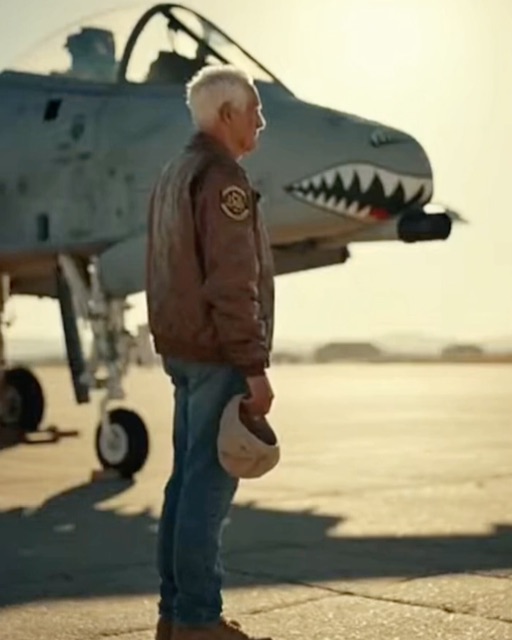
The old guy didn’t flinch. He laid one hand on the nose gear like he was touching a pulse. His jacket was beat to hell, and on the shoulder was a scorpion – faded, sand-colored, almost rubbed smooth.
Captain Todd Carver smirked and drifted into his space. “Sir, this is a restricted area. Unless that patch gets you through the gate, back it up.”
I glanced at the intake. My heart kicked. The red intake plug’s lanyard was wrapped weird, half-tucked. One wrong start and we’d be hoovering canvas at 40,000 RPM.
“Captain, hold on,” I said, voice cracking. “We didn’t run the APU check. And that plug – ”
He cut me off with a stare. “You heard me, Brent. Fire. Her. Up.”
The old man finally looked at Carver. Not angry. Just… tired. “You don’t wake her,” he rasped. “You ask.”
Carver laughed. “Ask who? The plane?”
The old guy tapped the side of the intake with two knuckles. The sound went deep, like it traveled through bones. I swear the whole line went quiet.
“Do you know what a hung start smells like?” he asked me without looking. “Smells like burning money and a funeral.”
My blood ran cold.
He reached into his pocket. Not fast. No drama. He pulled out a bent metal tag on a short chain and held it out to me. “Check the logbook, page one,” he said. “Then look under the canopy rail.”
I flipped the maintenance binder open with shaky fingers, grease sticking to my hands. There, pressed flat between the cover and the first page, was a Polaroid of a younger man under the same scorpion patch, standing in front of this exact jet with desert dust on his boots.
I wiped the dust off the canopy rail, leaned in, and froze. The stencil under the plexi made my knees go weak. It said…
PCC. W. DAVIES – ‘SCORPION’S STING’
Primary Crew Chief. Walter Davies. That was his name on the tag. He wasn’t just some old timer. He was her old timer. This jet, tail number 81-0964, had a name. And he had been its keeper.
I looked from the stenciled name back to the old man, whose eyes were now fixed on Captain Carver. The pieces clicked into place with a terrifying thud.
Carver, impatient, leaned over my shoulder. He read the stencil, and a flicker of something – annoyance, maybe confusion—crossed his face before the mask of arrogance slammed back down.
“Cute,” he scoffed, waving a dismissive hand. “A history lesson. That was thirty years ago.”
He turned to me. “Now, for the last time, Airman, start the pre-flight sequence.”
But something had shifted in me. It wasn’t bravery, not really. It was the old man’s voice, the smell of a funeral he described. It was the name on the rail.
“The intake plug, sir,” I managed, my voice steadier this time.
“I’ll take responsibility for the plug,” Carver snapped.
The old man, Walter, spoke again, his voice a low rumble. “It’s not the plug you should be worried about.”
He hadn’t moved from his spot near the nose. “It’s the number two hydraulic line.”
Carver rolled his eyes so hard I thought they might get stuck. “The board is green. All systems are nominal. I ran the diagnostics myself.”
“The board lies sometimes,” Walter said simply. “She’s got a ghost in her. Always has.”
He looked at me, a silent instruction in his gaze. “Get down on your back, son. Slide in behind the main gear. Put your hand on the line that feeds the port side flaps. The gauge will read 3,000 psi, just like it’s supposed to.”
He paused. “But you’ll feel her shaking.”
This was it. My career was flashing before my eyes. Defy a direct order from a pilot, or listen to the ghost whisperer of the flightline.
I looked at Captain Carver, whose face was turning a dangerous shade of purple. “Airman, if you get on that ground…”
I didn’t hear the rest. I was already dropping to one knee, then onto my back, the hot concrete searing through my uniform. I shimmied under the massive fuselage, the smell of hydraulic fluid and old metal filling my head.
It was dark and cramped. I found the bundle of lines and traced one with my fingers, just like he’d said.
At first, nothing. Just a smooth, cool metal tube. Carver was going to crucify me.
Then I felt it.
It wasn’t a violent shake. It was a tremor, a tiny, high-frequency vibration, like a plucked guitar string that hadn’t quite gone silent. It was so faint, you’d never notice it unless you were specifically looking for it. It was a sign of a pinhole leak, a seal about to go. An aneurysm waiting to happen.
At ten thousand feet, that tremor would become a rupture. A total loss of hydraulic pressure. A death sentence.
I slid back out, my face pale and covered in grime. I couldn’t speak. I just looked at Walter and nodded.
Captain Carver’s jaw was set like granite. “What? What did you feel?”
“A vibration, sir,” I said, my voice barely a whisper. “It’s there.”
“Impossible,” he spat, his confidence finally cracking. “The diagnostics…”
“Diagnostics don’t feel,” Walter interrupted, his tone flat. “They just read numbers. Men feel.”
Carver was about to explode. I could see the rage building, the humiliation stinging him. He opened his mouth to tear into us, to call the Security Forces, to end all of our careers right there on the ramp.
But a new voice cut through the tension.
“Having some trouble, Captain?”
We all turned. A black staff car had pulled up silently on the edge of the hardstand. A full-bird Colonel was getting out, his flight cap pulled low.
It was Colonel Evans. The Wing Commander. The Wing King himself.
My heart fell into my boots. We were all dead.
Captain Carver snapped to attention so fast he almost fell over. “No, sir! Colonel, sir! Just running through final checks.”
Colonel Evans’s eyes scanned the scene. He saw the open maintenance log, me covered in dust on the ground, and Captain Carver’s flustered expression.
Then his eyes landed on Walter.
And the Colonel’s entire demeanor changed. The hard edge softened. A slow, incredulous smile spread across his face.
“Walt?” he said, his voice full of disbelief. “Walter Davies? I’ll be damned.”
He walked right past Captain Carver, straight to the old man, and stuck out his hand. “What in God’s name are you doing on my flightline, you old son of a gun?”
Walter took his hand, a hint of a smile touching his own weathered face. “Came to see my girl, Jim. Heard she was still flying.”
“Still flying and still causing trouble, I see,” Colonel Evans said, clapping Walter on the shoulder.
Captain Carver looked like he’d been struck by lightning. He just stood there, mouth slightly agape, watching the Wing Commander greet this old man like a long-lost brother.
“Captain,” the Colonel said, turning back, his voice now dangerously calm. “Fill me in. What was the issue?”
Carver stammered, trying to regain his composure. “Sir, this… this civilian was interfering with pre-flight procedures. Airman Brent was… confused.”
“I wasn’t confused, sir,” I said, finding my spine again. “Mr. Davies identified a possible hydraulic failure.”
I explained the vibration, the tremor in the line that the gauges couldn’t see.
Colonel Evans listened patiently, his gaze fixed on Carver. When I finished, he looked at Walter. “She still doing that little dance with the number two line?”
Walter nodded. “Since ’91. Only when it gets hot. You remember.”
“I remember you grounding me in a sandstorm because of it,” the Colonel said with a chuckle. “Told me the same thing. Saved my tail that day.”
He turned his full attention back to Carver. The temperature on the ramp seemed to drop twenty degrees.
“Captain Carver,” he began, his voice low and precise. “This man, Walter Davies, was the Primary Crew Chief for this specific airframe during Desert Storm. He kept it flying through more sorties than any other A-10 in the theater.”
The Colonel let that sink in.
“He knows every rivet, every wire, every single ghost in this machine. When he says there’s a problem, you don’t question it. You don’t mock him. You say, ‘thank you, sir,’ and you ground the aircraft. Do you understand me?”
“Yes, sir,” Carver whispered, his face ashen.
But the Colonel wasn’t finished. He took a step closer, his eyes narrowing as he read the captain’s name tape.
“Carver…” he said slowly. “You wouldn’t happen to be related to Major Franklin Carver, would you? Flew Phantoms back in the day. Nickname was ‘Pops’.”
Captain Carver’s head snapped up, his eyes wide with shock. “He was my grandfather, sir.”
A heavy silence fell over the flightline. The distant whine of another jet taxiing was the only sound.
Colonel Evans looked from the young captain to the old crew chief, a strange, sad expression on his face.
“I’ll be damned,” he said again, softer this time. He looked at the tail of the A-10. “Walt, do you remember that Sandy mission? North of the line. A Phantom pilot, call sign ‘Gambler 2’, took a hit.”
Walter’s eyes grew distant, lost in a memory of sand and fire. “I remember. We spent three days patching holes after that one.”
The Colonel focused back on Captain Todd Carver, whose confident swagger was now completely gone, replaced by a fragile stillness.
“Your grandfather’s F-4 was shot to pieces,” the Colonel explained, his voice painting a vivid, terrible picture. “He was losing altitude fast over hostile territory. No way he was going to make it back.”
“His wingman had to bug out, low on fuel. But one aircraft stayed.”
He pointed a finger at the A-10 sitting before them. “This one. Scorpion’s Sting. The pilot made pass after pass, keeping the enemy’s heads down while your grandfather wrestled his crippled jet toward friendly lines. He didn’t make it all the way, had to punch out.”
“But because of the cover this plane provided,” the Colonel said, his voice thick with emotion, “the rescue choppers were able to get in and get him. They picked up Major ‘Pops’ Carver out of the desert because the pilot of this A-10 refused to leave him behind.”
He then gestured toward Walter.
“And the only reason that pilot had a plane capable of doing it,” he finished, “the only reason his guns didn’t jam and his engines didn’t quit, is because this man right here spent eighteen hours a day with his hands buried in its guts, making sure it would bring its pilot home.”
Captain Carver stood there, frozen. He wasn’t just looking at an old man anymore. He was looking at a debt he never knew he owed. He was looking at the reason his family name continued, the reason he even existed.
His arrogance wasn’t just ignorance; it was a deep, profound disrespect to his own blood.
Slowly, deliberately, Captain Carver took two steps forward. He stopped in front of Walter Davies. His shoulders, which had been puffed with authority just minutes before, were slumped in defeat.
“Sir,” he said, his voice choked and raw. “I… I am sorry. I had no idea.”
Walter just watched him for a long moment. There was no triumph in his eyes, no satisfaction. Only a deep, weary empathy.
“The bird doesn’t care about the name on your jacket, Captain,” Walter said softly. “She only cares about the hands that treat her right and the pilot who listens.”
He patted the nose of the A-10 again. “You take care of her. She’ll take care of you.”
Captain Carver nodded, unable to speak. He then turned to me. “Airman Brent. Ground the aircraft. I want a full diagnostic and physical inspection of the entire hydraulic system. Take as long as you need.”
He looked me in the eye. “And thank you.”
Later that afternoon, after the jet was safely tucked away in the hangar, I found Walter sitting on a bench, just watching the flightline. I brought him a cold bottle of water.
He took it with a grateful nod. We sat in silence for a while, watching the planes come and go.
“He’ll be a good pilot,” Walter said, gesturing with his chin toward the maintenance bay where Carver was now talking intently with the senior NCO, pointing at schematics. “Today, he learned the most important lesson.”
“What’s that?” I asked.
“That the stripes on your sleeve and the bars on your shoulder give you authority,” he said, taking a slow sip of water. “But respect… respect is earned in the dirt, with your hands, and with an open ear.”
He taught me more that day than a tech manual ever could. He showed me that a legacy isn’t just a story in a book; it’s a living, breathing thing, written in grease and stenciled under a canopy rail. It’s a quiet vibration in a hydraulic line, a warning from the past to protect the future.
The real strength wasn’t in the roar of the engine, but in the quiet wisdom of those who knew how to listen to its hum. It was a lesson about humility, about honoring the giants on whose shoulders we stand, even when they look like nothing more than a forgotten old timer with a faded patch on his sleeve.