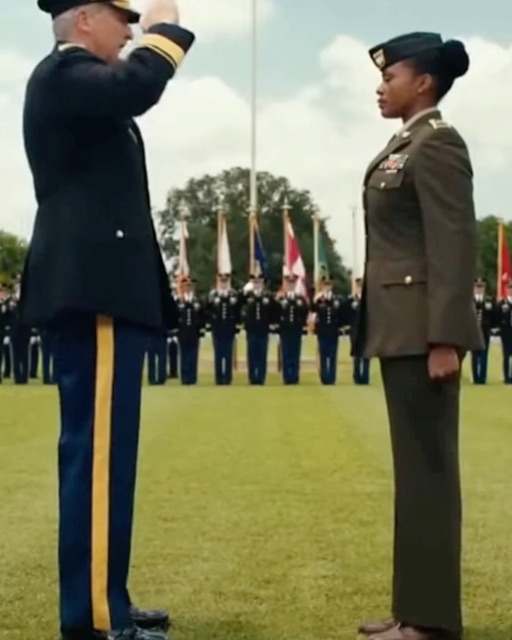
My right hand stayed glued to my thigh. I could feel the leather of my glove bite my skin. My jaw clenched so hard my molars ached.
“Captain, salute your superior or be court‑martialed,” the general barked. His voice cracked across the field. Families stared. Flags snapped. My blood ran cold – and I still didn’t move.
Two months ago, he buried the truth under a perfect report and pinned the blame on a dead sergeant. My sergeant. I swallowed the rage. I memorized the dates. I waited.
Now, on the parade field, he took one step closer. “Last chance,” he hissed.
I stepped in too. Close enough to see the pulse in his neck. Close enough to smell aftershave under the heat and brass.
I didn’t raise my hand.
I raised an envelope.
His eyes flicked to the seal. The color drained from his face.
I leaned in, so only he could hear me, and whispered, “Sir, as of 0600, you’re…”
He looked at the signature, and the entire reviewing stand went silent as his lips formed the first two words of the order… “relieved of command.”
General Thorne’s face was a mask of disbelief, then fury. He snatched the envelope from my hand, his knuckles white. The crisp paper crinkled in his fist.
For a moment, nothing happened. The world seemed to hold its breath. The band, poised to play, remained silent. The flags hung limp for a second, as if even the wind was waiting.
Then, Thorne’s aide, a young Major with a perpetually worried look, scurried down from the reviewing stand. He whispered something urgent to the General. Thorne just shook his head, his eyes locked on mine.
He saw no triumph in my gaze. There was only a cold, hard finality. This wasn’t about my career. This was about a flag-draped coffin and a lie etched into the official record.
This was for Sergeant Frank Miller.
Two months earlier, we were in a dust-choked valley, miles from anywhere that mattered. The mission was a simple reconnaissance, or so we were told. General Thorne called it a “milk run” on the briefing call.
Frank Miller didn’t think so. He was my senior NCO, a man who could read the land like a book and smell trouble from a mile away. He’d been in the service twenty years, with lines around his eyes that told more stories than any war historian.
“Sir, these vehicles aren’t ready,” he’d told me quietly the night before we rolled out. We were standing by the humming motor pool lights. “The transmission on number three keeps slipping. I’ve logged it three times this month.”
I believed him. I took his concerns to the operations officer, who took them to Thorne. The message that came back was clear. The mission was a go. The General needed this success for his file. A promotion to the Pentagon was on the line.
“Make it work, Captain,” was the final word.
So we made it work. Frank, being Frank, put himself in the driver’s seat of vehicle three. “If it’s going to fail, it’ll fail on me,” he’d said with that grim, reassuring smile of his. That was the kind of man he was.
It failed.
The transmission gave out on a steep, gravelly incline. The vehicle slid backward, careened off the narrow track, and rolled into a ravine. The official report, signed by General Thorne himself, was concise.
It cited “operator error.” It pinned the failure on Sergeant Miller’s “negligent disregard for vehicle limitations.” It was a clean, simple lie that preserved the General’s perfect operational record.
I stood at Frank’s funeral and watched them hand his widow, Sarah, a folded flag. I listened to the platitudes about his heroism. And I knew the truth was being buried right along with him.
That night, I went home and opened a new file on my laptop. It was a blank page. I typed Frank’s name at the top.
My investigation started in the motor pool. The maintenance logs were the first stop. I pulled up the records for vehicle three. They were spotless. Perfect.
Too perfect.
There was no mention of a faulty transmission. Not a single entry. Frank’s official reports had vanished. It was as if his concerns had never existed.
I knew who had the authority to sanitize those records.
My next stop was Private Evans, a young mechanic who worshipped Frank. He was jumpy, his eyes constantly darting around the workshop.
“I can’t talk about it, Captain,” he stammered, wiping grease from his hands with a rag that wouldn’t come clean.
“You were on duty the night Frank logged the final complaint,” I said, keeping my voice low. “I just need to know what you saw.”
He looked like a cornered animal. “Sir, they’ll send me to the arctic. My career will be over.”
“Frank’s career is over,” I countered, my voice harder than I intended. “His life is over. His wife is a widow. All for what? So a General can get a new star on his collar?”
The kid’s face crumpled. He led me to a dusty back corner of the supply room. Tucked behind a stack of old tires was a beat-up metal clipboard. On it, under a layer of grime, was a carbon copy. A flimsy, yellowing piece of paper.
It was Frank’s original work order from that night, in his own neat, blocky handwriting. “Catastrophic transmission slippage under load,” it read. At the bottom was a stamp: “Received.”
It was something. It was a start. But it was my word, and a scared Private’s, against a General’s.
I needed more.
The next few weeks were a blur of sleepless nights and clandestine meetings. I spoke to two other soldiers from the platoon. They confirmed Frank’s worries about the vehicle. They’d heard him arguing with the motor sergeant.
But they were afraid. General Thorne commanded loyalty through fear, and no one wanted to be in his crosshairs.
The hardest part was visiting Sarah Miller. She lived in a small house off-base, the kind with a perfectly manicured lawn that Frank had always been so proud of. Now, the grass was getting a little too long.
She opened the door and her eyes were hollow. She was polite, but distant. She’d been fed the same lie as everyone else.
“Daniel, thank you for coming,” she said, her voice thin. “But I don’t want to talk about the accident. The report was very clear.”
“Sarah, the report was a lie,” I said gently.
She stiffened. “Don’t. Please don’t do that. Don’t try to make it something it wasn’t. It hurts less to think it was just… a mistake.”
I understood. A mistake was random, tragic. A lie was a betrayal. It meant Frank’s life was thrown away on purpose.
I left her my number. “If you change your mind. If you find anything. Anything at all.”
Weeks turned into a month, then more. I compiled my file: the carbon copy, the anonymous statements from the other soldiers. It was thin. Circumstantial. I took it to the Inspector General’s office anyway.
The colonel who heard my case was a stern, by-the-book officer. He listened without expression. He took my file.
“Captain Carter, you are making an accusation that could end your career, whether you’re right or wrong. Are you aware of that?” he asked.
“Yes, sir,” I said.
“I will look into it,” he said, and I was dismissed.
For three weeks, I heard nothing. I felt the pressure mounting. Thorne’s eyes followed me everywhere. He knew I was up to something. I was reassigned to a desk job, organizing supply manifests. A clear message.
I almost gave up.
Then, one evening, my phone rang. It was Sarah Miller. Her voice was shaking.
“Daniel? Can you come over? I found something.”
When I arrived, she had a tablet computer sitting on her kitchen table. It was Frank’s personal device.
“I couldn’t bring myself to look through his things until today,” she said, tears welling in her eyes. “He kept a journal. Not a work thing. Just… for himself.”
She opened a file. It was a series of dated entries. For the last six months of his life, Frank had been documenting his concerns about the fleet’s readiness. He wrote about supply shortages, ignored maintenance requests, and pressure from command to keep vehicles operational no matter what.
And there it was. An entry from the day before the mission.
“Reported transmission on V3 again. Third time this month. Was told by Ops that the General’s office wants us at 100% readiness for the upcoming inspection. They’re cooking the books. This is going to get someone killed.”
He had even attached a short video. It was of him, sitting in the cab of the vehicle, the engine running. The camera was pointed at the tachometer. He revved the engine, and you could hear a sickening grinding sound as the needle jumped erratically.
“This is proof,” I breathed. “Sarah, this is everything.”
She looked at me, a new fire in her eyes. The grief was still there, but now it was mixed with a cold, righteous anger. “Get him, Daniel,” she whispered. “Get him for Frank.”
I took the new evidence to the IG’s office the next morning. This time, the colonel’s demeanor was different. He watched the video. He read the journal entries. He made a single phone call.
“An official order will be cut,” he said to me. “How it’s delivered… that can sometimes be a matter of discretion.”
He looked at me, a glimmer of understanding in his eyes. He knew I didn’t just want justice. I wanted honor restored.
Which brought me back to the parade field.
General Thorne was still standing there, the crumpled order in his hand. The Major was pleading with him to step down quietly.
“This is a disgrace!” Thorne finally roared, his voice carrying across the silent field. He pointed a trembling finger at me. “This Captain is a traitor! He has fabricated evidence! Arrest him!”
Two military policemen started to move towards me from the edge of the field. My heart hammered against my ribs. Had I miscalculated?
But then, the base commander, a colonel who had been standing on the reviewing stand, strode purposefully down the steps. He was a good man, a fair man. He walked past the general and stood in front of me.
He didn’t look at me. He looked at the two MPs.
“Stand down,” he said, his voice calm but absolute. The MPs froze in their tracks.
The Colonel turned to the General. “Marcus, the order is from the Department of the Army. It’s over. You will hand command of this base to me, effective immediately.”
The fight seemed to drain out of Thorne all at once. His shoulders slumped. The paper fell from his fingers and fluttered to the manicured grass. He looked old. He looked small.
The Major gently took his arm and led him away, not toward his staff car, but toward a plain sedan that had pulled up discreetly behind the bleachers.
The parade was canceled. The crowd dispersed in a murmur of confusion and rumor.
I stood there, alone in the middle of the vast field, the silence deafening.
The investigation was swift. Thorne’s entire career was built on a foundation of doctored reports and bullied subordinates. My file was just the key that unlocked the door. Once it was open, a flood of other complaints, other corner-cutting incidents, came to light.
Private Evans testified, his voice shaking but clear. Sarah presented Frank’s tablet. The video of the failing transmission was played in the hearing room. The grinding sound of the engine was the sound of Thorne’s career ending.
He was court-martialed, stripped of his rank and honors, and forced into a dishonorable retirement. His name became a cautionary tale whispered in the halls of the Pentagon.
But my work wasn’t done.
A month later, another ceremony was held on that same parade field. It was smaller, more intimate. Frank’s platoon was there. Sarah was in the front row, holding a single rose.
The base commander read from a new official citation. It spoke of Sergeant Frank Miller’s diligence, his unwavering commitment to his soldiers’ safety, and his integrity. It officially amended his record, striking the lie of “operator error” and replacing it with the truth.
He was posthumously awarded a medal for meritorious service. They gave it to Sarah.
After the ceremony, I walked with her to the small cemetery on the edge of the base. We stood before Frank’s headstone. The grass around it was now neatly trimmed.
She placed the rose at the base of the cool marble.
“He would have been so embarrassed by all the fuss,” she said, a small smile touching her lips. “But he would have been proud. Not of the medal. But that the truth came out.”
“He was a good man,” I said quietly. It felt like the truest thing I had ever said.
“He always said leadership wasn’t about the rank on your collar,” she recalled, looking at me. “It was about the people walking beside you. You were a good leader to him, Daniel. You brought him home.”
We stood in silence for a while, the only sound the wind whispering through the trees. It felt like peace. It felt like justice.
My stunt on the parade field didn’t go unnoticed. I received a formal letter of reprimand in my file for “a breach of decorum.” But my commanding officer delivered it with a firm handshake and a look in his eye that said more than words ever could. My career wasn’t over. It was just starting.
Looking at that headstone, I understood something fundamental. Honor isn’t a word carved in stone or a medal pinned to a uniform. It’s a choice. It’s the choice to speak up when others are silent, to fight for those who can no longer fight for themselves. It’s the heavy burden of truth, and the quiet dignity of carrying it.
The most important battles are not always fought on foreign soil. Sometimes, they are fought for the soul of a single, forgotten name. And winning that battle is a victory that echoes for a lifetime.