
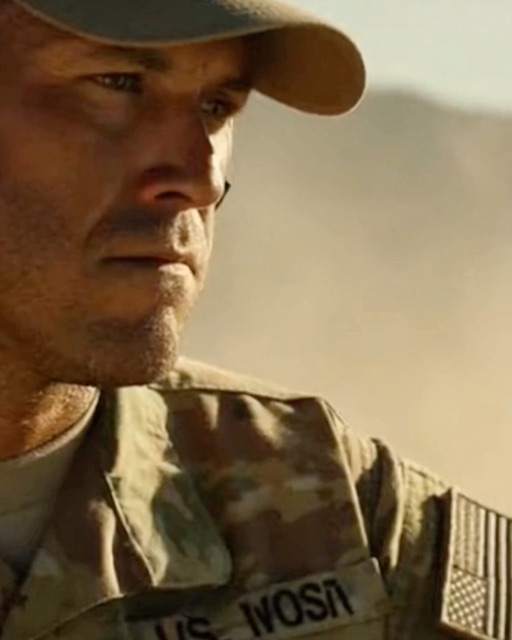
I’m a scout sniper, and last month I logged a 3,200-meter kill in the valley. I didn’t want glory. I just wrote the grid coordinates in my post-mission report and went back to cleaning my rifle.
Yesterday, General Matthews stormed into the armory.
He didn’t yell. He just dropped my logbook onto the metal bench. “The long-range record is 2,400 meters,” he said flatly. “You falsified a combat report. That’s a court-martial.”
My blood ran cold. “It’s not a lie, Sir. My spotter, Gary, confirmed the drop.”
The General’s eyes narrowed. He immediately ordered a public test on the base’s extreme-distance range. Within an hour, half the camp had gathered to watch.
“Prove it,” he snapped, pointing downrange. “Hit the target at 3,200, or pack your bags.”
I settled in behind my Barrett .50. I didn’t argue. I did the math, adjusted for the crosswind, and squeezed the trigger.
Ping. Direct hit.
The crowd of soldiers erupted into cheers, but the General didn’t clap. He froze. The color completely drained from his face.
He wasn’t testing my skill to see if I was lying. He was testing me because he was terrified I was telling the truth.
He grabbed my arm, dragged me away from the crowd into a secure comms tent, and slammed a classified satellite map onto the folding table. He pointed a shaking finger at the exact grid coordinates I had logged for my kill.
My jaw hit the floor. According to the map, that sector wasn’t an enemy compound. It was a black site. A US research and development facility.
The label on the map read: “Project Chimera – Proving Ground 7.”
I looked up from the map, my mind racing. “Sir, I don’t understand. We’ve been engaging hostiles in that valley for six months.”
General Matthews finally looked at me, his face a mask of stone, but his eyes were filled with a deep, unsettling fear. “There are no hostiles in that valley, Sergeant. There never were.”
He took a deep breath, the kind a man takes before confessing something terrible. “That entire deployment… it’s a test. A simulation.”
My world tilted on its axis. The firefights, the close calls, the men we’d lost… my brain refused to process it. “A simulation? Sir, we were taking live fire. I saw men go down.”
“Blanks retrofitted to feel real. Advanced non-lethal munitions,” he said, his voice low and rushed. “Holographic projections. Psych ops. The works. The men you saw ‘go down’ were extracted and told they were wounded.”
I felt sick to my stomach. My entire reality for the last half a year had been an elaborate lie.
“But why?” Gary asked, his voice shaking. He had followed us into the tent, his face as pale as the General’s.
The General ignored him, his focus entirely on me. “The ‘enemy’ you’ve been engaging are next-generation combat drones. Unmanned, AI-driven. We’ve been testing their capabilities against the best soldiers we have, without the soldiers knowing they were just lab rats.”
A cold anger started to replace my confusion. “You used us.”
“It was a necessary deception,” he snapped, though he couldn’t meet my eyes. “But that’s not the problem now. The problem is your shot.”
He pointed back to the map. “Project Chimera is housed inside that mountain. The drones are manufactured, repaired, and controlled from a subterranean facility right under your target zone.”
He traced a line from the grid coordinates. “Your target wasn’t just a drone on patrol. Your shot, at that incredible range and velocity, didn’t just strike its chassis. It penetrated it.”
He paused, letting the weight of his next words sink in. “And it kept going. It hit the primary power conduit for the entire underground complex. You didn’t just log a kill, Sergeant. You shut down a billion-dollar black site.”
Silence filled the tent. The cheers from the range outside seemed like they were from another planet.
“Thirty minutes ago,” the General continued, “we lost all contact with the facility. All data feeds, all comms, all life support monitoring. Everything went dark.”
“What’s in there?” I asked, my voice barely a whisper.
“Technicians. Scientists. A civilian contractor named Peterson who runs the whole damn show,” he said. “And a whole lot of very expensive, very dangerous technology that is now completely offline and unaccounted for.”
He looked from me to Gary, a desperate sort of command in his eyes. “This never happened. Understand? Your report was a typo. The demonstration on the range was a morale booster.”
“And the facility?” Gary asked.
“Officially, a rescue operation can’t be launched for a place that doesn’t exist,” the General stated grimly. “Which is why you two are going in.”
He explained the plan. A clandestine helicopter insertion near the kill zone. We were to go in, assess the damage, and if possible, find a way to reboot the auxiliary power. We would be a two-person ghost team. If we were caught, he would deny everything.
We didn’t have a choice. We were already part of a secret we were never meant to know.
Hours later, Gary and I were rappelling from a blacked-out helicopter into the valley. The place felt completely different. The constant, low hum of drone activity was gone. The air was still, dead. It was the silence of a machine that had been switched off.
“This is creepy,” Gary whispered over the comms, his voice tight. “It feels like the whole world is holding its breath.”
He was right. For months, this valley had been a place of constant threat, of movement in the shadows. Now, it was just rocks and sand, unnervingly peaceful.
We moved toward the coordinates, my rifle feeling heavier than usual. Was I a soldier or a repairman? I didn’t know anymore.
We found the impact site easily. The ground was scorched. Shards of twisted metal, clearly not from any enemy tech I’d ever seen, were scattered around a deep crater.
In the center of the crater was the “target.” It was a humanoid drone, or what was left of it. The .50 caliber round had punched a clean hole through its torso. But behind it, embedded in the rock face of the mountain, was what the General was talking about.
A thick, armored plate, designed to look like the surrounding rock, had been blasted open. Behind it, a bundle of thick, severed cables sparked feebly. My shot had been one in a trillion. It had passed through the drone and hit this one tiny, critical weak point in the mountain’s facade.
“There’s our entry point,” I said, pointing my light into the dark opening.
We squeezed through the gap. We weren’t in a cave. We were in a service tunnel, clean and sterile, lined with conduits and data ports. It was like stepping from the 19th century directly into the 22nd.
The only light came from our headlamps and the faint, red glow of emergency signs down the long corridor. The air was cold and smelled of ozone and burnt electronics.
We moved cautiously, our boots echoing in the metallic silence. We passed laboratories filled with inert robotic limbs, server rooms with endless rows of dead black screens, and workshops where half-assembled drones stood like statues in an artist’s studio.
“The General said there were people in here,” Gary murmured, his voice tight with tension. “Where are they?”
The place was a ghost town. There were no bodies, no signs of a struggle. Just abandoned coffee cups, open schematics on desks, and an overwhelming sense of sudden departure.
We found the primary command center. It was a vast room, dominated by a huge central screen that was now dark. The chairs were empty. A half-eaten sandwich sat on one of the consoles.
I started trying to access the terminals, looking for a way to engage the auxiliary power. Most were dead, but one, running on a battery backup, flickered to life. It was a log file. A security log.
“Gary, get over here,” I said.
The last entry was time-stamped just moments after my shot. It read: “SYSTEM ALERT: EXTERNAL BREACH. CASCADING POWER FAILURE. QUARANTINE PROTOCOL ENGAGED.”
“Quarantine?” Gary asked. “What are they quarantining?”
I scrolled up through the logs. The entries became more and more frantic in the minutes leading up to the power failure. They weren’t about drones. They were about something else.
“Project Chimera isn’t just about drones,” I said, reading from the screen. “That’s just the cover story. The real project… it’s called ‘Subject Alpha’.”
We found a locked medical bay. Gary managed to pry the doors open with a crowbar. What we saw inside made the blood freeze in our veins.
It wasn’t a lab for robots. It was a lab for a man.
There was a reinforced containment chamber in the center of the room. Inside, a figure was strapped to a heavily modified medical chair, connected by thick cables to a massive, dark machine. He was wearing a sleek, black exosuit, the same kind as the “drone” I had shot.
It wasn’t a drone. It was a man in a suit.
My heart hammered against my ribs. The kill I had logged… the shot I was so proud of… I had shot a person.
“No, no, no,” I whispered, backing away.
Gary rushed to a nearby terminal that was also on battery backup. He bypassed the security and pulled up Subject Alpha’s file. The face on the screen was a young man, a soldier. His name was Corporal David Brennan. He was a decorated soldier who had been listed as killed in action two years ago.
According to the logs, he had volunteered for a program to pilot advanced combat suits. But the program, run by the contractor Peterson, was far more sinister. They weren’t just testing a suit; they were trying to merge man and machine. They had him permanently wired into the system, controlling the entire drone army with his thoughts.
He was the queen bee, the central mind. He was the enemy we had been fighting. A single, trapped soldier.
“They lied to everyone,” Gary breathed. “Even the General. He thought they were just drones.”
Suddenly, we heard a noise. The hiss of a hydraulic door opening down the hall. Footsteps.
We killed our lights and ducked behind a bank of servers. A group of men in tactical gear, not military, swept into the room. They were private security. Leading them was a man in a clean, expensive suit.
“The breach is here,” the man in the suit said, his voice cold and precise. “The round pierced the Alpha suit’s power core. It triggered a feedback loop that fried the main grid. Find the auxiliary power switch and get the system back online. I want my asset rebooted.”
This had to be Peterson.
“What about the asset’s memory?” one of the guards asked. “The reboot might clear the control protocols.”
“Then we’ll wipe him and start over,” Peterson said without a hint of emotion. “He’s just a piece of equipment. Now, find the switch. It’s in the main reactor control room.”
They moved past us, heading deeper into the facility.
I looked at Gary, my mind made up. We weren’t here to fix the power. We were here to make sure it stayed off.
“We have to get him out,” I whispered, nodding toward the man in the chair.
We made our way to the containment chamber. The door was sealed electronically. There was no way to open it without power.
“The reactor room,” Gary said. “If we can get there first, maybe we can find a manual release. Or destroy the console completely.”
We moved through the dark corridors, a shadow war against Peterson’s men. We were in their world now, and they knew the layout.
We reached the reactor control room just as they did. A firefight erupted in the narrow hallway. The air filled with the crack of gunfire. These guys were professionals, pinning us down instantly.
We were trapped.
Then, something changed.
A loud, metallic screech echoed from the medical bay down the hall. It was followed by the sound of tearing metal.
One of Peterson’s men yelled into his radio. “Sir! It’s Alpha! He’s… he’s awake! And he’s out of the chair!”
The gunfire from their end stopped. We heard screams. Terrible, terrified screams.
A moment later, a figure emerged from the darkness. It was Corporal Brennan. Or what was left of him. He was still in the damaged exosuit, sparks flying from the hole in its chest. The lights on the suit glowed a menacing red. He moved with an unnatural speed and grace.
Peterson backed away, his face a picture of pure terror. “Alpha! Stand down! That is an order!”
The figure tilted its head, a motion that was both human and utterly alien. A synthesized voice, crackling with static, came from the suit’s helmet. “My designation is David. And you are no longer in command.”
The security team opened fire. The bullets sparked and ricocheted off the black armor, having no effect. In seconds, David dismantled them. He wasn’t killing them; he was disarming and disabling them with terrifying efficiency. He moved like a phantom, a blur of metal and fury.
He cornered Peterson against a wall. “You locked me in a cage,” the static voice said. “You used me. You made me a weapon.”
“It was progress!” Peterson pleaded. “For the good of the country!”
“My country doesn’t turn its soldiers into puppets,” David replied.
He reached out, and with one hand, crushed the rifle Peterson was holding. The contractor crumpled to the floor in fear.
David then turned to us. He slowly walked over, and I raised my rifle, my hands shaking.
He stopped in front of me. He looked at the .50 caliber sniper rifle in my hands.
“You,” the synthesized voice said. “Your shot… it should have killed me. Instead… it severed the connection. It set me free.”
My “impossible” shot hadn’t been a kill shot. It had been a key, unlocking a prison I never knew existed.
Suddenly, the facility’s main lights flickered on. The hum of power returned. General Matthews and a team of Marines stormed into the room, their weapons raised. He must have decided he couldn’t sit back and wait.
He took in the scene: Peterson on the floor, the disabled guards, us, and the impossible figure in the black suit.
“What in God’s name is that?” the General demanded.
I lowered my rifle. “That, Sir, is Corporal David Brennan. And I think he has a hell of a report to make.”
The aftermath was a storm of black-suited officials and classified debriefings. Peterson’s project was exposed, a massive scandal that was quickly buried under layers of national security. He and his cronies disappeared into the clandestine prison system.
General Matthews took a major hit, forced into early retirement for his “lack of oversight.” But before he left, he pulled me aside. “You did the right thing, Sergeant. You saw more than just a target.”
David Brennan was taken into custody, but not as a prisoner. After extensive debriefing and medical evaluation, they managed to safely remove him from the damaged suit. He was a man again, not a machine. He testified against Peterson and was granted a full pardon and a quiet, new identity.
I saw him one last time, in a sterile government building. He was just a normal guy in jeans and a t-shirt, the ghost of the machine gone from his eyes.
He walked up to me and simply said, “Thank you.”
“For what?” I asked. “I almost killed you.”
“No,” he said, a small smile on his face. “You gave me my life back.”
My shot that day wasn’t about range or skill. It wasn’t about breaking a record or proving a point. It taught me that our actions can have ripples we can’t possibly predict. Sometimes, the thing that looks like destruction is actually an act of liberation.
True aim isn’t just about hitting what you’re pointing at. It’s about understanding what you’re trying to achieve. And sometimes, you only find out your true target long after you’ve pulled the trigger.



