“Women like you don’t last out there,” the young Marine smirked, palm heavy on my shoulder. I didn’t flinch. I just looked at his hand until he felt it.
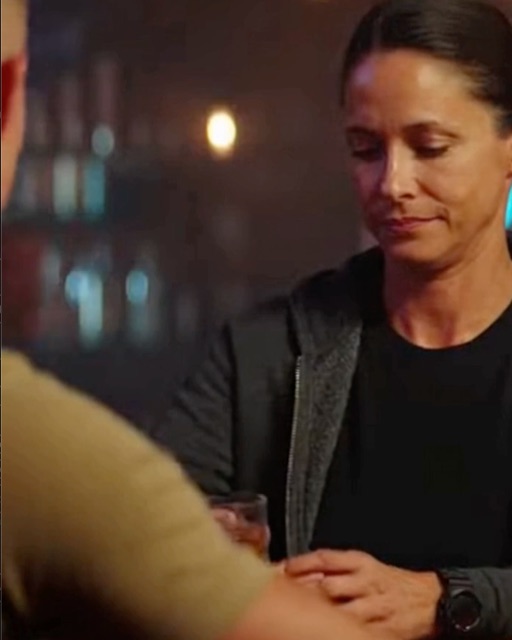
I was trying to be invisible that night – plain jacket, faded jeans, water only – tucked at the far end of a beach-town dive where the floor’s sticky and the neon hums. I needed quiet. I got a lesson.
His buddies snickered. “C’mon, sweetheart, smile.” My jaw locked. The bartender, Trent, watched from the sink, eyes narrowing like he’d seen this movie before.
“Take your hand off,” I said, low.
He squeezed instead. My heart thudded once, hard. The room tilted tighter.
So I reached into my jacket and placed a single card on the bar. No speech. No scene. Just one card.
His laugh died in his throat. Color left his face. He stared at the photo, then at me, then back at the tiny gold emblem in the corner. His hand snapped back like he’d been burned.
Trent went still. The buddies shut up. The Marine straightened, shoulders locked, mouth opening and closing like he forgot how to breathe.
“Ma’am,” he stammered, voice cracking. “I didn’t realize – ”
But when his eyes landed on the single word printed under my photo, he froze and whispered it like a confession.
“Widow.”
The word hung in the stale air, heavy and absolute. It was my name now. It was my rank.
He took a half-step back, then another, his posture shifting from arrogant swagger to ramrod-straight deference. The smirks on his friends’ faces had vanished, replaced by a dawning, uncomfortable shame.
“Ma’am. I… I am so sorry.” His voice was a raw scrape.
I picked up the card, my fingers tracing the worn edges. It was a Gold Star Family identification card. My face, younger by five years and a thousand lifetimes, smiled back from the laminated plastic.
I just nodded. I didn’t have the energy for anger.
Trent slid my glass of water closer. A silent offering of support.
The Marine didn’t leave. He stood there, rooted to the sticky floor, his eyes fixed on the spot on the bar where the card had been. It was like he was seeing a ghost.
“He was…?” he started, but couldn’t finish.
“He was,” I said, answering the unspoken question. “Marine Corps. Captain David Miller.”
Saying his name out loud felt like stirring embers I was trying to let go cold. A flicker of warmth, then the familiar ache.
The young man flinched, a barely perceptible tremor that ran through his entire body. He looked like he’d been struck.
“Captain Miller,” he repeated, his voice barely audible. “From the 2nd Battalion.”
I looked at him then, really looked at him for the first time. He was so young. Barely out of his teens, with a fresh haircut that screamed Parris Island and an ego that hadn’t yet been tempered by real loss.
“You knew him?” I asked, my own voice tight.
“No, ma’am,” he said quickly, shaking his head. “Never. Just… heard the name. He was a legend.”
His friends were shuffling their feet, desperate to melt into the wood-paneled walls. One of them nudged his arm.
“We should go, Michael,” he muttered.
The Marine, Michael, didn’t move. He just kept looking at me with an expression I couldn’t quite decipher. It was more than just shame. It was something deeper. Something broken.
Finally, he gave a stiff, formal nod. “My deepest condolences for your loss, ma’am. There’s no excuse for my behavior.”
Then he turned and walked out, his friends trailing behind him like chastised children. The bar felt cavernous in their absence.
Trent came over, wiping the counter with a clean rag. “You okay, Sarah?”
I managed a weak smile. “Define okay, Trent.”
He grunted. “Fair enough. That kid looked like he’d seen a firing squad.”
I stared at my reflection in the polished bar top. The woman looking back at me was tired. Her eyes held a story I didn’t want to tell anymore.
Five years ago, I was Sarah Miller. I was a wife. I was a planner of futures, a painter of walls, a keeper of promises.
Now, I was just a widow. A title given to me by a war I never fought in and a country I still tried to love.
David used to say that strength wasn’t about how hard you could hit, but how hard you could get hit and keep moving forward. I was moving. But forward felt a lot like standing still.
This town, this bar, it was our place. We’d come here the night before he deployed for the last time. He’d sat right where Michael had stood, his hand over mine on the worn-out wood.
“I’ll be back before the paint on the nursery walls is even dry,” he’d promised, his voice full of the unshakeable confidence that made him a leader.
The nursery walls were still a pale, hopeful yellow. They’d stayed that way for five years.
I finished my water, left a ten on the bar for Trent, and stepped out into the cool, salty air. I expected to feel relief. Instead, I felt a profound sense of unease.
The way that young Marine, Michael, had looked at me. It wasn’t just a soldier recognizing the family of the fallen. It was personal.
I tried to shake it off as I drove home to my too-quiet house. It was just a bad night. A reminder of a world I no longer belonged to.
Two days later, there was a knock on my door.
I wasn’t expecting anyone. My life had shrunk down to my work-from-home job, the grocery store, and the occasional quiet night at the end of Trent’s bar.
I looked through the peephole and my stomach dropped. It was him. Michael.
He wasn’t in uniform. He wore jeans and a plain grey hoodie, but he stood with that same rigid posture. He looked younger in the daylight, and more scared.
I opened the door a crack. “What do you want?”
“Ma’am,” he said, his eyes on his shoes. “I know I have no right to be here. But I couldn’t… I needed to apologize properly.”
He was holding a small, potted orchid. Its purple flowers were vibrant and perfect. David had always brought me orchids.
My heart ached. “You apologized at the bar.”
“That wasn’t enough,” he said, finally meeting my gaze. His eyes were red-rimmed. “What I said… it was disrespectful. Not just to you, but to his memory. To everything he stood for.”
Something in his voice made me open the door a little wider. This wasn’t the arrogant kid from the bar. This was someone else entirely.
“How do you even know where I live?” I asked, suspicion creeping in.
“I asked the bartender, Trent,” he admitted. “Told him I was a Marine who served with your husband. It was a lie, ma’am. I’m sorry for that, too. I just… I had to.”
Against my better judgment, I let out a sigh. “Come in.”
He stepped inside, looking around the small living room like it was a museum. His eyes lingered on the mantelpiece, on the framed photo of David in his dress blues, his smile so wide it crinkled the corners of his eyes.
“Please, sit,” I said, motioning to the armchair.
He sat on the edge of the cushion, ramrod straight, the orchid still clutched in his hands.
An awkward silence stretched between us. I didn’t know what to say. He clearly had something on his mind, something more than just an apology.
“You’re wrestling with something, Corporal,” I said, using the rank I’d guessed from his age and demeanor.
His head snapped up in surprise. “It’s Lance Corporal, ma’am. And… yes. I am.”
He took a deep breath. “When I saw your card, when you said his name… Captain Miller. He was my CO’s CO on my first tour. The man who trained the officer who led my platoon.”
Now it made a little more sense. The legacy of a good officer runs deep.
“He was a good man,” I said softly.
“Everyone said so,” Michael agreed. “They said he was the kind of leader you’d follow into hell. That he cared about his men more than anything.”
He paused, swallowing hard. “We lost our platoon sergeant a few months ago. Sergeant Evans. He… he stepped on an IED. Saved three of us.”
The story was painfully familiar. A different man, a different patch of dirt, but the same ending.
“I’m sorry,” I said, and I meant it.
“He had a wife,” Michael continued, his voice cracking. “A little girl. I was supposed to write a letter to her. I’ve been carrying the paper for two months and I can’t… I can’t write a single word.”
He looked up at me, his eyes pleading. “How do you do it? How do you live with it? I’ve been so angry. Lashing out. Picking fights. Acting like a stupid kid at a bar. I see his face every time I close my eyes. And all I can think about is his little girl without a dad.”
And there it was. The real reason he was here. He wasn’t looking for forgiveness. He was looking for a map.
He saw my Gold Star card and thought I had the answers. He thought I knew the secret to surviving the unsurvivable.
“There is no secret,” I told him, my voice gentle. “You just… do. You breathe in. You breathe out. You get up in the morning. And you try to honor the life they lived.”
I told him about David. About his terrible jokes and the way he’d hum off-key when he was cooking. I told him about the promise of the pale yellow nursery.
He listened, his rigid posture slowly softening. He told me about Sergeant Evans, about his booming laugh and his obsession with ridiculously spicy hot sauce.
We talked for two hours. Two strangers, bound by a grief that wore different uniforms but had the same hollow core.
As he was about to leave, he finally placed the orchid on my coffee table.
“Thank you, ma’am,” he said. “This… this helped more than you know.”
“Call me Sarah,” I said. “And you can call me if you ever need to talk again.”
I thought that would be the end of it. A strange, cathartic meeting that would fade into a memory.
But a week later, he called. He’d finally written the letter to Sergeant Evans’s widow. He read it to me over the phone. It was simple, heartfelt, and beautiful.
After that, we fell into an unlikely friendship. We’d meet for coffee sometimes. He’d tell me about the challenges of leading his fire team, and I’d offer what little wisdom I had, gleaned from years of listening to David.
I was helping him, but he was helping me, too. He was pulling me out of the quiet house, out of the past. He was a link to the world David had loved, a world of brotherhood and sacrifice that I had only ever seen from the outside.
One afternoon, we were sitting on a bench by the ocean, watching the waves roll in.
“You know,” Michael said, staring out at the horizon. “There’s something I never told you about the day we lost Sergeant Evans.”
I waited, a knot of apprehension tightening in my stomach.
“The IED that got him… it was a secondary. There was a first one, a smaller one, that went off down the road. It was meant to draw us in. The big one was buried right in the middle of the path, where they knew we’d take cover.”
He turned to me. “We were on a joint patrol that day. With another unit providing overwatch. The call came over the radio, from their commander, warning us. He’d spotted the disturbed earth from his vantage point. He screamed at us to get back.”
Michael’s voice dropped to a whisper. “His warning saved my entire squad. All of us. Except for Sergeant Evans, who was at the front. The commander’s call gave Evans just enough time to turn and shield the man behind him.”
He looked down at his hands. “I never knew the commander’s name. It was all chaos. But his voice… I’ll never forget it. It saved my life.”
A cold dread, sharp and sudden, washed over me. “When was this, Michael? What was the date?”
He told me the date.
February 12th.
The day David died.
My blood ran cold. I felt like I couldn’t breathe. “The commander,” I said, my voice a strangled whisper. “Did you ever find out who he was?”
“No,” Michael said, looking at me with concern. “They were med-evaced out right after. We never got the chance. Why?”
I couldn’t speak. I just stood up and started walking numbly toward my car.
“Sarah? What is it?” he called after me.
I drove home in a daze, my hands shaking on the steering wheel. It couldn’t be. It was too impossible. A one-in-a-million coincidence.
Back in my quiet house, I went to the closet. In the back, on the top shelf, was a sealed box. It held David’s personal effects. The things they’d sent home from that dusty, faraway place.
I hadn’t opened it in five years.
With trembling fingers, I broke the seal. Inside, beneath his folded flag, was a stack of letters held together by a rubber band. His last letters to me. I had read them all.
Except for one.
It was in a separate, sealed envelope, marked “Just in case.” His last letter. The one you pray you never have to read. I’d never been able to bring myself to open it.
Now, I had to.
My hands shook so badly I could barely tear the paper. I unfolded the single sheet inside. David’s familiar, strong handwriting filled the page.
“My Sarah,” it began. “If you’re reading this, it means I didn’t keep my promise. And for that, I am more sorry than you will ever know. Don’t you dare be sad for too long. Paint that nursery blue or pink. Fill this house with laughter. Live a life big enough for the both of us.”
I choked back a sob and kept reading. The last paragraph was about his final day.
“It’s been a strange day, my love. We were providing overwatch for a young platoon from the 2nd. Good kids, but green. We spotted something… a trap. I got on the radio, tried to warn them. I hope it was in time. There’s one kid in particular, a Lance Corporal with more swagger than sense. Reminds me of me at that age. I hope he gets home safe.”
My eyes scanned the last line, the words blurring through my tears.
“I pushed him to live a long life. I hope he does. Tell him, if you ever meet him, that Captain Miller said to make it count. His name is Russo. Michael Russo.”
The letter slipped from my fingers.
The man who had mocked my weakness, the boy whose life I was helping to put back together, was the last person my husband had saved. David’s final act on this earth was to give his own life to save the young man who, five years later, would walk into my life.
I met Michael the next day at the same bench by the sea.
I didn’t say anything at first. I just handed him the letter.
He read it, his face paling. He read it again, his hands starting to shake. When he looked up at me, his eyes were filled with a storm of disbelief, grief, and dawning, gut-wrenching understanding.
“It was him,” he whispered. “The voice on the radio. It was your husband.”
I just nodded, tears streaming down my face.
“He saved me,” Michael said, his voice breaking completely. He buried his face in his hands and sobbed, his whole body shaking with the weight of a five-year-old debt he never knew he owed.
I sat beside him, putting a hand on his back. And in that shared moment of impossible grief and unbelievable connection, something shifted inside me.
The emptiness that had been my constant companion for five years was suddenly filled with a profound sense of purpose. David’s sacrifice wasn’t an ending. It was a beginning. It was a legacy that was sitting right next to me, breathing and alive.
Months turned into a year. Michael reenlisted, but he was a different man. The swagger was gone, replaced by a quiet, steady confidence. The confidence of a man who knew the value of a second chance. He became a leader, the kind of man David would have been proud of.
He never called me Ma’am or Sarah again. He called me family.
And I finally painted the nursery. I painted it a bright, hopeful shade of sky blue. It wasn’t a room for a baby anymore. It was a room for me. A place to paint, to read, to start my own next chapter.
Strength isn’t about the armor you wear or the loudness of your voice. It’s not about never getting knocked down. True strength is found in the quiet spaces, in the enduring love for those we’ve lost, and in the grace we show to those who are still finding their way. It’s about understanding that sometimes, the greatest sacrifices don’t create endings; they create new, unexpected, and beautiful beginnings.