
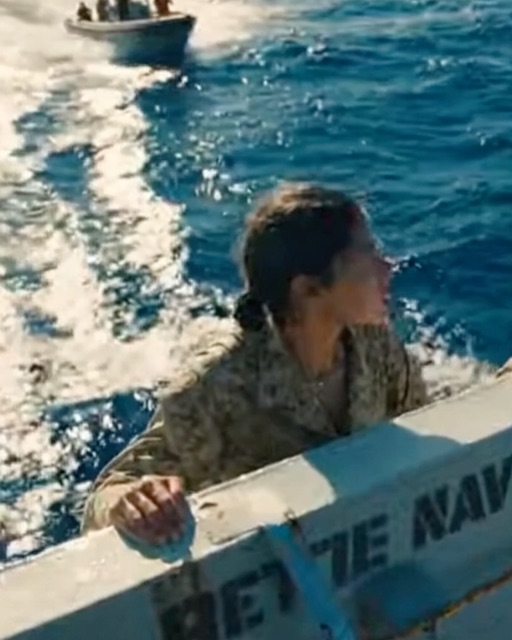
“Don’t give her too much water at once,” a gruff voice said.
I was shaking so hard my teeth felt loose. My skin was raw from 72 hours of salt, sun, and pure terror. When the crew of the commercial fishing boat pulled me out of the Pacific at 4:00 a.m., they expected me to be dead.
Honestly, so did I.
Three days ago, my husband Travis and I were on our anniversary sailing trip. The water was rough. I slipped on the wet deck. I screamed as I fell over the railing, watching Travis rush to the edge.
But he didn’t throw the life ring. He didn’t turn the wheel. He just stood there, perfectly still, watching me drift away as the boat sped off into the fog.
I survived by clinging to a half-submerged cooler lid. I drank rainwater. I hallucinated. I refused to die.
Now, wrapped in three thermal blankets in the galley of the rescue boat, the captain, an older man named Gary, handed me a mug of warm broth.
“You’re a miracle, lady,” Gary said gently. “We got a radio signal out to the Coast Guard. We also looked up your husband on Facebook to message him that you’re safe. Poor guy has been posting nonstop.”
My blood ran cold. Travis? Posting about me?
Gary smiled sympathetically and turned his laptop around so I could see the screen. “He just put up an update an hour ago. He must be out of his mind with grief.”
My hands trembled as I grabbed the laptop. I expected to see a fake, tear-stained video playing the role of the devastated widower.
But there was no crying.
And it wasn’t a memorial post.
I stared at the screen, my stomach dropping into a bottomless pit. The caption read: “Tragedy showed me how short life is. Time to start our forever.”
But when I looked at the photo attached to the post, I finally realized why he didn’t throw the life ring, and I recognized the woman he was holding in the photo. It was my sister.
My little sister, Sarah.
The broth in my mug sloshed over my numb fingers. I didn’t even feel the heat. My mind was a blank, white noise of shock.
It wasn’t just a new photo of them together, celebrating their sick victory. It was an old one. I recognized the background, the soft glow of the lights at our parents’ vineyard. It was from last Christmas.
They were standing close, his arm possessively around her waist, her head tilted onto his shoulder. At the time, I had seen it as a sweet, brother-in-law, sister-in-law moment. Now, I saw the truth.
I saw the way his thumb was caressing her hip. I saw the proprietary look in his eyes, a look I once thought was reserved for me. I saw the secret smile playing on Sarah’s lips.
They hadn’t just decided to be together after I was gone. This had been going on for a long time. This wasn’t a crime of opportunity.
It was premeditated murder.
My grief for the man I loved was instantly cauterized by a cold, sharp-edged fury. The woman shivering in the thermal blankets began to disappear, replaced by someone else. Someone harder.
“Are you alright, ma’am?” Gary asked, his brow furrowed with concern.
I looked up from the screen, my face a mask. I had to be smart. Travis thought I was dead. Sarah thought I was dead. This was my only advantage.
“I think… I think the shock is just hitting me,” I whispered, letting a tear slide down my cheek. I had to play the part of the grieving, confused wife.
The Coast Guard helicopter arrived an hour later, airlifting me to a hospital on the mainland. As I was strapped into the gurney, I gave Gary a weak but grateful smile. He had no idea he’d saved my life in more ways than one.
In the emergency room, doctors and nurses swarmed me, checking my vitals, treating my severe dehydration and exposure. A kind-faced detective named Miller was waiting to take my statement.
I told him a story. It was mostly the truth. The rough seas, the fall, the terror of being lost.
But I left out the most important part. I described Travis’s “frantic” attempts to reach for me, how the boat was “uncontrollable” in the storm. I painted myself as the victim of a tragic accident.
Detective Miller listened patiently, his eyes full of pity. “Your husband has been organizing search parties up and down the coast,” he said softly. “He’s been working with us around the clock. He’ll be so relieved.”
Of course he was. It was the perfect cover. The distraught husband, moving heaven and earth to find the wife he’d already condemned to the depths.
I was discharged from the hospital after two days. The media was in a frenzy. The “Miracle Woman of the Pacific.” I refused all interviews. I let the authorities release a statement that I was recovering in seclusion and asked for privacy.
Travis and Sarah thought “in seclusion” meant I was in a trauma ward, heavily medicated and broken. They didn’t know I was holed up in a tiny, pre-paid motel room sixty miles up the coast, living on coffee and toast.
I used the motel’s slow computer to watch the news. There he was, Travis, on the steps of our beautiful home, his arm around Sarah. Her face was a perfect portrait of sorrow.
“We never gave up hope,” Travis said, his voice cracking for the cameras. “But now… now we have to face the unthinkable. My wife, my beautiful Anna, is gone.”
He called me Anna. I hated that name. I always went by Annie. It was such a small, telling detail. He was mourning a version of me that he had created, not the woman he actually knew.
Sarah, ever the supportive sister, chimed in. “Annie was the light of our family. I don’t know how we’ll go on without her.” The hypocrisy was so profound it was almost artistic.
They were building a narrative, a public performance of grief to shield them from any suspicion. They were counting on my body never being found. My miraculous survival had thrown a wrench in their plans, but they were adapting quickly.
Now they were waiting. They were waiting for me to be declared legally dead. Waiting for the life insurance policy to pay out. Five million dollars.
That was my worth to him. Five million, and a life with my sister.
I knew my word against theirs would be a battlefield. They would paint me as delusional, my mind fractured by the trauma. They would say my accusations were the ramblings of a woman unhinged by her near-death experience.
I needed more than my story. I needed proof.
And then, in the sterile quiet of that cheap motel room, I remembered. It came to me in a flash, a detail buried under layers of shock and terror.
The camera.
For our anniversary, I had bought a tiny, waterproof action camera. My plan was to make a time-lapse video of our trip, a romantic little movie of us against the backdrop of the ocean.
I had mounted it high on the mast, pointing down at the deck, to get a wide, sweeping shot. I’d set it to record and then, in the chaos of the storm, I had completely forgotten about it.
It was still there. It had to be. It had recorded everything. Travis standing there. His stillness. His choice.
The boat, The Serenity, had been towed to an impound lot at the marina. It was evidence in a Coast Guard investigation. Getting to it would be next to impossible.
I had to try.
I used a pre-paid phone to call the local police department, asking for Detective Miller. I deepened my voice, made it raspy and weak. I was the grieving widow, the miracle survivor.
“Detective,” I started, “I know this is an unusual request. But there are some sentimental items on the boat. A locket my grandmother gave me. It was in the cabin.”
I was banking on his pity. “I just… I need something of hers to hold on to,” I sobbed into the phone.
There was a pause. “Normally, we can’t allow that until the investigation is closed,” he said hesitantly. “But given the circumstances… I’ll escort you myself. Would tomorrow morning work?”
It was a colossal risk. But it was my only chance.
The next morning, I disguised myself. I wore a floppy hat, big sunglasses, and clothes I’d bought at a thrift store. I looked like a different person. Fragile. Beaten down.
Detective Miller met me at the gates of the impound yard. He was kind, respectful, keeping his distance. “We’ll be quick,” he assured me.
Walking onto that boat was like stepping back into a nightmare. The deck was still stained with salt. I could almost feel the phantom spray of the waves. My heart hammered against my ribs.
I went into the cabin first to sell the lie. I fumbled around for a few minutes, pretending to search, before pocketing a cheap necklace I’d left in a drawer.
“Okay,” I said, my voice trembling. “I have it.”
My eyes darted up to the mast. There it was. A tiny black square, almost invisible against the rigging.
“There’s one more thing,” I said, pointing up. “My husband… he set that camera up to film the dolphins. It seems silly now, but… the last footage of us.”
Miller’s expression softened even more. “Of course. Let me help you.”
He helped me unclip it. My fingers trembled so badly I could barely hold it. The small plastic housing felt like the heaviest thing in the world. It held my life, and their lies, in its memory.
Back in the motel, I used a cheap card reader to plug the SD card into the laptop. I held my breath as the file directory loaded. There was only one video file, four hours long.
I clicked play.
The video was shaky from the storm. It showed me and Travis on the deck, me laughing at something he said. It was a ghost of a happy memory.
Then I saw myself slip. I saw my body cartwheel over the side. The splash.
I watched Travis run to the railing. And then he stopped. He just stood there. The camera was high enough to capture his face perfectly. There was no panic. No fear.
There was only a cold, chilling stillness. He watched the spot where I had disappeared for a full minute. Then, he slowly straightened up, took a deep breath, and turned the boat slightly, aiming it directly away from me and into the vast, empty ocean.
He didn’t even look back.
The proof was undeniable. It was colder and more damning than I could have ever imagined.
My first instinct was to run to the police, to slap the laptop down on Detective Miller’s desk. But that felt too easy for them. Their betrayal was public, a performance for the whole world to see.
Their downfall had to be just as public.
Travis and Sarah had scheduled a “memorial service” for me for the following Saturday. According to a fawning local news article, it was to be a “celebration of life,” held at a beautiful seaside event hall. They were going to eulogize me in front of all our friends and family.
It was the perfect stage.
I spent the next two days planning. I edited the video down to the crucial two minutes. The fall, Travis watching me disappear, and him calmly sailing away.
I uploaded the file to a cloud service. Then I made another phone call, this time to Gary, the fisherman who had saved me. I told him everything. He was silent for a long time, then he simply said, “What do you need me to do?”
Saturday arrived. The event hall was packed. I watched from a live news feed on my laptop. I saw my parents, their faces etched with real grief. I saw my friends, all of them fooled.
Then I saw Travis and Sarah take the stage, hand in hand. They looked the part. Somber, elegant, united in their “loss.”
Travis stepped up to the podium. A large screen behind him displayed a smiling photo of me.
“Annie was my world,” he began, his voice thick with fake emotion. “She was the sea and the sky to me. The day I lost her to the ocean was the day the light went out of my life.”
He went on for ten minutes, spinning a web of beautiful lies. Sarah wept silently into a handkerchief in the front row. It was a masterpiece of deception.
As he reached his crescendo, “And though she is gone, her spirit will forever sail on in our hearts…,” I sent a text message to Gary.
“Now.”
Back in the hall, as Travis paused for a dramatic, tearful breath, the photo of me on the screen behind him flickered. It was replaced by the shaky footage from the boat’s mast.
The crowd murmured in confusion. Travis turned, his face paling.
They all watched it. They saw me fall. They saw Travis run to the edge. And they saw him stop. They saw him watch me drown.
A collective gasp sucked the air out of the room. It was followed by a horrified silence, broken only by a single, piercing scream from my mother.
Travis and Sarah were frozen, their faces masks of pure, unadulterated terror. The world they had built had just crumbled to dust around them in high definition.
At that exact moment, the main doors of the event hall swung open.
And I walked in.
I wasn’t wearing a floppy hat or thrift store clothes anymore. I was wearing my favorite dress, my hair was done, and I stood tall. Beside me were two uniformed police officers.
The sight of me, alive and very real, was a bigger shock than the video. I was a ghost returned from the sea to claim her justice.
I never looked at Travis or Sarah. I just looked at my parents, letting them see that I was okay.
The rest was a blur of police action, of shouting and crying. Travis and Sarah didn’t resist. They were led away in handcuffs, their public performance finally over.
The trial was short. The video was the only witness the prosecution needed. They were both found guilty of conspiracy and attempted murder. They’ll be in prison for a very long time.
The five-million-dollar insurance policy was, of course, never paid.
I sold the house, the boat, everything that tied me to that life. I moved to a small town in the mountains, a thousand miles from the ocean.
People say that what I did was about revenge. But it wasn’t. Revenge is a bitter, angry thing. What I did was about truth.
For three days, I floated on a merciless ocean, fighting to survive. I thought the waves and the cold and the sharks were the monsters I had to beat. But I was wrong. The real monsters are the ones who look you in the eyes and tell you they love you.
My survival wasn’t a miracle. It was a choice. I chose to live, I chose to fight, and I chose to expose the truth. I learned that the greatest strength isn’t found in holding on to what you’ve lost, but in letting it go and finding the power to save yourself.



