“SHE WAS SENT TO DROP A WARLORD – THEN HER SCOPE FOUND A GHOST
“Who’s she targeting?”
Our SEAL commander, Derek Navarro, didn’t ask because he doubted me. He asked because even our comms chief sounded rattled, staring into Peek Valley like it could stare back.
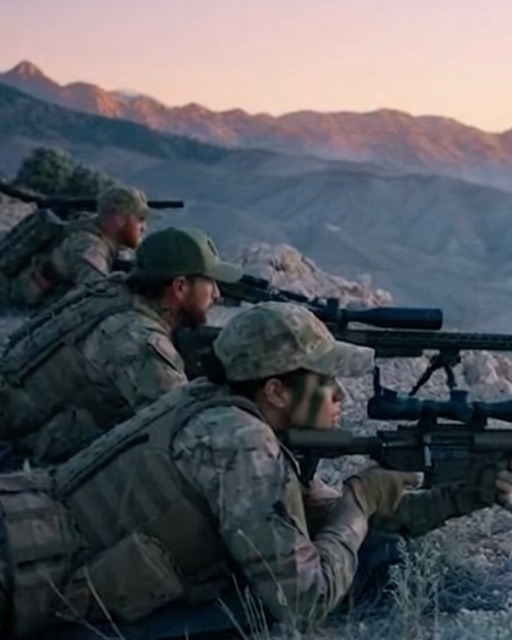
We were after one man: Farid Daryani. First light. Broken stone outpost. Layers of guards. No sane shot.
I’m Mara “Thorne” Caldwell. Navy JTAC now. Marine scout sniper before that. Patience is my spine.
I cracked open my battered case. My grandfather’s bolt-action lay inside, his notebook sliding against oiled wood. One line underlined twice: “The hardest shot is the one you choose not to take.”
We crawled into the hide while the valley cooked itself into a mirage. Winds kept twitching like a lie detector. I read dust swirls, bird wings, heat waves. Every second, a tiny math problem solved in my gut.
Daryani stepped out.
I settled on his chest.
Then I froze.
Not on him. On a ripple of shadow high on the opposite ridge – too still, too patient, watching us watch them.
“A second shooter,” I whispered.
Navarro’s breath caught. Intel had muttered about a ghost: “Pale Wolf.” An American once. Hired by the enemy now. The kind who made distances feel short.
“Can you take him?” Navarro asked, barely more air than words.
I made one click. Then another. Then nothing. Waiting for the valley to blink.
Seconds stretched until my heartbeat felt like a metronome I couldn’t ignore.
When I finally touched the trigger, the rifle didn’t roar. It exhaled.
I wasn’t aiming at Daryani anymore – because when the glare slid off the other sniper’s scope, I saw the initials carved into the stock he was holding.
They were mine.
Not my name, not spelled out, just the three letters I cut into the polymer on a humid evening after brand-new ordnance finally felt like it belonged to me. MTC.
My stomach dropped like the earth missing a step. My M40 had gone missing two years back after a river ambush that should’ve killed us all.
I stared through the heat shimmer at my own initials peeking from a rifle cradled by the man they called Pale Wolf.
“Do not fire,” I said, and my mouth was dry like I’d swallowed chalk.
Navarro shifted beside me and didn’t hide the edge in his voice. “Say again?”
“Do not fire,” I repeated, and lifted my cheek a whisper off the stock to breathe. “I know his rifle.”
“You know his rifle?” Navarro said, and I heard him suck in a curse and then swallow it back down.
“I know my rifle,” I said. “That’s mine in his hands.”
For a second the wind stalled and the whole valley went quiet, and the chance to take Daryani slid by like foam on water.
The man in the courtyard breathed and turned away, small and soft beside all the concrete.
“Navarro, scope that far ridge at my bearing,” I said, slow and even. “Look for sun on glass and a notch of ruin shaped like two fingertips.”
Navarro’s breathing steadied while he searched, then I felt him tense like a wire.
“Got him,” he said. “That’s a right-handed hold. White scarf. He’s not looking at Daryani.”
“He’s looking at us,” I said. “And he’s talking.”
A moth jumped, and that was what the dust looked like through ten power as the ghost tapped the toe of his boot against a stone and sent a tiny puff to the left.
It was either nothing or code, but I remembered being a kid on my grandfather’s porch with a pair of battered binoculars and a field guide to the world. He taught me that animals send messages without words.
He had tapped the porch rail sometimes in the evenings and made me watch the way the field changed. “Don’t stare at the target,” he’d say. “Stare at how the target lives.”
The ghost tapped the stone again. Left. Pause. Two short. Right.
“Does that mean anything to you?” Navarro asked, and he relaxed a hair, almost like he could feel the memory too.
“It’s a count,” I said. “Or a yes-no. Or he’s mocking us.”
“Take a shot or call it, Thorne,” Navarro said, but the warning in his voice was soft, like he trusted me even when I didn’t trust myself.
I found Daryani again in my glass and the man still had a chest that rose and fell, still had a mouth that drank tea, still had guards who looked bored enough to miss a hawk drifting by if it carried iron.
The ghost tapped his boot one more time, then gently pulled his muzzle down and laid his cheek on the stock like a man laying a head on a pillow.
He wasn’t aiming at Daryani anymore either.
“Navarro, he’s telling us to hold,” I said. “He could be baiting a counter-sniper.”
“Or he’s lining up on me,” Navarro muttered, but I felt him smile from the corner of his mouth because it started to feel like somebody else besides us could read a storm.
“Give me thirty seconds,” I said, and I thumbed my push-to-talk like it had a pulse.
Our comms chief, Harrigan, coughed a dry cough in my ear. “Been better openings, Thorne.”
“Stand by,” I said. “We got a wild card.”
My left hand stayed afloat on the stock and I pulled my eye off the world just long enough to check the old field notebook that rode in the case beside my rifle.
It wasn’t a magic book. It was just a pocket of notes and numbers and the way my grandfather wrote like he was writing to me across a table I wouldn’t sit at for years.
On the inside of the back cover, there was a small map of Peek Valley penciled with squinting care. He’d hunted there once with the Rangers before I was born.
He’d written next to a taper in the rock: “False mouth, west. Watch the shadow. It keeps secrets at midday.”
The ridge the ghost was on lay like a sleeping animal, its spine a scatter of rocks and its ribs cut by the same narrow throat that pushed wind into everything.
“I need a feed from Raven,” I said, and Harrigan grumbled and sent a drone to the south arc with the slow grace that comes when short range can save lives.
The screen at his chest blinked and then painted a low-resolution kindness of the valley, lines and shapes and something that looked like breath against stone.
The drone buzzed gentler than a bee and carried the same fear of being swatted.
It rolled its camera across the far ridge, past the white scarf, past a side cut in the rock that didn’t look like much at all unless you had held your thumb against that shape once in a black-and-white photo and been told it kept secrets at midday.
“Harrigan,” I said, and he kept the camera planted there because maybe he could feel my spine get ready, “push five degrees left.”
There was a tarp tucked under the ledge, weathered gray and stitched with dirt, and it wasn’t the tarp itself that mattered.
It was the little shape under it that looked like it had a copper wire running out and a stubby antenna pointing at the sky.
“You got it?” I whispered.
“Repeater,” Harrigan said, and now he swore out loud. “That’s not theirs. That’s ours.”
“Which means somebody’s listening on our side,” Navarro said, and a quiet grew where his patience usually lived.
The ghost lifted one hand off his rifle and fluttered his fingers twice, like a teacher who wanted two of something.
“Two watchers,” I said. “Not counting him.”
Daryani raised his cup again and laughed at something small in the courtyard. A goat bleated like a punchline.
My breath came back to me in pieces that fit my lungs again.
“Navarro,” I said, “Daryani’s a decoy.”
Navarro did not argue. He did not need me to say how I knew. He already knew it too.
“Scale back,” he told Harrigan. “Kill the repeater if you can, close to the bone, no thunder.”
Harrigan muttered and then smiled because that was what he liked to do with a problem. “A whisper, boss.”
The drone drifted to the thermal image of a square of metal no bigger than a paperback and snapped its little charge like a mouse trap.
The repeater hiccupped and died, and I felt something like a weight lift off the back of my neck.
The ghost rolled his head, careful and small, and put his scope on the sky like he was watching a hawk no one else had noticed.
He slid a small mirror from his sleeve and blinked it once.
I thought of training, of the way sunlight can carry a sentence across a mile better than a radio when bad ears tuck in close to hear.
He blinked left, then right, then left-left, then held.
I didn’t know the code. He didn’t know me. But language is more than letters and you can tell a man’s voice by the way he looks at the world.
He was saying not yet.
He was saying do not take the easy shot and miss the larger thing.
“Boss,” Harrigan murmured into the net, “possible heat signature north of the outpost, along the dry wash. Bigger than a dog, cooler than a truck.”
Navarro settled even lower and put a slow smile on his voice like he’d been waiting to like this day.
“Follow it,” he said. “Thorne, hold that overwatch. We move at your call.”
The ghost adjusted one click the same way I had and then did nothing, like the patience he carried was older even than mine.
The dry wash bent like a question mark and the thermal smear dragged two more behind it, a caravan no one was supposed to see.
A tarp. A litter. A metal box I knew from a mile away because you can’t forget the hum of a portable dialysis unit once you’ve heard it in a dust-frothed clinic.
Daryani’s kidneys had been the subject of a rumor tied to an old injury and the rumor was holding its breath under that tarp like it didn’t want to be seen.
“Navarro,” I whispered, “shadow convoy. East cut. Slope road.”
Navarro didn’t ask if I was sure. He just started to move.
“Zigzag,” he told the team, his voice a rope we could all hold, “use the basalt shelves like friends, and don’t kick the green rocks, they talk too loud.”
I watched the ghost watch the same thing and for a second it felt like I was looking at a reflection of myself in a window at night.
We both had our cheekbone print in the same place on the stock. We both breathed small.
He slid his hand toward the trigger and then away, not committing yet, and I knew he felt the old lesson moving under the skin of the day.
We didn’t choose the hard shot. We let it find us.
Harrigan’s drone hiccupped and then came back, and I could tell by the sound in his throat he liked what he saw.
“Movement on the ridge line above the wash,” he said. “Two more, maybe three. Tall, thin, ridgewalkers.”
“Not ours,” Navarro said, and his hand made a fist small enough to hold where we were all going.
The ghost rolled to his right, saw them too, and flattened like a heartbeat going soft.
“Permission to shoot,” I said. “Not at Daryani. At the tall one on the left.”
Navarro breathed once, in and out. “Do it.”
I slid the crosshairs until the ridgewalker’s shoulder filled with their easy angle, then I decided not to put a hole in that shoulder.
I kissed the rock two inches left of his eye with a 175-grain whisper and watched him startle backward like a man walking out of a dream into a doorframe.
He didn’t die. But he believed in God again and he pulled back from the lip where his next choice would’ve been to drop on top of my team.
The ghost saw the same thing and tapped his stone once, twice, in a rhythm that sounded like approval.
Another ridgewalker lifted a hand, looking for the shot. The ghost breathed out one note, and the man’s radio exploded in a red mist of steel and shame.
We both made noise in the valley now, but it wasn’t the kind that draws mortars. It was the kind that sounds like fate.
The caravan in the wash picked up speed, panicked like startled deer, and the litter bearer stumbled and went to one knee.
The tarp fluttered and the metal box hummed its tiny awful hum.
“Navarro,” I said, and my voice felt like it had teeth, “we got him in the wash.”
Navarro let a small prayer die in the back of his mouth where he kept other small things he didn’t show. “Winchester, move.”
They tilted into the ravine with the angles of men who had learned to walk like water, and I kept the world still for them.
The ghost and I pinned the ridgewalkers back while the team closed like night.
For one stupid second I wanted to swing my muzzle at the ghost and end the whisper of legend with a hard fact, the way a surgeon sometimes longs to just pull and be done.
But the letters on his stock held me, and the old book in my pocket said don’t.
“Thorne,” Navarro breathed, deeper now, “we’re at the wash.”
A hail of angry stone spat by IED went up twenty yards to their left and showered them with prickly dust, and I felt my throat open to shout.
Before I could, the ghost’s rifle banged and a thread of det cord tucked near a broken thorn bush snapped loose and lay down like a snake deciding not to strike.
He had taken a shot I couldn’t see from my angle and cut a vein in the earth in a way only someone who knew that ground too well would know.
I wanted to ask him how. I wanted to ask him who had taught him where to place the rounds to make a wire forget it was useful.
He didn’t answer because he couldn’t hear the questions, but we still spoke.
Down in the wash Navarro and his two fastest men hit the litter like a bad idea that had been waiting to trip, and the tarp flew back like a curtain.
Daryani was smaller in person than war makes people on paper. He had pale lips and hooked fingers and an IV taped badly to a bruised arm.
He screamed when Navarro’s medic broke the tape and then stopped, either because he passed out or because he remembered he was not a king in that second.
“Package,” Navarro said, which was the clean way to say we had a man who had paid people to die for him and now he would have to live for a while instead.
“Extract,” I said, and my mouth had more in it to say but I didn’t have breath for it all.
Ridgewalkers darted and popped like fish in a bucket and the ghost kept them in with little flicks of sound.
We pulled the team back, slow enough not to look scared, fast enough to not let courage get us killed, and the world got smaller and closer as the dust rose to make it kind.
When their boots found the shelf below me, Navarro looked up and gave me a smile I had never seen him give anyone except his daughter in the photos he looked at when he thought no one else was watching.
“We got him,” he said, and I could not help it, I smiled back so hard my face hurt.
The valley first light became full light, and with it came the part of the story where someone always seems like a hero and someone looks like a ghost.
The ghost stood on the far ridge for a second too long, and I finally saw his face through the glass.
He wasn’t old like some legends grow. He was something like forty with eyes that were not tired so much as used.
He saw me see him.
He lifted the rifle and laid it on a rock and let go of it. Then he took a folded cloth from his chest pocket and tied it to the barrel like a white wish.
“I want him,” Harrigan started to say, hungry the way a man is hungry for a story that will tell itself at the bar forever.
I shook my head before I let myself think too much. “No. He bought our lives three times in that wash.”
Navarro stared across the cut and spit into the dust the bitter taste of choosing not to hunt. “Let him go, then.”
I nodded and let my finger slide off the trigger like a dancer leaving stage.
The ghost lifted his hand once, low and small, and I felt something like a goodbye in it.
He turned and walked into the broken teeth of the ridge, light on his feet as if the rocks wanted him safe.
When the medevac bird finally punched the air above us, Daryani hissed and curled inside himself like a beetle touched by a stick.
We loaded him and nobody spit and nobody cheered. We just breathed.
I stayed on the ridge while the others went down, because leaving a high place too quick after you’ve been the sky can make you dizzy.
A small scrap of plastic fluttered into my boot and I bent to pick it up because leaving trash makes me feel like a ghost too.
It was a playing card, aged and thin as onion skin. The Nine of Clubs.
On the back was a smear of dirt that looked like somebody had used it to wipe his fingers, and inside the smear somebody had written THORNE in capitals, neat and careful.
I looked across at the place where the ghost had been and did not see him. But I held the card in my hand until the print of it burned into my skin.
Back at the forward site, Harrigan muttered into six phones and swore into none of them, and that was how I knew we’d captured more than a man.
Daryani was alive, and that meant paperwork and politics, but it also meant chains of names would fall from his mouth like bad teeth, and someone would make a string out of them.
Navarro sat on an ammo can and watched my hands clean my rifle the way you watch a prayer.
“You did good,” he said, simple like he meant it and didn’t need to dress it up.
“I did lucky,” I said, and he coughed a small laugh and shrugged like luck is just another word for having been ready for too long.
There was a brown envelope on my cot when I walked in that night. No address. No stamp. Just my name in a block hand that used to write reports in East Africa and arguments on notes to people he loved and then walk away.
Inside there was another playing card. The Ace of Spades.
On the unprinted side, under the spade, someone had written a message that made my fingers feel cold the way metal feels cold in winter.
False mouth, west. Your grandfather taught me that.
I sat down with the card between my fingers like a prayer book and let a whole ache I hadn’t known was growing come and sit with me.
I could hear my grandfather’s laugh in the spaces between the letters like he had always known this day would come and wanted to be funny about it anyway.
The next morning we put Daryani in a box with padding and official names and sent him away so other people could argue about him.
We stayed and hunted the leak.
Harrigan scuffed at the dirt under the repeater until he found what he wanted, a tiny print that had been stepped on by the boot of a friend and become a puzzle instead of a clue.
He had a gift for turning one into the other, and by midday he’d found the road our mole had taken with his heart in his mouth.
It wasn’t a big betrayal. They never look big until they have grown fat on small dishonesties.
A private contractor who liked his watch too much had let a local colonel borrow his code book for a cigarette and a story, and the colonel had liked both things too.
The watch looked cheap. The code book looked like a crossword with all the easy answers filled in.
Navarro saw both and didn’t say much, but the man with the watch didn’t look at his wrist the rest of the day.
People sometimes think the ghost is the man on the other ridge. Often the ghost is the thing we don’t face inside our own gates.
We wrapped up the leak quiet and hard, not with handcuffs and sirens but with papers and the kind of talk that ends careers slower than a bullet but just as surely.
That night, someone left a rifle case by the mess door, like you’d leave boots you don’t need anymore.
Nobody saw who, because seeing takes work and lots of people were tired of it that day.
The latch on the case was scuffed and one corner had a little chip like a tooth had cracked under grinding.
Inside lay my old M40, the one I’d lost to water and fire and a story I didn’t like telling to anyone who hadn’t felt the heat of that river on their shoulders.
It looked older and cleaner than it had any right to look.
The initials on the stock were the same as the ones I had carved with a cheap knife and a bored heart in the barracks, and there was a line scratched underneath them that I had not put there.
Don’t sell your soul to the first good reason.
There was a paper folded into the foam, and my hands went careful and clumsy all at once as they reached for it like it might run if I moved too fast.
I unfolded it and stared at the letters for a minute because my heart had come to beat in my mouth.
Thorne,
You saved more than you know.
The first time I saw you shoot was a competition eight years ago, Camp Lejeune range four. You didn’t win. You left.
You sat thirteen tables over from me at the PX and bought a bad coffee and wrote notes with your off hand so your shooting hand could rest. You didn’t see me and I liked that.
I worked for people who wore ties and told me to find men who believe in drifting banners. I found too many who believed in themselves instead.
Your grandfather taught me to find the heat that rises off water at noon and to trust it over words.
He had plenty of words too. Most of them were made to feel good in your ear after they had fixed the world a little.
I left things because I had to, not because I wanted to, and I took things for the same reason. Your rifle was one.
You can hate me for it if you want. I’ll hold that with all the other things I carry.
You didn’t pull the trigger today and you won me another day to keep breaking a wall a piece at a time.
It’s a wall that leaks faces into rivers and we both hate that kind of story.
Daryani wasn’t here. To you that doesn’t change what you did. To me it means I can finish paying for a mistake I made in another valley with another man who thought a radio makes you a king.
Don’t chase me. Not because I can outrun you. Because you have better places to be.
– R
I squinted at the flourish of the R because it had a shape I’d seen once on a certificate with a cheap frame hanging in a hallway that smelled like oil.
Roland Harker.
He had trained with my grandfather in the hills and had been a Marine before he went to work for letters that don’t read well out loud.
He’d fallen off the map after a sting in Iran went bad and a list of assets turned into a roll call at a funeral with too many empty sleeves.
The rumor said he had sold out. The rumor lied.
It doesn’t matter how loud a lie is when it comes out of a mouth you trust. It still gets inside your head and charts a map for you to follow without looking at the road.
I folded the paper back into the foam and sat with the case on my knees like it was a little casket and a little cradle, both.
Navarro came and stood in the door and didn’t ask what I had because he could see the history in the corner of my eye where water never washes it away.
“He helped us,” Navarro said, looking at the ground and then up at me like he wanted me to argue so he could argue back and we could meet in the middle.
“He returned something he took,” I said, and felt the edge go out of me like breath at the end of a long run.
He nodded. “He saved my team,” he said, and it sounded like he was trying it out on his tongue to see if it felt like something he wanted to keep.
“Not just yours,” I added, thinking of the man with the dial in his arm who would talk and make other men lay down their guns for a day or two.
We didn’t see the ghost again in that place, but stories of him hung in the air like dust for a while.
Three weeks later, a little village west of Peckham Dam had a party with thin balloons and thick stew because their men didn’t have to pay someone for water anymore.
Daryani’s militia forgot to show up because their boss was learning how it felt to talk for long stretches and get nothing back but nods.
We got a crate of walnuts and two chickens and a very old radio from those people, and Harrigan tuned the radio to a station that had one good song and five bad ones and said it was the best gift he had ever gotten.
The war didn’t end. It never ends like a door closing when you want to go to sleep.
It changed shape around the edges the way a river does when a log drops into it and water makes a new sound for a while.
That night, when the generator hiccuped and the lights went soft, I lay on my cot with the M40 case under it and the field book open on my chest.
I read the line my grandfather wrote again, the one with the pencil mark that had gone lighter with age but was still steady.
The hardest shot is the one you choose not to take.
It wasn’t a law. It wasn’t even advice most days. It was just a map back to the person you hope you are when things quiet down.
There are jobs that teach you to count heartbeats, and there are jobs that teach you to count days after, and sometimes they’re the same job.
I thought about R’s letter and the way he signed just that one letter like he’d forgotten how to write the rest of his name or didn’t need it anymore.
I decided not to chase him because the paper told me not to, and paper doesn’t lie as often as mouths do.
But I kept the playing cards because a ghost had put ink to them and because ink sometimes draws a line where you can stand and know where you are.
A week later a boy with a gap in his front teeth brought a package to the gate and told the sentry he had come to sell boots.
Inside the boot was a note addressed to Harrigan and it made him swear and then kiss the card and look embarrassed.
It had the grid for a cache full of hard drives that someone had meant to burn and hadn’t had time to because men with antennas had come to talk about kidneys and other small pains you can’t soldier through.
We sent the cache up the chain and it came back down as good news dressed in new words.
Five more places. Three more names. One less rumor.
We never caught R, and that is a story that sits nice in the mouth even if it isn’t the ending that lets you clap.
We caught other men and we told other lies to make peace look like justice and sometimes I think that’s a sin and sometimes I think you do what you have to do so children will go to sleep with bread in their stomach.
On my last day in that valley, I walked to the place where the repeater had been with a cup of tea that tasted too sweet and not sweet enough, and I just stood for a while.
Morning made the rock look kind, and if you squinted, you could see the ghost in the shadow of a thorn and a girl with a book in her pocket sitting on a porch hoping someone would come tell her who she was.
You ask me what the twist was and I don’t know that there was just one. Maybe it was finding my name in a place I had left it and didn’t expect to see it again.
Maybe it was learning that a monster still needing a machine to do his body’s work made him more human and not less, and that made it harder to hate him.
Maybe it was seeing that the man we called a traitor had been wearing his own skin wrong for years trying to fix a thing he broke when someone he loved trusted him one minute too long.
We got on the plane with Daryani’s roar folded into a crate down below and Harrigan hummed the bad song from his radio because it made him hate less of the world.
Navarro sat across from me and didn’t say much, and then he surprised me and pulled a coin from his pocket and handed it to me.
Challenge coin, command issue, scuffed and humble as a man’s heart when he’s done pretending.
“For the day you didn’t shoot,” he said. “For the day you saved us.”
I tucked it into my boot where it knocked my ankle now and then like a friend tapping on a door.
Every time the wind catches a ridge wrong now, I think of that man with my initials in his hands and the white cloth on his barrel, and I smile because I understand a little of what it means to be more than one story at a time.
If there’s any lesson in it, it’s this. You are not the sum of the shots you take. You are also the sum of the shots you don’t take, and the people you end up saving because you waited for one breath more.
Waiting isn’t weakness. Mercy isn’t surrender. And sometimes the most daring thing you can do is put the rifle on the rock, tie a square of white to it, and walk away into the heat knowing you’ve made room for a better ending.