The command sliced through the locker room without warning, killing every conversation mid-breath.
Private Lena Brooks didn’t react. Didn’t flinch. Didn’t argue. Just stood there with that same calm, unreadable stillness that somehow made things worse.
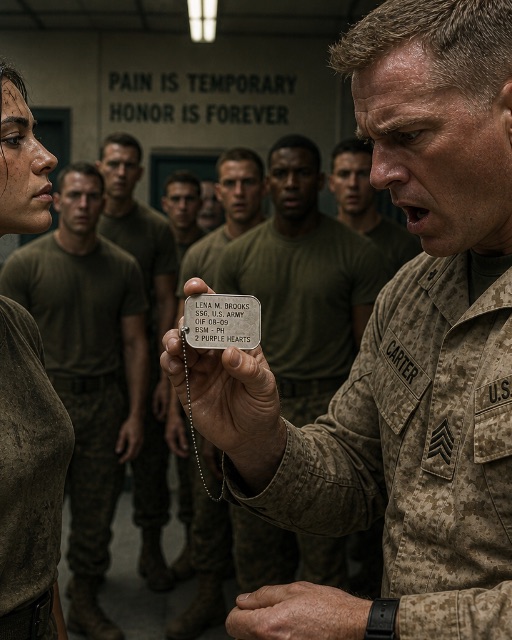
Staff Sergeant Carter stepped closer, eyes locked on the chain at her collarbone, already deciding she needed to be put in her place.
“You didn’t earn that name.”
No one moved. No one spoke. Because everyone knew what came next – and no one wanted to be the one caught in it.
He reached up and hooked his finger under her dog tag, tugging just enough to make a point. The message was clear: out here, you’re nothing unless I say you are.
But Lena didn’t resist. She didn’t even look at his hand.
“Go on,” he said, leaning closer. “Take it off.”
For a moment, the entire room held its breath.
Then – slowly, almost too easily – she lifted her hand, unclasped the chain, and placed the tag into his palm.
It should’ve felt like a win.
But something shifted the second it left her neck.
“Read it.”
Her voice was quiet. Flat. Controlled.
Carter frowned, glancing down at the tag like it was nothing more than standard issue. But as his eyes moved across the engraving… his expression changed.
First confusion. Then recognition. Then something I’d never seen on that man’s face before.
Fear.
His hand started shaking. The tag slipped between his fingers and hit the concrete floor with a sound that echoed like a gunshot.
He stepped back. One step. Then another.
“That’s… that’s not possible,” he whispered. “You can’t be – ”
“Say it louder,” Lena said. She hadn’t moved an inch. “So everyone hears.”
Carter’s mouth opened. Closed. Opened again. His face had gone white – completely drained — like a man who just realized he’d been picking a fight with something far above his clearance level.
The two privates nearest to the door bolted. Someone behind me muttered a prayer.
I looked at the tag on the floor. I could barely read it from where I stood, but I caught the last name — and it wasn’t Brooks.
It was a name I’d seen before. On a plaque. In the general’s office. Right next to a photo of a soldier who supposedly died in a classified operation nine years ago.
Carter finally spoke — his voice cracking like a kid caught in something he couldn’t undo.
“I didn’t know. I swear I didn’t—”
Lena bent down. Picked up the tag. Clasped it back around her neck like nothing happened.
Then she looked at him — really looked at him — and said five words that made every person in that room understand exactly who she was and exactly what was about to happen to Staff Sergeant Carter’s career.
She said: “My father didn’t die. He—”
She paused, letting the silence twist itself into a knot in Carter’s gut.
“He was promoted.”
The words landed with the force of a physical blow. Carter stumbled back again, catching himself against a row of metal lockers with a loud clang.
His eyes were wide, darting from Lena to the door and back again, like a cornered animal searching for an escape that wasn’t there. The whole tough-guy act he’d spent years building crumbled into dust in less than a minute.
I stood there, frozen like everyone else. My name is Sam Miller, just a private trying to get through basic without making waves.
Staff Sergeant Carter was the kind of NCO who enjoyed making waves. He picked on the new guys, the quiet ones, anyone he thought he could push around to make himself feel bigger.
Lena Brooks had been his favorite target from day one. She was small, quiet, and never rose to his bait. She just did her work, did it better than most, and kept her head down.
Her competence seemed to make him even angrier. He couldn’t fault her performance, so he went after her personally.
Now, watching his face drain of all color, I understood. He hadn’t been picking on a quiet private. He’d been harassing the daughter of General Thorne.
The same General Thorne whose name was on the highest award for valor this base offered. The same General Thorne who was a living legend, a ghost story told to new recruits.
A man everyone thought had died a hero’s death in the mountains of Afghanistan.
Lena just watched Carter fall apart. She didn’t look triumphant or smug. She just looked… tired.
“I… I apologize, Private,” Carter stammered, his voice barely a whisper. “I had no idea. It was a mistake.”
“It wasn’t a mistake,” Lena replied, her voice still level, but with an edge that cut right through his pathetic excuses. “It was a choice. You make it every day.”
She turned, her back to him, and started packing her duffel bag as if nothing had happened. The dismissal was more brutal than any shouting match could have been.
The rest of us just stood there, pretending to be busy with our own gear, but we were all listening. Waiting.
Carter didn’t move. He just stared at her back, his whole body trembling. His career was flashing before his eyes, and it wasn’t a pretty picture.
Finally, without another word, Lena shouldered her bag and walked out of the locker room. The door swung shut behind her, leaving a thick, suffocating silence in her wake.
Carter slid down the lockers and sat heavily on the bench. He put his head in his hands.
No one went over to him. No one offered a word of comfort. He had made his bed, and now he had to lie in it, alone.
For the next few days, the base was a strange place. The story spread like wildfire, whispered in the mess hall and on the training grounds.
Staff Sergeant Carter was suddenly a ghost. He was still there, but no one spoke to him unless they absolutely had to. He was assigned to latrine duty. Then sanitation. Then inventory in a dusty, forgotten warehouse.
It wasn’t a formal punishment you could see on paper. It was worse. It was a slow, quiet fade into obscurity. He was being erased.
Lena, on the other hand, was treated like a landmine. People gave her a wide berth, their eyes full of a new kind of respect mixed with fear.
They stopped seeing Private Brooks and started seeing the General’s daughter. It was exactly the thing she probably never wanted.
I saw her a couple of nights later, sitting alone on a bench by the track, just staring up at the stars. I nearly walked right past her. Part of me wanted to.
But I remembered the look on her face in the locker room. Not anger. Just a profound weariness.
I hesitated, then walked over. I didn’t say anything, just sat on the other end of the bench.
We sat in silence for a few minutes. I thought maybe I’d made a mistake, that she wanted to be left alone.
“He’s not really a General anymore,” she said, her voice soft. It made me jump.
I looked over at her. She was still looking at the sky.
“After the operation, when he ‘died,’ they moved him into intelligence,” she continued. “He runs a department here. Different name, different title. Very few people know who he really is.”
“Why did you use your mom’s name?” I asked, my voice barely above a whisper.
She finally looked at me. There was no suspicion in her eyes, just a straightforward honesty.
“I wanted to see if I could do this on my own,” she said. “I wanted to earn my place. Without his shadow over me.”
She gave a small, sad smile. “Looks like that’s over now.”
“I don’t think so,” I found myself saying. “Everyone saw you that day. You didn’t yell. You didn’t pull rank. You just… stood your ground.”
She considered that for a moment. “I was so close to losing it. For years, I believed he was gone. I grieved him. Then one day, I get a letter. ‘I’m alive. Come to this address.’ Just like that.”
I couldn’t imagine it. Mourning your father for almost a decade, only to find out it was all a lie, a necessary one, but a lie nonetheless.
“Joining the army,” she said, “was my way of trying to understand the world he chose over his family.”
“Do you?” I asked.
“Sometimes,” she admitted. “And sometimes, I just see the cost.” She nodded in the direction of the barracks, where Carter was probably scrubbing a floor somewhere. “That’s a cost, too.”
I thought she meant Carter’s career, but I was wrong. She was talking about something else, something deeper.
About a week later, we were all called for a surprise multi-day field exercise. It was designed to test our limits, push us past our breaking points.
The terrain was brutal, the conditions were miserable, and the tasks were nearly impossible. It was exactly the kind of chaos that separates the real soldiers from the ones just wearing the uniform.
Carter was in our platoon. He was a shell of his former self. He kept his eyes on the ground, did his work without a word, and seemed to shrink with every passing hour. The other NCOs ignored him, leaving him to founder.
On the second day, a storm rolled in. Not a gentle rain, but a violent, whipping downpour that turned the canyons into raging rivers.
We were tasked with a river crossing. The rope line was slick, the current was strong, and visibility was almost zero.
Carter went to cross. He was clumsy, distracted. Maybe he was trying to prove something, or maybe his nerve was just gone completely.
Halfway across, his foot slipped. He lost his grip and the current snatched him, pulling him under.
He surfaced once, sputtering, before being swept downstream toward a series of rapids we’d been warned about.
For a second, everyone just froze. The supervising officer was shouting into his radio, trying to get a fix on his position. But we all knew. By the time a rescue team could be scrambled, it would be too late.
People glanced at each other. This was Carter. The man who had made our lives hell. A dark part of you, the part that keeps score, whispered to just let it happen.
Then Lena moved.
She was already shrugging off her pack, grabbing a spare rope and a carabiner from her webbing. “Miller!” she yelled. “With me!”
I didn’t even think. I just moved.
“Private, stand down! That’s an order!” the Lieutenant shouted.
“He’ll be dead by the time you get approval, sir,” Lena shouted back, not stopping. “There’s an anchor point fifty yards down. If we can get a line across, we can catch him before the rapids.”
She wasn’t asking for permission. She was a soldier with a mission.
We sprinted along the muddy bank, the rain stinging our faces. Lena was fast, her movements economical and precise. She wasn’t panicking. She was calculating.
We found the spot she meant, a thick outcrop of rock. She secured the rope with a knot I’d never seen before, quick and strong.
“He’s coming,” I yelled, pointing into the churning brown water. I could just make out his helmet bobbing.
“The rope won’t reach him,” Lena said, her eyes scanning the situation. “I have to go in.”
“That’s suicide,” I told her.
“It’s a calculated risk,” she corrected me, handing me the end of the rope. “Anchor me. Don’t let go, no matter what.”
Before I could argue, she clipped herself in and waded into the freezing, violent water. The current immediately tried to rip her away, but she dug her heels in, fighting her way out.
She timed it perfectly. Just as Carter’s flailing body was about to pass, she lunged, grabbing a fistful of his tactical vest.
The force of it nearly pulled me off my feet. I dug my boots into the mud, wrapping the rope around my body, leaning back with every ounce of my strength. The rope went taut, groaning under the strain of two people and a furious river.
For a horrible moment, I thought I was going to lose them both. Then, another pair of hands grabbed the rope next to me. And another.
I risked a glance back. Half the platoon was there, pulling, their faces set with grim determination. They weren’t pulling for Carter. They were pulling for Lena.
Slowly, inch by excruciating inch, we hauled them back to the bank.
We collapsed in the mud, gasping for breath. Carter was coughing up water, shivering uncontrollably, but he was alive.
Lena unclipped herself and knelt beside him, checking his breathing. He looked up at her, his eyes full of a dawning, horrified understanding.
The person he had tried to break had just saved his life.
The exercise was called off. We were all trucked back to base.
The next morning, I was cleaning my rifle when Carter walked up to me. He looked… smaller.
“I need to talk to her,” he said. His voice was raw. “Do you know where she is?”
I pointed toward the empty mess hall. “Probably in there.”
I watched him walk away, his shoulders slumped. A few minutes later, I walked over and looked through the window.
Carter was standing in front of Lena, who was sitting with a cup of coffee. He wasn’t standing like an NCO. He was standing like a defendant before a judge.
I couldn’t hear what he was saying, but I could see it. I saw his shoulders shake. I saw him wipe his eyes. I saw him offer an apology that came not from a fear of consequences, but from a place of deep, gut-wrenching shame.
Lena listened. She just listened, her face calm. When he was finished, she said something, just a few words. He nodded, then turned and walked out.
He walked straight to the command building.
Later that day, Lena found me. We sat on the same bench as before.
“He confessed,” she said. “Not just about me. About everything. Years of it.”
“What’s going to happen to him?” I asked.
“My father came to see me this morning,” she said, sidestepping my question. I tensed. I hadn’t met the “ghost” yet. “He was on the observation team during the exercise. He saw everything.”
She looked at me. “He said he was proud of me. Not for saving Carter. But for doing it when every part of me didn’t want to.”
She took a breath. “He said that’s what the name on the tag really means. It’s not about power. It’s about duty. Especially when it’s hard.”
A tall, older man in civilian clothes walked up then. He had kind eyes but a posture that could never truly relax. He looked at Lena with a love so fierce it was almost heartbreaking.
This was General Thorne. He looked from his daughter to me.
“Miller,” he said, his voice quiet but commanding. “Thank you. You showed courage out there.”
“I was just following her lead, sir,” I said honestly.
He smiled, a rare, genuine thing. “That’s the smartest thing a soldier can do.” He then looked back at Lena. “Carter was given a choice. A dishonorable discharge, or a demotion to Private and a transfer. He’s going to a logistics base in Alaska. He’ll be unloading supply planes for the rest of his contract.”
I was surprised. It wasn’t the career-ending blow I’d expected.
“He chose Alaska,” Lena finished. “A chance to start over. To earn something back.”
It was a form of justice I had never considered. It wasn’t about destruction. It was about redemption. Carter wasn’t just being punished; he was being given a difficult path to becoming a better man.
In that moment, I understood the lesson. True strength wasn’t in a name or a rank. It wasn’t in breaking people down or holding a grudge.
It was in the quiet integrity of choosing to do the right thing when it would be so much easier, so much more satisfying, to do the wrong one. It was in offering a hand to the very person who tried to push you down.
I saw Lena a lot after that. The whispers about her died down. She was no longer just the General’s daughter. She was Private Brooks, the soldier who ran into a storm to save one of her own.
She had earned her name. Both of them. Not because of who her father was, but because of who she had chosen to be.