
The shove wasn’t training. It was a message.
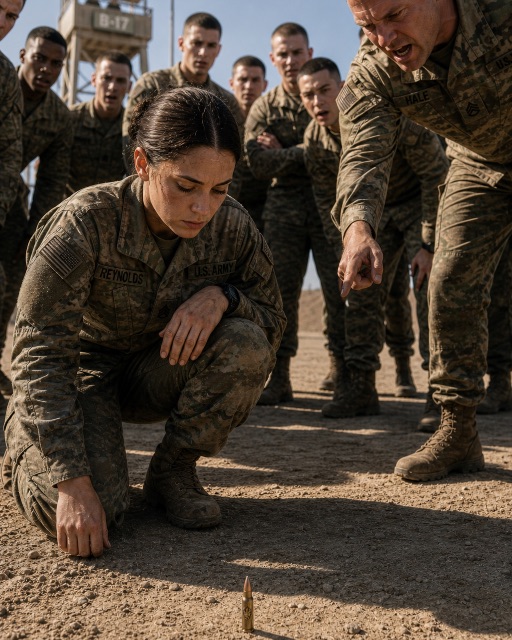
Sergeant Hale’s palm hit my shoulder blade like he was swatting a fly off a wall. Hard. Public. The kind of hit that says you don’t belong here without using the words.
I didn’t stumble. I’m not built like that.
But my hand grazed my chest pocket on impact. And something slipped free.
A single round. Dropped straight down between my boots. Didn’t roll. Didn’t bounce. Just… landed. Face up. Like it wanted to be seen.
Hale laughed. That low, wet chuckle he saves for when he knows the whole formation is watching.
“Can’t even keep track of your own gear, Reynolds. And you think you belong here?”
Smirks. Glances. The usual.
Fort Irwin in August is 112 degrees of nothing. Dust and silence and men who’ve already decided what you are before you open your mouth.
I didn’t move.
Didn’t pick it up.
Didn’t speak.
Because I already knew what was on that casing.
“Pick it up, Reynolds,” Hale snapped. Louder this time. Annoyed that I wasn’t reacting.
I crouched. Slow. Not to grab it – to look at it. To let the sun hit it at just the right angle.
That’s when Corporal Trent Webber, two rows back, leaned forward. His face changed. I watched his jaw go slack in real time.
“That’s not standard issue,” he said. Quiet. Like he was talking to himself.
Someone else shifted. Then another.
“That’s hand-etched.”
The marking. Tiny. Precise. Carved into the brass near the base with the kind of detail that takes hours. Not a factory stamp. Not regulation. A symbol I’d seen exactly once before – in a classified briefing folder that was never supposed to leave Building 4.
The same symbol that was on the round that killed Staff Sergeant DeMarco eight months ago.
The case they closed.
The death they ruled “training accident.”
The one Hale signed off on.
I stood up. Slowly. The round still on the ground between us.
Every single person in that formation was frozen.
Hale’s smile was gone. His eyes flicked down to the bullet, then back to me. For the first time since I’d arrived at this unit, I saw something behind his expression that wasn’t contempt.
It was recognition.
He knew what that symbol meant.
And now he knew that I knew.
I reached into my back pocket and pulled out my phone. One tap. Speaker on. The line was already connected.
A voice came through – calm, official, unmistakable:
“Sergeant Hale, this is Special Agent Dwyer with CID. Do not move. Do not speak. You are being recorded.”
The formation didn’t breathe.
Hale’s mouth opened. Nothing came out.
I looked him dead in the eyes and said the only words I’d been waiting eleven weeks to say:
“I’m not a private, Marcus. I never was.”
I reached for my collar and peeled back the velcro name tape. Underneath was a second patch. Silver. Embossed.
Hale read it. His face went white.
Because printed beneath my real name was a rank he never expected—and a unit designation that meant only one thing:
I wasn’t here to train.
I was here to find out who carved that symbol into the round that killed DeMarco.
And the answer had just shoved me in front of forty witnesses.
But that’s not even the part that made my hands shake.
Because when I finally picked up the bullet and turned it over, I saw something on the other side of the casing. Something that wasn’t in any file. Wasn’t in any briefing.
A second name. Freshly etched. Still bright from the carving tool.
It was mine.
And the date next to it was today.
A cold wave, separate from the desert heat, washed over me. This wasn’t just a clue. It was a threat.
The shove wasn’t a message of contempt. It was an assassination attempt gone wrong.
Two military police officers appeared at the edge of the formation, their movements sharp and practiced. They’d been parked a quarter-mile away, waiting for my signal.
Hale saw them and something in him broke. The tough sergeant persona dissolved into pure, raw panic.
He looked at me, then at the bullet in my hand, his eyes wide with a terror that went beyond getting arrested.
“It wasn’t me,” he whispered, a desperate plea. “I swear, it wasn’t me.”
The MPs took him by the arms. He didn’t resist. He was like a marionette with its strings cut.
My hand closed around the brass casing, the metal still warm from the desert sun. One side held justice for DeMarco. The other held a death warrant for me.
My real name, Special Agent Kate Dwyer, felt foreign on my own tongue after months of being Private Reynolds.
The platoon was dismissed by the ranking NCO, their faces a mixture of confusion, awe, and fear. They walked away, casting backward glances, the whispers starting like a brushfire.
I stayed put, waiting until the dust settled, until it was just me and the vast, indifferent desert again.
My colleague, Agent Miller, was the voice on the phone. His voice crackled in my ear now. “Kate? Status? Did we get him?”
I let out a breath I didn’t realize I’d been holding for three months. “We got him, Ben. But the situation is compromised.”
I explained about my name on the casing. The date.
There was a long silence on the other end of the line. “They knew you were coming.”
“Worse,” I said, looking over at the barracks where Hale had been a king just ten minutes ago. “Someone wanted me gone today. Hale was supposed to be the trigger man.”
A training accident. Just like DeMarco. A misfire on the range, a tragic mistake. Hale would have signed off on it, just like before.
And if anyone got suspicious, this bullet would have been planted on my body. A little calling card left after the fact.
But the shove had been clumsy. My reaction too quick. And a pocket that was supposed to stay closed had opened. Fate had intervened.
Later, in a sterile interrogation room that smelled of stale coffee, I sat across from Marcus Hale.
He wasn’t the monster I had built him up to be. Stripped of his uniform and his authority, he was just a tired man in his late thirties with fear-haunted eyes.
“I didn’t kill DeMarco,” he said, his voice hoarse. “You have to believe me.”
“I believe you,” I said calmly. “But you covered it up. You signed the paperwork. So you either tell me who did, or you’re going to take the fall for all of it.”
He flinched. “They have my wife. Not physically, but… they have things. Pictures. Information. They said they’d ruin her, put her in danger. They said all I had to do was look the other way.”
It was a classic, ugly story. Blackmail.
“DeMarco found out,” Hale continued, his gaze fixed on the table between us. “He wasn’t snooping. He just stumbled onto it. Something about the ammunition requisitions not adding up.”
“And the symbol?” I asked.
“It’s a brand,” Hale said, shaking his head. “A signature. For custom jobs. Untraceable rounds, sold to people who shouldn’t have them. DeMarco saw a crate with that mark. He asked too many questions.”
This was bigger than one murder. This was an illegal arms operation running out of a U.S. military base.
“Who?” I pressed. “Who is the artist?”
Hale looked sick. “He’s just a kid. Quiet. Good with his hands. Nobody would ever suspect him.”
He leaned forward, his voice dropping to a near whisper. “It’s Webber. Corporal Trent Webber.”
The name hit me like a physical blow.
Webber. The soldier who had looked so shocked. The one who had first identified the etching.
It hadn’t been shock. It had been performance.
He was pointing the finger, directing the play, making sure the spotlight fell squarely on Hale while he hid in the background.
“Webber gave you the bullet with my name on it, didn’t he?” I asked, the pieces locking into place with sickening clarity.
Hale nodded miserably. “This morning. Slipped it to me. He said you were getting too close. He told me to arrange an ‘accident’ on the range today. He said if I did, the stuff they had on my wife would disappear.”
My mind raced back through the last few weeks. The quiet corporal who always kept to himself. The one who spent his free time in the machine shop, supposedly working on personal projects.
He was the artist. The craftsman of death.
And he had been standing two rows behind me, a picture of innocence, watching his whole plan unfold.
Or, watching it fall apart.
The most dangerous part wasn’t that Webber was a killer. The most dangerous part was that he was smart. He had orchestrated everything perfectly.
He had even used my own investigation against me, knowing I was closing in on Hale. He was setting Hale up to be the perfect scapegoat.
But his ego was his flaw.
He couldn’t resist signing his work. Not just the symbol for his brand, but my name. A final, arrogant flourish before the curtain fell.
I left Hale with Agent Miller and walked back out into the blinding sunlight. I didn’t head for the command building. I headed for the machine shop.
The place was empty, the air thick with the smell of grease and hot metal. Tools were laid out on a workbench with surgical precision.
And there, in a small wooden box under a pile of oily rags, I found it.
His sketchbook.
Page after page was filled with designs. Intricate patterns, logos, and symbols. On the last page was a drawing of the coiled serpent—the same symbol from the bullet.
Next to it were practice etchings on spent casings. And a list of initials with dates.
S.S.D. Staff Sergeant DeMarco. With the date of his death.
And below that, S.A.K.D. Special Agent Kate Dwyer. With today’s date.
He had been planning this for weeks.
As I stared at the book, a shadow fell over the doorway.
“Looking for something, Private?”
I turned. Trent Webber stood there, wiping his hands on a rag. He wasn’t smiling. His face was a blank, calm mask. The mask of a predator.
“I prefer Agent Dwyer,” I said, not moving from the workbench.
He gave a small, unimpressed shrug. “Doesn’t matter what you call yourself. You’re in a place you don’t belong.”
“I think you are,” I replied, holding up the sketchbook. “This is quite the body of work, Corporal. You’re a real artist.”
His eyes flickered to the book, and for the first time, I saw a flash of emotion. Not fear. Pride.
“You should have stayed out of it,” he said, his voice flat. “DeMarco was a fool. Hale was a coward. I thought you were smarter.”
“Your mistake was thinking you were the smartest person in the room,” I told him. “And getting cocky. Why my name, Trent? Why sign it before the job was even done?”
He took a step into the room. “A statement. Art should be signed. He was going to push you, I was going to push him. It was a perfect plan.”
“Perfect plans have a way of coming apart,” I said, slowly moving my hand toward my side. “Like a cheap pocket seam.” I was unarmed. My weapon was still logged in the armory under my fake identity. A rookie mistake, born from weeks of playing a part.
He saw the movement. He saw my empty hip. And he smiled. A genuine, chilling smile.
“That’s the difference between you and me, Agent. I don’t make mistakes.”
He lunged.
He was faster than I expected. Stronger. He wasn’t just a quiet kid who sat in the corner; he was coiled wire, all lean muscle and pent-up aggression.
He went for my throat, but eleven weeks of playing a clumsy private hadn’t erased years of training. I pivoted, using his momentum against him, and sent him crashing into a metal lathe.
He grunted, recovered, and came at me again, this time with a heavy wrench he’d snatched from the wall.
He swung it in a vicious arc aimed at my head. I dropped, the wrench whistling through the air where my skull had just been.
I came up from my crouch with a length of steel pipe I’d grabbed from the floor. It wasn’t elegant, but it was effective.
We circled each other in the grimy shop, the only sounds our ragged breaths and the scrape of our boots on the concrete.
He was driven by ego. I was driven by the face of a good man, Staff Sergeant DeMarco, who died because he noticed a discrepancy on a form.
“You killed him for paperwork,” I said, my voice low and steady.
“I killed him because he was a threat to my business,” Webber corrected, his eyes gleaming. “This was my way out. My ticket to a better life than this dustbowl.”
He lunged again, and this time I was ready. I blocked the wrench with my pipe, the impact jarring my arms to the shoulder.
But it gave me the opening I needed. I kicked out, my boot connecting solidly with his knee.
He roared in pain and surprise, stumbling backward. The wrench clattered to the floor.
Before he could recover, I was on him. It wasn’t a brawl anymore. It was a takedown. Precise. Controlled. The way I had been taught.
Within seconds, he was on the ground, his arm twisted behind his back, my knee pressed firmly into his spine.
He was still trying to fight, still filled with that arrogant rage.
“It’s over, Trent,” I said, breathing heavily.
From the doorway, Agent Miller’s voice cut through the tension. “Ma’am, you might want to see this.”
He was holding a laptop. On the screen was a bank account summary, traced from a buyer on Webber’s list. It contained millions of dollars. The kid wasn’t just starting out; he was running a global enterprise from a dusty machine shop.
The full weight of what we had uncovered settled in. DeMarco hadn’t just stumbled on a local side hustle. He had poked a hornet’s nest of international arms trafficking.
And Corporal Trent Webber, the quiet artist, was the kingpin.
The legal proceedings were long and complicated, but the evidence was undeniable. Webber’s pride—his sketchbook, his signed bullets—was his own undoing. He and his entire network, from suppliers within the military to buyers across the globe, were dismantled.
Hale cooperated fully. His testimony was crucial. In the end, he was dishonorably discharged and served a short sentence for his role in the cover-up, but he was spared the murder charge. I heard later that he and his wife moved away, trying to build a new, honest life far from the shadows that had nearly consumed them. It wasn’t a full pardon, but it was a second chance.
A few months later, I drove to a small, quiet cemetery a few states away. I found the headstone marked with the name Staff Sergeant Robert DeMarco.
I stood there for a long time, the wind rustling the leaves on the trees. I told him it was done. I told him his last act wasn’t a mistake, but a moment of courage that saved countless lives.
I placed a single, polished brass casing on the grass in front of the stone. It was empty. Clean. No markings, no symbols. Just a simple piece of metal, representing a story that was now, finally, over.
Leaving the cemetery, I thought about the nature of things. We spend so much time looking at the surface—the rank on a uniform, the smile or scowl on a face, the reputation that precedes someone. We see the bully, the victim, the quiet kid in the corner.
But the truth is never that simple. It’s often hidden in the details, in the things that fall out when we’re shoved. It’s in the tiny, hand-carved symbol on a bullet, or the fear in a man’s eyes when he’s finally stripped of his power.
Justice isn’t always a loud, dramatic event. Sometimes, it’s quiet. It’s a slow-burning fuse that starts with one person daring to ask a question, to notice something is wrong. And truth, no matter how deeply it’s buried, will always find its way to the light. It just needs someone willing to do the digging.



