The slap cracked across the parade deck like a gunshot.
For one impossible second, the world seemed to split open.
Two thousand service members stood frozen beneath the punishing Virginia sun, boots aligned, uniforms pressed so sharp they looked forged from iron. A gull circled above the tree line. Somewhere, a generator hummed.
But on the deck itself, after that sound, there was only silence.
Not ordinary silence. The kind that falls when everyone realizes they’ve just witnessed something irreversible.
Vice Admiral Richard Vance still held his arm half-raised, fingers stiff, as if his body hadn’t caught up with what he’d done. Silver at the temples. Decorated. Immaculate. Swollen with unquestioned authority.
A vein pulsed at his temple.
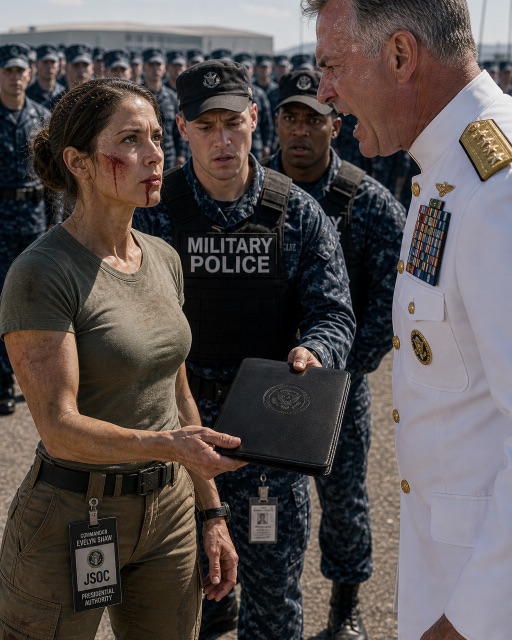
In front of him stood a woman in faded cargo pants and a plain olive T-shirt. No insignia. No rank. No cover.
Only blood.
A vivid red mark bloomed across her cheek in the shape of his hand. Her lip had split; a thin line slid down her chin and touched her collar.
She didn’t flinch. She didn’t raise a hand. She didn’t even blink.
She just stared at him.
That was the worst part, Lieutenant Darren Mercer would later think. Not the slap. Not the blood. Not even the Admiral’s shout afterward.
It was the way she looked at him. Like she had already watched better men than him destroy themselves.
“Security!” Vance roared. “Remove this civilian from my base. Now!”
Mercer stood three rows off the central lane, every muscle locked. He was thirty-two, a Navy criminal investigator temporarily attached to base security. For six minutes, he’d been trying to figure out why a civilian-cover woman had arrived at a live inspection with clearance beyond his access.
Then the Admiral hit her.
Two Military Police officers stepped forward because they had to. They made it three steps, then stopped. The taller one swallowed.
“Sir,” he said carefully, “she is authorized directly by the Secretary of – ”
“I don’t care if she’s authorized by God Himself,” Vance snapped. “This is my command.”
Her voice cut through his anger. Low. Even. Precise.
“Admiral Vance,” she said, blood still falling from her lip, “you just assaulted a superior officer.”
A ripple moved through the nearest ranks before discipline crushed it back into silence.
Vance laughed. Brittle. Performative. Already cracking.
“You? A superior officer? Let me guess – Pentagon consultant? Interagency auditor? One of those children sent to lecture real commanders?”
She said nothing.
Instead, she reached into her pocket.
Mercer took an involuntary step forward. Every armed guard stiffened.
Slowly, the woman withdrew not a civilian badge, not a Pentagon ID, but a slim matte-black burn folder. No markings except a small embossed seal Mercer recognized more from rumor than training.
The kind of object that didn’t belong in daylight. The kind that moved through windowless rooms under dead phones and armed guards.
Her eyes never left Vance as she placed it in the MP’s trembling hands.
The young officer looked down, and every drop of color drained from his face.
“Oh my God,” he whispered.
Vance’s expression flickered. Just a heartbeat. Just long enough for Mercer to see uncertainty slip beneath his skin.
The woman wiped the blood from her chin with the back of her hand. When she spoke again, her voice held no anger.
That made it so much worse.
“My name,” she said, “is Commander Wendy Shaw.”
Mercer watched Vance searching memory – rank structures, command lists – trying to place her and failing.
Then she delivered the blow.
“Joint Special Operations Command. Presidential special-access authority. Temporary embedded command review.”
She tilted her head slightly.
“And as of 0900 this morning, acting oversight authority for this installation.”
No one moved. No one breathed. The heat felt suffocating.
Vance looked at the MPs. “That’s impossible.”
The taller MP, still staring at the folder, spoke without looking up. “Sir… her access compartment is above ours. Above yours, too.”
Vance’s jaw tightened. His hand drifted – slowly, almost unconsciously — toward the sidearm on his hip.
That was when Commander Shaw finally smiled.
A small, tired smile. The kind a woman gives when a man has just confirmed everything she already suspected about him.
“Admiral,” she said softly, “I wasn’t sent here because of a training inspection.”
She took one step closer, close enough that only he could hear the next sentence.
And what she whispered into his ear made the Vice Admiral’s knees visibly buckle on the parade deck in front of two thousand of his own men.
“I know about Petty Officer Samuel Morales,” she whispered, her voice a ghost in the humid air. “And I have his mother’s phone number, Richard.”
The Admiral’s face, which had been a mask of rage and defiance, slackened. All the air went out of him. He aged a decade in a single breath.
The name, Morales, hung between them like a specter.
He took a stumbling step back, his hand falling away from his sidearm as if it had been burned. His eyes were wide with a terror that had nothing to do with rank or authority.
It was the terror of a man whose deepest, darkest secret had just walked out into the sunlight.
Shaw didn’t press. She didn’t need to. She simply stood there, a small woman in cargo pants, and watched his entire world crumble.
She turned to the two MPs, her voice now crisp with command. “Place the Vice Admiral under escort. Take him to his office. He is not to speak with anyone or touch any communications device.”
The MPs, jolted into action, looked at each other, then at the shell of the man who had been their commander seconds before. They moved, this time with purpose, flanking Vance.
“You can’t do this,” Vance mumbled, but the words had no force. They were just echoes.
“I already have,” Shaw said, her gaze sweeping over the parade deck. Then her eyes found Mercer.
They locked onto him, and for a terrifying second, he felt seen. Not as part of a formation, but as an individual.
“You,” she said, her voice carrying easily. “Investigator. Lieutenant Mercer. You’re with me.”
Mercer’s blood turned to ice. How did she know his name?
He stepped out of the ranks, his training taking over as he walked the thirty feet toward her. The world had narrowed to the space between them. The two thousand other service members might as well have been on another planet.
He stopped five feet away and gave a salute so sharp it felt like it might snap his arm. “Ma’am.”
She didn’t return it. Instead, she just looked at him, really looked at him, with an unnerving intensity. “At ease, Lieutenant. Walk with me.”
She turned and began walking toward the main administrative building, leaving the chaos on the parade deck to be sorted out by junior officers. Mercer fell into step beside her.
“Ma’am,” he began, his mind racing. “I don’t understand.”
“You don’t need to understand, Lieutenant. You just need to listen,” she said, not unkindly. “Six months ago, you filed a preliminary inquiry report on a training accident.”
Mercer stopped walking. The air caught in his throat.
The Morales case. It had been his first real investigative assignment on the base. A young Petty Officer, Samuel Morales, killed during a live-fire drill. The official cause was “operator error.”
But Mercer had found things that didn’t add up. Maintenance logs for the weapon system were pristine—too pristine. Morales’s training record was flawless. He had even filed a safety concern about the system’s targeting software the week before the accident.
Mercer had documented it all, submitted his findings, and recommended a full investigation.
Two days later, his report was kicked back, stamped “Unfounded.” He was reassigned to base security duties. His commanding officer had pulled him aside and told him, for his own good, to let it go.
He had. He hated himself for it, but he had.
“Your report was flagged as being in conflict with the official narrative,” Shaw continued, walking again. “It was buried. Very effectively, I might add. But not everything that’s buried stays dead.”
She led him into the cool, quiet halls of the admin building, their footsteps echoing on the polished linoleum.
“Some reports,” she went on, “when they’re closed out under a certain level of protest, they trigger a silent alarm. Not in any system Vance could see. Something deeper. It lands on a list. A very short, very serious list.”
She stopped in front of the Admiral’s office, where the two MPs stood guard outside the closed door. “My job is to read that list.”
It all clicked into place for Mercer. The reason she was here. The reason she knew his name. It wasn’t random. It wasn’t a coincidence.
“You’re here because of my report,” he said, the words barely a whisper.
“I’m here because you did your job, Lieutenant,” she corrected him. “Even when you were told not to. I’m here because you cared more about the truth than your career. That’s a rare quality.”
She turned to the MPs. “Is he secure?”
“Yes, ma’am,” the taller one said. “Quiet as a mouse.”
Shaw nodded. “Good. Wait here.”
She opened the door and walked inside, leaving Mercer in the hallway with his heart pounding against his ribs. He had thought his career had stalled, that his moment of integrity was a fool’s errand that had cost him.
Now he understood it had been an invitation.
Inside the opulent office, Vance was sitting behind his enormous mahogany desk. The fight had gone out of him. He just looked old and tired.
“It was the contractor, wasn’t it?” Shaw said, walking to the window and looking out at the parade deck, now slowly being dismissed. “Starkweather Defense. Your old friend from the Academy.”
Vance didn’t answer. He just stared at his hands.
“The targeting system was faulty. Starkweather knew it, sold it to you anyway. You pushed the contract through. When Petty Officer Morales died, you couldn’t let the truth come out. It would have ended you both.”
She turned from the window. “So you destroyed a young man’s reputation to save your own. You labeled a brave sailor, who died trying to warn his shipmates about a problem, as incompetent.”
A single tear traced a path down Vance’s weathered cheek. “I didn’t have a choice.”
“There is always a choice, Richard,” Shaw said, her voice hard as steel. “You chose to sacrifice a young man’s life and legacy for money and a promotion. Now you want to talk about the real twist?”
She walked over to the desk and picked up a framed photo of Vance with his family.
“This isn’t just about a cover-up. I followed the money. The kickbacks from Starkweather. Where do you think I thought they were going? A boat? A house?”
She put the picture down. “But you were more creative than that, weren’t you?”
Vance finally looked up, his eyes pleading. “Please.”
“You created a shell corporation,” Shaw continued, ignoring him. “A charity. The ‘Vance Fund for Gold Star Families.’ You funneled the dirty money into it. On paper, it looked like you were a philanthropist, donating your own salary to help the families of the fallen.”
She leaned forward, her hands flat on the desk. “But you never gave a single dime to any of them. You used the charity as a personal slush fund, living high while pretending to be a saint. You weren’t just covering up a death. You were stealing from the very idea of honor.”
The bloodstain on her cheek seemed to darken. “You slapped me out there, Richard. But that was nothing. The real slap in the face was what you were doing to the families of people like Samuel Morales. You were using their grief as your personal piggy bank.”
Vance finally broke. A choked sob escaped his lips. The great, powerful Vice Admiral was gone. In his place was just a pathetic, greedy old man.
Shaw straightened up. “Lieutenant Mercer’s report was the loose thread. You pulled on it, and it brought you here,” she said. “He had the courage you lost thirty years ago.”
She opened the door and stepped back into the hallway, leaving Vance to his ruin.
She looked at Mercer. “It’s over.”
In the weeks that followed, the story rippled through the Navy. Vice Admiral Vance was dishonorably discharged and faced a litany of federal charges. Starkweather Defense was brought up on criminal negligence and fraud. The entire command structure was shaken from top to bottom.
But Shaw wasn’t finished.
A month later, she called Mercer to a small, off-base law office. When he arrived, an older woman with kind, tired eyes was sitting in the waiting room.
“Lieutenant Mercer, this is Elena Morales,” Shaw said quietly. “Samuel’s mother.”
Mercer felt his breath catch. He wanted to apologize, to say something, but the words wouldn’t come.
Mrs. Morales stood up and, to his shock, took his hand. “Commander Shaw told me about what you did,” she said, her voice thick with emotion. “You tried to find the truth for my Sammy. Thank you.”
Shaw then placed a folder on the table between them. Not a black folder, but a simple manila one.
“As part of the legal proceedings, all of the money Admiral Vance stole was recovered,” Shaw explained. “It amounted to just over two million dollars. The Department of Justice has released it.”
She slid a check across the table to Mrs. Morales. “This is not compensation for your son, ma’am. There is no money in the world for that. This is the restoration of what was stolen in his honor. This is his legacy, returned to you.”
Tears streamed down Mrs. Morales’s face as she looked at the check, and then at Mercer. “He was a good boy,” she whispered. “He always tried to do the right thing.”
“Yes, ma’am,” Mercer said, finally finding his voice. “He was.”
The final lesson wasn’t a lesson at all, but a simple truth that settled deep in Mercer’s bones that day. It was a truth that Wendy Shaw embodied and that Samuel Morales had died for.
It’s that integrity is not a grand gesture performed for an audience. It’s a quiet choice. It’s the report you file knowing it will be buried. It’s the safety concern you raise knowing you’ll be overruled. It’s the small, unseen act of doing the right thing, simply because it’s right.
Real strength isn’t about the rank on your collar or the volume of your voice. It’s about the quiet, unwavering conviction in your heart. You never know which small, brave choice will be the one that starts an avalanche and finally brings the mountain down.