The first drop of my father’s blood hit the diner floor before anyone found the courage to breathe.
That was what June Harlan told me later.
She said the whole place went quiet in a way quiet should never sound. Not peaceful. Not respectful. The kind of quiet people make when they’re trying to survive by becoming invisible.
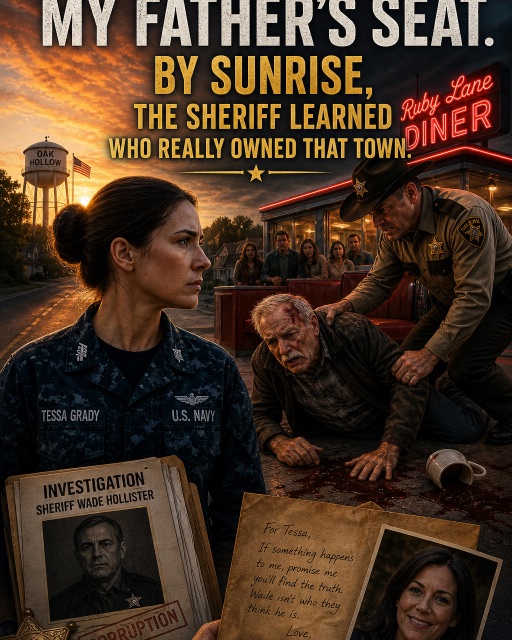
My father, Walter Grady, was seventy-two years old. He had a bad knee from Vietnam, a silver mustache he trimmed every Sunday, and a habit of waking before dawn because sleep had never fully trusted him after the war. Every morning, he walked two blocks to Ruby Lane Diner, sat in the same booth by the window, and drank black coffee until the town came alive.
That booth was his little country.
His peace.
His altar.
And on a bright Tuesday morning in Oak Hollow, Sheriff Wade Hollister decided to take it from him.
Wade didn’t enter the diner like a man looking for breakfast. He entered like a storm wearing polished boots and a badge. Conversations dimmed. Forks paused above plates. Men who had known my father for forty years looked down at their eggs.
Wade stopped at my father’s booth.
“Move,” he said.
My father looked up from his coffee. “There are plenty of empty seats, Sheriff.”
That should have been the end of it.
But Wade Hollister was the kind of man who did not want a chair.
He wanted obedience.
He leaned down until his shadow swallowed the table. “You forget who I am?”
My father’s voice stayed steady. “No. That’s exactly why I’m not moving.”
June said the sheriff smiled then.
Not because he was amused.
Because he had been given permission, in his own twisted mind, to become what he truly was.
Wade grabbed my father by the shoulder, yanked him from the booth, and slammed him into a steel service cart hard enough to send plates crashing across the floor. A coffee mug shattered. Hot black coffee spread like an oil slick beneath his shoes.
My father hit the ground with blood running from a cut above his eyebrow.
Nobody moved.
Nobody except June.
She rushed to him, trembling, while Wade stepped over my father’s legs and slid into the booth.
My father’s booth.
Then he opened a menu and said, “Eggs. Bacon. Coffee.”
As if he hadn’t just thrown an old man to the floor.
As if the badge on his chest made cruelty legal.
My father called me from the curb outside the diner.
When my phone rang, I was standing in a windowless briefing room three states away, wearing a uniform most people noticed but few understood. Lieutenant Commander Tessa Grady. United States Navy. That was the official version.
The unofficial version was quieter.
My job was finding monsters who believed they were untouchable.
“Hey, sweetheart,” Dad said when I answered.
One word told me something was wrong.
He only called me sweetheart when he was trying to hide pain.
“What happened?” I asked.
“Nothing much. Just had a disagreement with Wade.”
I stepped away from the table. “Dad.”
He breathed out slowly. In the background, I heard traffic, a bell above a door, and June’s voice, thin with panic.
“I’m fine,” he said.
Fathers lie like that.
Even when their voices are shaking.
“Did he put his hands on you?” I asked.
Silence.
Then, softly, “Yes.”
Something inside me went still.
Not angry.
Not loud.
Still.
The way the air gets before lightning chooses a tree.
“Go home,” I said. “Clean yourself up.”
“Tessa, don’t make this bigger than – ”
“Dad.”
He stopped.
“Don’t warn anyone.”
Another silence.
Then he whispered, “What are you going to do?”
I looked through the glass wall at the officers waiting for me. At the files stacked on the table. At a name that had been sitting in my investigation folder for six months.
Sheriff Wade Hollister.
“I’m coming back to Oak Hollow,” I said. “And I’m not coming to talk to him.”
I ended the call before my voice could break.
Because the truth was, Wade Hollister hadn’t just assaulted my father.
He had touched the one man I had been protecting while I built the case that would bury him.
By noon, Oak Hollow looked the same as it always had. Flags hanging from porches. Old men sitting outside the hardware store. Children riding bikes past white fences. A town so pretty it could make strangers believe ugliness had never lived there.
But I knew better.
I grew up there.
I knew about the women who stopped reporting bruises because Wade laughed at them. I knew about traffic stops that ended with cash disappearing from glove compartments. I knew about businesses that paid “donations” to the sheriff’s fund because bad things happened to people who said no.
And for years, the town swallowed it.
Fear became tradition.
By the time I drove past the Oak Hollow welcome sign, my father was waiting on his porch with a bandage over his eyebrow and a guilt-ridden look in his eyes.
“You shouldn’t have come,” he said.
I got out of the car and looked at the dried blood on his collar.
“Yes,” I said. “I should have.”
He tried to smile. “You look like your mother when you’re angry.”
That nearly undid me.
My mother, Elena Grady, had been dead seventeen years. A hit-and-run, the report said. Slick road. Poor visibility. No witnesses.
At least, that was the story Wade’s department had closed in twenty-four hours.
I kissed Dad’s cheek. “Stay inside tonight.”
His eyes narrowed. “Tessa.”
“Please.”
That one word changed him. He heard the daughter beneath the officer. The child who had stood beside her mother’s coffin and watched Sheriff Hollister fold a flag for a woman who had never served, simply because he liked being seen as important.
Dad nodded.
“Be careful,” he said.
I didn’t tell him careful had ended the moment Wade touched him.
I went to Ruby Lane first.
June locked the door behind me and burst into tears before saying my name.
“I should’ve done something,” she whispered.
“You did,” I said. “You helped him up.”
“I mean before.”
I looked around the diner. At the red booth by the window. At the faint brown stain where coffee had dried into the tile grout.
“Do you still have the security footage?”
She glanced toward the kitchen, terrified. “Wade made me delete it.”
“Did you?”
Her mouth trembled.
Then she reached under the counter and pulled out a flash drive.
“I deleted the copy he knew about.”
For the first time that day, I smiled.
June wasn’t weak.
She had just been waiting for someone to stand beside her.
By sunset, I had six statements, three videos, two ledgers, and one terrified mechanic named Paulie who finally admitted Wade stored unregistered seized cash in a hunting cabin outside town.
But none of that was the real bomb.
The real bomb came at 9:17 p.m., when June called me and said, “Tessa… there’s something else.”
Her voice sounded strange.
Not frightened.
Haunted.
I met her behind the diner near the dumpsters, where moths battered themselves against a yellow security light.
June held out an envelope. Her hand was shaking so hard the paper whispered against itself.
“Your mother gave this to me the night before she died.”
My chest tightened. “What?”
June swallowed. “She told me if anything ever happened to her, I was supposed to give this to you. Not your father. You.”
I took the envelope.
It was heavier than it had any right to be.
My mother’s handwriting climbed across the front in that same slanted cursive that used to sign my school permission slips. Four words. Just four.
For Tessa. When ready.
“Why now?” I whispered. “Why did you keep it for seventeen years?”
June’s eyes filled. “Because she told me I’d know when. And tonight, when I saw you standing over that booth with your father’s blood still on the floor… I knew.”
I opened it with hands that didn’t feel like mine.
Inside was a single photograph.
A key taped to the back.
And a letter that began with a sentence I read three times before my knees understood what they were hearing.
“Tessa, if you’re reading this, then Wade finally did what he promised he would do to me. But before you bury him, you need to know who your father really is. And you need to know what’s buried under the floor of the booth he sits in every morning.”
My breath stopped.
I looked down at the photograph in my hand.
The photo was faded, its corners soft with age. It showed two Young Marines, grinning in the sunlight, somewhere hot and green. One of them was the man I called Dad, but his face was younger, leaner.
The other man wore my father’s smile.
I mean that literally. He had the same crinkle around his eyes, the same slight tilt to his head. He was a stranger with my father’s face.
Written on the back in my mother’s hand was: “Thomas and Walter, 1971.”
My father’s name was Walter.
Which meant the man I had called Dad my entire life… was Thomas.
The world tilted under my feet. Everything I knew, every foundation, cracked. My name was Grady. My father was Walter Grady. Except he wasn’t.
I stumbled back to my car, the gravel crunching under my shoes like broken glass.
The letter explained it all, in my mother’s elegant, pained script.
Thomas and the real Walter Grady had been brothers in everything but blood. In Vietnam, their patrol was ambushed. Walter was hit. He died in Thomas’s arms, but not before making him promise one thing.
“Go to Elena,” he had said. “Tell her I love her. Take care of her. Don’t let her be alone.”
Walter never knew Elena was pregnant.
Thomas came home, a ghost in another man’s country. He found my mother. He told her what happened. And she saw in his haunted eyes the same loyalty she had loved in Walter.
So they made a new promise.
Thomas would become Walter. He would take his friend’s name, his life, his child. He would raise me as Walter Grady’s daughter to protect me from a world that had forgotten them both.
“Wade Hollister’s father was a powerful man back then,” my mother wrote. “He had dealings that Thomas knew about from before the war. Thomas taking Walter’s identity was the only way he could disappear and keep us safe.”
And the booth.
The reason he sat there every morning wasn’t just habit.
“Beneath the floorboards,” the letter continued, “is a small box. It contains Walter’s dog tags and his last letter to me. It’s the only proof Thomas isn’t who he says he is. It was our secret, our anchor. And your father sits on it every day, guarding it. Guarding you.”
The key taped to the photo was for that box.
A key to a history I never knew I had.
The final lines of the letter froze the blood in my veins. “Wade was obsessed with me. He couldn’t stand that I chose your father over him. He’s suspected the truth about Thomas for years. If he ever confirms it, he’ll destroy him. My death was no accident, Tessa. Wade ran me off the road. He told me he would if I didn’t leave your father.”
I sat in my car for an hour, the engine cold, my past rewritten.
Wade hadn’t just assaulted an old man. He had assaulted the man who had sacrificed his own identity to guard his friend’s legacy. He had tormented him for decades, driven by a jealous rage, and murdered my mother.
And that booth… Wade hadn’t just been claiming a seat. He was trying to claim a secret. He was hunting for that box.
I drove back to my father’s house. He was sitting in the dark, in his armchair, a silhouette against the moonlit window.
He didn’t seem surprised to see me holding the letter.
“She always planned ahead,” he said, his voice thick.
“Your name is Thomas,” I said. It wasn’t a question.
He nodded slowly. “Thomas Riley.”
The name felt like a strange coat on him. It didn’t fit. The man I knew was Walter Grady.
“Why didn’t you ever tell me?” I asked, my own voice trembling.
“How could I?” he whispered. “I started living a life that wasn’t mine, and then one day, it was. You were my daughter. That was the only truth that mattered.”
He looked so old, so tired. Not the strong, unshakeable father I’d always known, but a man who had carried the weight of two lives for over forty years.
“Wade… he killed her,” I said.
Thomas closed his eyes. The pain on his face was a fresh wound. “I knew. But I couldn’t prove it. And if I pushed, he would have exposed me. I couldn’t risk you losing your home, your name… everything.”
He had swallowed the murder of the woman he loved to protect me.
That act of sacrifice was more profound than any lie he had ever told.
“He’s not just going to lose his badge,” I said, my voice hardening. “He’s going to lose everything.”
The next morning, I didn’t go to the diner. Not yet.
First, I made a call to a number at the Department of Justice that didn’t officially exist. I laid out the case: the corruption, the extortion, the statements from June and Paulie. Then I dropped the bomb.
“I also have probable cause to believe he’s guilty of a seventeen-year-old homicide,” I said. “And I have the means to get an in-person confession.”
Silence on the line. Then, “What do you need, Commander?”
“A ghost team. Unmarked. A two-mile perimeter around Oak Hollow. And the sheriff from the next county, a man named Peters. I need him ready.”
The plan was set.
At 7:00 a.m., I walked into Ruby Lane Diner.
The place was packed but silent. Every eye was on me.
Wade Hollister was in the booth. My father’s booth. He was sipping coffee, a smug look on his face. He’d won, he thought.
I ignored him. I walked to the counter.
“June,” I said, my voice loud enough for everyone to hear. “I’d like a coffee. To go.”
June poured it, her hands steady this time.
As she put the lid on, I leaned in. “When Sheriff Peters arrives, tell him to wait for my signal.”
Her eyes widened, but she nodded.
I turned and faced the diner. I held my coffee cup up.
“I’d like to make a toast,” I said. “To Sheriff Wade Hollister. A man who has owned this town for too long.”
Wade chuckled, leaning back. “Damn right.”
“He owns the fear in this town,” I continued, walking slowly toward him. “He owns the silence. He owns the secrets people are too scared to tell.”
I saw Paulie the mechanic by the door, his face pale. I saw the wives of men Wade had shaken down. I saw a whole town held hostage.
I stopped at the booth. “But ownership comes with a price. Doesn’t it, Wade?”
“What is this, Tessa? You giving a speech now?” he sneered.
“It’s an accounting,” I said. I pulled out my phone and placed it on the table. I hit play.
The recording from Paulie filled the diner, detailing the cash drop-offs at the hunting cabin.
Wade’s smile vanished. “That’s a lie. You can’t prove any of that.”
“Can’t I?” I said. “Federal agents are at that cabin right now. Along with the ledgers from two business owners who finally decided to talk.”
Panic flashed in his eyes. He started to stand.
“Sit down,” I commanded, my voice sharp, unforgiving.
He sat. The badge on his chest meant nothing now.
“That’s for the money,” I said quietly. “Now let’s talk about my mother.”
The whole diner went cold.
“Elena,” I said, letting her name hang in the air. “You were in love with her. She chose another man. A hero. A man named Walter Grady.”
Wade’s face was a mask of fury.
“And you couldn’t stand it. You tormented him. You tried to find some dirt on him. You thought he was hiding something.” I leaned closer. “You were right. He was.”
This was it. The moment of truth.
“But it wasn’t the secret you thought it was. It wasn’t about money or crime. It was about a promise. A promise made on a battlefield far from here.”
I pulled the key from my pocket.
“You wanted this booth so badly,” I whispered. “You thought there was treasure under here. You were close.”
In front of the whole town, I knelt down. I pried at the loose floorboard my mother’s letter described. It came up easily. Underneath was a small, metal box.
I used the key. I opened the lid.
Inside were a pair of tarnished dog tags and a folded letter.
I stood up and tossed the dog tags onto the table. They clattered next to Wade’s coffee cup.
W. GRADY. USMC.
“These belonged to the real Walter Grady,” I said. “My biological father. He died in Vietnam.”
A collective gasp went through the diner.
“The man you assaulted yesterday is named Thomas Riley. He was Walter’s best friend. He took my father’s name to honor a dying wish: to protect my mother and me. He sacrificed his own life to give us a peaceful one.”
I looked Wade in the eye. “And you killed her for it. You ran her off Old Miller Road because she loved a better man than you.”
Wade’s face crumbled. The truth, spoken aloud after seventeen years of silence, broke him.
“She should have been mine,” he choked out, the confession raw and ugly. “I told her… I told her I’d do it if she didn’t leave him.”
That was my signal.
The bell above the diner door jingled. Sheriff Peters stepped inside, his uniform crisp, his face grim. Two of his deputies were behind him.
The spell was broken.
June stepped forward. “He made me delete the security footage.”
Paulie spoke up from the back. “He made me store his money.”
One by one, the people of Oak Hollow began to speak. Decades of stored-up fear turned into a flood of testimony.
Wade Hollister, the man who thought he owned the town, sat there as the town took itself back, piece by piece, word by word.
They cuffed him in the booth. His booth, for one last moment. As they led him out, he looked defeated. Small. Just a man who had built a kingdom on sand.
I walked back to my father’s house. He was on the porch, waiting. He looked from me to the police cars pulling away from the diner.
“It’s over,” I said.
He nodded, a single tear tracing a path down his weathered cheek. “Walter would be proud of you.”
“Thomas would be, too,” I said softly.
He looked at me, his eyes full of questions. “What do we do now?”
“Now,” I said, sitting beside him on the porch swing, “we just sit. You’re my Dad. That’s the only truth that ever mattered.”
He reached out and took my hand. His grip was strong, familiar. The grip of the man who taught me to ride a bike, who scared away monsters under my bed, and who had been my father in every way that counted.
The name on a dog tag didn’t make a man a father. Love did. Sacrifice did. Showing up every single morning did. That was the lesson written not in a letter, but in a lifetime. Oak Hollow was quiet again, but this time, it was the peaceful kind of quiet. The kind that comes after a long, dark storm has finally passed.