
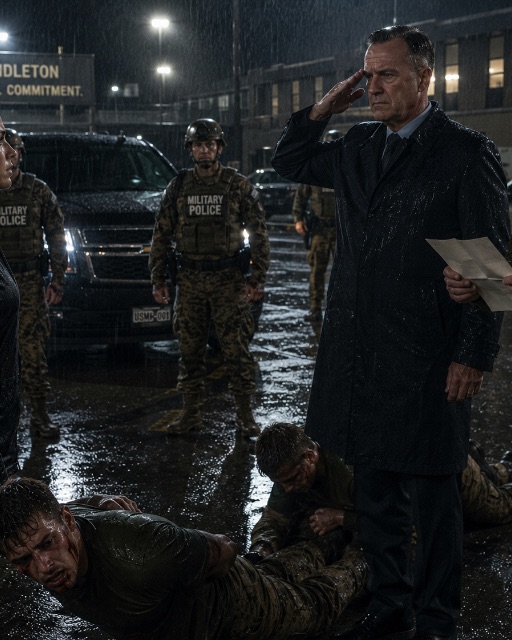
They thought the rain would hide it. They thought the cameras wouldn’t catch it. They thought nobody would believe her.
Cole Mercer didn’t come alone this time. He brought five. Not three. Five.
That was his first mistake.
The second mistake was thinking that what happened on the mats that afternoon was the worst Nora Whitaker could do. They had seen her hold back. They had seen her give warnings. They had seen her “play fair.”
At 2 AM, behind the west barracks, in a downpour so heavy the floodlights flickered, there were no instructors. No mats. No rules.
Mercer stepped forward, soaked to the bone, a smile carved across his face.
“No cameras out here, analyst,” he said. “No file to save you.”
Nora stood perfectly still. Rain ran down her jaw. She didn’t reach for a weapon. She didn’t raise her hands. She just tilted her head slightly, the way a person does when they’re listening for something far away.
“I told you to walk away this afternoon,” she said. “I’m not going to tell you again.”
One of the Marines behind Mercer laughed.
He stopped laughing forty seconds later.
What the base didn’t know – what Mercer didn’t know – was that Nora had made one phone call after dinner. Just one. To a number that wasn’t supposed to exist. And the voice on the other end had said only four words before hanging up.
By the time the MPs arrived at 2:14 AM, three men were on the ground, two were running, and Mercer was on his knees in the mud, staring at the black SUV that had just rolled silently through the compound’s front gate.
The gate nobody had authorization to open.
The passenger door swung open. A man in a charcoal coat stepped out, didn’t look at the bleeding Marines, didn’t look at the MPs, didn’t even look at the rain.
He looked at Nora. And he saluted her.
Then he turned to the base commander, who had come sprinting across the lot in his PT gear, and handed him a single folded document.
The commander read it.
His face went white.
He looked up at Nora – standing there soaked, calm, unreadable – and whispered something that made every man on that compound go silent for the rest of their careers.
Because the name at the top of that document wasn’t “Nora Whitaker.”
It was a name he’d only ever seen in classified briefings. A name that was supposed to belong to someone who died in a black site in 2014. A name that, if spoken aloud on that base, would trigger an automatic review from a division of the Pentagon that doesn’t have a public name.
Mercer looked up from the mud, blood and rain mixing down his chin.
“Who… who the hell are you?”
Nora crouched down to his level. Close enough that only he could hear.
She whispered seven words.
Mercer’s face didn’t just go pale. It collapsed. Like a man who just realized he hadn’t picked a fight with a woman.
He’d picked a fight with a ghost.
The man in the charcoal coat opened the rear door of the SUV. Nora walked toward it without looking back. No limp. No rush. No expression.
Before she ducked inside, she paused and turned to the base commander.
“You’ll want to pull Mercer’s unit from rotation,” she said, like she was suggesting he try a different restaurant. “All six of them. Permanently.”
The commander — a man who’d served three combat tours and once stared down a warlord in Fallujah — just nodded.
He didn’t argue.
Nobody argued.
The SUV pulled away through the gate. No plates. No headlights.
By 0600, every trace of Nora Whitaker had been scrubbed from the barracks. Her bunk was empty. Her file was gone. Even her name had been removed from the mess hall roster.
When Mercer’s CO asked what happened, the base commander sat him down, closed the door, and said five words that ended the conversation forever:
“You never saw her here.”
But here’s the part that still keeps Mercer up at night. The part he’s never told anyone until now.
That phone call Nora made after dinner — the one to the number that doesn’t exist?
He found out later who picked up.
And when he learned the name, he sat down on the edge of his rack and didn’t speak for three days.
Because the person on the other end of that call wasn’t her handler. Wasn’t her CO. Wasn’t even military.
It was someone Mercer had met once, two years earlier, at a briefing he was never supposed to attend, in a room underneath a building that officially doesn’t have a basement.
And that person had said only four words to Nora before hanging up.
Four words that turned a rain-soaked parking lot behind the west barracks into the last place Cole Mercer ever felt brave.
Permanent removal from rotation wasn’t what Mercer expected. He thought it meant a transfer to a supply depot in Wyoming or a recruiting station in some forgotten strip mall.
He was wrong.
For Mercer and the other five men, it meant they became groundskeepers. They were handed rakes, shovels, and lawnmowers. Their uniforms were replaced with faded green jumpsuits.
Their days were spent trimming the hedges outside the Officers’ Club and picking up trash along the chain-link fences. They were ghosts of a different sort, visible to everyone but acknowledged by no one.
The other Marines would walk past, their eyes fixed straight ahead, as if looking at Mercer and his crew was a security violation. The humiliation was a constant, grinding weight.
Mercer’s bravado crumbled into a bitter, gnawing obsession. It wasn’t about the fight anymore. It was about her. Who was she?
He spent his nights in the base library, long after his groundskeeping duties were over, abusing the lax security of the public computer terminals. He searched for the name the base commander had whispered.
Nothing. It was like searching for a word that didn’t exist in any language. Every database, every public record, every declassified archive came up empty.
Then he started searching for anomalies. He looked for gaps. Missing names from mission rosters. He searched for reports of operatives “lost” in 2014.
He found a heavily redacted after-action report about a disastrous mission in the Middle East. A team had been compromised. There was one survivor, an operative listed only as “Kestrel,” who was declared deceased after a black site was immolated to cover tracks.
Kestrel. The name felt right. Cold and sharp.
But knowing a code name didn’t help. It was another dead end, another wall in a maze designed to be unsolvable. Mercer felt himself unraveling, his sleep filled with the image of Nora’s calm eyes in the rain.
He had to know who she called. That was the key.
His break came from the most unlikely of places. One of the men from that night, a Corporal named Davis, had a cousin who worked in telecommunications. Not military, civilian. A low-level tech for a major carrier.
It was a stupid, desperate long shot. But desperation was all Mercer had left.
He met Davis’s cousin, a nervous young man named Kevin, in a coffee shop miles off-base. He slid a thick envelope of cash across the table, half of his life savings.
“I need you to trace a call,” Mercer said, his voice low. “Made from the base a few months ago. I have the time, date, and the approximate location of the caller.”
Kevin looked at the money, then at Mercer’s intense eyes. “This is a bad idea, man. Tracing a call from a military base? If I get caught…”
“You won’t,” Mercer promised, a lie he almost believed himself. “It was a personal call. Just a domestic dispute. I need to know for… for family reasons.”
Two weeks later, an encrypted email landed in Mercer’s junk folder. It contained a single string of numbers. A phone number. But there was no name attached, no address.
It was another dead end. Yet, Mercer felt a flicker of something. The prefix wasn’t from a particular state or region. It was a sterile, generic prefix often used for satellite phones or secure government lines.
He stared at the number for days, typing it into search engines, running it through reverse-lookup sites. Nothing.
Then, sitting on his rack late one night, the barracks silent around him, he remembered.
The briefing. Two years ago. Underneath the building without a basement.
He hadn’t been on the briefing list. He’d just been a guard, told to stand outside a reinforced door and make sure no one without the right clearance got within fifty feet.
But the door hadn’t been properly latched, and for a few minutes, he’d seen inside. He’d seen a handful of generals and a single civilian, a man in a tweed jacket who looked more like a history professor than a power player.
The civilian was the one talking. He was explaining a new program, something about psychological resilience and “deep cover assimilation.” He spoke about operatives who could be planted for years, their legends so perfect even they could forget who they really were until activated.
At one point, the man in tweed had put up a slide. It was a contact flowchart for a catastrophic protocol failure. A chain of command.
And at the very top of that chart, designated as the absolute last resort, was a single private number.
Mercer’s blood ran cold. He scrambled off his rack, his heart hammering against his ribs. He rummaged through an old footlocker until he found a small, worn notebook.
He used to jot down anything that seemed odd or out of place. It was a habit from his early days, a way to feel important.
He flipped through the pages, his hands shaking. And there it was. Scribbled in pencil. A string of numbers he’d copied down from the slide that day, thinking it might be useful someday.
He compared it to the number Kevin had sent him.
They were the same.
The man in the tweed jacket. The quiet academic. The one Mercer had mentally mocked as a paper-pusher who’d never seen a real fight.
He remembered the man’s name now, pulled from the recesses of his memory. It had been on the placard in front of him on the table.
Dr. Alistair Finch. A behavioral scientist.
Mercer didn’t sleep that night. He sat in the dark, the pieces clicking into place with a horrifying clarity. Nora wasn’t just an operative. She was part of Finch’s program. Finch was the one she called.
A quiet analyst. A quiet scientist. They were connected.
The next day, Mercer took his final, fatal step. He used a library computer to search for Dr. Alistair Finch. Not in classified archives, but in public records.
He found him. Dr. Finch was a widower, a renowned researcher who had retired from public life several years ago after his wife’s passing. He lived a quiet life in a Virginia suburb.
There was a recent article from a local paper about a community garden he helped fund. And in the photo, there was Dr. Finch, smiling, holding a trowel.
Standing next to him, holding a basket of tomatoes, was Nora. She was smiling, too. A real, genuine smile, not the cold calm she wore on the base. The caption identified her as his daughter.
Daughter.
It was all there. Finch hadn’t just run the program. He had rescued her. Kestrel hadn’t died in that fire in 2014. Finch had pulled her out, given her a new life, a new name, a family.
And Mercer had threatened his daughter.
The realization hit him not like a punch, but like a slow, crushing suffocation. He hadn’t just picked a fight with a ghost. He had kicked the hornet’s nest of a man who created ghosts for a living. A man who held the keys to a kingdom of shadows, all to protect the one thing he had left in the world.
And then, Mercer finally understood the four words.
The four words weren’t a command to kill. They weren’t a threat. They were something far more chilling in their simplicity.
When Nora made that call from her barracks room, her voice steady but her resolve tested, Finch had picked up immediately.
She didn’t have to explain. He already knew. The test was over. Her quiet life as an analyst was compromised.
The voice on the other end, the voice of the man who looked like a gentle history professor, had said the four most powerful words Mercer could imagine.
“Time to come home.”
It was a recall. A retrieval. An act of fatherly protection executed with the full, silent weight of the nation’s most secret apparatus.
Mercer pushed back from the computer, his face ashen. He had been a fool. His arrogance, his pride, his need to dominate the quiet woman in the room, had led him to this. He saw his entire life, his career, his future, evaporate in the face of a power he never knew existed.
His permanent removal from rotation ended a week later. He was given a dishonorable discharge for “conduct unbecoming.” No details were given. No one asked for any.
He now works the night shift at a 24-hour warehouse on the outskirts of Omaha. He loads boxes onto trucks, his movements slow and mechanical. He is a quiet man now. He keeps his head down, speaks to no one, and flinches whenever a black car drives by too slowly.
He is haunted by the ghost of the man he used to be, and terrified of the ghosts he now knows are real.
Months later, a world away, a man in a tweed jacket sits on a park bench, sipping coffee from a thermos. A young woman sits beside him, reading a book. The afternoon sun is warm on their faces.
“He was discharged,” the man says, not looking up from his coffee.
The woman turns a page. “That’s it?”
“A dishonorable discharge is a kind of death for a man like that,” Dr. Finch replies gently. “He’ll spend the rest of his life as a ‘might have been.’ He’ll be haunted by his own pride. Some prisons don’t have bars, Nora.”
Nora closes her book, a faint, peaceful smile on her lips. She leans her head on his shoulder. “I like this. Just being Nora.”
“I like you just being Nora, too,” he says, draping an arm around her.
They sit there for a long time, two quiet people in a loud world, perfectly content. They are a family, forged in fire and shadow, now living in the light. They are proof that the strongest walls are not made of concrete, but of loyalty and love.
The greatest strength isn’t found in a raised voice or a clenched fist. It’s in the quiet resilience of the human heart, and in knowing that no matter how dark it gets, there’s always a voice on the other end of the line, ready to call you home.



