
The fluorescent lights in the briefing room buzzed like a warning.
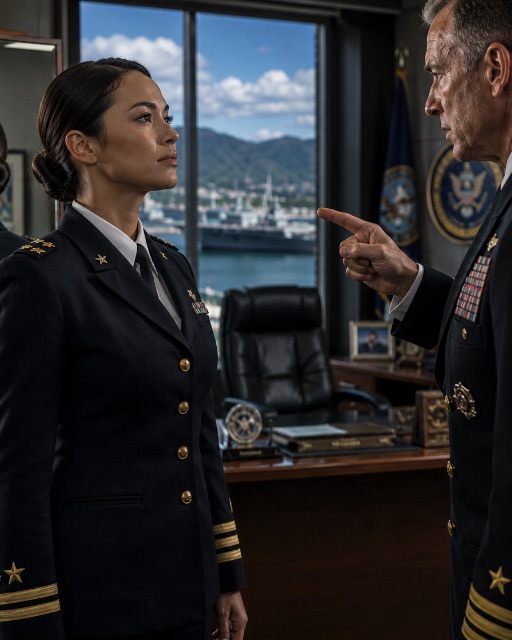
Admiral Wendell Hargrove stood at the head of the table, his face red, veins thick on his neck. Six officers sat frozen in their seats. Nobody breathed.
“Lieutenant,” he said, pointing at me. “Remove your uniform. You’re done.”
I didn’t flinch. Didn’t blink. I’d been waiting for this moment for eleven weeks.
My name is Sheila Corcoran. Thirty-two. Naval Intelligence. And for the past three months, I had been quietly dismantling the biggest weapons diversion scheme in Pacific Fleet history.
Three shipments. Javelin missiles. Classified targeting arrays. Experimental naval mines. All vanished from Pearl Harbor inventory. All replaced with paperwork so clean it could pass a congressional audit.
But not mine.
I found the first discrepancy on a Tuesday night, buried in a cargo manifest that had been countersigned by someone four pay grades above me. The kind of signature that makes junior officers stop asking questions.
I didn’t stop.
I pulled every transfer log. Every dock camera timestamp. Every fuel requisition that didn’t match a scheduled departure. I cross-referenced port authority records with classified movement orders. And slowly, like watching a photograph develop in a darkroom, a face emerged from the data.
His face.
Admiral Wendell Hargrove. Thirty-one years of decorated service. The man who personally pinned my commendation ribbon six months ago. The man who shook my father’s hand at his retirement ceremony. The man now standing five feet from me, ordering me to strip my rank.
He thought I was the leak. That’s what he’d told NCIS. That’s what he’d whispered to the JAG office. That’s the story he planted to get ahead of what he knew was coming.
“I said remove your uniform, Lieutenant. That’s a direct order.”
The room was silent. I could hear the harbor wind against the windows.
I stood up slowly. Smoothed the front of my jacket. Looked him dead in the eyes.
“You have just made the biggest mistake of your life.”
He laughed. Actually laughed. That dry, powerful laugh that senior officers use when they think rank is a shield.
“Is that a threat, Lieutenant?”
“No, sir. It’s a timestamp.”
I pulled my encrypted tablet from under the table and set it down. The screen was already live. A green light blinked in the corner – the secure uplink I’d activated ninety seconds before he opened his mouth.
“Everything you just said – and everything you’ve done for the past eleven weeks – has been monitored under a Title 10 counterintelligence authorization signed by the Secretary of the Navy.”
His laugh died.
“You don’t have that authority,” he said. But his voice cracked on the last word.
“I don’t,” I agreed. “Colonel Dana Mitchell does. She’s been listening since you walked into the room.”
The tablet chirped. A voice came through the speaker, calm and cold as deep water.
“Admiral Hargrove, this is Colonel Mitchell, Defense Criminal Investigative Service. Do not leave the building. Federal agents are entering the facility now.”
The color drained from his face like someone pulled a plug.
I watched him look toward the door. Then toward the window. Then toward his aide, a Commander named Pruitt, who was already backing away from him.
That’s when I saw it. Hargrove’s hand moved to his breast pocket.
Not for a pen. Not for his reading glasses.
He pulled out a phone – personal, unregistered, the kind you buy at a gas station – and pressed a single button.
“Who did you just call?” I said.
He didn’t answer. He just looked at me with an expression I will never forget. It wasn’t anger. It wasn’t fear.
It was relief.
The tablet buzzed again. Colonel Mitchell’s voice came back, but this time it was different. Urgent. Almost breathless.
“Sheila. We have a problem. The shipment we flagged at the port — it’s gone. It moved forty minutes ago. And the manifest has your signature on it.”
My blood went cold.
I never signed a manifest.
I looked at Hargrove. He was smiling now.
“You think I’m the only one, Lieutenant?” he whispered. “You think this is just about missiles?”
He leaned closer. Close enough that only I could hear.
“Check your father’s retirement file. Page forty-seven. Then ask yourself why they really sent you to Pearl Harbor.”
The door burst open. Two agents in tactical vests entered.
But I wasn’t looking at them. I was looking at my tablet, scrolling to a file I’d downloaded weeks ago and never opened. My father’s service record. The full, unredacted version.
I found page forty-seven.
And when I read the name listed as his classified handler for a program that officially doesn’t exist, my hands started shaking.
Because the name on that page wasn’t Hargrove’s.
It was Vice Admiral Wallace Thorne.
The world tilted. Thorne. The walking legend. The man they called “The Anchor” in the intelligence community because he held everything steady.
He was my father’s best friend. He was my godfather.
He was the one who recommended I join Naval Intelligence. He was the one who personally advocated for my assignment to Pearl Harbor, calling it a “career-making opportunity.”
The DCIS agents moved past me, their focus entirely on Hargrove. They cuffed him as he stood there, that serene, unsettling smile still fixed on his face.
Colonel Mitchell’s voice crackled from the tablet again. “Corcoran, status?”
I couldn’t form words. My mind was a frantic scramble, trying to connect dots I never knew existed.
“Sheila, talk to me. What did he say to you?”
I swallowed, the sound loud in the suddenly quiet room. “He mentioned my father’s file.”
There was a pause on the other end of the line. A long one.
“And?” Mitchell finally asked, her voice tight.
“And Vice Admiral Thorne’s name is on it.”
The silence that followed was heavier than a torpedo.
“Stay where you are, Lieutenant,” Mitchell said, her tone all business. “My people will escort you to a secure room. Don’t speak to anyone.”
The line went dead.
The agents led me out, past the stunned faces of the other officers. I walked like a robot. One of them, a young man with a slight Southern accent, tried to be gentle.
“Ma’am, we’re just going to debrief you.”
I knew what that meant. I was no longer the investigator. I was a person of interest.
They put me in a small, windowless room with a metal table and two chairs. It felt colder than it should have. For hours, I sat there, replaying Hargrove’s words.
Why did they really send you to Pearl Harbor?
It wasn’t a punishment. It wasn’t a reward.
It was a test. Or a trap.
The door finally opened. Colonel Mitchell walked in alone. She looked tired, her professional mask showing cracks around the edges. She sat down across from me.
“Your digital signature was found on the manifest for the missing shipment,” she said, without preamble. “It’s a perfect cryptographic match. You’re the prime suspect.”
“It was forged,” I said, my voice hoarse.
“I know,” she replied, and a sliver of hope cut through my despair. “The timestamp on the signature is from two days ago, at a time when you were in a secure vault reviewing signal intelligence. You were logged in, under camera. You couldn’t have done it.”
I let out a breath I didn’t realize I’d been holding. “So I’m cleared?”
“You’re alibied for the forgery,” she corrected. “You aren’t cleared of anything. The fact remains, someone with intimate knowledge of your security credentials framed you. And you just dropped the name of one of the most powerful men in the Department of Defense.”
She leaned forward, her eyes searching mine. “I need you to be honest with me, Sheila. What was your father’s relationship with Wallace Thorne?”
“Thorne’s my godfather,” I said numbly. “They served together for thirty years. He came to every one of my birthdays. He was at my academy graduation.”
He was family. The thought felt like a betrayal.
“This is bigger than Hargrove,” I added, the pieces clicking into place. “Hargrove wasn’t the mastermind. He was a field manager. Thorne is the one pulling the strings.”
Mitchell nodded slowly. “That’s a career-ending accusation to make without proof.”
“Hargrove gave me the proof. He wanted me to find it. He wanted me to go after Thorne.”
“Why?” Mitchell asked. “Why would he point you to his own boss?”
I thought about the look on Hargrove’s face. The relief. It wasn’t the look of a man who was caught. It was the look of a man who had completed his mission.
“It’s a contingency,” I realized aloud. “Hargrove knew I was closing in. He let me catch him. His arrest is the trigger for the next phase, and that phase involves me taking the fall while Thorne disappears deeper into the shadows.”
Mitchell ran a hand over her face. “This is insane.”
“They sent me here to fail,” I continued, the theory solidifying. “Maybe I was getting too good, too close to something back in DC. They put me on this case, expecting me to either miss the diversion or get tangled in it. When I actually succeeded, they activated this plan to discredit me and the entire investigation.”
“If you’re right,” Mitchell said, looking at the door as if expecting agents to burst in, “then I can’t protect you. Thorne’s reach is everywhere. The moment you are formally processed, you’ll be buried under so much red tape and legal trouble you’ll never see daylight again.”
She stood up. “Which is why you’re not being formally processed.”
I looked at her, confused.
“I have you logged as being in a secure debriefing for the next 72 hours. That’s the window I can give you,” she said, her voice dropping to a whisper. “After that, my hands are tied. I’ll have to issue a warrant for your arrest.”
“What am I supposed to do?”
“Hargrove’s aide, Commander Pruitt. He looked terrified. Scared men talk. He’s being held on the third floor of the JAG building. His lawyer is a civilian from off-base.”
She slid a small, anonymous-looking key card across the table. “This is a back gate pass. There’s a gray sedan in the visitor lot. Keys are in the glove box. My name isn’t on any of it.”
It was an incredible risk for her to take. “Colonel, why are you doing this?”
“Because thirty years ago, my father was a chief petty officer who had his career ruined by a ‘misunderstanding’ with a powerful officer,” she said, her eyes hard as granite. “I believe you. And I don’t like bullies, no matter how many stars are on their collar. Now go. Find me something I can use.”
I was out of the building in five minutes. The Hawaiian air felt different, thick with humidity and paranoia. I found the car and drove, my mind racing.
Pruitt. The weak link. I tailed his lawyer’s car from the base to a small coffee shop in Honolulu. I waited until the lawyer came out, then I made my move.
I found Pruitt in a small, private conference room, looking pale and sick.
“Commander,” I said, stepping inside and closing the door.
He jumped, his eyes wide with fear. “Lieutenant Corcoran? You shouldn’t be here. They said you were…”
“Under arrest? Framed? I am. By the same people you’ve been working for.”
“I don’t know what you’re talking about,” he stammered, avoiding my gaze.
“Yes, you do,” I said, my voice soft. “I saw your face in that briefing room. You’re not like Hargrove. You’re not a true believer. You’re just a man who followed orders and is now in way over his head.”
I sat down across from him. “Hargrove is gone. He’s going to prison for the rest of his life. But he’s not the one who signed away the missiles with my digital key. That was someone with high-level access to the base server. Someone like a flag officer’s aide.”
His face went white. He opened his mouth to deny it, but no sound came out.
“They used you, Pruitt,” I continued, pressing the advantage. “They made you the triggerman to frame me. And when this is over, do you think they’re going to protect you? You’ll be the loose end they tie off.”
He finally broke, tears welling in his eyes. “I didn’t have a choice. You don’t understand. It’s not just Hargrove. It’s… a network. They call themselves ‘The Sentinels.’ They believe the Navy’s leadership is failing the country. They’re positioning their own assets.”
“And the weapons?”
“They’re not selling them for cash,” he whispered. “They’re trading them. For political favors. For influence. Building a shadow arsenal for a war they think is coming.”
“Thorne,” I said. “He runs it.”
Pruitt nodded. “From the very top. He recruits officers he thinks are true patriots. Men like Hargrove. Men like your father.”
My heart pounded in my chest. “My father?”
“He was one of them. Part of Project Nightshade. That was the original name for The Sentinels. But your father got out. He retired. Thorne saw it as a betrayal. That’s why he sent you here. To see if the apple fell far from the tree. Or if he could use you to hurt your father.”
The betrayal was deeper and colder than I could have imagined. My whole life, my whole career, had been a move in someone else’s chess game.
“I need proof, Pruitt. Something that leads directly to Thorne.”
He hesitated, then seemed to make a decision. “Hargrove had a ledger. A physical one. He didn’t trust digital. He called it his ‘fire insurance.’ It details every transaction, every name. He keeps it in a place no one would ever look.”
“Where?”
“In the base archives. A storage box under your father’s name. A box of his old service mementos that Hargrove offered to store for him as a ‘favor’ after he retired.”
It was twisted. It was diabolical. And it was brilliant. Who would ever look for an admiral’s criminal ledger inside a retired officer’s box of memories?
Getting into the archives was the easy part. The back gate pass Mitchell gave me was still valid. Finding the box was harder. It was filed under a non-service-related code. But Pruitt gave me the number.
Box 1138. Corcoran, A.
I found it in a dusty corner of the basement. My dad’s name was on the label: Captain Andrew Corcoran. My hands trembled as I sliced open the tape.
Inside were old photos, a spare set of captain’s bars, a program from his retirement ceremony. And underneath it all, a slim, leather-bound book.
I opened it. It was filled with Hargrove’s precise handwriting. Dates, shipping codes, account numbers, and names. So many names. Officers I knew. Politicians. Corporate leaders. And at the very top of the first page, one entry: “W.T. – Anchor.”
I had him. I had them all.
I took a picture of every single page with a burner phone I’d bought, then uploaded the encrypted files to a secure cloud server only I had access to.
Just as the last file finished uploading, the archive door creaked open.
It wasn’t Mitchell. It was Vice Admiral Thorne. He stood there in his perfect dress whites, looking more disappointed than angry.
“Sheila,” he said, his voice calm and paternal. “I was hoping it wouldn’t come to this.”
“So was I, sir,” I said, my hand resting on the heavy ledger.
“I built this country’s intelligence network, Sheila. Did you really think you could use it against me without my knowing?” He took a step into the room. “Colonel Mitchell is a good officer, but she’s predictable. Her loyalty to the rules is her weakness.”
“And her strength,” I shot back.
“Hargrove was a fool,” Thorne continued, ignoring me. “Emotional. He always admired your father too much. This whole stunt, pointing you to the ledger… it was his idea of poetic justice. He wanted you to burn it all down. He felt we’d lost our way.”
That was the twist. Hargrove’s relief wasn’t about completing a mission for Thorne. It was about starting one against him. He knew he couldn’t stop Thorne from the inside, so he armed me to do it from the outside.
“Your father saw the truth, too,” Thorne said, his voice dropping. “That’s why he left. He didn’t have the stomach for what must be done to keep this country safe.”
“What you’re doing isn’t keeping the country safe,” I said. “It’s holding it hostage.”
“Semantics,” he waved his hand, and for the first time, I saw the fanaticism in his eyes. “I gave you a chance, Sheila. I brought you here. I wanted you to join us. To continue your father’s legacy. Our legacy.”
He took another step. “Give me the ledger, and we can forget this ever happened. You can have any post you want.”
“It’s too late, Admiral. The files are already sent.”
He smiled, a sad, knowing smile. “Sent where? To Mitchell? By the time she gets through the encryption, my people will have cleaned the house. You have nothing.”
“You’re right,” I said. “I didn’t send them to her.”
His smile faltered.
“See, I learned from you. The system is compromised. So you have to work outside of it. I sent them to the one person in Washington who hates you more than anyone I know.” I named a rival four-star admiral, a man Thorne had politically neutered years ago, who was now chair of a powerful oversight committee. “I sent them to his personal email. And I’m guessing he doesn’t care much for encryption when it comes to getting revenge.”
The color drained from Wallace Thorne’s face. The Anchor had come loose from his moorings.
His phone buzzed. He looked at it, and the last of his composure shattered. He looked up at me, a man who had held the secrets of the world, now utterly exposed.
“You,” he whispered, with pure venom.
The archive doors burst open, but it wasn’t his people. It was Colonel Mitchell and a team of federal agents. She had my back after all.
“Vice Admiral Thorne,” she said, her voice ringing with authority. “You are under arrest.”
The conclusion was swift but quiet. To avoid a national scandal, Thorne was allowed to “retire for health reasons” before being indicted by a secret grand jury. His network, The Sentinels, was dismantled from the inside out, using the very ledger Hargrove had left for me. Pruitt’s testimony earned him a plea deal and an honorable discharge.
I was cleared of all charges. My name was restored.
A week later, I found myself on the porch of my father’s house in Virginia, overlooking the Blue Ridge Mountains. He was sitting in his rocking chair, holding a cup of coffee.
“I read about Thorne in the papers,” he said, not looking at me.
“Dad,” I started. “I know about Project Nightshade.”
He finally turned to me, his eyes full of a sadness I hadn’t understood before. “I thought it was patriotism, Sheila. For a long time, I believed it. But patriotism, when it’s twisted by pride and power, just becomes tyranny. I couldn’t be a part of it. Leaving was the hardest and best thing I ever did.”
He looked at me, a glimmer of pride in his old eyes. “You’re a better officer than I ever was. You didn’t just follow the trail. You held the line.”
Colonel Mitchell offered me a promotion and a new post in DC, working directly for her. A chance to rebuild.
The real lesson wasn’t about conspiracies or spies. It was simpler. Loyalty to a person, or even a uniform, is conditional. But loyalty to the truth, to what’s right, is absolute. Hargrove, in his own broken way, understood that in the end. He couldn’t fix the mess he’d made, but he could put the tools to do it into the right hands.
Sometimes, the most patriotic act is not following orders, but questioning them. It’s about remembering that the uniform represents an ideal, and when the people wearing it betray that ideal, you don’t abandon it. You fight to reclaim it.



