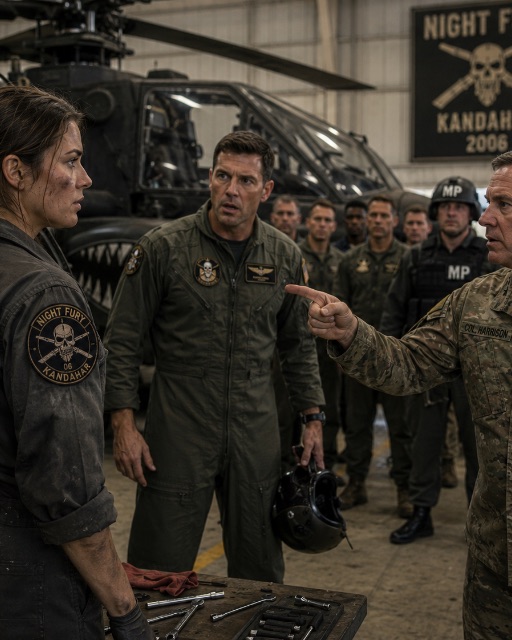
Before sunrise, the hangar was all pale sand and cold metal. Floodlights humming. A flag outside snapping once in the wind like a quiet reminder the day had started whether you were ready or not.
I had my sleeves rolled and my gloves on. The Apache sat in the bay, dark and still. I laid my tools out in a straight line and opened an access panel, working the checks the same way I had for years – slow enough to be precise, fast enough to be finished before anyone decided I was worth noticing.
That was the job. Be useful. Keep the work clean. Let the aircraft speak for you.
Mechanics filtered in with the morning noise. Boots on concrete. Energy drinks cracking open. Half-finished stories from the barracks.
“Early again?” one of them called out. More amused than unkind. “You live in here, Karen?”
I didn’t look up. “Morning,” I said, and kept turning the wrench.
They drifted away. Interest fading the second I refused to be entertainment.
Then it happened.
I reached for a torque wrench and my sleeve rode up – just enough to show the edge of an old patch stitched high on my arm. Black and gold. Faded like it had survived things it wasn’t supposed to.
I pulled the fabric down. Instinct. Habit. Privacy.
By midday the hangar had its rhythm. Checklists. Chatter. The clean bite of hydraulic fluid in the air. A captain passed with a clipboard.
“Need this bird ready by fourteen-hundred,” he said without meeting my eyes. “No surprises.”
“No surprises,” I echoed. Because I didn’t give people reasons to remember my name.
Then the pilot walked in.
Late for briefing. Helmet tucked under his arm. Flight suit crisp. Confidence effortless. He took two steps past me.
And stopped.
Not a stumble. Not a pause. A full stop – like something had snagged on the edge of his attention and yanked him back.
His gaze wasn’t on the aircraft. Wasn’t on the panel.
It was on my sleeve. On that worn patch I’d tried to hide.
He came one step closer. Careful. Like he didn’t want to misread what he was seeing.
“Ma’am,” he said. His tone shifted into something precise. Something different. “Where did you get that patch?”
I kept my hands steady on the metal. Eyes down. Like nothing had changed.
But the hangar quieted anyway. Conversations thinned. Boots stopped. Even the guys who’d joked earlier went still, watching without understanding why they were watching.
The pilot’s fingers tightened once around his helmet.
Then he said one more thing – soft, professional, and unmistakably familiar. Not a question anymore.
A confirmation.
“Night Fury squadron,” he whispered. “Kandahar. 2006.”
My hands stopped moving.
He took one more step. His voice dropped so low only I could hear it.
“You’re not a mechanic,” he said. “You’re the one who flew the extraction that night. The one they told us didn’t make it back.”
I finally looked up.
His face drained of color. Because he recognized mine – not from a briefing room. Not from a manifest.
From the memorial wall he’d walked past every morning for seventeen years.
He took a step back. His mouth opened. The helmet slipped from his grip and hit the concrete with a sound that echoed through the entire hangar.
Every head turned.
He looked at me like he was staring at a ghost. And then he said the name — the call sign — that hadn’t been spoken out loud since the night they told his unit no one survived.
The name that was still engraved on a brass plate bolted to the wall six buildings away.
My name.
I set down the wrench. Pulled my sleeve up all the way. Let the full patch show — the skull, the rotor blade, and the date stitched underneath in thread so faded you had to know what it said to read it.
His eyes filled. His jaw clenched.
“How?” he breathed.
I looked at him for a long moment. Then past him — at the row of mechanics now frozen in place, at the captain with his clipboard lowered, at the morning that had just become something none of them would ever forget.
I opened my mouth to answer.
But before I could speak, a door at the far end of the hangar slammed open. A colonel walked in, flanked by two MPs.
He pointed directly at me.
And said five words that made the pilot’s face go from shock to fury:
“That woman is under arrest.”
The colonel’s eyes locked on mine.
Cold. Familiar.
Too familiar.
Because I knew him too. From that same night. From that same flight.
The pilot turned toward him instantly. “Sir — what is this? She’s—”
“Stand down,” the colonel snapped.
Not loud. But final.
The MPs moved in. Fast. Like they’d been waiting for this moment. Like the order had been sitting in a drawer for seventeen years, waiting for someone to open it.
The pilot stepped between us. “With respect, sir, you don’t understand who she is—”
“I understand exactly who she is,” the colonel said.
And for the first time…
there was something else in his voice.
Not authority. Not control.
Fear.
He looked straight at me. And said it. Quiet enough that only I could hear.
“You were never supposed to come back.”
The hangar went dead silent.
Because whatever happened that night in Kandahar… wasn’t an accident.
And I wasn’t the only one who survived it.
I felt the cuffs touch my wrist. Cold. Familiar in their own way.
And that’s when I smiled.
Because the colonel didn’t know what I’d been doing in this hangar for the last eleven months. He didn’t know who I’d been waiting for. He didn’t know about the second patch — the one stitched on the inside of my jacket, the one with a name on it that wasn’t mine.
The pilot saw my face. Saw the smile. And something behind his eyes changed — like he finally understood I hadn’t been hiding.
I’d been hunting.
I turned my wrist just enough for the colonel to see what I was already holding in my palm.
The color left his face the same way it had left the pilot’s — only faster. Worse.
Because the small object resting against my glove was something only three people on earth had ever seen.
And two of them were supposed to be dead.
The object in my palm was a small silver locket, tarnished by time and dirt. Not military issue. Something personal. It was dented on one side, as if it had stopped something small and fast.
Colonel Davies stared at it, his carefully constructed composure shattering like glass. His breath hitched.
The pilot, Captain Thorne, looked from the locket to the colonel’s face. Confusion warred with a dawning, terrible suspicion.
“Sir, what is going on?” Thorne demanded, his voice low but insistent.
Davies ignored him. His focus was entirely on me, on the locket. “Where did you get that?” he hissed, the words barely audible.
“You know where,” I said softly. My voice was even, calm. All the panic had been burned out of me years ago in a burning wreck. “He gave it to me. Right before the end.”
A flicker of memory then, sharp as shrapnel. The acrid smell of smoke and burning fuel. The scream of twisted metal. My co-pilot, Sergeant Richard Evans, pushing me out of the cockpit door.
His face was streaked with soot and blood. “Go,” he had gasped, pressing the locket into my hand. “Don’t let him get away with it. Tell them.”
I didn’t need to ask who “he” was. We both knew. Then-Major Davies, on the comms, giving us coordinates that led us straight into an ambush. Coordinates that were supposed to be our rescue.
“He told me to run,” I said, looking back at Davies. “He told me to live. And he told me to hold onto this until the time was right.”
The MPs hesitated, their hands hovering near my wrists. They were soldiers trained to follow orders, but the scene unfolding in front of them was from no training manual.
Thorne took a definitive step to my side, planting his feet. He was a captain, Davies a full colonel. It was an act of career suicide. “I’m not standing down, sir,” he said, his voice ringing with conviction. “Not until I know why you want to arrest a hero we all thought was dead.”
Davies’s face turned a blotchy red. “Captain Thorne, this is a matter of national security. You are interfering with a lawful order!”
“Is it security, sir?” I asked, unzipping my dusty work jacket. “Or is it something else?”
I peeled back the lapel. Sewn onto the inside lining was another patch. It wasn’t a squadron patch. It was a simple name tag, the kind sewn onto a uniform.
EVANS.
Thorne’s eyes widened. He remembered the name from the casualty list. The pilot and the co-pilot. Lost together.
“You see,” I continued, my gaze never leaving the colonel’s panicked eyes. “Rich knew you’d never stop looking for me. He knew you’d scrub my records, declare me dead, and bury the truth so deep no one would ever find it.”
I held up the locket. “But you forgot about this. And you forgot about him.”
With my thumb, I pried open the delicate clasp. The dent had jammed it slightly, but it gave way with a faint click.
It didn’t contain a picture.
Inside, nestled in the velvet lining, was a tiny, tightly folded piece of paper. It looked ancient, fragile.
Davies lunged. “Don’t!”
But it was too late. One of the MPs, acting on instinct, put a hand on the colonel’s chest, holding him back.
I unfolded the paper carefully. On it was a single line of text, written in neat block letters. A serial number.
Thorne leaned closer to read it. It was a long string of letters and numbers. It meant nothing to him.
But it meant everything to Davies.
“That night wasn’t an extraction mission, Captain,” I said, my voice carrying across the now-silent hangar. The other mechanics were gathered in a wide, silent circle. “It was a cleanup operation.”
I looked at Davies. “We weren’t sent to save a compromised asset. We were sent to be silenced. Rich and I stumbled onto something we shouldn’t have. An off-book inventory of Stinger missiles.”
I held up the paper. “This is the serial number from one of the crates. A crate then-Major Davies had signed for and reported as ‘lost in a transport incident.’”
Davies’s eyes were wild. “She’s lying! She’s a traitor who faked her own death!”
“Did I?” I replied. “Then why did you just try to stop me from showing this? Why does the sight of this locket make you look like you’ve seen a ghost?”
The pilot, Thorne, finally understood. His face hardened into a mask of cold fury. He had mourned these pilots. He had toasted their memory. His unit had carried their loss for seventeen years.
“So you shot them down,” Thorne said, his voice dangerously low. “You set them up and had them eliminated to cover your tracks.”
“Prove it!” Davies spat, regaining a sliver of his bluster. “It’s the word of a deserter against a decorated colonel!”
He was right. It was my word against his. A ghost’s word.
But I wasn’t counting on just my word.
“You’re right, Colonel,” I said, a real smile touching my lips for the first time. “It is just my word.”
I paused, letting the silence hang heavy in the air. “But it’s not just my story.”
A new sound entered the hangar. The slow, rhythmic step of someone walking deliberately from the shadows at the far end of the building.
Every head turned.
A man emerged into the light. He was older, with graying hair and a face etched with lines of hardship. He wore simple civilian clothes, but he walked with a familiar, disciplined gait.
He had a noticeable limp.
He came to a stop beside me, his eyes, clear and steady, finding Colonel Davies.
Davies’s jaw went slack. The last of his authority crumbled into dust. He looked like his world had just ended.
The man gave a small, sad smile. “Hello, sir,” he said. “It’s been a long time.”
It was Sergeant Richard Evans.
Thorne gasped. The other mechanics murmured in disbelief. He was the other name on the memorial wall.
Evans held up a small, discreet audio recorder. A tiny red light was blinking. “You have the right to remain silent, Colonel. But I highly recommend you don’t. We’ve been recording since you ordered Karen’s arrest.”
The MPs looked at each other, then at Davies, their allegiance dissolving in real time. They were soldiers of the United States Army, not a corrupt officer’s private enforcers.
“How?” Davies whispered, his voice broken. “You were… the crash…”
“I was,” Evans confirmed. “But Karen pulled me from the wreck before she ran. Found a local family who hid me, patched me up. It took years to heal, to find a way back.”
He looked at me, a lifetime of gratitude in his gaze. “She never gave up on me. And I never gave up on bringing you to justice.”
He turned back to Davies. “I’m the one who got her this mechanic’s job. I knew you were being transferred here. We were just waiting for the right moment. Waiting for a witness.”
He nodded toward Captain Thorne. “Someone who was there that night. Someone whose word couldn’t be dismissed. We just had to wait for him to recognize her.”
The entire plan laid bare. It wasn’t an accident. It was a trap, years in the making. A trap built on patience, loyalty, and the unshakable belief that the truth had to come out.
The hangar doors slid open again, this time revealing the base commander, a stern-faced general, flanked by more security personnel. He had clearly been alerted to the situation.
Thorne strode forward and saluted sharply. “General, sir. Captain Thorne. I wish to report evidence of treason and a conspiracy to murder two US Army pilots, perpetrated by Colonel Davies.”
He pointed to me and Evans. “And here are the two pilots he tried to kill seventeen years ago.”
The general’s eyes took in the scene. The terrified colonel. The two living ghosts. The determined captain. The silent audience of mechanics. The small, silver locket still in my hand.
He looked at Davies, his expression one of utter disgust. “Colonel,” he said, his voice like ice. “You are relieved of your command. Escort him to the brig.”
The MPs, no longer hesitant, firmly took Davies by the arms. He didn’t resist. He was a hollowed-out man, his legacy destroyed in the space of ten minutes.
As they led him away, his eyes met mine one last time. They held no anger. Only the bleak, empty recognition of final defeat.
Weeks later, the dust had settled. The official inquiries were concluded. The story had been corrected.
I stood in my dress uniform, the fabric crisp and unfamiliar after so many years in grease-stained coveralls. Beside me stood Richard Evans, leaning lightly on a cane, and Captain Marcus Thorne.
We were in front of the memorial courtyard. The wall was made of polished black granite, engraved with the names of the fallen.
A maintenance worker was just finishing his work. Where the small brass plate bearing my name and Richard’s had been, there was now just smooth, blank stone.
We were no longer ghosts. We had our lives back. Our honor had been restored.
Marcus shook his head, a slow smile on his face. “For seventeen years, I walked past this wall and thought of the pilot who flew into hell to save my team. I never imagined I’d get to thank her in person.”
“You did thank me, Captain,” I said. “You stood your ground in that hangar. You chose to believe in a hero over a lie. That was all the thanks I ever needed.”
Richard put a hand on my shoulder. “We did it, Karen. We finally did it.”
Looking at the empty space on the wall, I felt not triumph, but a quiet, profound sense of peace. The journey had been long and impossibly hard, paved with loss and loneliness. But it was over.
Some battles are not won with explosions and grand charges. They are won with quiet endurance. They are won by holding onto a small, silver locket in the dark, waiting for the sun to rise. They are won by simply refusing to let the truth die, even when the world has already written your eulogy.
And that is a victory that lasts forever.