
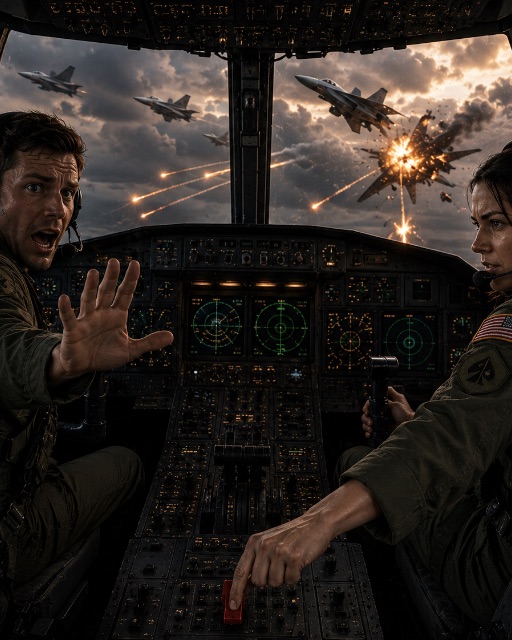
The master alarm started as a chirp and turned into a scream. My spine locked.
Eight red dots on the scope. Fast movers. Closing.
“Renee,” I croaked. “Tell me that’s a glitch.”
Captain Renee Mercer didn’t blink. White-knuckle grip on the yoke. Eyes on the horizon. Too calm. Wrong kind of calm.
Command came on. Nearest support: forty minutes. We had three.
I thought about bailing. She told me to check the cabin.
I stumbled back, yanked the hatch, and the cold hit me first – then the truth.
Stretcher after stretcher strapped to the rails. IV bags swaying. Forty wounded soldiers. And in the center, twelve kids webbed together under blankets. A little boy hugged a chewed-up dinosaur and whispered, “Are the bad planes coming?”
I couldn’t answer. If we jumped, they died.
I lunged for the radio. “We’ll comply – ” I didn’t finish. Renee’s hand clamped my wrist like a vice.
Then she ripped the comm wire clean out. Sparks kissed the console.
“Strap in,” she said. Metal in her voice.
I froze. Out the right window, two sleek fighters slid up so close I could see the pilot’s visor. Tap-tap on his helmet. Point down. Land now.
MISSILE LOCK. MISSILE LOCK. MISSILE LOCK.
My heart punched through my ribs. “We surrender! We—”
Renee’s heel slammed the rudder. She rolled us toward the threat. Not away—into it.
Then she peeled back duct tape I’d never noticed under her seat. A hidden panel. A keypad. A fat red toggle.
She typed a code with steady fingers. Somewhere deep in the belly, something heavy unlatched. The whole floor… shifted.
I looked at her. She wasn’t the quiet “bus driver” anymore. She was someone I’d never met.
She flipped the red switch.
And as the panels under our wings snapped open, I finally saw what she’d been hiding this entire time.
It wasn’t weapons. There were no missile pods or gun barrels.
It was an array of strange, crystalline emitters and matte-black dishes that hummed with a low, resonant power. They felt… alive.
“What is that?” I yelled over the engine’s roar.
Renee didn’t answer with words. She banked the lumbering transport plane so hard the g-force pushed me deep into my seat.
The enemy pilots must have thought her insane. A flying brick trying to dogfight.
Then the world on my scope dissolved into madness.
The eight red dots blinked. Then they became sixteen. Then fifty. Then a hundred. A swarm of phantom contacts flooded the enemy’s radar.
My own screen cleared, showing only the eight true hostiles, now lost in a digital blizzard of her making.
A torrent of garbled audio poured from the enemy’s frequency, which my systems were still monitoring. I heard panicked Russian, then confused Mandarin. Two different sets of aggressors.
“They’re shooting at ghosts!” I shouted, watching two missile trails curve harmlessly into empty sky, chasing phantoms.
Renee’s face was a mask of concentration. Her hands danced over the hidden console, a blur of motion.
She wasn’t just flying a plane. She was conducting an orchestra of chaos.
She pointed our nose directly at a mountain peak ahead, a move that screamed suicide.
The lead enemy fighter, breaking free from the confusion, took the bait. He lined up for the perfect kill shot on our tail.
“Renee, pull up! Pull up!” I screamed.
She held her course. The ground-proximity alarm began its frantic wail.
At the last possible second, she cut the engines to near idle. The plane dropped like a stone, a gut-wrenching fall of a thousand feet.
The enemy fighter, locked onto our previous trajectory, couldn’t react in time. He fired a volley of cannon shells straight into the mountainside where we should have been.
We leveled out just above the jagged rocks, the bottom of our fuselage screaming as it scraped against stone.
Renee powered the engines back up, and we clawed our way back into the sky, leaving the confused and scattered fighters behind us.
I watched the red dots on my scope recede, breaking off in different directions, their hunt a failure.
The silence in the cockpit was heavier than the noise had been. The only sound was the steady drone of our engines.
I slumped in my seat, my body trembling with leftover adrenaline. My mind was reeling.
I looked at Renee. She was just a pilot again, calmly checking her gauges, her breathing even.
The mockery from the fighter jocks at the airbase replayed in my head. They called her “The Transporter,” “The Bus Driver.” They teased her for flying a “boring” route, hauling supplies and personnel while they danced with death in the skies.
I had bought into it. I saw her as my unassuming, by-the-book captain on a milk run.
I had never been so wrong.
“Who are you?” I finally managed to ask, my voice barely a whisper.
She took a long, slow breath before speaking. “A long time ago, I wasn’t a bus driver, Ben.”
She finally used my name.
“I was an engineer,” she continued, her eyes fixed on the horizon. “A systems architect.”
“For what? What was that back there?”
“Project Chimera,” she said. The name meant nothing to me. “It was an advanced electronic warfare and camouflage system. The idea wasn’t to fight back. It was to disappear. To become a ghost in the machine.”
The system she had just used. It was hers. She built it.
“They put me in the cockpit to test it. I knew it better than anyone. We were proving it worked. We were untouchable.”
Her voice held a note of pride, but it was edged with a deep, lingering sadness.
“So what happened? Why are you flying this… this bus?” I asked, gesturing around the old, rattling cockpit.
She was quiet for a long moment.
“A senator came for a demonstration. A man with a big ego and a lot of influence. He wanted to see it up close.”
“He insisted on riding in the test plane. Against my judgment. Against protocol,” she said, her grip tightening on the yoke.
“During a high-g maneuver, a power conduit I’d red-flagged for replacement a week earlier finally gave out. It caused a minor surge. The system re-calibrated, but for three seconds, we were blind.”
She paused. “Three seconds is an eternity.”
“The senator panicked. He thought we were under attack. He grabbed a fire extinguisher and smashed it into a secondary control panel, trying to ‘help’.”
“The foam shorted out half the cockpit. We started to go down. I managed to land it, but it was a controlled crash. He broke his leg.”
My blood ran cold. I could see where this was going.
“They needed a scapegoat,” Renee said, her voice flat. “They couldn’t admit a powerful senator had endangered a multi-billion-dollar project. They couldn’t admit the brass had ignored my maintenance requests.”
“So they blamed the pilot. “Pilot error.” They said I pushed the system too hard. They said I was reckless.”
“They buried Chimera, labeling it ‘unstable.’ And they buried me right along with it. Grounded me. Stripped my test-pilot wings. Sent me here, to fly the safest, most boring routes they could find.”
The injustice of it was a physical weight in my chest. All that skill, all that genius, thrown away to protect a powerful man’s pride.
“But the system… it’s on this plane,” I said, confused. “How?”
A faint smile touched her lips for the first time. “I have a friend. My old commander. General Thornton. He never believed the official story.”
“He knew they’d put me on this route, through contested airspace. He had a team secretly install a Chimera prototype on this old bird. ‘Just in case,’ he said. He’s the one who had me duct tape the panel. Make it look like a field repair.”
So this wasn’t an accident. We were meant to be a decoy, a target, to test her and the system in a live-fire scenario. The thought made me sick.
Then a new, chilling realization dawned on me.
“Renee… those fighters weren’t just on patrol, were they? They were hunting for us specifically.”
Her calm demeanor cracked for a second. Worry flickered in her eyes. “Their coordination was too good. Their approach was too aggressive for a random encounter.”
“They knew we were coming.”
My mind raced. Why would they send eight advanced fighters after a single, ancient transport plane? It was overkill. Unless…
Unless it wasn’t the plane they were after.
“I need to check on the passengers,” I said, unbuckling.
I hurried back into the cargo bay. A young nurse, Sarah, was checking on the wounded soldiers. They were all stable, shaken but unharmed.
My eyes went to the children in the center. They were huddled together, some crying quietly.
I knelt beside the little boy with the chewed-up dinosaur. The one who had asked if the bad planes were coming.
“Hey, champ,” I said softly. “You okay?”
He looked up at me with wide, dark eyes that seemed too old for his small face. He just nodded, hugging his toy tighter.
Something about him was different. The other kids had torn clothes, smudges of dirt on their faces. This boy’s jacket was clean, his hair neatly combed.
And around his wrist was a small, plastic hospital band. But it wasn’t from the field hospital. It was a different color, with lettering I didn’t recognize.
I gently took his wrist. He didn’t resist. The band had a name, “Daniel,” and a string of numbers. It looked more like a registration code than a medical ID.
Sarah, the nurse, came over. “He won’t let go of that dinosaur,” she whispered. “Hasn’t said a word to anyone but you.”
I looked at the dinosaur. It was a cheap plastic toy, but it felt… heavy. And there was a thin, almost invisible seam running along its back.
My heart began to pound again, but for a whole new reason.
I leaned in close to the boy. “Daniel,” I whispered. “Did your father give you that toy?”
He nodded again, a single, solemn movement.
“Did he tell you to keep it very, very safe? And only give it to a man with a beard and gray hair?”
His eyes widened in recognition. He’d been given a description. General Thornton.
It all clicked into place. The high-level extraction. The specific targeting. The children as cover.
This boy, Daniel, was the package.
I raced back to the cockpit. “Renee, it’s one of the kids. A boy named Daniel. He’s the target.”
She looked at me, her face grim. “I was afraid of that. Thornton told me there was a ‘sensitive asset’ on board. He didn’t say it was a child.”
“They have to know,” I said. “The enemy. They knew he was on this flight. That means our destination, Base-7, is compromised. They’ll be waiting for us there.”
Renee’s jaw was set. She was already thinking three steps ahead.
“Base-7 is out,” she agreed. “They’ll have everything from surface-to-air missiles to ground troops waiting to ‘welcome’ us.”
“So where do we go? We’re low on fuel. We can’t stay in the air forever.”
She pulled up a detailed topographical map on her secondary screen. “There’s another option. An old Cold War-era airstrip. It’s decommissioned. Not on any modern charts.”
She pointed to a spot deep in a treacherous mountain range called the Serpent’s Spine. “It’s called Shepherd’s Landing. Thornton and I used it for Chimera tests. The hangar is shielded. We can land there, but the approach is a nightmare. It’s a one-way ticket through a canyon.”
As if on cue, my threat display lit up again.
This time it was four dots. But they were moving with a focused, disciplined precision the first group lacked. They weren’t coming for a fight. They were coming for a kill.
“They’ve sent their aces,” Renee said, her voice dangerously low. “They know they were tricked. They won’t fall for the same thing twice.”
“Renee, the system… can it handle four more?”
“The first attack drained the primary power cells,” she admitted. “We’re running on auxiliaries. I have maybe one or two tricks left. They have to be good ones.”
She pushed the yoke forward, diving toward the jagged peaks of the Serpent’s Spine. The entrance to the canyon was a thin crack in the rock, a needle she had to thread with a bus.
The enemy fighters were on us in minutes. Warning tones screamed through the cockpit.
“Ben, I need you,” she said, her voice calm and clear. “Divert all non-essential power to the Chimera system. I need every drop you can give me.”
My panic was gone. It had been replaced by a cold, sharp focus. I was no longer a passenger. I was her co-pilot.
I worked the power distribution board, shutting down everything but flight controls and her system. The cabin lights died. The heating cut out. We were running dark and cold.
“Power is routed,” I confirmed.
We entered the canyon. The rock walls were so close I felt like I could reach out and touch them. The enemy fighters couldn’t fly side-by-side. They had to fall into single file behind us.
The lead pilot was skilled, staying just outside the effective range of our phantom imagery. He was waiting for a straight path to get a missile lock.
“He’s not taking the bait,” I said.
“He doesn’t have to,” Renee replied. “He just has to follow us. But he doesn’t know this canyon like I do.”
She banked sharply to the left, revealing a fork in the canyon I hadn’t seen on the map.
Then she did something incredible. She activated Chimera, but not to create a swarm of targets.
She projected a single, perfect image of our plane continuing straight. At the same time, she cut our real plane hard to the left, into the other fork, hugging the rock wall.
For a moment, there were two transport planes in the canyon.
The enemy pilot behind us, forced to make a split-second decision, followed the ghost.
We heard the explosion echo through the rock as he flew his multi-million-dollar fighter jet straight into a dead-end cliff face. A karmic end for a hunter following a ghost.
“One down,” I breathed.
The remaining three were more cautious. They stayed back, tracking us by heat signature.
“The next part is the riskiest,” Renee said. “Chimera has one last function. A full-spectrum cloak. It will make us invisible to radar, thermal, and visual for about sixty seconds. But it takes all our power. We’ll be gliding blind.”
“Do it,” I said without hesitation. I trusted her.
She engaged the system. The hum from the emitters changed pitch, rising to an almost unbearable whine.
Outside, the world seemed to ripple, like a heat haze. And then we were gone. My own console showed our heat signature just… fading to nothing.
We were a ghost. A 70-ton glider whispering through a canyon.
The sixty seconds felt like a lifetime. I counted each one in my head, my hands gripping the console. The silence was absolute.
Then the power came back on with a jolt. The engines sputtered back to life.
Ahead of us, I saw it. A flat stretch of cracked concrete. Shepherd’s Landing.
We were home free.
As Renee brought us in for a rough but perfect landing, a lone military jeep raced out from a hidden hangar to meet us.
The man who stepped out was older, with a stern face, a neatly trimmed gray beard, and the stars of a General on his collar. General Thornton.
The cargo ramp lowered, and I helped Sarah lead the children out into the crisp mountain air.
Thornton walked right past me, right past Renee, and straight to the small boy.
He knelt down, his stern face softening. “Daniel,” he said gently. “I’m a friend of your father’s. He told me you had something for me.”
Daniel looked at the General, then at the chewed-up dinosaur in his hands. He held it out.
Thornton took it reverently, like it was made of glass. Inside that toy was the life’s work of Daniel’s father, a top enemy scientist who had defected, containing data that would save thousands of lives.
Only then did the General turn to Renee. He put a hand on her shoulder.
“The Senator’s been formally censured, Renee,” he said. “The logs from your ‘unstable’ system were just broadcast to the Joint Chiefs. They saw everything. Your flight data just single-handedly green-lit the entire project.”
He smiled. “Your name is cleared. They’re not just giving you your test-pilot wings back. They’re giving you command of the whole program. Welcome back, Commander Mercer.”
A single tear traced a path through the grime on Renee’s cheek. All those years of being sidelined, of being mocked, were over.
Thornton looked at me. “And you, son. Captain Mercer tells me she couldn’t have done it without you. She’s requested you as her official co-pilot and systems liaison for the new program.”
I was stunned. I looked at Renee, and she gave me a small, genuine smile.
“Strap in, Ben,” she said. “The ride’s just getting started.”
Standing there, on that forgotten airstrip, I finally understood. I had been so focused on ranks and reputations, on the flashy fighter jocks, that I had completely missed the quiet hero right beside me.
Greatness isn’t always loud. Sometimes, it’s the steady, unassuming person you underestimate, the one they call the “bus driver,” who has the strength and skill to fly you right through hell and get everyone home safe.



