They said it would be quick. Five rounds at fifty yards, a neat little demonstration to remind support staff to stay in their lane.
The Wyoming sky over Fort Ironwood was a clean, hard blue. The paper targets fluttered like decisions nobody wanted to make.
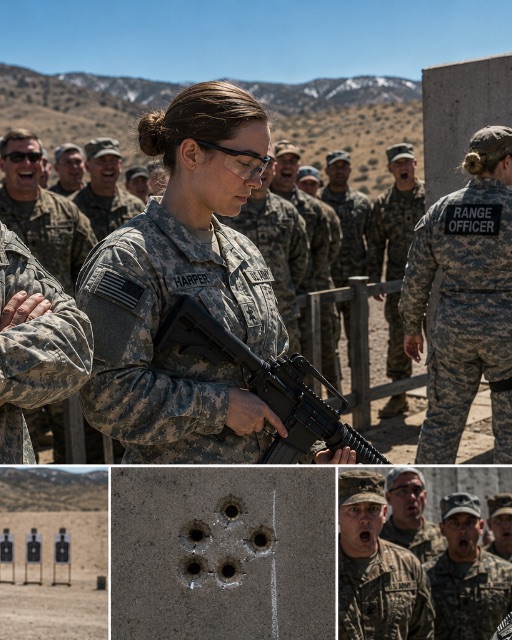
Private Nicole Harper stepped to the line with an M4 and a face nobody remembered from anywhere important.
Behind the safety barrier, Combat Group Charlie leaned into the moment the way young soldiers do when they think they already know how the story ends.
The colonel’s grin arrived before the first shot did.
Crack.
No hole. A ripple of laughter rolled through the line like a wave at a football game. Then the second round. The third. Still nothing on paper.
Even the range wind sounded amused.
“Garden-hose stance,” someone snorted loud enough for everyone to hear. “Did she even open her eyes?”
Nicole didn’t defend herself. She didn’t shrink. She didn’t flinch. She just breathed like a metronome and kept doing the most offensive thing in any room built for spectacle.
Nothing.
By the fifth “miss,” the colonel’s lesson had written itself. He folded his arms, ready to deliver the moral. The one about knowing your role. The one about humility. The one he’d been rehearsing since breakfast.
That’s when Range Master Sergeant Diane Foster did something nobody expected.
She didn’t dismiss the line. She didn’t scold the clerk. She didn’t laugh.
She walked.
Past the targets. Past the wooden frames. Past the fifty-yard markers. All the way to the concrete backstop thirty yards behind the paper.
The crowd quieted the way a joke quiets when the punchline comes late and wrong.
Foster knelt. Touched concrete. Ran her fingers across something. Measured with her eyes the way only someone who has counted distances in bad places can.
The colonel called out something about malfunction. About checking equipment. About wrapping it up.
She didn’t answer.
She stood. Turned. And her face had the color of new paper.
“Colonel.” Her voice carried across the range like a bullet. “You need to come see this.”
He didn’t move at first. Nobody did.
“Now, sir.”
He walked. Slowly. The way a man walks when his stomach already knows what his brain won’t admit. The trainees craned their necks. A few stood up.
Foster pointed at the back wall.
Five impacts. Tight as a quarter. Grouped so close you could cover them with a coffee lid. Exactly where a chest would be if the world were honest about aim.
Nicole hadn’t missed the targets.
She’d shot clean through the gap between the target frames – every single round – and buried them in the concrete backstop thirty yards behind where anyone was looking.
The colonel stared at the wall. Then he turned and stared at the private, who was still standing at the firing line, still breathing like a metronome, still not explaining herself.
The silence on that range was the loudest thing I’ve ever heard.
Then Foster leaned in close to the colonel. I was near enough to catch it. Five words.
“She wasn’t aiming at paper.”
The colonel’s jaw tightened. His arms unfolded. Something behind his eyes shifted – the way a lock clicks when you finally use the right key.
He opened his mouth to say something.
But before he could, a black SUV pulled onto the range road. No markings. Two men in civilian clothes stepped out. One of them held a manila folder. The other walked straight to Nicole, didn’t salute, didn’t introduce himself, and said three words that made every soldier within earshot go completely still.
“Your transport is ready.”
The colonel watched the nameless man speak to the private with a deference that didn’t match her rank. It was the kind of tone reserved for people who give orders, not take them.
The other man in the suit, the one with the folder, walked toward Colonel Wallace. He moved with a quiet economy, no wasted motion.
He stopped a respectful distance away and simply held out the folder. He didn’t say a word.
The colonel looked at the folder. Looked at Nicole, who was now calmly unloading her weapon as if she’d just finished a routine qualification. Looked back at Master Sergeant Foster, whose expression was impossible to read.
Then he did something nobody on that range had ever seen a full-bird colonel do in front of enlisted soldiers.
He stepped back. A small, almost imperceptible retreat.
What was in that folder – who Nicole Harper actually was, where she’d been before Fort Ironwood, and why five rounds through a gap no one else even noticed was the least impressive thing she’d done that year – well.
That’s the part that made my blood run cold.
Nicole handed her cleared rifle to a stunned range assistant. She turned and began walking toward the SUV, her steps even and unhurried. She didn’t look at the colonel. She didn’t look at anyone.
The man with the folder addressed Colonel Wallace, his voice low and flat. “Sir, we’ll take it from here.”
It wasn’t a request.
Colonel Wallace took the folder. The weight of it seemed heavier than paper and cardboard. He opened it.
The first page was a transfer order. It wasn’t for Private Harper. It was for him.
The second page was a photo. A grainy satellite image of a compound deep in some unnamed desert.
The third page was a single typed sentence: “The objective is not the target.”
He closed the folder slowly, the snap of the cover echoing the crack of Nicole’s rifle. His mind was racing, trying to connect dots that were scattered across years and continents.
As the SUV’s doors closed, sealing Nicole away from our world, Colonel Wallace finally found his voice. He directed it at Sergeant Foster.
“You knew,” he said. It was a statement, not a question.
Foster met his gaze. “I knew to watch for someone who didn’t color inside the lines, sir.”
Her words hung in the air. “Today wasn’t for the privates. It wasn’t a lesson for them.”
The truth landed on him like a physical weight. The demonstration, the jeering, the public humiliation. It was all a stage.
And he had been the main actor, completely unaware he was even in a play.
The SUV drove away, leaving a plume of Wyoming dust. Combat Group Charlie started talking in low murmurs, trying to piece together the fragments of what they’d just witnessed.
But the colonel was no longer with them. He was somewhere else entirely. He was back twenty years, a young captain in a dusty, forgotten outpost.
He remembered a quiet signals analyst, a kid named Peterson, who had tried to warn him. Peterson had noticed a pattern in the enemy’s radio chatter, a faint signal everyone else had dismissed as static.
Wallace, full of the arrogance of his fresh command, had laughed it off. He had told the kid to stick to his radios.
Two days later, the outpost was overrun. They lost eight soldiers. It was a failure that had shadowed his entire career, a ghost that sat on his shoulder in every briefing.
Peterson had been right. The kid wasn’t looking at the main target; he was listening to the silence in between.
Just like Nicole Harper wasn’t aiming at the paper.
He looked down at the folder in his hands. He understood now. This wasn’t a punishment. This was an invitation. A test.
A second chance.
He walked over to where Nicole had been standing. He looked down the range, through the empty wooden frame, to the five small marks on the concrete wall eighty yards away.
Most people see a target and aim for the center. They see the obvious path.
But the truly exceptional ones, they see the entire board. They see the gaps. They see the things no one else is looking at.
That’s where the real threats are. And that’s where the real solutions lie.
The colonel’s lesson for the day had been about knowing your role. It turned out, his role was to be the student.
The next few days were a blur for me and the rest of the base. Rumors flew like sparks from a fire. Private Harper was an assassin. A spy. The daughter of a general. Her records were wiped from the system overnight. It was like she had never existed.
But I saw Colonel Wallace change. The arrogant swagger was gone, replaced by a thoughtful quiet. He started asking more questions in briefings. He started listening, really listening, to the lowest-ranking specialists.
He sought out Sergeant Foster. I saw them talking late one afternoon by the now-empty firing range.
“She didn’t have to humiliate me like that,” the colonel said, his voice soft.
Foster shook her head. “With all due respect, sir, it wasn’t about humiliation. It was about pressure.”
She continued. “They needed to know what you would do when your worldview was shattered in public. Would you get angry? Would you try to save face?”
“Or,” she paused, “would you have the humility to admit you were wrong and the wisdom to understand why?”
Colonel Wallace stared off at the distant mountains. “I almost failed, didn’t I?”
“You almost did, sir,” Foster said honestly. “But you didn’t. You stepped back. You listened. That was the right answer.”
A week later, Colonel Wallace was gone. Transferred to a joint command so secret that its name was just a string of numbers. I figured that was the end of the story.
I was wrong.
About a year later, I was on a transport plane heading for a deployment. The mood was tense. We were flying into a hot zone, part of a major operation to dismantle a sophisticated enemy network.
The mission briefing was being given by a man on a secure video link. His face was just a silhouette. He spoke about the primary objectives, the strike teams, the air support. Standard stuff.
Then, at the end, he said something that made me sit bolt upright.
“One final thing, ladies and gentlemen,” the silhouette said. “Our intelligence on this comes from a non-traditional source. It’s an asset who sees the gaps.”
“Our intel says the enemy’s command center is not in the main compound. That’s a decoy. They are operating out of a small, insignificant-looking medical clinic two klicks to the east.”
He paused. “Every other agency missed it. They were all aiming at the paper.”
The voice was familiar. Deep, calm, and stripped of all its former arrogance. It was Colonel Wallace.
“Trust the intel,” he finished. “Trust the gaps. Wallace out.”
The mission was a success. A textbook operation with minimal casualties. They hit the clinic and captured the entire enemy leadership, completely by surprise. The main compound was empty, just as he’d said.
Afterward, as we were packing up, I saw her.
She was standing near a supply truck, dressed in sterile civilian clothes, her hair pulled back. She looked like a relief worker, someone you would never notice.
It was Nicole Harper.
She was talking to a local woman, holding a small child. She smiled, a genuine, warm smile, and handed the child a piece of candy. For a moment, she was just a person, not a weapon.
Our eyes met across the dusty compound. She gave me a small, almost imperceptible nod. It wasn’t a nod of recognition for me, personally. It was a nod that acknowledged the shared secret, the day on the range that had changed everything.
In that moment, I understood the final twist.
Nicole’s demonstration wasn’t just a test for the colonel. It was a message for all of us.
The world is full of people who make a lot of noise. They stand at the front, demand attention, and puff out their chests. They want you to see them hit the paper target.
But the real work, the work that saves lives and changes the course of events, is often done in the quiet gaps. It’s done by the unassuming analyst, the quiet logistician, the private who doesn’t care about impressing a crowd.
It’s done by the people who aren’t aiming at the paper. They’re aiming at the truth, no matter how far behind the target it might be.
Colonel Wallace learned to trust those people. He built his entire new command around that principle, recruiting the ones who saw the world differently. He became one of the most respected and effective leaders in the military, not because he was the smartest or strongest, but because he was humble enough to listen to the whispers everyone else dismissed as static.
And Nicole Harper? She just kept finding the gaps. Always quiet, always unnoticed, always hitting a target no one else could even see.
The true measure of a person isn’t the noise they make, but the impact they have when no one is looking. It’s a lesson about humility, about looking past the obvious, and about recognizing that the most powerful forces are often the ones you never see coming. True strength doesn’t need applause; it only needs to be right.