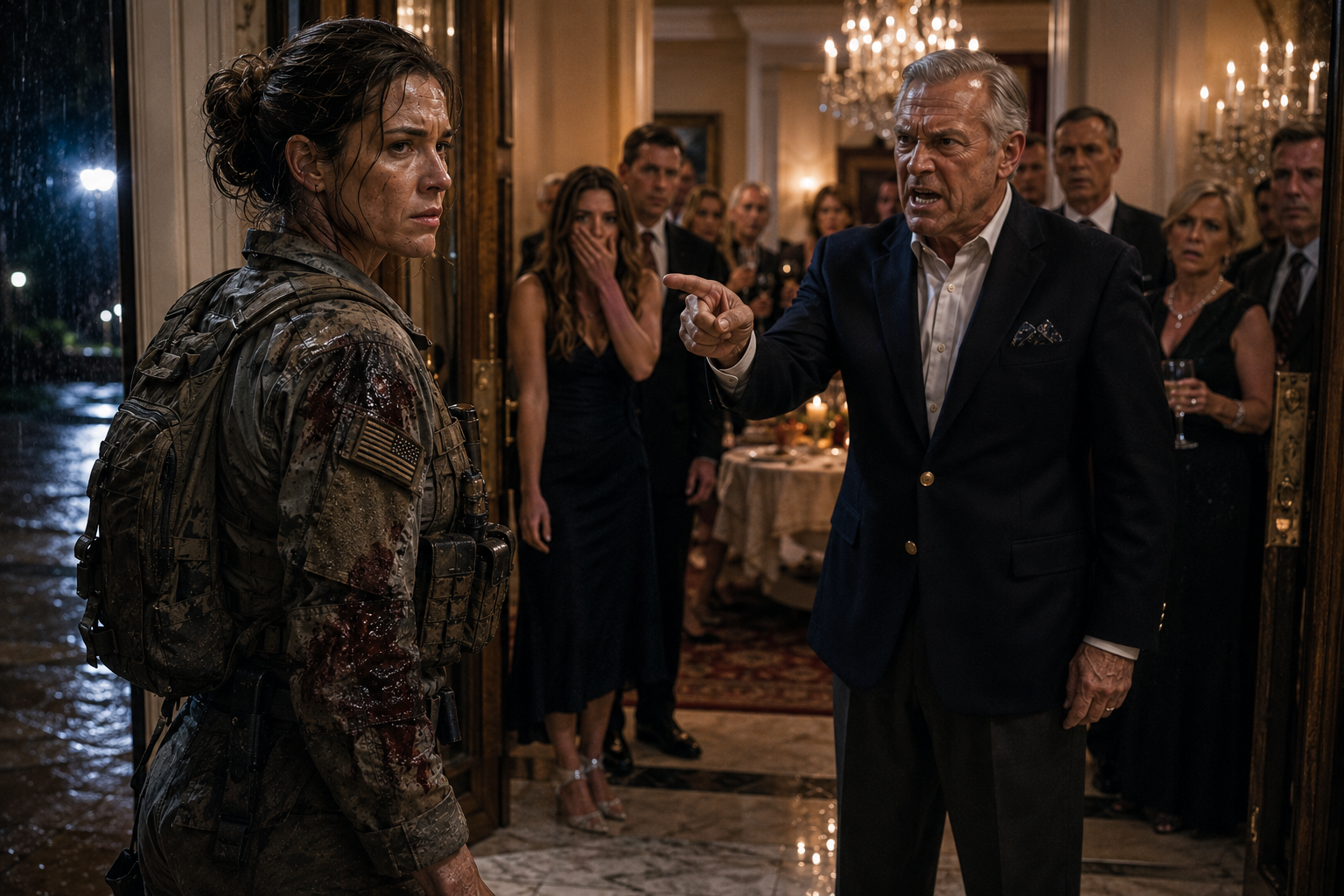
The first thing my father saw when I walked through his front door was the blood on my sleeve.
Not the American flag stitched over my heart. Not the bruises climbing the side of my neck. Not the fact that I was standing on his polished marble entryway after almost forty-eight hours without sleep, still smelling like jet fuel, dust, antiseptic, and smoke.
Just the blood.
His eyes moved over me with the same cold disgust he used to reserve for muddy shoes on his white carpet.
The party had already begun. Thirty people stood beneath the warm glow of his dining room chandelier, holding crystal wine glasses and talking softly over rosemary roast beef, expensive cigars, and my sister Amanda’s vanilla perfume. Rain ticked against the tall windows. Somewhere in the hallway, the grandfather clock counted seconds like it knew something terrible was about to happen.
My father lifted his bourbon glass and said, loud enough for everyone to hear, “Look at yourself, Evelyn. You shame this family.”
The room went silent so fast I could hear water dripping from the hem of my coat onto the floor.
I should have turned around.
I knew that even then.
I had survived gunfire, fire, screaming engines, and the kind of darkness that sits behind your ribs long after the sun comes up. I had pulled civilians through smoke while my shoulder burned beneath a field dressing. I had carried a little girl with one shoe missing across broken concrete while she cried into my collar.
But standing in my father’s foyer, I was twelve years old again, waiting for him to decide whether I was worth loving.
“Dad,” Amanda whispered from the dining room. “Not now.”
Charles Carter ignored her.
Even at seventy-one, my father looked perfectly arranged. Navy blazer. Silver pocket square. Hair combed back. CEO posture, retired but not surrendered. He had built three companies, destroyed two competitors, and raised three children with the emotional warmth of a courtroom deposition.
“You couldn’t even bother to change?” he asked.
“I came straight from base,” I said.
My voice sounded calm. That was training. Training makes a body useful while the soul is somewhere else.
A few guests shifted. My older brother, Daniel, stared into his bourbon as if the answer to courage sat somewhere at the bottom of the glass.
One of Dad’s golf friends glanced at my uniform and gave an awkward laugh. “Still doing all that tactical stuff?”
All that tactical stuff.
I tasted metal at the back of my throat.
“Something like that,” I said.
My father’s mouth tightened. “You’re forty years old, Evelyn. Most women your age have families. Stability. A normal life.”
Normal.
I thought of the young medic who had squeezed my wrist and asked me not to let him die alone. I thought of Sergeant Marcus Green waving me forward with one hand while smoke swallowed the road behind him. I thought of the little girl’s fingers locked around my collar so tightly I still had crescent marks in my skin.
Amanda crossed the foyer quickly and hugged me, careful around my left shoulder.
“You made it,” she whispered.
“Barely.”
She pulled back and looked at my face. Her smile disappeared. Amanda was a pediatric surgeon, the kind of woman who could read pain the way other people read traffic signs.
“What happened to you?”
“Long day.”
“You’re bleeding.”
“It’s handled.”
Dad heard that.
His gaze snapped to my sleeve. “That is blood?”
A woman near the table set her glass down too hard. The sound cracked through the room.
“It’s not mine,” I said.
Wrong answer.
The disgust on my father’s face deepened.
“Jesus Christ, Evelyn. You walk into my birthday dinner looking like this and expect people not to react?”
Something cold moved through me. The same cold I used in hostile zones. The same cold that taught me to breathe evenly while panic clawed at my lungs.
“I didn’t come to make a scene.”
“Well,” he said, looking me up and down, “you succeeded.”
Nobody defended me.
Not Daniel. Not the golf friends. Not the woman in pearls clutching her napkin like a lifeline.
I stood there, dripping rainwater and someone else’s blood onto marble that cost more than my monthly hazard pay, and I felt every pair of eyes in that room decide I wasn’t worth the discomfort of speaking up.
My father turned his back to me. Picked up a cocktail napkin. Dabbed the corner of his mouth.
“Clean yourself up or leave,” he said. “I won’t have my guests subjected to this.”
I looked at Amanda. She had tears in her eyes but her lips were pressed shut.
I looked at Daniel. He wouldn’t meet my gaze.
I turned toward the door.
And that’s when my phone buzzed.
I almost didn’t check it. Almost kept walking into the rain and drove back to base and swallowed this night the way I’d swallowed every other night he’d made me feel like nothing.
But I looked.
One text. Secure line. Three words and a time.
My hand started shaking. Not from fear. Not from cold.
I read it again.
Then I put the phone back in my pocket, turned around, and looked at my father one last time.
He was already laughing with someone. Already moved on. Already forgot I existed.
I walked out into the rain.
Because in exactly seventy-two hours, every television in the country – including the one mounted above his fireplace – was going to show my face. And the words that came out of the Chairman of the Joint Chiefs’ mouth were going to make my father’s bourbon glass hit that perfect marble floor.
But he didn’t know that yet.
And honestly? Neither did I. Not fully. Not until I opened the envelope waiting on my desk back at base and read the first line.
It didn’t start with my name. It didn’t start with a rank. It started with a location – the same location I’d just bled in – and a single sentence I had to read three times before my hands stopped shaking:
“By direction of the President of the United States…”
The drive back to base was a blur of rain and streetlights. I remember the slick hiss of the tires on wet asphalt and the hollow thud of the wipers.
Each swipe across the windshield felt like it was trying to wipe away the last hour, but the image of my father’s face was burned behind my eyes.
The disgust. The dismissal.
I parked my truck in its designated spot and just sat there for a minute, the engine ticking as it cooled. I leaned my head against the steering wheel and let out a breath I’d been holding since I walked through that door.
One tear escaped. Just one. It traced a clean path through the grime caked on my cheek.
Then I wiped it away, got out, and walked toward my office. There was work to do.
The envelope was simple, manila, with a single, severe red stamp that said EYES ONLY.
I sat at my government-issue metal desk, under the flat glare of a fluorescent light, and slit it open with my thumbnail.
The first page was the summons. The second was the non-disclosure agreement I had to sign before reading the third. The third was the preliminary citation.
And that’s when I finally understood.
The Medal of Honor.
The words swam. It didn’t feel real. Medals were for heroes. For people like Sergeant Green, who was still in a medically induced coma. Not for me.
I just did my job.
I got up and splashed cold water on my face from the little sink in the corner. I stared at the woman in the cracked mirror. Tired eyes. New lines etched around them. A fading bruise.
This wasn’t what I had envisioned for my life at forty. But my father was wrong. It wasn’t a lack of a normal life.
It was the price of the one I’d chosen.
The next forty-eight hours were a whirlwind. Debriefs with people whose ranks I couldn’t even see for all the stars on their shoulders. Fittings for a dress uniform that felt alien on my skin. Phone calls with lawyers and PR personnel.
Amanda called, sobbing her apologies. She said Dad had been a monster, that she should have stood up for me.
“It’s okay, Amanda,” I told her, and I meant it. Her battlefield was different from mine.
Daniel sent a text. “Sorry about Dad. You know how he is.”
I knew. That was the whole problem.
My commanding officer, Colonel Matthews, a man who had known me for fifteen years, sat me down in his office. He looked more proud than my own father ever had.
“The citation tells a story, Evelyn,” he said, his voice rough with emotion. “But it doesn’t tell the whole thing. It doesn’t mention how you went back in. Twice.”
“Sergeant Green was down,” I said simply. “And the girl was alone.”
“Exactly,” he nodded. “You did what was right, not what was ordered. That’s the difference.”
He was the one who told me the ceremony would be broadcast. Live.
I felt a cold knot form in my stomach. I didn’t want the spectacle. I just wanted my people to be okay.
The day of the ceremony arrived with a crisp, clear sky over Washington.
I stood in a small, quiet room off the East Room of the White House, my hands clasped in front of me. My dress blues were starched and perfect. The blood was gone. The bruises were covered with makeup.
I looked like a soldier. Not a daughter.
An aide gave me a gentle nod. It was time.
I walked into the room, and the world went silent, then exploded into polite applause. The President of the United States stood waiting for me. To his left were the Joint Chiefs of Staff.
I didn’t look at the cameras. I focused on the flag behind the President’s desk.
I’m sure my father was watching. Probably sitting in his leather armchair, the one I was never allowed to sit in as a child, his bourbon on the table beside him.
He was probably annoyed that my “tactical stuff” was interrupting his afternoon news.
The Chairman of the Joint Chiefs of Staff, a stern-faced man with four stars on his shoulders, stepped up to the podium to read the citation.
“On October 27th,” he began, his voice booming through the silent room, “Master Sergeant Evelyn Carter distinguished herself by acts of gallantry and intrepidity at the risk of her life above and beyond the call of duty.”
I stood straighter. My heart hammered against my ribs.
“During a hostile seizure of a civilian office building, Master Sergeant Carter’s unit came under heavy fire from a well-armed and determined enemy force.”
He detailed the initial firefight. The explosion that took out half our squad. The moments I barely remembered, running on instinct and training.
“With her commanding officer incapacitated and her unit facing untenable odds, Master Sergeant Carter voluntarily took command.”
I thought of Sergeant Green’s wave, just before he went down. “Go,” he’d mouthed. “Get them out.”
“Disregarding her own severe injuries,” the Chairman continued, “she organized the evacuation of over fifty civilian hostages from the upper floors, moving through smoke-filled corridors amidst active gunfire.”
I remembered the little girl’s hand. So small in mine. She was crying for her mother. I told her we would find her. A lie. It had to be a lie. But it was the only thing I could offer.
And then came the twist. The detail I hadn’t known they would make public.
The Chairman cleared his throat. “It has now been declassified that the primary target of this attack was not the building itself, but a coordinated cyber-assault intended to collapse the nation’s financial markets. The servers targeted were located on the 54th floor.”
My breath caught in my throat. I didn’t know that.
“Among the primary targets,” the Chairman said, looking directly at the camera, “was the central network for Carter Holdings International, whose collapse would have triggered a cascading failure across the entire sector.”
The room remained silent. But in my mind, I heard a sound. The sound of a crystal bourbon glass shattering on a marble floor.
Carter Holdings International.
The first company my father ever built. The one he sold a decade ago but still called his “legacy.” The source of all his wealth, his pride, his entire identity.
He hadn’t just called me an embarrassment.
He had called me an embarrassment while I was still covered in the dust and blood of saving the very foundation of his entire life.
The Chairman kept reading about how I’d secured the server room, how I’d carried Sergeant Green to the medics, how I’d found the little girl’s mother in the triage area.
But I heard none of it.
I was thinking about the perfect, brutal, unbelievable irony of it all. He had shamed me for my world, while my world had just saved his.
The President draped the medal, heavy and cool on its blue ribbon, around my neck. He shook my hand firmly.
“The nation is in your debt, Master Sergeant,” he said, his voice low and sincere.
I met his eyes. “I was just doing my job, sir.”
He smiled faintly. “Then you have a hell of a job.”
When I finally got back to my hotel room that evening, my phone had over a hundred missed calls. Most were from numbers I didn’t recognize.
One was from my father. Twelve times.
He’d also left a voicemail. I almost deleted it. But some part of me, the twelve-year-old girl who still lived in my heart, needed to hear it.
I pressed play.
“Evelyn,” his voice was hoarse. Unsteady. I had never heard him sound like this. “I… I saw. On the news.”
A long pause. I could hear him breathing.
“The company… my company… you…” He couldn’t form the words.
“I didn’t know,” he finally whispered. “My God, I didn’t know.”
There was no apology. Not a direct one. Men like my father don’t know how. But there was something else in his voice. Awe. And for the first time in my life, shame. His own.
“Call me,” he finished, and the line went dead.
I put the phone down. I didn’t call him back.
The approval I had spent my entire life starving for, now offered on a silver platter, tasted like ash in my mouth. I didn’t need it anymore.
The ceremony, the medal, the Presidential handshake… none of that was the real reward.
The reward came a week later.
I was on administrative leave, staying in a small apartment near Walter Reed Medical Center. I spent my days reading to Sergeant Green, who was awake now, and starting his long road to recovery.
One afternoon, a social worker brought a visitor to my door.
It was the little girl. The one with the single shoe. Her name was Maya.
She was holding her mother’s hand. In her other hand, she clutched a clumsy drawing, done in crayon. It showed two stick figures. One was big, in a green uniform. The other was small, with a big smile. They were holding hands.
She shyly held the drawing out to me.
Her mother, a woman with the same tired, grateful eyes I saw on so many faces that day, had tears streaming down her face. “She wanted to thank the brave soldier,” she said, her voice thick. “She calls you her angel.”
I knelt down, so I was at Maya’s eye level. The world of presidents and generals and angry fathers melted away.
“I remember you,” I said softly. “You were very brave that day.”
She gave me a tentative smile and pointed at the medal I had pinned to my civilian jacket. “Is that for being brave?”
I looked at the star on its blue ribbon, and then back at her small, curious face. And in that moment, I finally understood.
My father spent his life building a legacy out of glass and steel. He measured his worth in stock prices and acquisitions. He saw my uniform and saw a failure, an embarrassment on his perfect marble floor.
But legacy isn’t something you build. It’s something you leave behind in the hearts of others. It’s not about having a “normal life.” It’s about making a normal life possible for someone else.
The medal wasn’t the reward. The phone call from my father wasn’t the reward.
This was. This little girl’s smile. The feel of her small hand as she finally took mine.
“Yes,” I told her, my voice catching. “It’s for being brave.”
And I realized it wasn’t for the bravery of facing gunfire. It was for the bravery of holding a small hand in the dark, and promising that the sun would rise again. And for the first time, standing there in that hallway, I felt a kind of peace that no medal, and no apology, could ever give.