
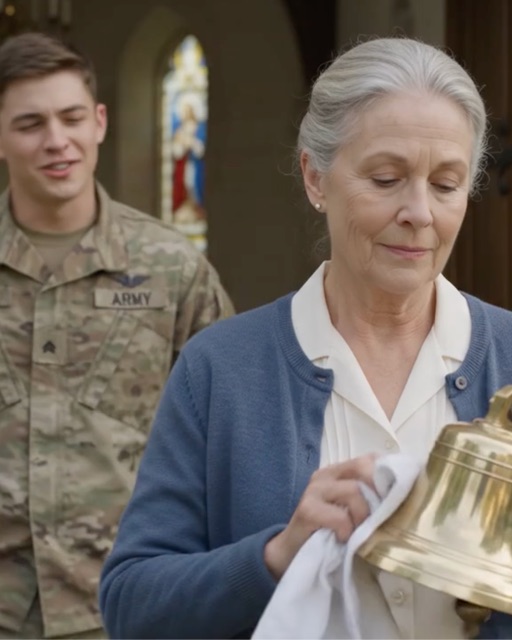
“You know that’s not a decoration, right?” the young private sneered, watching me polish the brass memorial bell by the chapel entrance.
I clean the base chapel every morning. Most soldiers nod. Some whisper prayers. But Private Knox and his buddies wanted to show off.
“That bell is for fallen soldiers,” Knox laughed, nudging his friend. “Civilians like you shouldn’t be touching things you don’t understand.”
I folded my cloth slowly. I didn’t say anything. I could still smell wet canvas, burned powder, and the antiseptic we ran out of twenty-eight years ago.
Before I could speak, the heavy oak doors flew open.
The Post Commander walked in. Behind him came the Brigade Sergeant Major, the Chaplain, and four armed soldiers carrying a long, heavy wooden case. Every soldier in the pews instantly snapped to attention.
But the General didn’t look at them. He bypassed the front row and walked straight toward my cleaning cart.
He stopped, snapped a crisp salute, and said, “Captain Rhodes.”
Private Knox’s jaw hit the floor. The smirk completely melted off his face. No one had called me Captain in almost three decades.
The Chaplain opened the wooden box to reveal the original Mercy Bell, cracked down the side and blackened with soot.
The General removed his gloves. “Ma’am, we pulled this from the archives. The official history states you rang it twice at every memorial ceremony in the valley. One ring for the fallen. One for those who carried them home.”
He handed me a frayed piece of rope. “Will you ring it one final time?”
Knox stared at me, pale and shaking, suddenly realizing who he had been mocking.
But my blood ran cold. I looked at the cracked brass, then at the young private who had just lectured me on grief.
“It wasn’t for the ones who carried them home,” I whispered, my voice echoing off the stone walls.
The General froze.
“The second ring,” I continued, my heart pounding, “was for the men command quietly listed as ‘missing’ – because admitting they were dead would expose the illegal order that killed them.”
The Chaplain lowered his eyes to the floor, shrinking back.
“And the man who gave that coward’s order,” I said, pointing a shaking finger at the massive, revered oil portrait hanging right above the altar, “is right there. General Wallace.”
A collective gasp went through the chapel. General Wallace was a legend, the base’s namesake. His portrait depicted a grim, determined hero.
Private Knox looked from the portrait to me, his face a mess of confusion and dawning horror.
The air grew thick and heavy, charged with the weight of my words. Twenty-eight years of silence had just been shattered against the hallowed walls of the chapel.
The General, a man I now knew as General Greyson, didn’t flinch. His eyes, sharp and intelligent, were locked on mine. He didn’t dismiss me. He didn’t call for the guards.
He simply asked, “What order, Captain?”
My hand was still trembling as I lowered it. The apathetic boy who had mocked me a moment ago was now the least of my concerns. The entire institution was staring back at me through the General’s eyes.
“Operation Gilded Peak,” I said, the name tasting like ash in my mouth. “A name polished up for the press back home. For us on the ground, it was a death sentence.”
I could see it all again. The oppressive heat of the valley. The dust that got into everything. The faces of the boys in Third Platoon, most of them no older than Private Knox.
“We were a medical company attached to the infantry,” I explained, my voice growing stronger with every word of truth. “Our job was to follow, to patch up, to save who we could.”
“General Wallace wanted a hill. Not a strategic hill. Not a hill that would win us the war. He wanted a flag planted on a summit for a photo opportunity. He wanted a medal.”
The Chaplain, a man named Father O’Connell, visibly winced. He looked much older now than he did as a young lieutenant processing our paperwork.
“Intelligence reported the hill was heavily fortified,” I continued. “Artillery, entrenched positions, a kill box in the approach valley. Everyone knew it. The battalion commander protested.”
“Wallace overruled him. He ordered Third Platoon to take that hill. He promised them air support that he knew was grounded due to weather. He promised them a relief force that had been diverted hours earlier.”
My gaze drifted to Private Knox. He looked like he was going to be sick.
“I was at the aid station at the bottom of the valley. We listened to it all on the radio. First, the confident calls. Then, the confusion. Then, the panic.”
The sounds came back to me, clearer than any memory ought to be. The crackle of the radio, the desperate pleas for the promised air support. The voice of a young lieutenant screaming that they were walking into a meat grinder.
“They were cut to pieces,” I whispered. “We could hear it. We could do nothing but listen to them die.”
“I took a group of medics up anyway, against direct orders to stand down. We thought we might find survivors.”
I took a deep breath, the sterile, institutional smell of the chapel failing to cover the phantom scent of blood and dirt.
“We found slaughter. But we also found a survivor. One. A corporal named David Miller. He was just a kid. Barely nineteen.”
A single tear I hadn’t realized was forming traced a path down my weathered cheek. “I had promised his mother I’d look after him.”
“He was badly wounded, but he was alive. We were carrying him back when Wallace’s ‘acceptable losses’ became a reality. The enemy, emboldened by their easy victory, swept down the valley.”
“They overran our position. Miller was killed. So were two of my medics. I took shrapnel in my leg and my shoulder.”
I subconsciously touched the faint scar above my collarbone, a permanent reminder.
“When I was recovering in a field hospital, the official report came out. Operation Gilded Peak was a ‘qualified success.’ A ‘strategic withdrawal’ was conducted.”
My voice dripped with a bitterness I had suppressed for decades. “And the thirty-four men of Third Platoon? Along with my two medics and Corporal Miller? They weren’t listed as Killed in Action. They were ‘Missing, Presumed Captured.’”
General Greyson’s face was a stone mask, but his knuckles were white where he gripped his gloves.
“A KIA declaration would have required a full investigation,” I said, looking from the General to the shamed Chaplain. “An investigation would have uncovered Wallace’s lies. His illegal, murderous order.”
“But ‘Missing’ men? Their files could be buried. Their families could be fed lines about ‘ongoing efforts.’ It was neat. It was clean. It protected a powerful man’s career.”
I turned my back on them and looked at the replica bell I polished every day. “So, I started a tradition. In our quiet, field-made memorial services, I rang the bell. Once for the fallen we were allowed to name.”
I met the General’s eyes again. “And a second time for the thirty-seven ghosts Wallace created. The men he erased.”
Silence fell once more. Private Knox, no longer a cocky boy but a humbled soldier, slowly walked over to the water fountain. He filled a small paper cup and brought it to me, his hand shaking.
“Ma’am,” he said, his voice cracking. “I’m sorry.”
I took the water, my anger at him having evaporated completely. He was just a child, a symbol of the very boys I was talking about.
It was then that General Greyson finally moved. He didn’t speak to me. He turned to the Chaplain.
“Father O’Connell,” he said, his voice low and dangerous. “You were Lieutenant O’Connell then. You were the adjutant who processed the casualty reports for this operation. Captain Rhodes’s accusation is of the most serious nature.”
The Chaplain couldn’t meet his gaze. He stared at the cracked, original bell in its case.
“Is it true?” the General demanded.
Slowly, his shoulders slumping under an invisible weight, the Chaplain nodded. “Yes, sir. It’s all true.”
He finally looked up, his eyes filled with a pain that mirrored my own. “I was twenty-four. General Wallace told me it was my duty. He said a full report would ‘damage morale’ and ‘give comfort to the enemy.’ He said the honor of the service was at stake.”
“He gave me a direct order to falsify the documents. He had me classify every man from that operation as MIA.” The Chaplain’s voice was hoarse. “It was the great sin of my life. I’ve heard their names in my prayers every night since.”
A new shock rippled through the gathered soldiers. The Chaplain was complicit.
But General Greyson wasn’t finished. He looked at me, and I saw something shift in his expression. It wasn’t anger or disbelief. It was confirmation.
“Captain Rhodes,” he began, his tone softening just a fraction. “I did not come here today just for a ceremony. This wasn’t a coincidence.”
Now it was my turn to be stunned.
“The official history of Operation Gilded Peak has always been suspect,” he revealed. “There are too many inconsistencies. Vague reports, redacted testimonials. I’ve had a team quietly reviewing these Cold War-era files for the last six months.”
This was the twist I never saw coming. He had been investigating all along.
“We kept hitting dead ends. Wallace’s influence ran deep; he scrubbed the records clean. But we found one recurring anomaly. A footnote in an after-action report about a rebellious medic Captain who was wounded and sent home shortly after.”
His eyes found mine. “A Captain who, according to a few unofficial letters we found, insisted on ringing a bell twice.”
“We found you a month ago,” he continued. “Working here. Quietly tending to the memory of this place. I didn’t want to just come and interrogate you. I thought… maybe seeing the bell, being honored in the way you should have been, would bring the truth to the surface.”
He had set the whole thing up. The ceremony, the original bell, the public setting. It was a gamble. A gamble that my conscience would finally outweigh my fear.
He was right.
“You said Wallace scrubbed the records,” I said, a thought sparking in my mind. “But he couldn’t scrub everything.”
I walked past Private Knox and my cleaning cart. I knelt down beside one of the back pews, where I kept my personal bag. For twenty-eight years, I’d carried it with me to this chapel every morning.
From it, I pulled a worn, leather-bound journal. Its pages were yellowed and fragile.
“I kept a personal log,” I told the General. “Every detail. Every order I heard over the radio. Every name. I have the exact time coordinates where we found Corporal Miller. Where my medics died.”
I held it out to him. “It’s not an official document. It’s just my word. But it’s the truth.”
The General took the journal with a reverence he hadn’t even shown the bell. He opened it to a random page, his eyes scanning my faded script.
At that moment, the Brigade Sergeant Major, a man who had stood silent and stoic this whole time, stepped forward.
“Sir,” he said to General Greyson. “The Chaplain’s sworn confession, combined with the Captain’s testimony and her journal… it’s enough.”
General Greyson nodded. He closed the journal and held it tightly. He looked at the portrait of General Wallace, his expression turning to ice.
“Sergeant Major,” he commanded. “Have that painting removed. Immediately. Place it in storage pending a full historical review.”
Then he turned to the armed soldiers. “This bell,” he said, gesturing to the original, cracked Mercy Bell, “is no longer an archived relic. It will be restored and will take its rightful place here, at the entrance of this chapel. Along with a new plaque.”
He looked directly at me. “A plaque that tells the true story of Operation Gilded Peak and lists the names of all thirty-seven heroes who were lost that day.”
A wave of emotion so powerful it almost buckled my knees washed over me. The truth. It was finally seeing the light.
Over the next few weeks, things changed. The story, now officially sanctioned, spread across the base and beyond. The portrait of Wallace came down, creating a blank space on the wall that spoke louder than any painting could.
Investigators, using my journal and the Chaplain’s confession, began the formal process of changing the status of the lost soldiers. They contacted the families. Old, heartbroken parents and siblings, who had lived for decades with the agonizing uncertainty of ‘missing,’ were finally given the harsh closure of truth, and the honor their loved ones deserved.
Private Knox came to find me a week later. He didn’t bring his friends. He found me polishing the new plaque that had been temporarily placed by the bell.
“Captain Rhodes,” he started, his voice quiet and respectful. “I’ve been reading about those men. About what you did. I just wanted to say… what I did was inexcusable. I thought I knew what a soldier was. I thought it was about being tough and loud.”
He shook his head. “But it’s not. It’s about what you did. It’s about integrity. It’s about remembering.”
“It’s about telling the truth, Private,” I corrected him gently. “Even when it’s hard. Especially when it’s hard.”
He nodded, a tear in his eye. “I’m reenlisting. I requested a transfer to the medical corps.”
I smiled, a real smile, for the first time in a long time. The arrogant boy was gone. In his place stood a young man who understood sacrifice.
The day of the final ceremony arrived. The chapel was full, not just with soldiers, but with the families of the lost men of Third Platoon. They were old now, with white hair and wrinkled hands, but their eyes held a new peace.
General Greyson had asked me to wear my old uniform. It was tight in the shoulders, but it still fit. The Captain’s bars on the collar gleamed.
He stood at the altar, the blank space on the wall behind him. He spoke of courage, not just on the battlefield, but the courage to right a decades-old wrong. He praised the Chaplain for his painful honesty. He honored me in a way that brought me to tears.
Then, he read each of the thirty-seven names aloud. After each name, a single chime from a small silver bell rang out.
Finally, he turned to me. “Captain Rhodes. The Mercy Bell is yours.”
I walked to the entrance, where the original, soot-stained bell now hung, a beautiful new plaque beneath it. I took hold of the old, frayed rope.
The entire chapel was silent.
I pulled the rope once. A deep, resonant BONG echoed through the hall. For the fallen.
Then, I pulled it a second time. A clearer, more triumphant BONG. Not for the forgotten, not for the missing.
But for the truth.
As the sound faded, I let go of the rope. I was no longer the chapel janitor. I was no longer a keeper of a bitter secret. I was Captain Eleanor Rhodes, and I had finally brought my soldiers home.
Honor isn’t found in the shine of a medal or the prestige of a name. It’s forged in the quiet, difficult moments of telling the truth. True courage is not just facing the enemy in front of you, but facing the wrongs within your own ranks, no matter how long they have been buried. For a truth unspoken is a wound that never heals, but a truth revealed, no matter how painful, is the first step toward peace.



