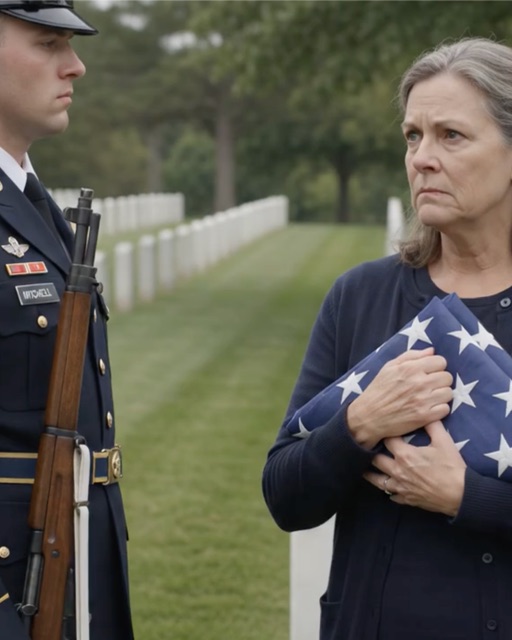
“Again,” the woman in the navy cardigan whispered, right as we lowered our rifles.
I froze. We don’t do “again.” Not at a military funeral. Not ever.
Sergeant Shane cut her a look that could slice steel. “Ma’am, please step back.”
She didn’t move. She cradled two perfectly folded triangles in her arms like newborns. The edges were worn, plates polished to a mirror. Her knuckles were white.
I’d seen her an hour earlier in the church hall, sitting alone at a plastic table, folding flags while the coffee went cold. I’d joked, “We only bring one.” She didn’t laugh. She just folded a second. Then a third.
Now she was here, at the grave, standing so close I could smell the starch on the fabric.
“He gets three,” she said, voice steady but eyes shining. “Whether you like it or not.”
Murmurs rippled through the crowd. The widow stiffened. Sergeant Shane stepped in front of me, hand to his chest like a wall. “Ma’am, on whose authority?”
She looked past him. Right at me.
“Yours,” she said. “Specialist Mitchell. You’re the one who needs to see this.”
She slid a battered manila envelope from her bag and pressed it into my palm. It was soft with age, corners bent, something metal clinking inside. My heart pounded so hard I could feel it in my teeth.
“Open it,” she whispered. “Then tell me we don’t salute him three times.”
I pulled out a stack of photos – old Polaroids, ink-smudged papers, a single dog tag that didn’t match the name on the headstone. On top was a baby picture I’d never seen before.
I flipped it over and my blood ran cold at the handwriting on the back.
The inscription was simple, written in a confident, looping cursive. “For my son, Daniel. May you one day understand. Love, Dad.”
My name is Daniel Mitchell.
My breath hitched in my throat. My own father had died before I was born. A construction accident, my mother had always said. He was a good man who never got to meet his son.
That was the story. That was my life.
My fingers, clumsy in their white dress gloves, fumbled with the other items. I slid the dog tag off its chain. The metal was cool against my skin, the letters stamped deep.
WALLACE, JAMES. CPL. US ARMY.
The name on the headstone in front of us was Arthur Pendelton. Not Wallace.
Sergeant Shane’s voice was a low growl beside me. “Mitchell, what is it? We have a grieving family here.”
I couldn’t speak. I could only show him. I held up the baby photo, the one of me, with the inscription from a father I never knew.
He took it, his brow furrowed in confusion. He read the back and his hard expression softened just a fraction.
“This is some kind of sick joke,” he muttered, but the conviction wasn’t in his voice.
The woman, who I now realized was the widow, Eleanor Pendelton, spoke again. Her voice wasn’t demanding anymore. It was pleading.
“It’s not a joke, Sergeant. Please. Look at the rest.”
I dug back into the envelope. There was a photograph of two young men in desert fatigues, their arms slung over each other’s shoulders, grinning under a harsh sun. They were dusty and tired, but alive. So alive.
One of them was a younger version of the man in the casket photos displayed by the grave. Arthur Pendelton.
The other man… I recognized his eyes. I saw them every morning in the mirror.
It was James Wallace. My father.
My legs felt weak. The perfectly manicured grass of the cemetery seemed to sway beneath my feet.
The final item in the envelope was a letter, the paper yellowed and folded into a tiny square. The creases were so deep they were almost white.
I unfolded it carefully. The handwriting was the same as on the back of the photo.
“My Dearest Boy,” it began.
“If you are reading this, it means I didn’t make it home. I’m sorry. I am so desperately sorry. There isn’t a day that goes by out here that I don’t think about you. I picture your mother’s smile, and I imagine what you’ll look like. I hope you have her kindness.”
A tear dripped from my chin and landed on the fragile paper, smudging the ink.
“I need you to know something. Out here, you make bonds that are thicker than blood. You make promises. I made a promise to a man named Arthur. He’s my brother in every way that matters. He’s a good man, but he’s got a family back home waiting for him. A wife and a little girl.”
“Today, we got into trouble. Bad trouble. I don’t have time to write it all down, but there was a choice to be made. I made it. I’m getting him home to his family.”
“I love your mother more than words can say. Tell her that. And know that I love you, my son, more than my own life. Live a good one. Live a life that’s full. Live enough for the both of us.”
“Be brave. Be kind. Your Father, James.”
The world went silent. The murmuring crowd, the distant traffic, the rustle of leaves in the oak trees – it all faded away. The only sound was the frantic drumming in my own ears.
Sergeant Shane had read the letter over my shoulder. His hand, which had been a barrier moments before, now rested on my arm, supporting me.
He looked from the letter in my trembling hands to the woman, Eleanor. His eyes, usually so stern, were filled with a dawning, terrible understanding.
He took a deep breath, his chest swelling, his posture straightening to its full military bearing. He wasn’t just Sergeant Shane anymore. He was a guardian of a story that had been buried for over twenty years.
He turned to the rest of the honor guard. “Listen up.”
His voice was quiet, but it cut through the air with absolute authority. Two other soldiers, young men like me, snapped their attention to him.
“We are not finished here,” he said. He nodded toward the woman. “This family has requested an honor for two soldiers today. We will provide it.”
He looked directly at me. “Mitchell, can you do this?”
I swallowed hard, tasting the salt of my own tears. I looked at the flag we had already folded and presented to Eleanor. The flag for Arthur Pendelton. The man who came home.
Then I looked at the two flags she still held.
I nodded. It was the only answer I could possibly give.
I wiped my eyes on my shoulder, took a steadying breath, and rejoined the line with my fellow soldiers. The crowd watched in stunned silence as we took the second flag from Eleanor’s arms.
The movements were second nature, drilled into us for weeks. The crisp snapping of the fabric, the geometry of the folds, the final tuck. But this time, it was different.
Every fold felt heavy with meaning.
This fold was for a boy who grew up without a father. This snap was for a mother who told her son a gentler truth. This tuck was for a promise made in the dust and heat of a forgotten firefight.
When we were done, we held the second perfect triangle. Sergeant Shane stepped forward. He didn’t offer it to Eleanor.
He turned, marched the three paces to me, and presented it.
“On behalf of the President of the United States, the United States Army, and a grateful nation, please accept this flag as a symbol of our appreciation for your father’s honorable and faithful service.”
His voice cracked on the word “father.”
I accepted the flag. My flag. My father’s flag. The weight of it was immense, a solid, tangible piece of a life I never knew. It was both an ending and a beginning.
The bugler, who had been watching with a confused expression, caught Sergeant Shane’s eye. Shane gave a sharp, almost imperceptible nod.
The first notes of Taps floated over the cemetery again. The lonely, beautiful melody was for Corporal James Wallace. For my dad.
But we weren’t done.
Eleanor stepped forward and handed us the third flag.
We repeated the ceremony one last time. The motions were a blur of white gloves and blue fabric. A ritual of honor. A story told without words.
When the third flag was folded, Sergeant Shane took it himself. He walked to the headstone of her husband, Arthur Pendelton. He knelt down, his dress uniform pressing into the damp earth, and placed the flag there.
He didn’t say the official words. He just spoke quietly, for Arthur and for us.
“A promise kept, brother,” he whispered.
Then he stood, turned to the honor guard, and gave the command we had all been waiting for.
“Present, arms!”
Our rifles snapped up in unison.
“Honor guard, salute!”
We brought our hands up in the first salute. For Arthur Pendelton. The man who lived a full life.
“Second salute!”
For Corporal James Wallace. The man who gave that life.
“Third salute!”
For the promise that bound them together. For the son who finally knew the truth.
The silence that followed was profound. It wasn’t awkward or confused anymore. It was respectful. Sacred. The crowd, the family, the soldiers – we all understood now.
We weren’t just burying a man. We were honoring a legacy that had rippled through decades.
After the service concluded and the crowd began to disperse, Eleanor approached me. She took my hand, her grip surprisingly strong.
“Thank you, Daniel,” she said, her eyes shining with unshed tears. “I didn’t know if I could go through with it. I was so afraid.”
“Why?” I asked, my voice hoarse. “Why now?”
“Arthur made me promise,” she explained. “He lived every single day with your father’s memory. It wasn’t a burden, not a ghost. It was a guide. He tried to be the man your father believed he was.”
She told me everything. Arthur had spent years trying to find my mother and me, but my mother had moved away, changed her name back to her maiden name, and disappeared. She wanted to shield me from the complexities and the pain of a hero’s death.
“Arthur finally found you six months ago,” Eleanor continued. “He learned you had enlisted. He was so proud, Daniel. He saw your father in you. The same courage.”
It turned out it wasn’t a coincidence that my unit was assigned this funeral. Arthur, a decorated veteran with connections, had pulled every string he could. He wanted the son of the man who saved him to be the one to give him his final honors.
“He said it was the only way to bring you all together,” Eleanor said. “To finally close the circle.”
She then handed me one last envelope. This one was crisp, white, and bore the name of a law firm.
“He didn’t just live his life, Daniel. He built one for you, too.”
I opened it later that night, sitting on the edge of my bunk in the barracks. My father’s flag rested on my pillow.
Inside was a letter from Arthur himself. He wrote about the guilt he carried, but also the immense gratitude. He explained that all his success in life, his business, his wealth, felt like it belonged to James as much as to him.
So he had made it so.
Arthur Pendelton had left the entirety of his considerable estate, his house, his savings, his investments, in a trust. It was in the name of Corporal James Wallace.
Its sole beneficiary was me. Daniel Mitchell.
It wasn’t just money. It was a home. It was a future free of worry. It was a college education for any children I might have. It was a foundation set up to support the families of fallen soldiers, a foundation I was now an executor of.
It was a life. A life lived for two.
The next weekend, I drove for hours to Washington D.C. I found the wall, the long, black scar of polished granite covered in names.
I walked along the panels, my fingers tracing the cool stone, until I found it.
JAMES WALLACE.
I stood there for a long time, not as a soldier, but just as a son. I touched the letters of his name, and I told him everything. I told him about Mom, about my life, about the funeral.
And I told him I understood.
Honor isn’t just about dying bravely. It’s about living a life worthy of the sacrifices made for you. Arthur Pendelton had done that. He had kept his promise.
Now, it was my turn to keep mine. The one my father asked of me in his last letter.
To live a good one. To live enough for the both of us.