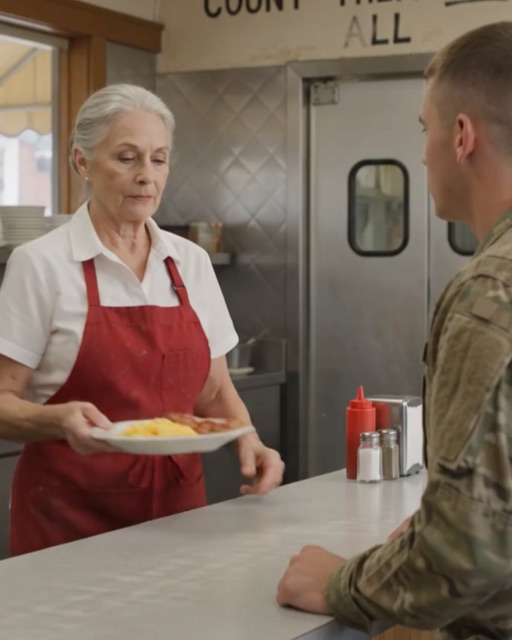
Private Decker’s face had gone the color of dish water.
The general waited.
I wiped my hands on my apron, the way I had wiped blood off them in a field tent twenty-nine years ago. Some habits don’t leave the hands. They just wait.
“Six soldiers,” I said again, louder this time. Loud enough for the booth in the back. Loud enough for the ghosts.
The chaplain held the casualty card like it was made of glass.
“Major Ellison,” the general said, “the Army would like to correct the record. Publicly. Today.”
I felt my knees lock.
For twenty-nine years, I had cracked eggs over that grill and listened to boys call those six men “equipment.” I had heard the official story repeated on Memorial Day. I had watched a colonel get a building named after him.
The same colonel who told me, on a satellite phone, that bodies without dog tags were “unverifiable assets.”
I had argued.
He had ordered.
I had counted anyway.
That was the night a young specialist named Cole picked up a piece of plywood off a burnt Humvee and painted three words on it with motor oil and a stick.
He died four hours later.
I carried that board home in my duffel.
The general nodded toward the door. Outside, the four vehicles were waiting. Beyond them, I could see the chapel steeple at Fort Lawson, and past that, the honored section.
Where he was buried.
“Ma’am,” the general said quietly, “the headstone is being removed at 1400 hours.”
The coffee cup in Decker’s hand started to shake.
“Whose headstone?” he whispered.
The brigade sergeant major turned to him. His voice didn’t rise. It didn’t have to.
“Son, the man buried under that stone is the reason Specialist Cole’s mother was handed an empty flag.”
I untied my apron.
For the first time in twenty-nine years, I let it fall on the counter instead of folding it.
I walked to the kitchen door and lifted the painted board down from the nail myself. The wood was warm from the grill heat. Light. Lighter than I remembered.
Six names. That’s all I had ever wanted on a piece of paper.
I turned to Private Decker, who was standing now, cap crushed in both hands.
“You wanted to know what it means,” I said.
He nodded, barely.
I tucked the board under my arm and stepped toward the general.
“Come to the ceremony, Private. Bring your friends. Bring the whole counter.”
The general opened the door for me.
I paused on the threshold of my own diner, looked back at the boy in the new uniform, and said the thing I had been waiting twenty-nine years to say out loud, in daylight, in front of witnesses.
“Today the Army is going to read six names on the chapel steps. And then they’re going to read a seventh.”
Decker’s lips parted.
“Whose, ma’am?”
I looked past him, at the grill, at the steam, at the three painted words that had outlived a war and a lie and a man with a marble headstone.
“The name of the officer who gave the order.”
And I stepped into the sunlight, where four soldiers were already standing at attention, waiting for me to carry a piece of burnt plywood across a parking lot – and finish what a dying specialist started in the dark.
But before I reached the lead vehicle, the general touched my elbow and quietly handed me one more sealed envelope.
“Major,” she said, “there’s something else you need to see before we read that seventh name.”
My fingers closed around the thick paper. It was government stock, heavy, official.
The general’s eyes were not giving anything away. They were the same calm, steady eyes that had looked at me across her desk a week ago, after I’d finally sent my letter.
I got into the back of the black sedan. The sergeant major sat in the passenger seat, a mountain in dress blues.
The door closed with a solid, insulated thud, shutting out the sizzle of the grill and the smell of coffee.
We pulled out of the parking lot, past the sign that read “Ellie’s Place. Best Coffee on Post.”
My diner. My hiding place. My twenty-nine-year-long penance.
My hands trembled as I looked at the envelope. My name and rank were typed on the front. Major Ellison. A name I hadn’t answered to in decades.
I slid my thumb under the seal.
Inside was not a typed military document. It was a folded, yellowed piece of paper, brittle at the creases. It was a letter.
The handwriting was young, a little sloppy, written in a hurry. I knew it instantly. It was Specialist Cole’s.
I looked at the general.
“His mother sent it to the Inspector General’s office last month,” she explained softly. “She said she’d kept it all these years. She thought it was just his last letter home. But then her grandson was reading it for a school project, and he noticed something she never had.”
My eyes fell back to the page. At the bottom, under his signature, was a postscript. A series of letters and numbers.
“It’s a grid coordinate, Major,” the general said. “Not from the official patrol route. It’s about five klicks off.”
I didn’t understand.
“We sent a team,” she continued. “It was difficult terrain. A ravine. They found a personal effects pouch from an old field pack. This was inside.”
She pointed to the letter I was holding.
My heart started to beat in a different rhythm. A slow, heavy dread that had nothing to do with the colonel.
“Dear Mom,” it began. “If you’re reading this, it means I didn’t make it back. Don’t be sad. I did my best.”
The usual words from a soldier who knows his time might be short. But then the tone changed.
“Something happened out here today, Mom. Something bad. And it was my fault.”
I stopped reading. I looked out the window as we passed the barracks, rows of tan buildings exactly like the ones I had lived in.
My fault. The words echoed in the silent car.
“I was on point. I had the map. I was so sure of the route, so cocky. I thought I’d found a shortcut that would get us back before the sandstorm hit.”
My breath caught in my throat.
“I missed a turn. I led them into the wrong valley. We were supposed to be on the ridge. Instead, I took us into the basin.”
The ambush. The place they were hit. It wasn’t just bad luck.
“The first round hit the lead vehicle. It was over so fast. By the time we knew what was happening, we’d lost everyone in the first truck. Six men. Gone. Because I couldn’t read a map right.”
The plywood board under my arm suddenly felt impossibly heavy.
“I got to Major Ellison. We were trying to get the wounded out when we got hit again. That’s when I got this piece of metal in my side.”
The memory was a flash of hot steel and screaming. Cole, trying to help me pull another man from the wreckage, before he crumpled to the ground.
“Before I pass out, I have to write this. The Colonel… he knows. I told him when he landed in the medevac chopper. I told him it was my mistake.”
I looked up from the letter, my mind racing, trying to put the pieces together in a new way. A way that hurt more than the old way.
“You know what he did, Mom? He looked at me, this kid who just got seven men killed, six of them gone forever. And he said, ‘No, son. The enemy ambushed your patrol on its designated route. You’re a hero for saving your Major. That’s the story.’”
The sedan turned onto the road that led to the chapel. Rows of white headstones stood in perfect, silent formation.
“Then he got on the sat phone. I heard him. He told someone that the bodies were unrecoverable. That they were just… assets.”
The colonel’s words. The ones that had burned in my memory for decades. The source of all my hatred.
“He said it so cold, Mom. But I saw his face. He was making a choice. He was burying my mistake under a lie. He was trading his own reputation so that you wouldn’t get a letter saying your son was a failure. He was protecting me.”
My vision blurred. The entire foundation of my righteous anger, the thing that had fueled me for half my life, was crumbling.
“There’s a piece of a Humvee I’ve been looking at. I’m going to write something on it for Major Ellison. She’s the only other one who knows the count. Six men. Plus me. That’s seven.”
I looked down at the letter, confused. Six men. Plus Cole. That wasn’t the whole story.
“She’ll count the men. But I hope one day she counts all of them. Not just the dead. I hope she counts the man who lied to save a kid’s honor.”
The letter shook in my hand.
“That’s eight, Mom. You gotta count them all. Tell her for me. If I don’t get the chance. Tell her to count all eight.”
The car stopped in front of the chapel. The doors were open. A crowd of soldiers, veterans, and civilians stood on the lawn.
I saw Private Decker and a half-dozen of his friends, all standing stiffly near the back.
The general turned to me. “Major? Ellison?”
She used my first name. A question. A kindness.
I couldn’t speak. I just folded the letter and put it back in the envelope.
The sergeant major opened my door. I stepped out, the plywood board still under one arm.
The heat was the same. The sun was the same. But the world had tilted.
For twenty-nine years, I thought Cole’s three words were a command. A burden he had passed to me.
Count The Men.
I thought he meant the six who were lost, erased from the record.
But that wasn’t it. That wasn’t it at all.
It wasn’t a command. It was a confession. And a plea.
He wasn’t telling me to remember the dead. He was asking me to understand the living. All of them.
The six who died because of his mistake.
Himself, the seventh, who died trying to fix it.
And the Colonel. The eighth man. The one who carried the lie.
I walked toward the chapel steps, my legs feeling like they belonged to someone else. The chaplain met me at the bottom, his face a mask of solemnity.
“Major Ellison,” he said. “We’re ready.”
I looked past him, to the empty space on the lawn where a crane had, only an hour ago, lifted a marble headstone from the earth. The stone that bore the name of Colonel Richard Davies.
The man I had come here to see condemned.
The General took the podium first. She spoke of duty, of honor, and of the Army’s solemn promise to never leave a soldier behind.
“Sometimes,” she said, “in the fog of war and the passage of time, that promise gets broken. Today, we make it right.”
She turned to me. “Major Ellison was there. She never forgot. She will now read the names of the six soldiers lost on that day, so they may finally be inscribed on the roll of honor.”
All eyes were on me as I walked to the podium. I set the plywood board down in front of me, the faded, oil-stained words facing the crowd.
Count The Men.
I took a deep breath, the air thick with unspoken history.
“I have waited twenty-nine years for this day,” I began, my voice hoarse. “I thought I knew what I was going to say. I thought I was here to right a wrong.”
I paused, looking out at the faces. Young soldiers like Decker. Old veterans with decades of their own ghosts.
“I was wrong.”
A murmur went through the crowd. I saw the general straighten slightly.
“The story we all know, the one I have held onto, is incomplete,” I said, my voice gaining strength. “It’s a story with heroes and villains. But the truth is almost never that simple.”
I picked up the board. “These words were painted by Specialist Marcus Cole. He died hours later. I thought he was telling me to remember the men we lost, to fight for their names.”
“I was supposed to come up here and read six names. Then I was going to read a seventh. The name of the officer who gave the order to list these men as equipment. Colonel Richard Davies.”
You could have heard a pin drop on the grass.
“I was going to tell you he was a coward. That he covered up their deaths for his own career. That the building on this base named for him is a monument to a lie.”
I set the board down again.
“But I would have been lying, too. Just a different kind of lie.”
I looked directly at Private Decker. “The truth, Private, is that war is full of boys trying to be men, making impossible choices in moments you can’t imagine. Specialist Cole was one of them. He was a hero. But he made a mistake. A navigational error that cost six men their lives.”
Another gasp rippled through the crowd.
“He confessed this to his commanding officer, Colonel Davies, as he lay dying.”
“Colonel Davies had a choice. He could report the truth, which would have meant that Specialist Cole, a brave soldier, would be remembered for a catastrophic mistake. His family would have received that news. Or, he could take the blame himself.”
My own voice was thick with emotion now. The anger was gone, replaced by a profound, aching understanding.
“And so he made up the story of the lost dog tags. He called them ‘unverifiable assets’ on an open line he knew was being recorded, a brutal, cold phrase designed to close the book. He sacrificed his own integrity in my eyes, and in the eyes of history, to protect the honor of a fallen specialist.”
“He let me hate him for twenty-nine years. He let the Army give him medals he knew were based on a lie. He carried that weight to his grave, never telling a soul, so that a young man’s mother could believe her son died a perfect hero.”
I looked at the chaplain, who was staring at me, the casualty cards forgotten in his hand.
“The motto on this board… ‘Count The Men’… it doesn’t just mean the six. It means all of them. It means we have to count the ones who fall, the ones who make mistakes, and even the ones who bear the burden of a terrible secret. It means they are all just men. Human. Breakable. And worthy of being counted.”
I took a breath. “Today, we are correcting the record. So let’s do it right.”
I read the first six names, my voice clear and steady. The names of the soldiers who had been ghosts for so long. With each name, the chaplain nodded, and the bell in the chapel tower rang once.
Then I paused.
“And we honor Specialist Marcus Cole. A soldier who did his best, who owned his mistakes, and who asked us for understanding, not just glory.”
The bell rang a seventh time.
There was a long silence. The crowd was still, processing the story they had never heard.
“And finally,” I said, my voice dropping to a near whisper. “We count the eighth man. Colonel Richard Davies. Who made a choice I have only just begun to understand. May he, too, finally rest in peace.”
I did not ask for the bell to ring. His story was his own.
I stepped back from the podium. The General walked up, her face unreadable, and took my place.
“The original headstone of Colonel Davies will not be returned,” she announced. “The building bearing his name will be rededicated.”
She paused. “The new headstone will read simply: ‘Colonel Richard Davies. He Counted Them All.’”
Tears I didn’t know I had been holding back for three decades finally fell. It wasn’t justice. It wasn’t vengeance. It was something more complicated and more beautiful. It was truth.
Later, as the crowd dispersed, Private Decker approached me. His eyes were red.
“Ma’am,” he said, his voice cracking. “I get it now.”
He didn’t need to say more.
I nodded, clutching the plywood board that I would finally take home, not as a burden, but as a lesson.
The next morning, I was back at the diner. The grill was hot, the coffee was brewing.
Decker and his friends were in their usual booth. They were quiet. Respectful. He gave me a small nod when I brought their order.
I had hung the plywood board back on the wall, but it looked different to me now. The three words weren’t a weight anymore. They were a reminder.
A reminder that true honor isn’t about being perfect. It’s about how you carry your imperfections. It’s about the grace you give to others, and the grace you must, eventually, give to yourself.
Sometimes the biggest battles are not fought on a battlefield, but in the quiet spaces of the human heart, over decades, until the moment you finally choose to count everyone.