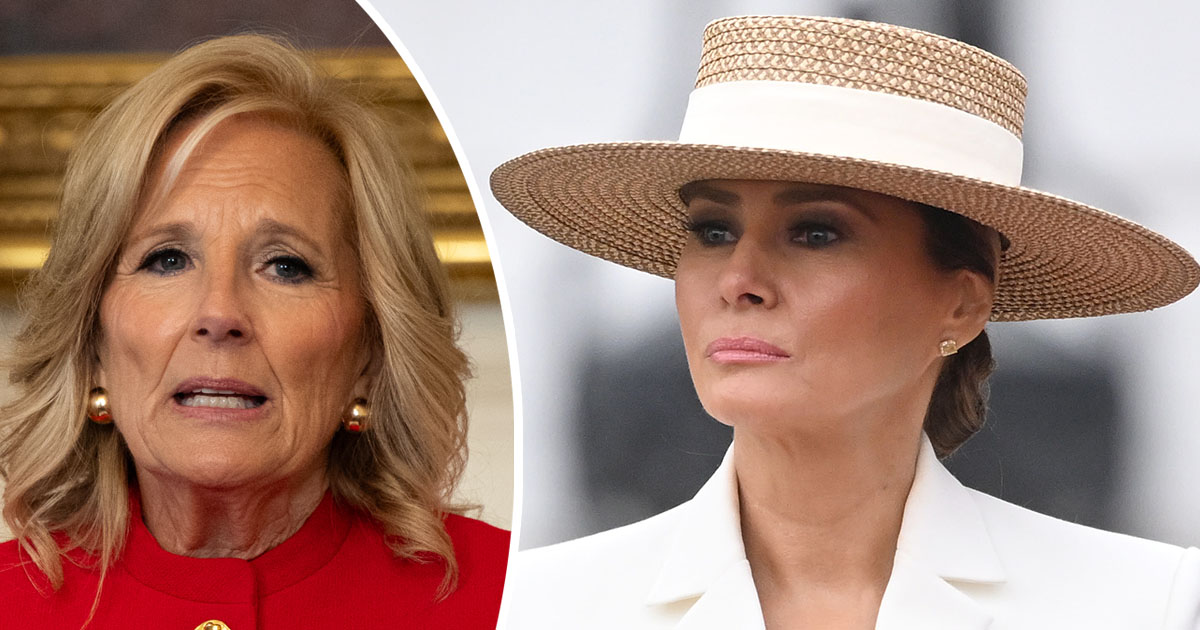
Jill Biden’s new memoir offers a calm, candid look at life inside the White House and the quieter moments most of us never see. Among the stories she shares is a brief, uncomfortable exchange with Melania Trump that took place as the nation prepared for Donald Trump’s return to the presidency. It was one of the very few times the two women spoke directly, and Jill’s account suggests it was cordial on the surface, yet undeniably strained.
In her book, titled View from the East Wing, Jill writes that her interactions with Melania were limited over the years. Their paths crossed only occasionally, and when they did, the tone was polite but chilly. That distance, Jill suggests, may have been shaped in part by hard feelings surrounding the 2022 search of Mar-a-Lago, which unfolded during Joe Biden’s presidency. Though the Justice Department has emphasized its independence in such matters, Jill believes Melania still associated the moment with the White House and her husband’s successor.
Jill’s retelling is measured rather than sensational. She does not dwell on disagreements or linger on personal criticisms. Instead, she describes what happened and how it felt, adding context where it helps the reader understand the unique pressures that accompany life at the very top of American politics. For many readers, especially those who have lived through multiple transitions of power, her perspective will feel both familiar and surprising.
A measured look at a frosty relationship
According to Jill, her relationship with Melania Trump never quite found its footing. Donald Trump and Joe Biden have interacted in public arenas far more frequently, including on debate stages and at official ceremonies. By contrast, the first ladies’ encounters were rare and brief. Jill notes that one of the most memorable moments came during a motorcade ride to the U.S. Capitol, just before Donald Trump was sworn in again as president. It was, she writes, quiet to the point of awkwardness.
“The presidents’ car was likely frosty too, but at least they’d spent considerable time in each other’s company,” Jill writes in View from the East Wing. “This would be one of few interactions Melania and I had ever had.”
Her description places the reader inside the car, where the hum of the motorcade and the gravity of the day seemed to weigh on the conversation. Jill tried to be friendly and make small talk. Melania replied politely, but the exchange did not grow into a comfortable chat. Jill’s portrait of the moment is not sharp-edged; rather, it is the kind of scene that many people can recognize from their own lives, when two individuals with little shared history meet during a stressful time and find themselves searching for words.
Context around the Mar-a-Lago search and why it mattered
Jill suggests that one source of tension may trace back to the 2022 FBI search of Mar-a-Lago as part of an investigation into classified documents. While that search took place during Joe Biden’s time in office, the Department of Justice has repeatedly said decisions of this kind are made independently and without presidential direction. Even so, Jill writes as though she sensed Melania associated the episode with the Biden White House, and that the emotion around it lingered.
Interestingly, Jill adds that she felt genuine sympathy for Melania in that situation. She understood the disruption and discomfort such a search can cause in a family home. “I have compassion for her, having been subject to the same kind of search,” Jill wrote. “I knew how distressing it was to have agents rummage through your underwear drawer.” She was referring to the FBI’s 2023 search of the Bidens’ Wilmington, Delaware residence, during which agents looked for classified materials as well. In both cases, Jill emphasizes the personal strain that comes when a private space suddenly becomes a site of official scrutiny.
For readers who have followed public life for many years, Jill’s acknowledgment may stand out. Political families often endure intrusions and pressures that most households never face, and moments like these can leave lasting impressions. In her telling, Jill does not excuse or accuse; she simply describes, offering a small window into how these events can shape relationships behind the scenes.
The inauguration traditions and a missed invitation
Jill also reflects on the rituals that typically soften the edges of political change. For generations, there has been a tradition in which the outgoing first lady invites the incoming first lady to the White House for tea and a tour of the family quarters. It is not required, but it has become a symbol of respect and continuity between administrations, a way to show that above policy and partisanship, the country and its institutions endure.
In 2021, that traditional meeting did not take place between Melania Trump and Jill Biden. Some accounts at the time suggested that Jill waited for a call that never came, and that she felt slighted by the break with custom. According to a report, a source close to the situation said Jill considered the absence of a tour and tea to be dismissive and contrary to long-standing practice. Whatever the exact motivations, the missed moment left a mark and may have contributed to the coolness that followed.
What stands out in Jill’s memoir, however, is not a tallying of grievances but a focus on how these choices affect the human side of the role. The first lady, regardless of party, becomes the nation’s hostess, a steward of symbolism as much as of the residence itself. When traditions falter, people notice, and the tone of a new chapter can be set before the first page is even turned.
The motorcade ride that spoke volumes
The scene Jill describes before Donald Trump’s return to the White House is quiet, even understated, yet it captures so much of what can make political life uneasy. Sharing a car on the way to the Capitol should have offered a chance for two first ladies to connect, however briefly. Jill made an effort to converse. She asked about Barron Trump and his studies, a simple and considerate topic. Melania answered with a single word—“NYU”—and then, Jill recalls, turned her attention to the passing scenery and small talk about the weather.
“‘NYU,’ Melania said, looking out the window,” Jill wrote in View from the East Wing. “Melania kept trying to switch the topic to the weather.” In print, the exchange reads as calm but cool, a moment where both women did their duty to be cordial without moving into warmer ground. Anyone who has ever tried to bridge a gap with a reserved acquaintance may recognize the feeling. Sometimes, circumstances and history weigh down even the lightest subjects.
There is no unkindness in Jill’s account. Instead, there is a sense of acceptance. She seems to understand that not every relationship in public life becomes friendly, and not every awkward moment has a neat resolution. Still, the detail she includes lets readers feel how the day unfolded from her seat, looking through the motorcade window at a country poised, once again, for change.
How the Bidens approached the 2025 transition
Jill notes that in 2025, after the election, she and President Joe Biden were prepared to follow the expected rituals of transfer and welcome. Protocol offers an important signal to the public that institutions matter more than rivalries. The Bidens, she writes, wanted to reflect that understanding. These carefully observed handoffs do not erase political differences, but they demonstrate a commitment to the office and to the country that extends beyond any single presidency.
For households watching at home, many of whom have seen multiple inaugural ceremonies over the decades, these images can be reassuring. They remind us that our system is designed to outlast individuals. Whether or not the principal players are personally close, these shared gestures anchor the nation’s expectations and help maintain civility at the very moments it is most tested.
The private burdens on public families
Jill’s reflections also highlight the ripple effects that politics can have on families, especially children. Asking about Barron Trump was, in part, a way to recognize that family life carries on regardless of who holds office. School plans, friendships, and milestones continue even as the news cycle turns and the schedules get busier. The quieter question beneath Jill’s memoir scene is a universal one: how do families find normalcy when nothing about their situation is ordinary?
For older readers who have raised children or guided grandchildren, the answer may feel intuitive. You focus on the next right thing. You keep routines where you can. You extend grace when possible. Even in the first families, whose lives are scrutinized and sometimes criticized, those same gentle rules often apply. Jill’s account suggests she tried to touch on that common ground, even if the moment did not blossom into a deeper conversation.
Why this story resonates now
At first glance, an awkward car ride might seem like a small detail. Yet it reveals the tone of a larger relationship—two women who share a rare job description, navigating an extraordinary day with courtesy but little warmth. It also shows how events far outside their control, like high-profile investigations and the bitter memories that accompany them, can seep into personal dynamics.
Jill’s empathy about the search of Mar-a-Lago, informed by her own experience in Wilmington, is a reminder that even political rivals can feel similar stress. Having strangers search a private home is unsettling for anyone. That she acknowledges this so plainly becomes one of the most human notes in her memoir. Rather than try to win a point, she describes a feeling most of us can understand: the desire for privacy and the discomfort when it is suddenly gone.
Reading between the lines without jumping to conclusions
Jill Biden’s recollections are offered as her perspective, and she presents them with restraint. She does not claim to know exactly what Melania was thinking that day in the motorcade. She shares what she saw and heard, and how it felt to try to make conversation while so much history and tension hung around them. Readers are free to draw their own conclusions. Some may see two people doing their best under the circumstances. Others may view it as a missed chance at goodwill. Either way, the story adds texture to a moment most of us only witnessed at a distance.
For those who appreciate the ceremonial side of American life, Jill’s emphasis on tradition will likely stand out. She points to rituals not as empty gestures, but as threads that help hold the national fabric together. When they are observed with care, transitions can feel steadier. When they are skipped, even for understandable reasons, the absence can be felt.
A calm closing note on civility
In sharing this chapter, Jill Biden offers a portrait of public life that is less about headlines and more about the everyday reality of being visible, vulnerable, and expected to be gracious amid enormous pressure. Her exchange with Melania Trump was not dramatic. It was simply strained. And yet, in that ordinariness lies its power. It reminds us that even at the highest levels, people are still people—navigating differences, absorbing slights, and sometimes choosing silence over conflict.
As the country moves forward, these glimpses behind the curtain can help us keep perspective. We can hold on to the idea that traditions matter, that empathy matters, and that the way leaders treat one another sets a tone that filters into every home. The image of two first ladies sharing a ride, speaking briefly, and then letting the quiet return may not be grand, but it is real. In its own way, it tells us what we need to know about the strain of the moment and the hope that, with time, grace can still find a way in.
View from the East Wing does not try to settle old scores. Instead, it invites readers to consider how official duties intersect with private lives, and how moments that last only a few minutes can leave impressions that linger for years. Jill’s acknowledgment of discomfort, her expression of sympathy, and her focus on tradition make this particular story feel both personal and, in a small but meaningful way, national.
For anyone who has watched decades of political change, the message is simple and familiar. People will disagree. Power will shift. Investigations will come and go. Through it all, the measure of character often shows up not in speeches, but in the quiet spaces between them. Jill Biden’s quiet, awkward ride with Melania Trump is one of those spaces. It is a reminder that even in a divided era, it is still possible to look for common ground, to observe the rituals that bind us, and to part with civility, if not warmth.
In the end, this is not a story about victory or defeat. It is a story about two women sharing a brief stretch of road on a consequential day, both carrying the weight of their histories and their households. It is about trying, however imperfectly, to be gracious. And it is about recognizing that sometimes, especially when eyes are everywhere and emotions run high, the kindest path is the simplest one: keep it polite, keep it brief, and keep moving forward.