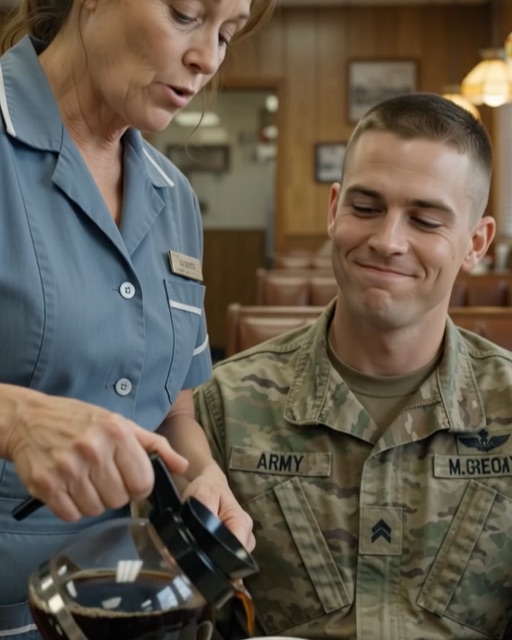
The private laughed when I told him the black ribbon on his guidon was tied on the wrong side.
Then he choked on his coffee.
Because the colonel standing behind him said, “She tied the first one under fire.”
The diner went dead quiet.
Ten minutes earlier it was a normal Thursday. Same booth. Same jokes. Same order – black coffee, biscuits, eggs over easy, bacon almost burned. I work mornings at Liberty Diner, two miles outside Fort Adams. They call me “ma’am.”
Most mean it.
One didn’t.
Private Brandon Keane – fresh haircut, loud mouth, arrogance worn like issued gear—watched me refill his cup and jerked his chin toward the old guidon photo over the register.
“You know that ribbon’s on the wrong side, right?”
His buddy kicked him under the table.
He kept going. “Everybody near a fort thinks old Army stuff is decoration.”
I smiled. Because grief doesn’t need an audience.
“No, honey,” I said. “The new ones are wrong.”
He snorted. “Sure.”
I set the pot down before my hands betrayed me. In the kitchen, I pressed my palm to cold steel and breathed through rotor wash, red dust, boys calling for their mothers in voices too young for war.
When I came back, a convoy had rolled to a stop outside. Not unusual. What was unusual was the colonel who pushed through our door with two command sergeants major and a soldier carrying a long black case.
Every soldier stood.
He didn’t look at them. He walked straight to me.
“Captain Mercer?”
The coffee pot slipped. Nobody has called me that in twenty-nine years.
Private Keane’s face drained.
The colonel removed his cover. “Ma’am,” he said gently, “the 118th is retiring the original company guidon today.”
I looked at the black case. “I heard.”
“We can’t do it without you.”
“I only worked the aid station,” I managed.
The older sergeant major’s eyes went glassy. “No, ma’am. You kept the company alive long enough to carry a guidon home.”
The colonel clicked open the case on the counter.
Scarlet field. Gold letters. One black ribbon tied under the spearhead—on the left side.
Keane stared at it. Then at the glossy photo of his unit’s display. Right side.
The colonel opened a weathered notebook. I knew the block letters before I saw the name.
Kandahar. 2010. Lt. Shane Salinas.
The first one I couldn’t save.
He read: “If we make it home, tie the ribbon on the side Captain Mercer ran toward. She’ll know why.”
Every soldier stood a little straighter.
Keane took off his cap with shaking hands.
I looked him in the eye. “The left side wasn’t for mourning,” I said. “It marked the side of the road where medevac was supposed to land.”
The colonel’s jaw tightened.
“But the landing zone got moved without telling us,” I whispered. “Shane died while I was hauling him toward empty ground.”
The sergeant major lowered his eyes.
“And the man who moved it?” I nodded at the convoy idling outside. “He’s right there, waiting to dedicate the new training wing.”
The colonel swallowed hard, then lifted something else from the case.
“There’s a second notebook,” he said quietly.
My hands went numb. That book was supposed to have burned.
I flipped it open—saw the first line, saw my name—and the next three words made the colonel flinch.
And it said: “Mercer ordered the move.”
The air in the diner turned to ice. My breath caught in my throat, a sharp, painful thing.
The colonel’s face, moments ago filled with reverence, hardened into a mask of duty. He looked from the notebook to me, his eyes now cold and assessing.
“Ma’am, this is an official After-Action Report addendum,” he said, his voice clipped and formal. “It was filed two days after the incident.”
Private Keane looked like he’d been hit by a truck. He stared at me, his mouth slightly open, the arrogance replaced by utter confusion.
The words were right there, in black ink. Signed by Corporal Allen Frazier. A boy I’d personally patched up just an hour before Shane was hit.
“That’s… that’s not possible,” I stammered, my own voice a stranger’s.
The colonel, whose name tag read ‘EVANS’, didn’t soften. He was a man of regulations now, not memories.
“The report states you received new intel about a compromised LZ and ordered the change of direction yourself,” he continued, reading from the damning page. “It was deemed a tragic but understandable field decision under duress.”
The words were a calculated lie, crafted to shield someone else. A lie I had been forced to live under in silence.
I didn’t order the move. I was just a captain in a bloody aid station. The command came from higher. From a man who was then Major Thompson.
He had been the one on the radio. His voice, panicked and sharp, had rerouted the bird. He had done it to cover a tactical error he’d made minutes before, an error that led the enemy right to our original, safer position.
He had sacrificed Shane to save his own career.
“Colonel,” I said, my voice shaking but finding a sliver of steel. “Corporal Frazier would never have written that. Not on his own.”
The older Command Sergeant Major, a man with a kind, weathered face, shifted his weight. His name tag read ‘DAVIES’.
“Sir,” CSM Davies said quietly, his gaze fixed on the worn diner floor. “I was a Specialist back then. I was on guard at the aid station. I… remember Corporal Frazier after he was debriefed by Major Thompson.”
Colonel Evans looked at his senior NCO, a flicker of irritation in his eyes. “And?”
“He was white as a sheet, sir. Shaking. He couldn’t look Captain Mercer in the eye for a week. We all just thought it was the battle.”
The memory hit me like shrapnel. Allen, avoiding my gaze, flinching when I tried to check his stitches. I thought it was trauma. It was guilt.
“Thompson threatened him,” I said, the realization a bitter taste in my mouth. “He was just a kid. Thompson must have told him what to write.”
Colonel Evans closed the second notebook with a sharp snap. The sound echoed the closing of a door in my face.
“Ma’am, with all due respect, what you’re asking me to believe is that a decorated general, the man we’re here to honor, falsified a report and built his career on a lie,” he said flatly. “This addendum is part of the official record. Shane Salinas’s notebook is a personal effect. I know which one the Army recognizes.”
His meaning was clear. The ceremony would proceed. History, written by the victors and the powerful, would stand.
My heart, which had carried this wound for nearly three decades, felt like it was finally breaking. I had kept my silence. I had left the Army I loved because the quiet injustice was too much to bear. I had built a simple life, serving coffee and biscuits, trying to forget.
And now, they had brought the lie right to my doorstep, wrapped in a flag of honor.
Private Keane, the boy who had started all this with a stupid joke, was watching me. His eyes were wide. He wasn’t seeing a waitress anymore. He was seeing the story crack open.
I took a deep breath, the smell of burnt bacon and stale coffee grounding me. I looked past the Colonel, through the diner window at the gleaming black cars waiting outside.
General Thompson was in one of them. Waiting to be celebrated for his leadership.
Something in me, a part I thought had died in the Kandahar dust, stirred. It was the part of me that ran toward the fire, not away from it.
“Colonel Evans,” I said, my voice suddenly clear and steady. The “ma’am” was gone. I was Captain Mercer again. “What was Major Thompson’s call sign that day?”
The Colonel was taken aback by the question. “I… I wouldn’t know that offhand. That’s classified information from a mission file nearly thirty years old.”
“It was ‘Pathfinder Six’,” I said. “And he wasn’t at Command HQ like he claimed in his report. He was less than two klicks east of us. His convoy had taken a wrong turn and made contact with the enemy force we were trying to avoid.”
CSM Davies’s head snapped up. “I remember that. We heard secondary comms chatter about a ‘Pathfinder’ element taking fire. We thought it was a different unit.”
“It wasn’t,” I said, locking eyes with him. “He redirected our medevac not because our LZ was compromised, but because he was trying to draw enemy fire away from his own mistake. He used our bird as a diversion. Shane Salinas didn’t die because of a field decision. He died to cover a lieutenant colonel’s panic.”
A hush fell over the entire diner. Even the cook had come out of the kitchen, wiping his hands on his apron.
“That’s a very serious accusation, Captain,” Colonel Evans warned, his hand resting on the case as if to protect the official story within.
“It’s the truth,” I said. I slid Shane’s weathered notebook across the counter. “Shane wrote, ‘tie the ribbon on the side Captain Mercer ran toward.’ He didn’t say ‘the empty field.’ He said the side I ran toward. That was west. Toward the original LZ-Alpha.”
I pointed a trembling finger at the second notebook. “That lie says I ordered the move east. But everyone who was there, everyone who carried a stretcher, saw which way I was running.”
My eyes found Private Keane’s again. “You wanted to know about the ribbon, Private? The ribbon remembers the truth. Even when people try to make you forget.”
He swallowed hard and gave a single, sharp nod.
Colonel Evans stood frozen, a man caught between a general’s pristine record and a waitress’s raw, unshakable truth.
“I’m going to the ceremony,” I said, untying my apron and dropping it on the counter. My hands were steady now. The grief was still there, but it wasn’t a weight anymore. It was fuel.
“Ma’am, that’s not a good idea,” the Colonel advised, his voice low.
“For twenty-nine years, I let him have his career,” I said, walking past him toward the door. “I won’t let him dedicate a building in the name of the honor he stole. Not today.”
I pushed the diner door open. The sun was bright. The air was crisp. For the first time in a very long time, I felt like I could breathe.
As I started walking toward the parade ground on the base, I heard footsteps behind me.
It was CSM Davies. He fell into step beside me, his face set with determination.
“I was a kid, ma’am,” he said, not looking at me. “Too scared to say what I saw. Not anymore.”
A few more steps, and another set of footsteps joined us. Private Brandon Keane, looking terrified but resolute.
“My dad… he was 118th,” he mumbled. “He said you always do what’s right. No matter what.”
I didn’t say anything. I just kept walking. A waitress, a Command Sergeant Major, and a cocky young private, marching toward a General.
The ceremony was already in full swing. A large crowd of soldiers in their dress uniforms, families, and local dignitaries sat in neat rows of folding chairs. On the stage, in front of a newly unveiled sign for the “Thompson Leadership & Training Wing,” stood the man himself.
General Marcus Thompson. Older, grayer, but with the same arrogant set to his jaw I remembered. He was at the podium, speaking about sacrifice, duty, and the unshakeable integrity of the American soldier. The hypocrisy was so thick I could have choked on it.
We didn’t rush the stage. We just walked, calmly and deliberately, down the center aisle. Heads turned. Murmurs spread through the crowd.
Security officers moved to intercept us, but Colonel Evans, who had apparently followed in his vehicle, stepped in front of them. “Let them through,” he commanded, his face a storm of conflict.
We stopped at the foot of the stage. General Thompson paused his speech, his eyes narrowing as he saw me. For a split second, I saw a flicker of the same panic he’d had on the radio all those years ago. Then it was gone, replaced by cold fury.
“Can I help you, ma’am?” he asked into the microphone, his voice dripping with condescension.
I didn’t need a microphone. Everyone was silent, leaning in.
“You can start by using my name, General,” I said, my voice carrying in the stillness. “It’s Mercer. Captain Mercer. You might remember me from Kandahar. LZ-Alpha.”
The color drained from his face.
“This is highly inappropriate,” he blustered. “This is a day to honor the regiment, not to air old grievances.”
“I’m not here for grievances,” I said. “I’m here for the truth. For Lieutenant Shane Salinas.”
I held up Shane’s worn notebook. “He left a last request. He said to tie a black ribbon on his company guidon. On the left side. The side I was running toward.”
I then held up the other notebook, the one with the lie. “And this is the report you had a scared Corporal sign, stating I ran the other way.”
CSM Davies stepped forward. “Sir, I was there. I was Specialist Davies. I corroborate Captain Mercer’s account. We heard your call sign, Pathfinder Six, taking contact. You rerouted our medevac to cover your own position.”
The crowd gasped. The soldiers in the front row were staring at Thompson, their faces a mixture of shock and dawning disgust.
“This is an outrage!” Thompson sputtered, his composure shattering. “An unsubstantiated accusation from a disgruntled… waitress!”
Then, from the crowd, a young, clear voice rang out. It was Private Keane.
“It wasn’t just them, sir!” he yelled, standing on his chair. “The whole diner heard it! The guidon doesn’t lie!”
Thompson looked around wildly, seeking support, but he found none. He saw only the questioning eyes of the soldiers he commanded, the men and women whose trust he had just lost in an instant. He saw Colonel Evans, standing grimly by the stage, no longer his ally. He saw a legacy, built on a lie, crumbling to dust in the space of three minutes.
He opened his mouth, then closed it. He tapped the microphone, a hollow sound in the vast silence, and then he turned and walked off the stage, his shoulders slumped in defeat.
The ceremony ended without another word.
A week later, I was back at the diner, pouring coffee. It was a normal Thursday, but nothing felt the same. The weight was gone.
The bell over the door jingled, and Colonel Evans walked in, this time alone. He sat at the counter, not in a booth.
“Ma’am,” he said, placing his cover on the counter. “General Thompson has been relieved of command, pending a full investigation. They found the original radio logs. You were right. About everything.”
I just nodded, topping off his cup.
“The Army… apologizes, Captain Mercer,” he said, his voice thick with emotion. “For failing you. For letting the truth get buried.”
He pushed something across the counter. It was a framed photograph. In it, the original 118th guidon was being formally retired. The black ribbon was tied neatly, securely, on the left side.
“We made it right,” he said.
I looked at the photo, at the scarlet field and the gold letters, and a tear I didn’t know I was holding finally fell. It wasn’t a tear of grief, but of relief.
Private Keane became a regular. He never mentioned that first day again. He’d just come in, order a coffee, and listen to the old vets tell their stories. He was learning a different kind of lesson now, one not found in any manual.
Sometimes, the greatest battles aren’t fought with guns, but with memory. And sometimes, the deepest honor is found not in medals and parades, but in the quiet courage to carry the truth, waiting for the day it finally needs a voice.
The ribbon on the wrong side had been a quiet protest for twenty-nine years. Now, it was a testament. A lesson that a lie can build a career, but it can never build a legacy. Because truth, like a soldier, is patient. And it will always, eventually, come home.