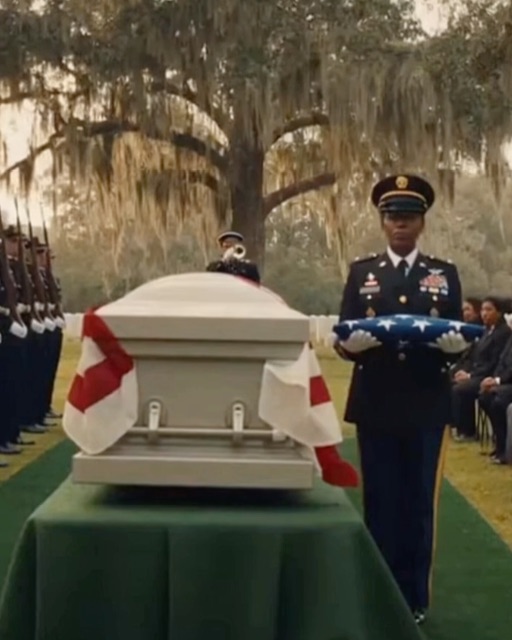
The Georgia heat was suffocating. The kind that makes your uniform stick to your back like a second skin. I stood at the edge of Raymond Holloway’s grave, holding a folded flag so tight my knuckles ached, and I told myself I would not break. Not here. Not in front of Marjorie.
Three volleys cracked the air. The honor guard was flawless. Marjorie sobbed once – just once – and it almost took me down.
Raymond had found me when I was nineteen, angry, and about to wash out of basic. He grabbed me by the collar and said, “Denise, you’re not quitting. You’re just scared. And scared is fine. Quitting is not.” That was thirty-one years ago.
I made General because of that man.
So when the last note of Taps faded and I knelt to present Marjorie the flag, I whispered, “He was the best of us.” She touched my cheek with a shaking hand and said, “He knew you’d be the one holding it.”
That should have been the end.
It wasn’t.
I walked Marjorie to the black car, my arm steady under hers. The crowd parted. A few vets saluted. I returned every one.
Then I felt it.
A hand. On my shoulder. Hard. Not respectful. Not gentle. The kind of grip that says I own this moment.
“Ma’am, I need to see some ID.”
I turned slowly. Officer Daniel Griggs. Mirrored sunglasses. Arms that had never carried anything heavier than a radar gun. A jaw set like he’d rehearsed this in the mirror.
“Excuse me?” I said.
“This is a restricted area. I need to verify you have authorization to be here.”
I looked down at my uniform. At the stars on my shoulders. At the ribbons that stretched across my chest like a roadmap of every hellhole on three continents.
“Officer,” I said, keeping my voice level, “I’m the one who authorized this ceremony.”
He didn’t flinch. He smiled. That thin, curling smile that people wear when they think they’ve found someone who won’t fight back.
“Ma’am, I don’t know where you got that costume, but around here, we verify credentials. Lot of folks like to play dress-up.”
Costume.
The word landed like a slap. Behind me, I heard Marjorie gasp. Two of the vets stepped forward, but I raised a hand. Held them back.
Griggs unclipped his radio. “Dispatch, I’ve got an individual at Oakwood claiming military rank. Requesting backup for possible stolen valor.”
Stolen valor.
My blood didn’t run cold. It ran hot. Reactor-core hot. The kind of hot that once kept me calm while mortar rounds cratered the ground fifty meters from my command post in Kandahar.
A small crowd was forming. Phones came out. I could feel the lens of every camera like a laser dot on my skin.
Griggs stepped closer. Close enough that I could smell the cheap aftershave and the coffee on his breath. He put his hand on his holster. Not drawing. Just resting. Just letting me see it.
“Turn around,” he said. “Hands where I can see them.”
Marjorie stood up from the car. “That woman is a United States General! She buried my husband! You leave her alone!”
Griggs didn’t even look at her. “Ma’am, sit down or I’ll cite you for obstruction.”
He was talking to a seventy-eight-year-old widow. At her husband’s funeral.
I turned around. I placed my hands on the hood of the patrol car. Not because I was afraid. Because I needed him to commit. Every second of this was being recorded, and I needed every single one.
The metal was scalding from the sun. I didn’t flinch.
He patted me down. Rough. Slow. Deliberate. His hands lingered where they shouldn’t have. A vet in the crowd shouted something I won’t repeat. Griggs told him to shut up or join me.
Then he leaned in and whispered something in my ear. Something he thought no microphone would catch.
My jaw tightened so hard I thought my teeth would crack.
He stepped back, satisfied. Smirking.
That’s when the black SUV pulled up. Two doors opened simultaneously. Out stepped Colonel Terence Whitaker, my aide-de-camp, and a woman in a charcoal suit I recognized immediately – because I’d had dinner with her in Washington six days ago.
Griggs saw the government plates. His smirk flickered.
The woman in the suit walked straight to Griggs, heels clicking on the cemetery asphalt like a countdown. She held up a credential case and flipped it open three inches from his face.
His face went white.
She looked past him, directly at me, and said two words that made every phone in that crowd start recording even harder.
She said: “General Hartwell…”
Then she turned back to Griggs, closed the credential case, and said something so quiet only he and I could hear. But I read her lips. And what she told him about what was about to happen to his career, his pension, and the next forty-eight hours of his life made the blood drain from his face so fast I thought he might pass out right there on the hot pavement next to the grave of the man who taught me that a soldier’s real power isn’t in her rank.
It’s in her restraint.
Griggs reached for his radio. His hand was shaking.
But before he could press the button, my aide handed me a phone. On the screen was a text from a number with a D.C. area code. I read the first line, and for the first time all day – I smiled.
It said: “We got all of it. Every second. And the Governor wants to know what you want us to do.”
I looked up from the phone, past the terrified face of Officer Griggs, and met the eyes of the woman in the suit. Her name was Katherine Thorne, and she was an Assistant Attorney General.
“Agent Thorne,” I said, my voice calm again. “Secure the officer.”
She nodded once. Two men in identical suits materialized from the SUV and flanked Griggs, who looked like his strings had been cut.
They didn’t cuff him. Not yet. That would be a local matter, and I knew protocol.
The crowd was buzzing now, the videos already uploading, hashtags already forming. A viral storm was brewing over Raymond’s grave, and I hated it.
My first duty was to Marjorie. I walked back to her, ignoring the cameras.
“I am so sorry, Marjorie,” I said, my voice softer than it had been in years. “This day was for Raymond.”
She clutched my hand. “Raymond would have handled that boy with two words and a look. You did it with more.”
I helped her into the waiting car, the one the Army had sent for her.
Colonel Whitaker leaned in. “Ma’am, what are your orders?”
“Get her home,” I said. “And stay with her until I get there.”
He nodded. “Yes, General.”
The car pulled away, leaving me in the center of the storm.
Agent Thorne came to my side. “The local chief of police is en route. He sounds… panicked.”
“I’ll bet,” I said, watching as they led a pasty-faced Daniel Griggs to a different car.
“What he whispered to you,” she started, “was it picked up on audio?”
I thought about his words, venomous and sharp, right against my ear. “Old man Holloway probably rolled in his grave seeing a woman cry over him. Some leader you are.”
It wasn’t just an insult to me. It was a desecration of Raymond’s memory.
“I don’t know,” I lied. “But I’ll give a statement.”
I wanted him for his actions, not just his words. I wanted this to be clean, by the book.
The Chief of Police arrived, sirens off, looking like he’d just run a marathon in a sauna. His name was Bill Seldon, and he looked at me like I was a bomb he had to defuse.
“General, I… I cannot apologize enough,” he stammered.
“Your apology is noted, Chief,” I said, my tone flat. “What you can do is give me Officer Griggs’s file. All of it. The unedited version.”
He paled. “That’s… highly irregular.”
Agent Thorne stepped forward. “A formal request from the Department of Justice is on its way to your office right now. I suggest you get a head start on it.”
Chief Seldon just nodded, defeated.
I spent the next two hours at the small police station. The air was thick with the smell of stale coffee and desperation.
In a small, windowless room, I read through the file.
Daniel Griggs was not a rookie. He’d been on the force for twelve years.
And his file was a mess.
Three excessive force complaints, all dismissed. Two harassment claims from female officers, both settled quietly out of court. A pattern of behavior.
Griggs was a bully with a badge, protected by a system that looked the other way.
But there was something else. Something that felt wrong.
His performance reviews were glowing. He was praised for his “proactive” and “assertive” policing. The very words used to excuse his aggression.
Then I saw it. Tucked into his initial application file from twelve years ago.
His personal statement.
It was full of the usual stuff about wanting to serve the community. But one paragraph stood out. He wrote about wanting to restore honor to a department that had been “tarnished by the old guard.”
The phrase stuck with me. Raymond had been a senior officer in that department for forty years. He was the old guard.
I called Agent Thorne into the room.
“Look at this,” I said, pointing to the line. “This wasn’t random.”
She read it. Her eyes narrowed. “He knew who you were. This was an ambush.”
“He saw a four-star general at his mentor’s funeral and saw an opportunity,” I said. “He was targeting Raymond’s legacy.”
“But why?” she asked. “What did Raymond Holloway ever do to him?”
That was the question.
The answer, I suspected, wasn’t in this building. I thanked the chief, who looked relieved to see me leave, and drove to Marjorie’s house.
The house smelled of lemon polish and old books, just like I remembered. Marjorie was sitting in Raymond’s favorite armchair, a photo album open on her lap.
Colonel Whitaker gave me a brief nod and discreetly went to the kitchen to give us privacy.
“He loved you like a daughter, Denise,” she said, not looking up.
“The feeling was mutual,” I replied, sitting on the ottoman at her feet.
I hesitated, not wanting to spoil the quiet peace. But I had to ask. “Marjorie, do you know the name Daniel Griggs?”
Her hands stilled on the photo album. She looked up, and the warmth in her eyes was replaced by a cold, distant memory.
“I do,” she said. “His father was Arthur Griggs.”
She took a deep breath. “Arthur was a snake. A con man in a nice suit. He ran a land development scheme here back in the nineties. A lot of good people lost their savings. Their homes.”
“What happened to him?” I asked.
“Raymond happened to him,” she said, a flicker of pride in her voice. “Raymond spent six months building the case. Followed every dollar. Arthur Griggs went to prison for fraud and embezzlement. He died in there a few years later.”
Suddenly, it all clicked into place. The resentment. The targeted disrespect.
This wasn’t about stolen valor. This was about a son’s twisted, misdirected revenge.
“The boy, Daniel,” Marjorie continued, “he was about sixteen when his father was arrested. He stood on our lawn and screamed at Raymond. Said he’d ruined his family.”
My stomach tightened. Griggs hadn’t just developed this hatred. He’d been nursing it for over two decades. He saw Raymond’s protégé, a General no less, and decided to tear down the last, most visible symbol of the man he hated.
I stayed with Marjorie for another hour, looking through old photos and listening to stories. It was the calm I needed before the next phase.
When I left, I called Agent Thorne.
“I know why he did it,” I said. “It’s personal.”
I explained what Marjorie told me. There was a long silence on the other end of the line.
“That changes things,” Thorne finally said. “This goes beyond departmental misconduct. This is malicious, premeditated. With the videos online, we can make an example of him.”
The governor wanted to know what I wanted. The DOJ was ready to act. I could bring the full weight of the United States government down on Daniel Griggs.
I could ruin him. Just like he believed Raymond had ruined his father.
And a part of me, the part that was still nineteen and angry, wanted that.
But then I thought of Raymond. I thought of his advice. “Scared is fine. Quitting is not.” He never said anything about revenge. He talked about duty. About doing the right thing, even when it was hard.
“Before we do anything,” I said, “I want to see the original case file on Arthur Griggs. Everything Raymond Holloway compiled.”
“That’s a twenty-five-year-old local case file, General,” Thorne said. “It could be buried in some dusty archive.”
“Find it,” I said.
It took her thirty-six hours.
I was in my hotel room when the encrypted file arrived on my laptop. It was hundreds of pages long. Evidence logs, financial records, witness statements.
It was a masterclass in police work. Meticulous. Unshakeable. Arthur Griggs was guilty beyond any doubt.
But at the very end of the digital file, there was a folder labeled “Ancillary.”
I clicked on it.
Inside were scans of handwritten notes. Raymond’s familiar, blocky script. They weren’t official police notes. They were personal.
He wrote about the case. About the families Arthur Griggs had destroyed.
Then, he wrote about the son.
“Saw the boy today,” one note read. “Full of rage. Doesn’t see his father’s crime, only his own loss. I don’t blame him.”
Another note, a few weeks later. “Spoke to Pastor Michael at the church. Set up a fund. An anonymous scholarship for Daniel. For his college. The boy shouldn’t pay for his father’s sins.”
My breath caught in my chest.
The last note was dated a month after that. “His mother found out. Came to the station. Threw the money back in my face. Said her son wouldn’t take a dime of ‘blood money’ from the man who killed his father. I tried to explain. She wouldn’t listen.”
Raymond tried to help him.
The man Daniel Griggs had spent his life hating, the man whose memory he tried to tarnish at his own funeral, had tried to give him a future.
This wasn’t just a twist. It was a tragedy.
I knew what I had to do.
I arranged to see Daniel Griggs. He was out on bail but suspended indefinitely, facing a mountain of charges. We met in a sterile conference room at a federal building.
He sat across the table from me, no longer smirking. He just looked tired and small.
“I’m not here to talk about what happened at the cemetery,” I began.
He looked up, confused.
“I’m here to talk about your father,” I said. “And Raymond Holloway.”
His eyes hardened. “That man destroyed my family.”
“No,” I said, my voice even. “Your father destroyed your family. And a dozen others in this town. Raymond Holloway just held him accountable.”
“You don’t know anything about it,” he spat.
“I know he was guilty,” I said. “And I know that after he sent your father to prison, Raymond Holloway went to his pastor and set up a college fund for you.”
The color drained from his face. The same way it had at the cemetery.
“He did it anonymously,” I continued. “Because he believed a son shouldn’t have to pay for the sins of his father. But your mother refused it.”
I slid a printed copy of Raymond’s handwritten note across the table.
He stared at it. His hands trembled as he reached for the paper. He read it once. Then again.
A sound escaped his throat. A choked, broken sob.
He looked up at me, his eyes filled with a confusion so profound it was painful to watch. His entire life’s narrative, the pillar of rage that had supported him for twenty years, had just crumbled into dust.
“Why?” he whispered. “Why would he do that?”
“Because that’s the man he was,” I said. “He saw a scared kid, not an enemy. He saw a chance to help, not a chance to gloat.”
I stood up. “You will face the consequences for your actions, Mr. Griggs. The law will see to that. But your real punishment is going to be living with this truth.”
I left him there with the note.
In the end, he pled guilty to all charges. He lost his job, his pension, and he served time. The videos faded, as they always do.
I could have ended his story, but Raymond’s actions showed me a better way. Instead of just tearing down a corrupt officer, I focused on building something up.
I used my influence, not for retribution, but for reform. I worked with the state to fund a new training program for the local police department, a program named The Raymond Holloway Initiative for Community Policing.
It focused on de-escalation, on ethics, on seeing the person, not just the potential suspect. The young officer who had looked so ashamed at the cemetery that day? He was the first to sign up.
The true lesson Raymond taught me wasn’t just about refusing to quit. It was about what you do after the fight is over. Strength isn’t measured by the enemies you defeat, but by the good you build in their place. Vengeance feels hot and powerful in the moment, but it leaves you with nothing but ashes.
Justice, real justice, is about planting something new in that scorched earth.
Raymond Holloway’s legacy wasn’t the uniform he wore or the criminals he caught. It was the decency he lived by and the good he inspired in others, even in the daughter he never had. And that’s a legacy no one can ever tarnish.