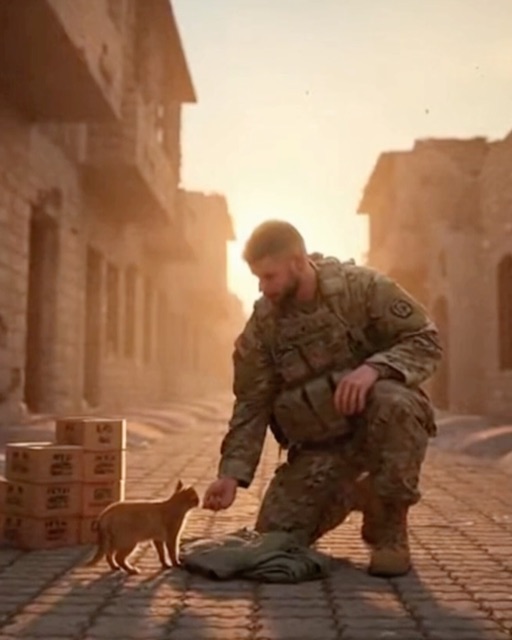
Private First Class Dennis Kowalczyk never talked about home. Never showed photos of a wife or kids like the other guys. But every morning, without fail, he’d crouch by the blown-out pharmacy on Vostok Street and wait.
The cat always came.
Mangy. One ear half-chewed off. Ribs showing through patchy orange fur. Dennis called him “Biscuit” for reasons nobody understood.
“You’re wasting rations on a damn cat,” Sergeant Wheeler told him once.
Dennis just shrugged. “He’s got nobody else.”
I watched Dennis share his MREs with that animal for three months. Crackers. Cheese spread. Once, I saw him give Biscuit an entire pouch of beef stew – the good kind – while he ate nothing but a protein bar.
The morning of the assault, Dennis was quieter than usual. He’d written something the night before, folded it tight, tucked it in his jacket pocket. I figured it was a letter home.
He took point. He always took point.
The IED hit at 0847.
When the medics got to him, there wasn’t much left to save. But one of them – a kid named Rodriguez – found the note. He read it, then looked up at me with this expression I’ll never forget.
“It’s not a letter,” Rodriguez said. His voice cracked.
I took the paper from his hands.
“To whoever finds this – please look after the orange cat by the pharmacy. His name is Biscuit. He likes the cheese spread best. Leave my jacket for him. It gets cold at night and he doesn’t have anywhere else to go. He’s a good boy. Don’t let him be alone.”
We buried Dennis three days later. Standard procedure. Flag. Salute. The whole thing.
But we left the jacket.
Wheeler thought it was stupid. “It’s just a cat,” he kept saying.
I didn’t argue. I just folded Dennis’s field jacket — the one with the coffee stain on the sleeve and the tear near the pocket — and laid it in the rubble by the pharmacy.
Biscuit didn’t show up that day. Or the next.
Two weeks passed. We’d moved positions twice. I’d stopped thinking about the jacket.
Then Rodriguez radioed me from a supply run. His voice was strange.
“You need to see this,” he said. “The pharmacy.”
I didn’t want to go back there. But I went.
The jacket was exactly where I’d left it. Weathered now. Covered in dust.
And curled up inside it, barely visible beneath the collar, was Biscuit.
He didn’t run when I approached. He just looked at me with those yellow eyes, then pressed his face deeper into the fabric.
I crouched down. My throat closed up.
That’s when I noticed something I hadn’t seen before — stitched into the jacket’s lining, hidden near the interior pocket, was a photograph.
I pulled it out carefully.
It wasn’t a photo of a wife. Or parents. Or a hometown.
It was a picture of Biscuit — younger, both ears intact — sitting on a porch next to a little girl in a wheelchair.
On the back, in handwriting that wasn’t Dennis’s, someone had written “Lila and her hero, Patches. Summer ’17.”
Patches.
The name hit me harder than the dust-filled wind. Dennis had called him Biscuit.
I looked from the photo to the cat nestled in the jacket. His fur was patchy, but I could see the distinct orange markings were the same. The white spot on his chest was identical.
It was the same cat. No doubt about it.
This wasn’t just some stray Dennis had taken a liking to. This was something else entirely. This was a story he’d carried with him, stitched into the lining of his uniform.
A story he’d died with.
I carefully tucked the photo back into my own pocket. I couldn’t leave it here.
Biscuit blinked slowly at me. He didn’t seem to care that I was there. He just wanted the jacket.
I went back to the transport and found my own rations. I opened a pouch of tuna, the kind we all hated but saved for bartering.
I walked back to the pharmacy and set it down near the jacket.
Biscuit lifted his head, sniffed the air, and cautiously crept out. He ate like he hadn’t seen food in a week.
From that day on, it became my duty.
Every other day, I’d find a reason to be near Vostok Street. I’d leave food and a small bowl of water. Wheeler gave me grief, but it was half-hearted. I think even he understood this was different.
This was a promise.
I became the man who crouched by the blown-out pharmacy.
I was finishing Dennis’s work.
The cat, Biscuit or Patches or whatever his name was, started to recognize me. He wouldn’t come close, but he wouldn’t run either. He’d just watch me from his nest in the jacket.
One evening, I sat there longer than usual. The sun was setting, painting the ruined city in shades of orange and purple.
Biscuit came out of the jacket and sat a few feet away from me. He just watched me.
“He really loved you, you know,” I said to the cat. The words felt foolish, but I had to say them.
The cat just blinked.
My tour was ending in a month. The thought hit me like a physical blow.
What would happen to Biscuit? What about the jacket? What about Lila?
I couldn’t just leave. I couldn’t be the guy who walked away and left Dennis’s last wish to be swallowed by the war.
I went to find Rodriguez. He was good with paperwork, knew the right people to talk to.
“You’re crazy, man,” he said when I told him my plan. “You want to take a stray cat back to the States?”
“He’s not a stray,” I said, showing him the photo. “He belongs to someone. To a little girl named Lila.”
Rodriguez stared at the picture for a long time. He turned it over and read the back.
“This makes no sense, Evans,” he said, handing it back. “But okay. I’ll see what I can do.”
What followed was a bureaucratic nightmare. Forms. Quarantine regulations. Vets who worked with the military. It cost me nearly every cent I’d saved.
Wheeler saw me filling out a form one night.
“You’re really doing it, aren’t you?” he asked. He wasn’t mocking me.
“I have to,” I said.
He just nodded. The next day, he handed me a hundred-dollar bill. “For the cat’s plane ticket,” he mumbled, and walked away before I could thank him.
The hardest part was catching Biscuit. It took me three days of coaxing with the best food I could find.
Finally, I was able to gently scoop him up while he was wrapped in the jacket. He fought for a second, then went limp in my arms, as if he knew.
I got him into a carrier, the jacket folded and placed inside with him.
Saying goodbye to that place was easy. Saying goodbye to the men was harder.
On my last day, Rodriguez handed me Biscuit’s carrier. The cat was silent, just staring out through the mesh.
“Good luck, Evans,” he said. “Find that girl.”
The flight home was long and strange. I’d spent a year in a world of dust and noise, and now I was surrounded by civilians watching movies and complaining about the food.
Biscuit was quiet the whole way.
Back on American soil, everything felt too bright. Too loud. Too fast.
I stayed at my parents’ house for the first few weeks, a stranger in my own childhood bedroom. Biscuit stayed in my room, mostly hiding under the bed. He only came out to eat when I was alone.
I had the jacket. I had the photo. I had the cat.
And I had a name. Lila.
I started on the internet. I searched for “Lila” and “Patches” and “orange cat.” Millions of results. Useless.
I tried searching for Dennis Kowalczyk. I found his military record, a sparse obituary. No family listed. It was a dead end.
I felt like I was failing. Dennis had trusted me, or trusted someone, anyone, to see this through.
One night, sitting on my floor, I looked at the photo again. The porch. The white railings. The specific type of siding on the house. The wheelchair.
The wheelchair had a small sticker on the armrest. A blue bird.
It was a long shot. A ridiculous, one-in-a-billion shot.
I started searching for charities that provided custom wheelchairs for children. I sent emails with a cropped picture of the sticker, asking if they recognized the logo.
Most didn’t reply. A few sent back polite “no’s.”
I was losing hope. Maybe I was meant to just adopt the cat. Maybe that was the end of the story.
Then, two months after I got home, I received an email.
It was from a small foundation in Ohio.
“Yes, that is our logo,” the email read. “We provide mobility equipment for children in the tristate area. The bluebird is for our ‘Fly Free’ program.”
My heart hammered in my chest.
I wrote back immediately, explaining the situation as best I could without sounding insane. I was a soldier. I was trying to honor a fallen comrade’s last wish. I was looking for a girl named Lila who received one of their wheelchairs around 2017.
I didn’t expect a reply. Privacy laws and all that.
But the woman who ran the foundation, a woman named Mary, wrote back.
“I remember that family,” she wrote. “The Petersons. A very sad story. The father passed away in the accident that injured the little girl. Her name is Lila Peterson.”
She gave me a town. A town just three hours from my parents’ house.
I had them. I had a name. A last name.
The next morning, I put Biscuit in his carrier. I folded Dennis’s jacket and put it on the passenger seat.
And I drove.
I found the address in an online phone book. A small, blue house on a quiet street.
It had a porch with white railings.
I sat in my car for twenty minutes, my hands shaking. What was I supposed to say? “Hi, I’m a stranger from a war you’ve only seen on TV, and I have your cat that’s been missing for years?”
I took a deep breath, grabbed the carrier, and walked to the door.
A woman answered. She looked tired, lines of grief etched around her eyes, but she had a kind face.
“Can I help you?” she asked.
“My name is Corporal Evans,” I started, my voice unsteady. “I served with a soldier named Dennis Kowalczyk.”
The woman’s face went pale. “Dennis?” she whispered.
“Ma’am,” I said, my throat tightening. “I think this belongs to you.”
I knelt down and opened the carrier door.
Biscuit—Patches—hesitated for a second, then slowly walked out onto the porch. He sniffed the air, looked around, and then walked right over to the door, as if he’d done it every day of his life.
The woman gasped, her hands flying to her mouth. Tears streamed down her face.
“Patches?”
A voice came from inside the house. “Mom? Who is it?”
A girl appeared in the doorway, guiding her wheelchair. She was older than in the photo, but I knew her instantly. It was Lila.
She stopped when she saw the cat. Her eyes went wide.
“Patches,” she breathed.
The cat went to her, rubbing against the wheels of her chair, then hopping effortlessly into her lap. He started purring, a loud, rumbling sound. He hadn’t purred once in the months I’d known him.
Lila wrapped her arms around him, burying her face in his orange fur. She was crying. Her mother was crying.
Frankly, so was I.
The woman, Sarah Peterson, invited me in. We sat in her living room while Lila refused to let the cat go.
“I don’t understand,” Sarah said, wiping her eyes. “Dennis… he never wrote. He never called. We didn’t even know where he was.”
“He was very quiet,” I said. “He never talked about home.”
“This was his home,” she said, her voice thick with emotion.
Then, she told me the story.
Dennis Kowalczyk was her son from her first marriage. Her first husband died when Dennis was young. She later remarried a wonderful man, Mark Peterson, and they had Lila.
Dennis was a good kid, but he always felt a little lost. A little separate. He adored his little sister.
And he adored their cat, Patches. The cat was the bridge between them.
“Three years ago, we were in a car accident,” Sarah said, her voice dropping to a whisper. “Mark… he didn’t make it. Lila’s spine was severely injured.”
She took a shaky breath. “Patches was in the car with us. Dennis was holding his carrier. In the crash, the door flew open, and Patches bolted. Dennis was devastated. He searched for weeks.”
She looked at me, her eyes full of a pain I couldn’t imagine.
“He blamed himself. For the accident, for Lila, for losing the cat. He thought if he’d held the carrier tighter, if he’d done something different… It broke him.”
A few months later, he enlisted. He just left a note. He said he needed to do something that mattered, to make up for his failure.
He never contacted them again.
It all clicked into place. The secrecy. The fierce, desperate love for that cat. Finding Patches in that war-torn town must have felt like a second chance. A miracle.
He couldn’t fix his sister’s legs. He couldn’t bring her father back. But he could take care of her cat.
He renamed him Biscuit. A new name for a new life, a way to separate the animal from the tragedy he’d run away from.
“He never failed,” I said, my own voice cracking. “He found him. And he made sure he was safe.”
I reached into my bag and pulled out the folded field jacket.
“He wanted him to have this,” I said, handing it to Sarah. “His last note… it was all about the cat.”
She unfolded the jacket, her fingers tracing the coffee stain on the sleeve. She held it to her face, breathing in the scent of dust and desert and her son.
We sat there for a long time, in the quiet of that small living room.
I had come to return a cat. But I had brought them back a piece of their son. A final message of love from a boy who couldn’t find the words to say it himself.
I left a few hours later. Sarah hugged me at the door.
“You brought him home,” she said. “You brought a part of my son home.”
As I drove away, I looked back at the house. Through the window, I could see a girl in a wheelchair, holding an orange cat, her face alight with a joy that had been missing for years.
Sometimes, the burdens we carry are the ones no one else can see. A soldier’s silence doesn’t always mean he has no one to love; sometimes it means he loves someone so much that the thought of them is too painful to bear. Dennis didn’t die for a flag or a country. He died holding onto the one pure thing he thought he could save. And in the end, his promise was kept. A small act of kindness in a world of chaos rippled across an ocean, and healed a wound that no one else could touch.