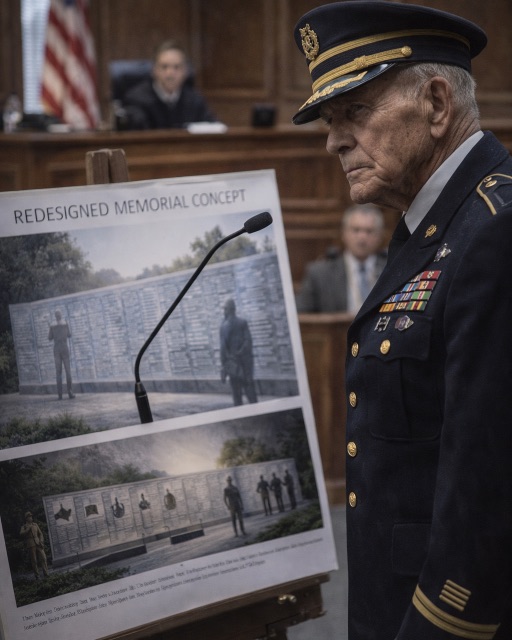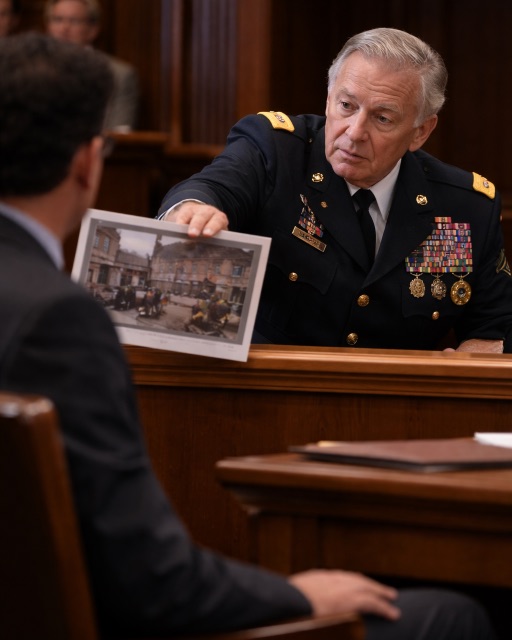
The courtroom was completely silent. The city attorney had just smirked, handing a faded photograph to the retired Army Sergeant on the stand.
The city wanted to bulldoze the old train depot – and the veterans’ memorial plaque with it – to build a parking garage. The Sergeant showed up to court in his full official dress uniform, his Purple Heart gleaming on his chest, to defend it.
“Did you personally know any of the men named on this memorial?” the attorney asked, his tone dripping with condescension.
“No,” the Sergeant replied.
“So your concern is purely symbolic,” the attorney scoffed. He slapped an old city planning photo onto the stand. “This picture proves the plaque was already moved years ago. It’s just a piece of metal in the way of progress.”
The Sergeant didn’t flinch. He picked up the photo. His jaw was set. His posture was perfect.
But as he stared at the glossy image, his hands started to tremble. The color completely drained from his weathered face.
He wasn’t looking at the plaque. He was looking at the empty space in the background.
The Sergeant slowly raised his eyes to the judge and slid the photo across the bench.
“The plaque hasn’t moved a single inch, Your Honor,” he whispered, his voice suddenly ice cold. “But if you look at what they secretly removed from behind it, you’ll realize what this city actually lost.”
The judge, a woman named Carol Hines with sharp eyes and a no-nonsense demeanor, adjusted her glasses. She pulled the photograph closer, her brow furrowed in confusion.
“I don’t see anything, Sergeant Miller,” she said, her voice patient but firm. “It’s a brick wall. There’s the plaque, and behind it… more brick.”
Sergeant Miller took a slow, steadying breath. His voice, when he spoke again, was low but carried to every corner of the silent room.
“Exactly, Your Honor. More brick. But there shouldn’t be.”
He pointed a slightly trembling finger at the photo.
“Right there,” he said, tapping a spot on the wall behind the memorial plaque. “In that space, there used to be a loose brick. And behind that brick, there was a small, hollowed-out cavity.”
The city attorney, a man named Arthur Davies, let out an exasperated sigh.
“Your Honor, this is absurd. We’re talking about a loose brick from fifty years ago? This is a waste of the court’s time.”
Judge Hines held up a hand to silence him, her eyes still fixed on Sergeant Miller. She saw something in his face—a deep, ancient pain that went far beyond a simple legal dispute.
“Let him finish, Mr. Davies,” she commanded.
Sergeant Miller nodded his thanks to the judge. “In that cavity,” he continued, “was a small, tin box. It was an old caramel tin, to be exact. And inside that tin was a promise I failed to keep.”
The courtroom held its collective breath. The air, once thick with legal jargon and dismissive smirks, was now heavy with untold history.
“I served in Vietnam,” the Sergeant began, his gaze turning inward, as if he were seeing the past projected onto the courtroom walls. “I was just a kid then. Not a Sergeant. Just a Corporal. Scared out of my mind, like everyone else.”
“I had a friend. His name was Daniel Evans. He wasn’t on that plaque. He wasn’t from this city. He was from the next town over.”
“Danny was the kind of guy who could find a reason to smile in a monsoon. He carried pictures of his girl back home, Eleanor. He was going to marry her the second he got back.”
“He talked about her all the time. How they met at this very train depot. He was shipping out for basic training, and she was there seeing her brother off.”
“He said it was love at first sight. He wrote to her every single day. Every single one.”
Sergeant Miller paused, swallowing hard. The medals on his chest seemed to rise and fall with a profound sorrow.
“The night before our last patrol, Danny came to me. He was quiet, which wasn’t like him. He handed me a letter.”
“He told me he had a bad feeling. He said, ‘If I don’t make it, Miller, you find my letters. I hid them for her. It’s a surprise.’”
“He told me about the loose brick behind the new memorial plaque at the depot. He and his buddies had put it up just before he deployed.”
“He’d hollowed out the space himself one night and put all her letters to him, and all the ones he’d written but hadn’t sent yet, inside that old caramel tin.”
“He said, ‘It’s our spot. It’s where we began. I want her to find them there someday.’”
“He made me promise. He said, ‘Promise me, Miller. You make sure she gets that box.’”
The Sergeant’s voice cracked, just for a second, before he regained his military composure.
“I promised him. The next day, Danny… he didn’t make it back.”
“I was hit, too. Badly. That’s where this came from,” he said, lightly touching the Purple Heart on his uniform.
“I spent months in a hospital, then more months in rehab. By the time I was back on my feet, years had passed. I had lost his file. I didn’t know Eleanor’s last name or exactly where she lived. All I knew was the depot.”
“I came here once, a long time ago. I looked at the plaque. I felt the brick. It was still there. I told myself it was safe. I told myself that one day I’d find a way.”
“I was a coward. I was ashamed I had failed him. So I let it be. I thought the box was still there, waiting. A promise sealed in brick and mortar.”
He slid his gaze from the judge to the city attorney, Mr. Davies, and his eyes were now blazing with a cold fire.
“This photograph shows that sometime between 1985 and today, someone repaired that wall. Someone found that loose brick and cemented it over.”
“Someone took that box. That tin box full of a dead soldier’s last words to the love of his life.”
“So, no, Mr. Davies,” the Sergeant said, his voice ringing with moral authority. “My concern isn’t just symbolic. It’s about a promise. It’s about the pieces of a young man’s soul that your ‘progress’ has paved over and forgotten.”
The silence that followed was absolute. It was broken only by a soft sniffle from someone in the gallery.
Mr. Davies looked shaken for the first time. His smug confidence had evaporated, replaced by a pale, uncertain look.
Judge Hines stared at Sergeant Miller for a long moment. She then cleared her throat.
“Mr. Davies,” she said, her tone leaving no room for argument. “I am ordering an immediate stay on the demolition of the train depot.”
“Furthermore, I want the city’s public works records for the last forty years pulled. I want to know every time a crew so much as touched that wall. I want to know what happened to that box.”
“This court is in recess until those records are found.” She banged her gavel, the sound echoing like a gunshot.
The next two days were a blur of activity. City clerks, grumbling about dusty archives, were sent digging into endless boxes of municipal records. Sergeant Miller sat on a bench outside the courtroom, waiting. He didn’t eat. He barely moved. He just waited.
Arthur Davies, the attorney, was a changed man. The condescension was gone. He looked haunted. He kept pacing the hallway, occasionally glancing at the old Sergeant, a man he had so casually dismissed just days before. Progress didn’t seem so simple anymore.
Finally, on the third day, a triumphant, dust-covered clerk emerged from the archives holding a thin file.
Judge Hines reconvened the court immediately. The room was packed. Word had gotten out, and the story had touched the heart of the city.
The clerk, a man named George, nervously took the stand.
“We found it, Your Honor,” he said, his voice reedy. “A work order from 1988. A small renovation project to repair some weather damage on the depot’s eastern wall.”
He read from the yellowed paper. “Notes from the foreman, a Mr. Henderson. It says, ‘Found loose brick behind memorial plaque. Removed brick for resetting. Discovered a small tin box in the cavity.’”
A collective gasp went through the room.
George continued reading. “‘Box contained old letters. Per city protocol for unclaimed personal items found on public property, the box was logged and placed in the City Archives, vault C. Item number 734.’”
Sergeant Miller’s head shot up. His eyes, which had been dull with a lifetime of guilt, were suddenly sharp and alive.
“Vault C,” Judge Hines repeated. “Is the item still there?”
“Yes, Your Honor,” George said, beaming. “I checked myself. It’s been sitting on a shelf for over thirty years.”
An hour later, they were all gathered in the musty, climate-controlled air of the City Archives. Sergeant Miller, Judge Hines, a pale Arthur Davies, and George the clerk stood before a small, metal table.
George, wearing white cotton gloves, gently placed a rusted, but intact, caramel tin on the table. It was exactly as Miller had remembered.
“Go ahead, Sergeant,” the judge said softly.
With hands that now shook uncontrollably, Sergeant Miller reached out and lifted the lid. The tin opened with a soft, metallic sigh.
Inside, nestled together, was a stack of letters, tied with a faded blue ribbon. The paper was yellowed, the ink slightly faded, but they were preserved.
Miller lifted the top envelope. The handwriting was a young man’s hurried scrawl.
“To my dearest Eleanor,” it read.
Arthur Davies, who had been standing silently in the corner, took an involuntary step forward. Something in the name seemed to snag his attention.
Sergeant Miller carefully untied the ribbon and began to read the top letter aloud, his voice thick with emotion.
“‘My Eleanor, The jungle is loud tonight, but all I can hear is your laughter from that day at the fair. I keep it in my pocket…’”
He couldn’t continue. He choked up, handing the letter to the judge.
Judge Hines took it and her eyes scanned the page. She read for a moment, her expression softening. Then she looked down at the address on the envelope.
Her eyes went wide.
She looked up, not at Sergeant Miller, but directly at Arthur Davies.
“Mr. Davies,” she said, her voice barely a whisper. “What was your grandmother’s name?”
Arthur looked confused. “My grandmother? Her name was Eleanor. Eleanor Davies. Why?”
“And her maiden name?” the judge pressed, her gaze intense.
“It was… it was Albright,” Arthur said, a dawning horror spreading across his face. “Eleanor Albright.”
Judge Hines slowly turned the envelope over for him to see. There, in faded ink, was the name and address.
Miss Eleanor Albright.
Arthur Davies stumbled back a step, his hand flying to his mouth. He stared at the letters, then at the old Sergeant, then back at the letters. The pieces of a puzzle he never knew existed were slamming into place.
“My grandmother…” he stammered. “She always had this sadness about her. My grandfather was a powerful man, a developer. He built half this city. He always said he’d rescued her from a life of poverty.”
“He… he was the one who pushed for the first depot renovation in the eighties,” Arthur whispered, the realization hitting him like a physical blow. “He must have known. He must have found the box and buried it in the archives, hiding it away.”
His grandfather hadn’t just been a man of progress. He had been a man who buried history he didn’t like. He had buried his wife’s first love.
Arthur sank into a nearby chair, his head in his hands. The entire case, his entire professional motivation to tear down that depot, had been built on a family lie. He was trying to finish the job his grandfather started—erasing the memory of Private Daniel Evans.
Sergeant Miller walked over and gently placed a hand on the young lawyer’s shoulder. All the animosity was gone, replaced by a shared, profound sense of loss and discovery.
“He loved her very much,” the Sergeant said quietly. “He talked about her until the very end.”
The case was dismissed, of course. Arthur Davies withdrew it himself, with a public apology to Sergeant Miller and to the memory of the men on the memorial.
But the story didn’t end there.
The city, moved by the incredible tale, scrapped the plans for the parking garage. Instead, they allocated funds to fully restore the old train depot.
Working together, Sergeant Miller and Arthur Davies led the project. Arthur, using his own family’s money, established a foundation.
They turned the depot into a beautiful community center and a local history museum.
The centerpiece of the museum was a new display. In a glass case, they placed the caramel tin, opened to show the letters. Beside it was a picture of a smiling young Daniel Evans and a beautiful, dark-haired Eleanor Albright.
They added a new, smaller plaque next to the original veterans’ memorial.
It read: “In memory of Private Daniel Evans. A love lost in war, a promise found in time. His story, and the love he held for Eleanor Albright, reminds us that our foundations are built not on concrete, but on the memories we fight to protect.”
On the day of the dedication, Sergeant Robert Miller, standing tall in his dress uniform, and Arthur Davies, his face full of a humility he’d never known, stood side by side and cut the ribbon.
The Sergeant looked at the memorial, at the tin box, and at the name of his friend, finally honored. A weight he had carried for fifty years finally lifted from his shoulders. His promise was kept.
The past is never truly gone. It lives in the silent spaces, in the stories we’ve forgotten, and in the promises that wait, patiently, to be fulfilled. Progress is important, but it is nothing if it costs us our soul, and the soul of a community is, and always will be, its history.