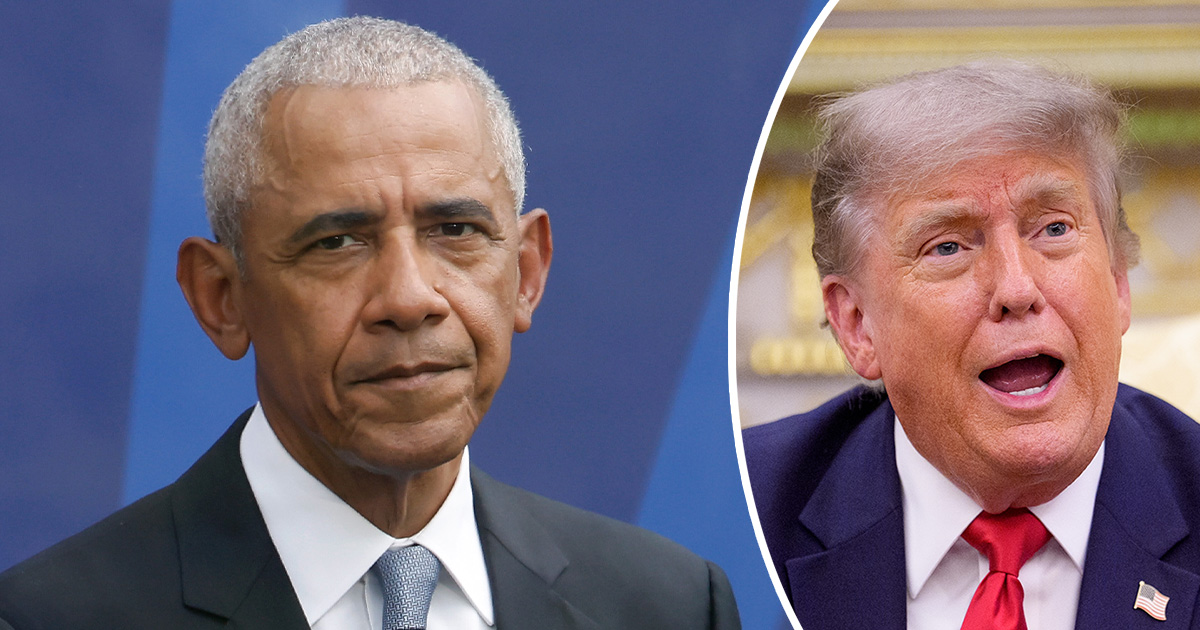
For years, Donald Trump has aimed sharp words at former President Barack Obama, often blaming him for a wide range of problems, great and small. Recently, that pattern resurfaced over the condition of the Lincoln Memorial Reflecting Pool in Washington, D.C. Now, Barack Obama has weighed in directly, describing Trump’s repeated focus on him as an obsession and joking that he seems to be living “rent-free” in Trump’s mind.
Older Americans have seen plenty of political back-and-forth over the decades, and this latest episode may feel familiar. But it also raises a straightforward question about leadership: when a person holds or has held the nation’s highest office, how much time should they spend talking about the person who came before them? Obama’s answer is simple. In his view, not much at all.
To understand the latest flare-up, it helps to look at what set things in motion. As the Reflecting Pool’s maintenance and costs came up in public conversation, Donald Trump pushed the idea that the pool’s troubles were the fault of the Obama administration. He used Obama’s full name, “Barack Hussein Obama,” a phrasing he has often preferred, and suggested that the renovation had been a mess from the start.
Trump said that Obama spent two years and more than $100 million trying to fix the pool and claimed that, despite all that effort, it never even opened. News organizations have noted different figures. The major renovation completed under Obama in 2012 was reported at about $34 million and did, in fact, reopen to the public after the work was finished. Like many public works projects, the Reflecting Pool has needed upkeep since then. But the claim that it never opened does not line up with widely documented events.
Even so, the Reflecting Pool dispute was just one more entry in a much longer story. Over the years, Trump has mentioned Obama frequently, tying him to a variety of problems and airing grievances about policy choices and public perception. Earlier this year, a video circulated from a social media account associated with Trump that depicted Obama and former First Lady Michelle Obama in a racist way. That video drew quick, broad criticism and reminded many people that the tension between the two figures has rarely cooled.
Obama responds to the long-running focus
Barack Obama generally avoids jumping into the daily back-and-forth. In public appearances since leaving office, he tends to talk about civic responsibility, voting, and the practical work of governing. But in a recent conversation on the podcast All the Smoke, hosted by former NBA player Matt Barnes, Obama chose to speak more directly. Barnes, who has followed the story like most of the country, observed that Trump seemed very fascinated with Obama and his family. Without naming Trump outright, Obama understood exactly whom he meant.
Pressed gently by Barnes—who praised Obama for meeting negativity with calm—Obama was asked, in everyday terms, if he ever felt like letting loose in return. That’s when the former president summed up the situation as he sees it. Barnes used the word “obsession,” and Obama agreed, saying that it sure looks that way from the outside.
Obama then added a line that captured attention. He said he clearly has a room in Trump’s head—“a suite,” as he put it—with the rent permanently unpaid. It was a light, humorous turn of phrase, but it carried a point: if one politician spends a great deal of time talking about another, especially about the one who came before, it might say more about the speaker than about the target.
For many readers who have followed national politics across many administrations, the dynamic is easy to recognize. Most presidents, once in office, concentrate on the problems on their desks and rarely look back for long. Differences in policy are normal, and even sharp disagreements happen. Still, there is an unwritten rule of sorts: past presidents come up occasionally, but the bulk of attention stays on current challenges, not yesterday’s scorecard.
The Reflecting Pool debate, made simple
The Lincoln Memorial Reflecting Pool sits between the Lincoln Memorial and the Washington Monument. It is one of the most photographed spots in the country, visited by millions of people each year. Like any large body of water in a public place, it needs routine care. The modern history of the pool includes a major reconstruction completed during Obama’s time in office. That work aimed to improve the pool’s structure and water quality. After that, the pool reopened and continued to welcome visitors. As often happens in public spaces, further maintenance and adjustments followed in the years after.
Claims that the pool was never opened after the renovations do not match the record. The pool did reopen, and people enjoyed it. There have been periods of draining, cleaning, and repair, but that’s part of caring for a historic site, not proof that it failed from day one. For many Americans familiar with the National Mall, the Reflecting Pool is a place of memory—of visits with children and grandchildren, of school trips and reunions, and of quiet moments looking out over the water toward the monuments.
In other words, while the recent back-and-forth over costs and blame made headlines, the more useful conversation is about how public landmarks are maintained, how improvements are funded, and how to keep these cherished places in good shape for the next generation. That is the kind of practical, nuts-and-bolts work most people want their leaders to focus on.
“A suite in his head”: what Obama meant by the joke
When Obama said he had a suite in Trump’s head, he was using humor to make a broader point. Humor has long been a tool that presidents use to lower the temperature. It can be a way to acknowledge an attack without becoming consumed by it. By framing Trump’s focus as an “obsession,” Obama suggested that the energy spent talking about past rivalries might be better directed elsewhere.
For many older Americans, this rings true to everyday life. Whether running a family business, managing a team at work, or volunteering in the community, rehashing old conflicts seldom moves things forward. Leadership is about deciding what matters most right now and putting attention there. Jokes can lighten the mood, but the takeaway is serious: it is hard to serve people well when you are constantly looking in the rearview mirror.
What Obama says a president should focus on
Obama put it plainly on the podcast. When he took office, thinking about the person who served before him was the last thing he had time for. There were crises to manage, bills to consider, and everyday decisions affecting millions of Americans. He said he did not spend his days measuring himself against his predecessor, asking, “What’s he done today?” That kind of comparison, in his view, would have been a distraction.
He went further, saying that a leader who devotes constant attention to the person who came before may be showing a lack of focus on the people they are meant to serve. It is a straightforward standard: talk less about yesterday, work more on today. Agree or disagree with Obama on policy, that idea is easy to understand, because it lines up with what most of us expect from those in charge. We want the potholes filled, the bills paid, the emergencies handled, and the future prepared for our children and grandchildren.
A long-running rivalry in clear view
The public rivalry between Trump and Obama did not spring up overnight. It has roots in old disputes and a long stretch of public criticism. Over time, the tone has often dipped into the personal. That is not unusual in politics, especially in an era when social media amplifies every jab and shout. But it can be exhausting to watch, and it can crowd out the real debates that affect everyday life, like the cost of health care, retirement security, public safety, and the health of the economy.
That is one reason Obama’s new comments have gotten attention. They boil the situation down to something most people can grasp: it is not healthy for any leader to fixate on their predecessor. The country’s problems are too large and too urgent for that. You may prefer the policies of one president or another, but the job description does not change. It calls for steady focus, practical solutions, and the humility to keep the spotlight on the work, not the feud.
Why this matters beyond political teams
It is easy to treat every political dust-up as just another headline to scroll past. But here, there is a broader lesson that speaks to anyone who cares about how the nation is governed. When conversation turns to personal blame, it can become a shortcut that avoids real answers. Fixing infrastructure. Supporting veterans. Providing reliable and dignified health care options as we age. Making neighborhoods safer. Guiding the economy through ups and downs. These are the hard, unglamorous tasks of leadership.
The Reflecting Pool debate makes a useful example. You can point fingers about who did what years ago, or you can ask a simpler, more helpful question: What needs doing right now to preserve and improve a public place that millions cherish? That kind of thinking applies everywhere—from national parks to local roads, from hospitals to schools. Leaders do their best work when they keep that forward-looking mindset.
How presidents usually handle predecessors
American history offers a fairly consistent pattern. Presidents often disagree strongly with those who served before them, and they may change course dramatically. But typically, they do not spend much time going back and forth in public with their predecessors. There are exceptions, of course, but the custom of moving forward has deep roots. It helps keep the focus on the policies at hand and the responsibilities of the office.
That is not because former presidents are off-limits from critique. Far from it. Vigorous debate is part of our national tradition. It is simply that the presidency is a demanding role, and the hours in a day are limited. There is always another briefing to read, another decision to make, another emergency to manage. Most leaders, in any field, learn quickly that spending too much time re-litigating the past crowds out the work that people count on.
A calmer way to hear this story
It can be tempting to take sides, raise voices, and treat politics like a never-ending contest. But this moment offers a calmer view. Obama used humor to describe what he sees as Trump’s ongoing fixation on him. He did not dwell on insults, and he did not turn the temperature up. He made a point about focus, duty, and the wisdom of keeping attention on the public’s needs.
Whether you agree with Obama, Trump, both, or neither, that reminder can be useful. It is the same lesson many of us have shared with our children and colleagues: look ahead, do the work, and do not let old rivalries steal the time you need to shape a better tomorrow.
The takeaway for anyone watching at home
What should the average person make of all this? First, it is healthy to separate the noise from the news. The noise is the personal feud, the jabs, and the attempts to score points. The news is the practical question: what is being done to solve real problems? If a leader spends day after day pointing backward, it is fair to ask what is being handled in the present.
Second, facts matter, even in a media environment that moves at lightning speed. Claims about public projects can be checked against public records. The Reflecting Pool is there for all to see, and its history is well documented. Taking a moment to verify what is said can keep us all from being swept up by statements that do not match reality.
Finally, it is worth remembering that public service is supposed to be about the public. Obama’s comment about having a “suite” in Trump’s head might make you smile, but it was also a gentle way of saying that attention should be on the people, not the rivalry. That is not a partisan view. It is a practical one, and it will always be relevant, no matter who sits in the Oval Office.
Closing thoughts
Barack Obama’s recent remarks cut through years of tangled headlines with a simple, memorable image. If a former president truly occupies space in another leader’s mind, it may be time to clear room for the work at hand. The country faces challenges that do not care who said what last week. They only care whether we find solutions that are steady, fair, and focused on the future.
As for the Reflecting Pool, it will continue to reflect what it always has: the enduring hope that brings people from all walks of life to the nation’s capital. Keeping that hope alive means caring more about what can be fixed today than about whose name gets dragged into the argument. On that point, at least, most Americans can find common ground.
However you view the personalities involved, the message here is straightforward and familiar. Keep your eyes on the task. Treat the work with respect. And remember that leadership, like the calm surface of the Reflecting Pool on a good day, looks best when it is clear, steady, and focused on something larger than any single person.