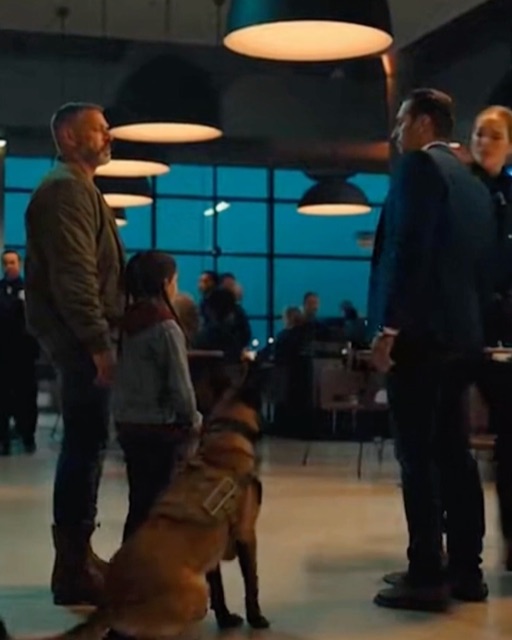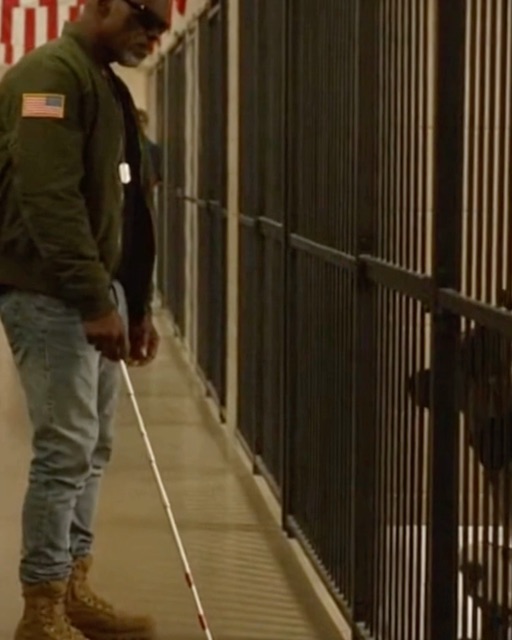
“Don’t go near him,” the kennel master warned, blocking the gate. “Thor isn’t a pet. He’s a weapon. He’s put two handlers in the hospital this month.”
I couldn’t see the dog, but I could hear him. The pacing. The low, rhythmic growl that sounded like a chainsaw idling.
“I need to see him,” I said, gripping my cane.
My name is Jared. I lost my sight in an ambush five years ago. Since then, I’ve been looking for a reason to keep going. I came here for a service dog, not a death wish. But something about that growl pulled me in.
“Sir, he’s scheduled to be put down tomorrow,” the master said. “He’s too damaged. PTSD.”
“So am I,” I said. “Open the gate.”
Reluctantly, the man slid the bolt back.
I stepped into the run. The growling stopped instantly.
The silence was heavier than the noise. I stood there, blind and defenseless, waiting for the attack.
It never came.
Instead, I felt a heavy weight lean against my leg. A cold nose nudged my hand.
The kennel master gasped. “That’s… that’s impossible. He never lets anyone touch him.”
I dropped to my knees, burying my hands in the dog’s thick fur. He didn’t flinch. He let out a long, shuddering sigh, resting his massive head on my shoulder.
As I stroked his neck, my fingers brushed against something strange on his old tactical collar. It wasn’t a tag. It was a piece of paracord woven into the leather – a specific, jagged knot.
My heart stopped. My blood turned to ice.
I knew that knot. I was the one who taught a young private how to tie it in the back of a Humvee, minutes before our convoy was hit.
I ran my thumb over the knot again, tears welling up behind my dark glasses.
“He’s not aggressive,” I whispered, my voice breaking. “He’s waiting.”
I turned my face toward where the handler was standing. “You can’t put this dog down. Because I know exactly who his handler was. And I know why he chose me.”
The kennel master, a man whose voice was pure gravel and authority, was silent for a long moment. I could feel his stare, could almost hear the gears turning in his head.
“His handler was listed as KIA,” he finally said, his tone softened with confusion. “Private Sam Miller.”
The name hit me like a physical blow. Sam. The kid from Ohio who was barely old enough to shave but had the heart of a lion.
“That’s right,” I managed to say. “Sam Miller. And this knot… I called it the ‘Miller’s Hitch.’ I taught it to him myself.”
I told him the story, my voice thick with memories I’d tried to bury for five years. We were packed in the back of that vehicle, the air thick with dust and nervous energy. Sam was fussing with Thor’s collar, wanting to add something personal to it.
I showed him the knot, a complicated little thing I’d learned from my own grandfather. A good luck charm.
“He tied it right there,” I said, my hand still on the dog’s neck. “Right before everything went white.”
Thor whined softly, as if he understood every word. He licked the tears from my cheek.
“He’s not waiting for just anyone,” I explained. “He’s waiting for someone who smells like his past. Someone who smells like that Humvee. Someone who smells like Sam.”
The kennel master, whose name I learned was George, let out a long, slow breath. “I’ve never seen anything like this.”
“You can’t kill him, George,” I pleaded. “It would be like burying a man who is still holding out hope.”
George was quiet. I heard him pacing just outside the run. He was a man of rules and regulations, I could tell. This situation was far outside any box he could check.
“His file is a mile long,” George said, his voice laced with frustration. “Aggression. Unpredictable. He’s a liability.”
“He’s grieving,” I shot back. “And he’s been alone. He recognized me. He knows I’m one of his.”
I stood up slowly, my hand never leaving Thor’s back. “Let me take him. I’ll sign whatever you want. I’ll take full responsibility.”
“The paperwork to reverse a euthanasia order is a nightmare,” he grumbled, but there was a crack in his armor. He saw what I felt.
“Then let’s have a nightmare,” I said. “It’s better than the alternative.”
It took three days. Three days of phone calls, of me sitting in the kennel office while George fought with bureaucrats on the phone. I refused to leave.
Each day, I spent hours with Thor in his run. We didn’t do much. I’d just sit on the concrete floor, and he would lay with his head in my lap.
I talked to him. I told him stories about Sam. About his goofy laugh and his obsession with bad action movies.
Thor would listen, his ears twitching, his tail giving a slow, soft thump against the ground. He was a great listener. Better than most people I knew.
On the third day, George walked into the run. He didn’t say anything at first. He just stood there.
“Alright,” he finally sighed, the sound heavy with defeat and something else… relief. “He’s yours.”
The ride home was quiet. Thor sat in the back of the taxi, his presence filling the small space. He didn’t make a sound.
My apartment was small, a place that had felt empty since the day I moved in. But as soon as Thor stepped inside, it felt like a home.
He explored every corner with his nose, his claws making soft clicking sounds on the hardwood floor. I just stood in the middle of the room and listened to him map out our new life.
Those first few weeks were a process of learning. I learned the sound of his breathing when he was asleep. He learned the sound of my footsteps and would meet me at the door.
He wasn’t a service dog in the traditional sense. He wasn’t trained to guide me through traffic. But he served me in other ways.
He was my anchor. His steady presence cut through the fog of my own PTSD. The nightmares that had plagued me for years started to fade.
It was hard to feel alone when a 100-pound Shepherd insisted on sleeping with his head on my chest.
But even as we healed together, I could feel his sadness. There was a part of him that was still waiting. Every time a car door slammed outside, his head would pop up, his ears alert.
He was still waiting for Sam.
And I felt a deep, nagging guilt. I had survived. Sam hadn’t. It felt fundamentally wrong.
I needed to do something. I owed it to both of them.
I started making calls. I called the VA. I called old contacts from my unit. I wanted to find out where Sam was buried.
The official story was always the same. Private Samuel Miller. Killed in Action. His body was returned to his family in Columbus, Ohio.
I felt that Thor and I needed to go. To pay our respects. To say a final goodbye at his grave. It was the only way, I thought, for us to truly move on.
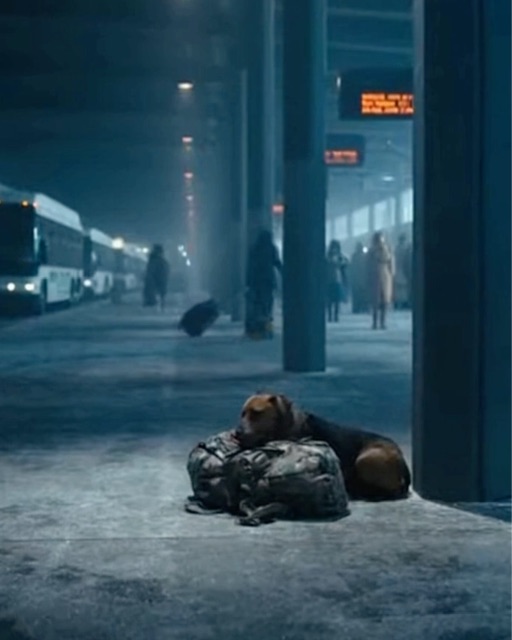
I booked a ticket on a pet-friendly bus line. The journey was long, but Thor was a perfect traveler. He just lay at my feet, a calm, solid weight.
We arrived in Columbus on a gray, overcast day. I got the address for the cemetery from a local VFW post.
We walked through the gates, the air still and heavy. I let Thor lead. I didn’t know how, but I trusted he would find him.
He moved with a purpose he hadn’t shown since I’d met him. He pulled me gently through rows of white headstones.
He stopped suddenly. He nudged a simple, clean stone with his nose and let out a soft whine.
I knelt down, my fingers tracing the chiseled letters. Samuel R. Miller. Beloved Son and Hero.
“We’re here, buddy,” I whispered to Thor. “We found him.”
I told Sam all about Thor. How brave he was. How he was safe now. How he was a good boy.
I untied the paracord knot, the ‘Miller’s Hitch,’ from the collar. It felt right to leave it here with him. A piece of us, a piece of that last moment, left where it belonged.
As my fingers worked the knot free, I felt something hard inside it. It wasn’t part of the cord. It was a small, thin piece of metal.
I worked it out of the tight weave. It was a dog tag. But not a standard issue one. It was one of those cheap ones you get from a machine at a pet store.
I ran my thumb over the engraved text. It was worn, but I could make out the letters. “If lost, call my mom,” it read. And then, a phone number.
My heart pounded in my chest. This wasn’t a memorial. It was a message.
Why would Sam put his mom’s number on Thor’s tag? Maybe it was just a precaution. But the knot… he tied it right before the attack. As if he knew something was about to happen.
We sat by the grave for an hour. Thor never moved. He just lay with his paws resting on the grass just in front of the stone.
When it was time to go, I re-tied the knot, with the hidden tag still inside. It didn’t feel right to leave it. It felt like a mission that wasn’t finished.
Back at the motel, the phone number burned a hole in my pocket. I was terrified to call. What would I even say?
“Hello, your son who died five years ago hid your phone number in his dog’s collar, and I just found it.”
It sounded insane.
But I had to know. For Sam. For Thor.
I dialed the number. It rang three times. A woman’s hesitant voice answered. “Hello?”
“My name is Jared,” I began, my own voice trembling. “I served with your son, Sam Miller.”
There was a sharp intake of breath on the other end. “Oh,” she said, her voice small. “It’s… it’s been a long time.”
I told her everything. About finding Thor. About the knot. About being at the cemetery.
She was quiet for a long time. I thought she might have hung up.
“You’re at the cemetery?” she finally asked.
“Yes, ma’am.”
“That’s not his grave,” she said, and her voice broke into a sob. “We bought that plot. We had the headstone made. But Sam… Sam’s not in it.”
The world tilted on its axis. My blood ran cold. “What do you mean?”
“Sam didn’t die, Jared,” she cried. “I wish to God it were that simple. He’s alive.”
That’s when the twist came. The one I never saw coming.
Sam had survived the blast. But the Sam who came back was not the Sam who left. He had a severe traumatic brain injury. He was in what the doctors called a persistent vegetative state.
He hadn’t spoken, or moved, or opened his eyes in five years.
His parents had been overwhelmed. The military sent Thor back to them, but the dog’s heartbroken whining and constant searching for Sam was too much to bear. It was a constant, painful reminder of the vibrant boy they had lost.
In a moment of despair, they surrendered him to a military dog adoption agency, hoping he would find a new life. They told the agency his handler was KIA. It was easier than explaining the living death their son was enduring.
They moved Sam to a private long-term care facility a few hours away. A quiet place where they could visit him, even though he never knew they were there. The headstone was their way of grieving for the son they knew, the one who was never coming back.
She gave me the address. It was a place called Stillwater Meadows.
The next morning, Thor and I took a cab there. It was a peaceful-looking facility, surrounded by trees. It didn’t look like a hospital.
A nurse led us down a long, quiet hallway. She opened a door at the end. “He’s in here.”
The room was bright. The only sound was the gentle beep of a machine. And there, in the bed, was a man. He was pale and still, but I would have known him anywhere. It was Sam.
Thor froze in the doorway. He let out a low, questioning whine.
He walked slowly toward the bed. He sniffed at the limp hand hanging over the side. His whole body trembled.
He nudged the hand with his nose. Nothing.
He whined again, louder this time, a sound of pure anguish and confusion. He looked back at me, his eyes asking a question I couldn’t answer.
“That’s him, boy,” I whispered. “It’s Sam.”
Thor placed his big paws gently on the edge of the mattress and licked Sam’s face. He licked his cheek, his forehead, his closed eyelids.
And then, it happened.
A single tear rolled from the corner of Sam’s eye.
The nurse gasped.
His fingers, which had been still for half a decade, twitched. They curled, just slightly, as if trying to grasp something.
Thor went frantic, whining and licking and nudging.
Another twitch. This time, a faint sound escaped Sam’s lips. It wasn’t a word. It was just a breath. A sigh. An acknowledgement.
The nurse was already on the phone, calling the doctor.
I knelt by the bed, tears streaming down my face, and placed my hand on Thor’s back.
We weren’t there to say goodbye. We were there to say hello.
We stayed. Sam’s parents drove down, their faces a mixture of shock, hope, and gut-wrenching guilt over giving up on Thor. They saw what we saw. The dog was a key, unlocking a door that everyone thought was sealed forever.
The progress was slow, measured in millimeters. A flicker of an eyelid. A squeeze of a hand. But it was progress.
Every day, Thor would lie on the bed with Sam. He would rest his head on his chest, a living, breathing, hopeful weight. The doctors called it a miracle. They couldn’t explain it.
But I could.
It was the unwavering loyalty of a dog who refused to believe his partner was gone. It was the power of a bond that not even a war could break.
I found my purpose in that quiet room. My mission was no longer about me. It was about them.
I moved to a small apartment nearby. I became a fixture at Stillwater Meadows. Jared and his dog. The blind man leading the way.
One afternoon, about a year later, I was sitting in the chair by Sam’s bed while Thor snored softly. Sam’s mom was there, reading a book aloud.
Suddenly, a voice, raspy and weak, cut through the silence.
“Thor,” it said. “Good boy.”
Thor’s head shot up. Sam’s eyes were open. And he was looking right at his dog.
Healing isn’t a straight line. It’s a jagged, difficult path, much like the knot Sam once tied in a dusty Humvee. It’s a path full of pain and setbacks. But it’s also a path that you should never, ever walk alone. Sometimes, the ones we try to save are the very ones who end up saving us. They remind us that even in the deepest darkness, a single, loyal heart can be enough to lead you back into the light.