
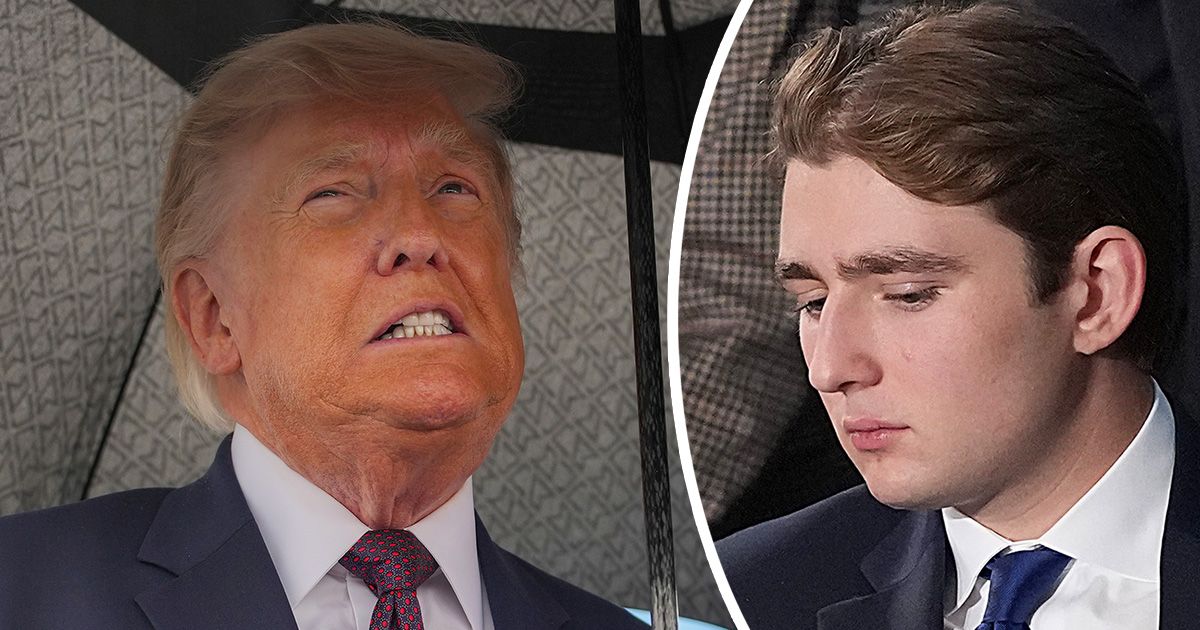
Donald Trump’s relationship with his youngest child, Barron, has long been a subject of curiosity. While the former president is frequently in front of cameras, Barron has mostly grown up outside the spotlight. That is why a brief moment during a White House ceremony quickly went viral, with many viewers insisting that Donald Trump appeared to forget or avoid saying his son’s name.
A moment that raised eyebrows
The scene unfolded in the East Room of the White House, where Donald Trump addressed the audience with Melania Trump nearby and their son, Barron, also in attendance. As he often does in public remarks, Trump shifted from the main topic to speak about family, turning to praise Melania’s role at home and in public life.
“Most importantly, and most importantly to her, she’s done an incredible job as First Lady. She’s an incredible mom,” Trump said, as reported by Tyla. In highlighting Melania’s parenting, he continued, describing her as “Barron’s parent,” and added, “She has a little boy who’s quite tall. He’s a little boy to us, but he’s quite tall, right? And his great parent. She takes great care of him, thank you.”
That choice of words—particularly the phrase “Barron’s parent” and the indirect description “a little boy who’s quite tall”—was what set the internet buzzing. Before long, clips and quotes of the moment were circulating widely across social platforms, with countless viewers reading it as a sign that he had either forgotten Barron’s name or was distancing himself from his son.
Why the phrasing struck a nerve
For many people who saw the clip, it was not just the absence of the name Barron but the way Donald Trump framed the remark. Saying “his great parent” about Melania sounded to some like an awkward attempt to talk about their son that never quite landed. In a tense media environment where every phrase is examined, a single awkward sentence can take on a life of its own.
Some viewers were quick to joke that the former president could not recall his son’s name. Others were more serious, arguing that referring to Melania as “Barron’s parent” sounded like a deliberate effort to present Barron as mostly her child rather than their child. The pattern of comments online had a familiar rhythm: a viral moment that many people interpret the same way, repeated thousands of times by users who may only have seen a short clip, not the full speech.
Not everyone heard it the same way
There was also pushback. Plenty of commenters argued that the line was obviously meant to be lighthearted and that Trump was emphasizing Melania’s contributions. Some said the remark was the sort of spontaneous, off-the-cuff phrasing that happens to anyone speaking extemporaneously, and that it was unfair to hold a split-second sentence up as a headline-making gaffe.
Others pointed out that he seemed intent on praising his wife’s parenting, particularly because Barron has largely been kept away from the political fray. In that reading, talking about Barron indirectly was less about forgetting a name and more about keeping the focus on Melania as a devoted mother.
Putting the moment in context
Part of why the comment landed so strongly is that Barron remains one of the least-seen members of the Trump family. He has grown into adulthood primarily outside the public eye and is known for being notably tall. Over the years, Melania has emphasized privacy for their son, and he has rarely joined political events compared with Donald Trump’s older children, who were frequent presences on the campaign trail and in the administration’s orbit.
That contrast fuels curiosity. When Barron is mentioned, even briefly, attention spikes. This latest remark, which placed the spotlight on Melania as a mother while nodding to Barron in a roundabout way, was bound to get noticed—and interpreted through many different lenses.
How live remarks can go sideways
Anyone who has spoken at length in front of a room knows how easy it is to stumble over a sentence. Public figures, even highly seasoned ones, sometimes chase a thought mid-sentence, creating phrasing that reads oddly in print. With Donald Trump in particular, supporters and critics alike recognize his habit of speaking spontaneously, circling back to phrases, and using shorthand to keep the audience engaged. That can produce lines that feel warm and conversational—or, at moments like this, vaguely confusing.
It may be that he meant to underscore Melania’s hands-on role as a parent. It may be that he was searching for a turn of phrase and never quite delivered it the way he intended. What is certain is that a few seconds of unscripted talk became a viral clip, and the internet did what it tends to do: rush to judgment and repeat the most entertaining interpretation.
Why many people heard the same thing
When a moment like this surfaces, it often collides with preexisting narratives. If someone already believes Donald Trump is prone to gaffes, they will be inclined to hear the line as proof he forgot his son’s name. If they see him as a doting parent, they may hear it as an awkward but affectionate attempt to credit his wife. Social media’s echo chamber intensifies whichever interpretation resonates most with each audience.
There is also timing. The clip’s spread coincided with conversations about parenting, family roles, and how public figures share credit within the home. References to holidays and milestones only fueled the viral energy, with jokes and jabs that were crafted to earn quick laughs and fast shares.
What he actually said, and what it might mean
Looking closely at the words themselves, two things stand out. First, he clearly intended to praise Melania’s work at home and as First Lady. Second, by calling her “Barron’s parent,” he created an odd-sounding label that, stripped of context, reads like he is separating himself from the role of father. In ordinary conversation, most people would say “our son” or simply use the child’s name. On a stage, however, speakers sometimes pivot to a descriptive phrase without realizing how it will sound later on video.
It is also worth noting that he described Barron as “a little boy who’s quite tall,” a line that mixes a parent’s nostalgia with a nod to the obvious. Many parents of grown children talk this way, remembering their kids as “little” even when they are fully grown. From that angle, the remark sounds like an affectionate aside, not an intentional slight.
The bigger picture of family and privacy
Through the years, Melania Trump has consistently aimed to shield Barron from politics and intense media scrutiny. That approach is not unusual for families in public life. Many leaders and celebrities make a point of keeping their children’s lives private, limiting how often they are named or featured. In that light, a less direct reference could be part of a long-standing instinct to preserve a measure of normalcy for him.
At the same time, the Trump family dynamic is well known to the public. Donald Trump’s older children have often been by his side professionally. The contrast with Barron’s low profile invites speculation whenever his name, or lack of it, briefly surfaces on a big stage.
Viral clips rarely tell a full story
Another key factor in these episodes is how fast short clips travel. A few seconds of video, repeated with snappy captions and familiar punchlines, can feel definitive even when it is not. That does not mean viewers are wrong to form impressions—it is human nature to react in the moment. But it does mean that the most shared version of an event is not always the most complete.
For anyone trying to make sense of what they saw, it helps to consider the broader setting. This was a ceremonial moment, delivered in a historic room, with family nearby and cameras rolling. The goal appeared to be applauding a spouse’s role, not delivering a carefully worded statement about parenting. Those circumstances can produce remarks that work in the room but read awkwardly on the page.
How reasonable people can disagree
It is entirely possible to hear the line and think, “That sounded strange—why not just say Barron’s name?” It is also reasonable to hear the same line and conclude, “He was making a light joke and praising Melania; no harm done.” The debate itself says as much about the moment we live in as it does about the words spoken on stage. Audiences are fragmented, attention is scarce, and the hottest take often rises fastest.
What remains consistent is the underlying truth that family moments, even brief ones, carry a special charge. People care about how parents talk about their children, and they pay close attention to whether that talk feels warm, proud, or distant. The intensity of reaction here underlines how closely many listeners track those signals.
Reading the tone, not just the transcript
When evaluating a snippet like this, tone can be just as important as wording. Was the room laughing? Did the speaker’s voice suggest affection, pride, or simple stage banter? Text on a screen cannot fully capture that. While transcripts help us weigh what was said, they can flatten humor, timing, and warmth. That is one reason why audiences who watched the full moment often report different feelings than those who only read or heard a quote.
To that end, some viewers who watched the broader exchange felt it was primarily a tribute to Melania’s motherhood, not a commentary on fatherhood. Others acknowledged the praise for Melania but still found the phrasing clumsy. Both reactions can be true: the intention may have been kind, and the delivery imperfect.
What we can safely conclude
There is no clear evidence that Donald Trump literally forgot Barron’s name. He referred to his son indirectly and emphasized Melania’s role as a parent. That combination gave many people the same impression online, leading to the widely shared claim that he had a memory lapse or created distance. Equally, there is a straightforward explanation in which he was simply spotlighting his wife and reached for a casual turn of phrase that came out awkwardly.
In other words, the clip supports more than one reading. Your take will likely depend on how you already perceive the speaker, your expectations for public remarks, and how much weight you give to unintended wording during live events.
The takeaway for thoughtful viewers
Moments like this are reminders to pause before drawing sweeping conclusions from a single sentence. It is helpful to consider the full context, the intent to praise a spouse, and the long-standing desire to protect a child’s privacy. At the same time, it is fair to acknowledge why many people reacted the way they did. Words matter, especially when they concern family, and especially when spoken from a podium where every syllable can be replayed a thousand times.
Whether you heard a father gently deflecting attention toward his wife or a clumsy line that left out an important name, the bigger lesson may be about how easily a few unscripted words can dominate the day’s conversation. In a crowded media world, the simplest clips often echo the loudest.
Bottom line
Did Donald Trump forget his son Barron’s name? We cannot say for certain based on this brief exchange. What we can say is that he highlighted Melania’s parenting, referred to Barron indirectly, and sparked a wave of similar reactions online. Some people heard the remark as distancing, others as a harmless joke and a heartfelt compliment to his wife. The truth likely lies in the unscripted middle, where intentions, habits, and live-stage wording meet in ways that do not always translate neatly to the screen.
As with so many viral moments, a little patience and a wider view help. Family is complicated, public life even more so, and a single sentence—however it lands—rarely tells the whole story.



