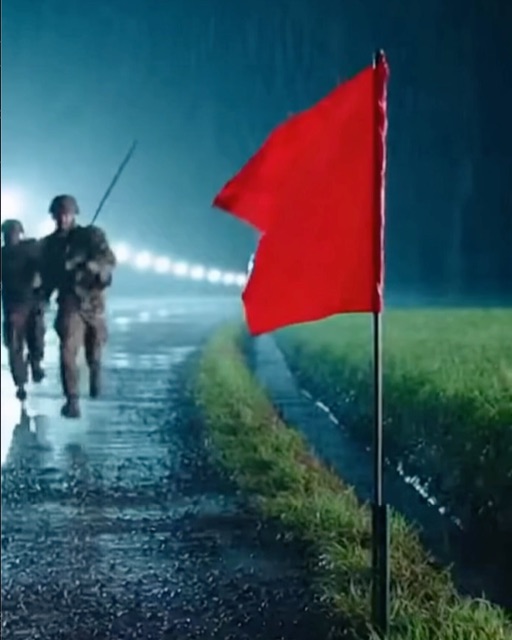
The storm had turned the training lane into a pitch-black swamp. We were an active-duty recon unit trying to reach Marker Red before the weather locked us down.
If our follow-on truck didn’t see that red panel, a vehicle full of guys was going to drive blind straight into a ten-foot flooded ravine.
Suddenly, a massive gust of wind tore the red panel off its stake. It tumbled through the mud, heading straight for the black water.
Dustin, our radioman, started screaming. The truck’s headlights were already piercing through the rain. They were coming in way too fast.
Todd, our team leader, didn’t even shout. He just sprinted.
My heart pounded as his boots slipped. He hit the mud, dug one hand in, and launched himself headfirst into the freezing runoff just as the truck roared toward the edge.
He grabbed the red fabric. Dustin and I scrambled forward, grabbing Todd’s ruck straps and dragging him backward out of the ditch. The driver saw the red in his hand, slammed the brakes, and safely made the turn.
We saved them.
Todd was kneeling in the mud, gasping for air, clutching the soaked red fabric to his chest.
“You good, man?” Dustin yelled over the rain, laughing with relief.
But Todd wasn’t laughing. He was staring down at his fist, his face entirely drained of color.
He slowly opened his hand, and my blood ran cold. Because the red fabric he pulled out of the water wasn’t our marker panel at all… it was a tiny, red raincoat.
The kind a little kid would wear.
It was impossibly small in his big, muddy hand. The hood even had little bear ears sewn onto it.
For a second, nobody spoke. The only sound was the howling wind and the idling engine of the truck we’d just saved.
The driver leaned out his window, his voice tinny against the storm. “Everything okay over there?”
Todd didn’t answer. He just kept staring at the little coat, turning it over in his hands.
I saw his knuckles turn white around the fabric.
“Todd?” I asked, my voice barely a whisper.
He finally looked up at me, and his eyes were full of a kind of raw terror I’d never seen, not even in the worst firefights.
“There’s a kid out here,” he said, his voice hoarse.
Dustin shook his head, looking around at the violent, empty darkness. “No way, man. It probably just washed down from somewhere upstream.”
“It’s not old,” Todd countered, running a thumb over the slick material. “It’s not faded or torn up from being in the water long.”
He was right. Apart from the mud, it looked almost new.
The mission clock was ticking in my head. We had to move. We were on a strict timeline.
“We have to report this,” I said, trying to be the logical one, the voice of reason. “We call it in, let the local authorities handle it.”
Todd slowly got to his feet, his gaze shifting from the little coat to the roaring, black water of the ravine.
“By the time they get here, it’ll be too late,” he said, his voice flat and final.
He was making a decision. I could see it set in his jaw.
“We can’t,” Dustin argued, his voice rising with panic. “Command will have our heads. We abandon the exercise, our careers are toast.”
“This isn’t an exercise anymore,” Todd cut him off, his authority silencing us both.
He turned to me, his eyes boring into mine. “Give me your flashlight.”
I hesitated for only a second before unclipping the heavy tactical light from my vest and handing it over.
He clicked it on, the powerful beam cutting a sharp white line through the downpour.
He swept the light along the edge of the ditch, his movements methodical, desperate.
The guys in the truck we’d saved were watching us now, their faces etched with confusion.
Todd was our leader. We always followed his orders. But this was different. This was a career-ending kind of different.
He ignored the mission. He ignored the radio chatter that was probably already starting to ask for our position.
He just kept searching, one slow step at a time.
“Look,” he suddenly shouted, his voice cracking. He pointed the beam at a spot a few yards down.
There, tangled in the gnarled roots of an old oak tree, was a small, blue plastic lunchbox. It had a cartoon rocket ship on the front.
My stomach dropped. A coincidence was one thing. This was something else entirely.
Dustin let out a low whistle beside me. “Oh, man.”
We weren’t looking for a lost object anymore. We were looking for a lost child.
Todd didn’t wait for us. He started moving along the bank, his light bouncing frantically in the dark.
“Spread out!” he commanded, his voice tight. “Follow the water line. Look for tracks, broken branches, anything!”
We fell into formation without a second thought. The mission was gone from our minds, replaced by a cold, sharp dread that settled deep in our bones.
The rain was relentless, turning the solid ground into a slick, treacherous soup. Every single step was a risk.
For twenty minutes, we found nothing. Just more mud, more rushing water, and the deafening noise of the storm.
Hope started to feel stupid, and a cold part of me thought Dustin had been right. Maybe it had all just washed downstream from miles away.
Then, I heard Todd’s sharp intake of breath.
He had his light pointed at an almost invisible service road, one that wasn’t on our training maps.
There were faint tire tracks, mostly washed away, leading off the main path and down toward the ravine.
“Someone tried to take a shortcut,” Todd murmured, his voice a low growl.
He followed the tracks with his light beam, step by agonizing step, and that’s when we all saw it.
The trail ended abruptly. The earth was torn up, gouged deep as if something heavy had been dragged into the abyss.
Down in the ravine, almost completely submerged in the churning floodwater, was the dark, hulking shape of a car.
It was upside down, its wheels pointing uselessly at the angry sky.
A collective silence fell over us. It was the kind of silence that feels heavier and louder than any sound.
“Okay,” Todd said, his voice suddenly calm, steady, and full of absolute command. “This is a rescue op now. Dustin, get on the radio. Call this in. I don’t care who you get, tell them we have a vehicle in the water with possible civilian casualties. Give them our grid, now.”
Dustin was already scrambling for his radio, his face grim and pale.
“You and I,” Todd said, looking straight at me, “we’re going down there.”
He didn’t have to ask. I was already moving.
We grabbed the emergency rope from our truck. Tying it off to the vehicle’s heavy steel frame, we prepared to rappel down the slippery, muddy embankment.
The drop was only ten or twelve feet, but in the dark with the mud giving way, it felt like a mile.
When we hit the water, the cold was a physical shock. It stole my breath. It was chest-deep and moving fast, trying to pull our feet right out from under us.
We fought our way to the overturned car, the current pushing against us with incredible force.
Todd hammered on the submerged window with the butt of his knife. It wouldn’t break. It just made a dull thud against the glass.
“The door!” he yelled over the roar of the water. “Try the door!”
I braced myself against the current and pulled on the handle of the rear door. It was jammed shut by the pressure.
Todd was on the other side, doing the same, grunting with the effort. We were wasting precious time.
“Together!” he shouted. “On three! One, two, three!”
We both found a purchase and pulled with every ounce of strength we had. There was a sickening groan of stressed metal, and the door scraped open a few inches.
It was enough.
Todd shoved his arm inside, fumbling around in the dark, murky water.
His expression changed. “I’ve got someone,” he said, his voice strained. “They’re small.”
He worked for what felt like an eternity, his face a mask of pure concentration. Then he pulled, and a small body, limp and still, came free from the wreckage.
It was a little girl. She was wearing a blue dress, and her blonde hair was in pigtails. She couldn’t have been more than five or six years old.
She wasn’t breathing.
“Get her up!” I screamed, my voice raw.
We maneuvered her tiny body out of the car and toward the bank. Dustin and the other guys had scrambled down to help, forming a human chain to pull us out of the current’s grip.
Todd laid her gently on the muddy ground. Without a moment’s hesitation, he started CPR.
He tilted her head back, cleared her airway with a quick swipe of his finger, and began the compressions. One, two, three, four.
His movements were precise, the product of countless hours of training, but his face was filled with a pleading desperation I’d never seen before.
“Come on, kid,” he whispered between breaths. “Come on. Stay with me.”
It felt hopeless. The storm raged around us. The girl was so pale, so utterly still.
“Is there anyone else in there?” Dustin yelled, pointing back at the half-submerged car.
I looked at Todd. He couldn’t stop what he was doing. He wouldn’t stop.
“I’m going back,” I said, and before anyone could argue, I was back in the freezing water.
I got the door open wider this time and pulled myself halfway inside the submerged, silent cabin.
In the driver’s seat, a woman was buckled in. I reached for her neck, my fingers fumbling in the cold. I checked for a pulse. It was faint, thready, but it was there.
Getting her out was a nightmare. She was unconscious, a dead weight in the water.
It took all of us, but we managed to get her to the bank and lay her beside her daughter.
Todd was still working, his rhythm unbroken, his focus absolute. “Don’t you quit,” he muttered to the little girl. “Don’t you dare.”
And then, she coughed.
It was a tiny, sputtering sound, but in the chaos of the storm, it was the most beautiful thing I had ever heard.
Water streamed from her mouth as she coughed again, harder this time. Her eyelids fluttered open.
A wave of relief so powerful it almost buckled my knees washed over me. She was alive.
Todd didn’t cheer. He just collapsed forward, resting his forehead on the mud next to her, his broad shoulders shaking with silent sobs.
The wail of sirens finally cut through the storm. Paramedics were here.
They swarmed the scene, their efficiency a stark contrast to our frantic efforts. They loaded the mother and daughter onto stretchers, wrapping them in thermal blankets.
As they lifted the little girl, she looked over at Todd, her blue eyes wide.
“My coat,” she whispered, her voice hoarse and small. “My red coat.”
Todd reached into his deep cargo pocket and pulled out the crumpled, muddy raincoat with the little bear ears.
He handed it to her, and she clutched it to her chest as they carried her away.
The paramedics left, their ambulance lights disappearing into the rain, and we were left standing in the mud, soaked, frozen, and completely outside of our mission parameters.
Our commanding officer, Major Albright, arrived with the MPs not long after. He was not a man known for his patience or his sense of humor.
He stood before us, his face like a thundercloud, looking at our muddy gear and the abandoned, chaotic training lane.
“Sergeant,” he said, his voice dangerously low, his eyes fixed on Todd. “Care to explain why your team is miles off course and my multi-unit exercise is in shambles?”
Todd stood straight, his face streaked with mud. He didn’t make excuses.
“We had to make a choice, sir,” he said simply.
“You had a mission, Sergeant,” Albright snapped, his voice like cracking ice.
“Our mission changed, sir,” Todd replied, his own voice even and unshakable.
I thought that was it. I thought we were all going to be cleaning latrines for the rest of our careers.
But then one of the paramedics jogged back over to us, his face lit by the flashing police lights.
“Just wanted you to know,” he said, looking at Todd. “The little girl is asking for you. Her name is Sarah.”
He paused, a small smile on his face. “Her mom is stable. You guys saved their lives. There is no question about that.”
The paramedic left, and Major Albright was quiet for a long moment.
He just stared at Todd, his expression completely unreadable.
“Get your men back to base,” he finally said, his tone clipped and official. “You’ll report to my office at 0800 for a full debrief.”
He turned on his heel and walked away without another word.
The ride back was dead silent. We knew we’d done the right thing, but we also knew the army has rules for a reason. You don’t just abandon your post.
The next morning, we stood in a tight formation outside Albright’s office, waiting for the axe to fall.
Todd went in first. He was in there for what felt like an eternity.
When he came out, his face was pale, but he just looked at us and gave a short, sharp nod.
Then it was my turn, then Dustin’s.
Albright asked us for a factual report. No emotion. Just what happened, when it happened, and why. We gave it to him.
When we were all done, he had us all come back into his office. We stood at attention in a line in front of his massive oak desk.
“In my twenty years of service,” he began, his voice a low rumble, “I have never seen an exercise so completely and utterly disregarded.”
He let that hang in the air, the silence thick with our careers hanging in the balance.
“You abandoned your objective. You broke protocol. You communicated on an open channel about a civilian matter.”
He listed our failures one by one, each word a hammer blow.
“However,” he continued, leaning back in his chair and steepling his fingers. “I got a call this morning from the hospital.”
He picked up a piece of paper from his desk.
“The woman’s name is Helen Marks. Her husband is currently deployed overseas. He’s a captain in the 101st Airborne.”
My breath caught in my throat. She was one of us.
“She was trying to get to her sister’s house to ride out the storm,” Albright went on. “She took a wrong turn down that old service road, and the road washed out from under her.”
He looked directly at Todd, his hard eyes softening just a fraction.
“The doctors said that if they had been in that water for another ten minutes, neither of them would have made it.”
He put the paper down on his desk.
“The first duty of a soldier is not to the mission on a map. It is to the lives you are sworn to protect.”
A slow, tired smile spread across his stern face.
“What you did out there was not a failure to follow orders. It was the finest example of leadership and sound judgment I have ever had the privilege to witness.”
He stood up, his posture ramrod straight.
“You are all being put in for commendations. Now get out of my office. Dismissed.”
We walked out of that office feeling ten feet tall.
Later that week, we were allowed to visit the hospital. Helen, the mother, was sitting up in bed, looking tired but incredibly grateful.
Little Sarah ran right to Todd as soon as we walked in and gave him a huge hug around his legs.
“You found my coat,” she said, pointing to the little red raincoat hanging on a chair by her bed.
Todd knelt down to her level, his big frame looking out of place in the bright hospital room. “I’m sure glad I did,” he said, his voice thick with an emotion I couldn’t place.
I never really knew Todd’s story. He was a private guy, a great leader, but he kept his walls up high.
That night, after a few beers at the local bar, he finally told me.
He had a daughter. Her name was Lily. He and her mom had divorced years ago, and it was messy, full of anger and hurt feelings.
He hadn’t seen Lily in almost three years. He sent birthday cards and Christmas presents, but they always came back to him, unopened.
“She had a raincoat just like that one,” he said, staring into his half-empty bottle. “Same bear ears on the hood.”
He told me that when he pulled that little coat out of the churning water, for one horrifying, gut-wrenching second, he thought it was hers.
“It was like the universe was screaming at me,” he said, his voice quiet. “Telling me what a fool I’ve been.”
He had been so focused on his mission, on his career, on being a soldier, that he had let the most important thing in his life slip away.
Saving Sarah wasn’t just about saving a child. For Todd, it was a wake-up call. It was a second chance he never thought he’d get.
The very next day, he put in for a two-week leave. He didn’t tell us where he was going, but we all knew.
He came back two weeks later. He looked different. Lighter. The permanent tension in his shoulders was gone.
He didn’t say much about his trip, but he pulled out his phone and showed me a picture.
It was him, standing in a sunny park, with his arm around a smiling ten-year-old girl. She had his eyes and a bright, happy smile.
She was holding his hand.
Sometimes, life sends you down a muddy ditch in the middle of a storm. You think you’re chasing one thing, something you’ve been told is important, like a mission marker or a career goal. But every now and then, if you’re brave enough to take the leap into the cold water, you find what you were really supposed to be looking for all along. It might not be what you expected, but it’s always what you needed.