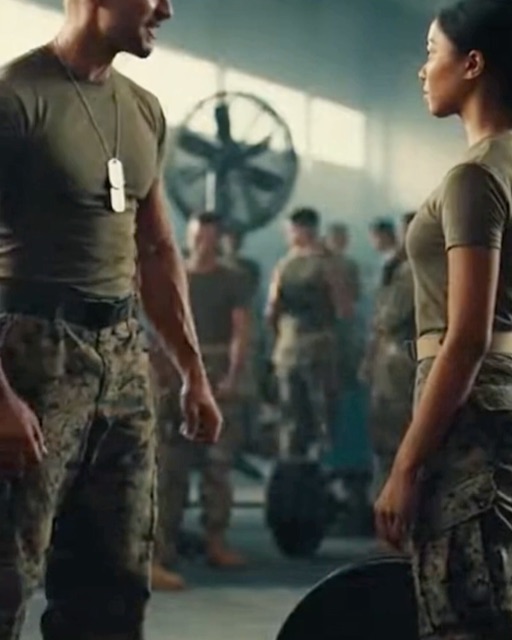
Plates clanged. Sweat burned my eyes. I was re-racking a bar when Darren strolled over to the heavy bag with that grin he wears when he’s got an audience.
The new girl was there. Quiet. Hair tied back, wrists taped neat. Just working the bag – clean, tight shots. No noise. No showboating.
She’d been here a week. Ate alone. Skipped small talk. Rumors stuck to her like lint – ducking tasks, weird vibes, probably not going to last. You know how it gets.
“Careful, sweetheart,” Darren called, loud enough to make the bench guys look up. “Don’t break a nail.”
She didn’t even flick her eyes at him. Pop-pop. Pop. That was it.
He stepped closer. “People like you should be home with a stroller, not playing soldier.”
The bag stopped swinging. She said, calm, almost bored, “It doesn’t concern you.”
That set him off. “Think you’re tough? Show me.”
She turned back to the bag. “No.”
A few of us drifted in, pretend-stretching, pretending not to watch. Someone killed the music. The room tightened.
Darren moved fast. No warning. Body kick – sharp, trained—caught her right under the ribs.
She hit the mat hard.
My chest went ice-cold. Even the treadmill guy stopped.
She lay there a second, palm pressed to her side, breathing slow. Then she blinked once, rolled to a knee, and stood. No flinch. No tears. Just this dead-calm stare that made the hairs on my arms lift.
Darren smirked, backing up like he’d won the lottery. “Know your place. Go home.”
A couple chuckled under their breath.
She didn’t look at him. She looked at the rest of us.
“You all saw that,” she said. Voice steady. “Good.”
Then she walked to her duffel, unzipped it, and pulled out a thin black wallet—one of those with a window. She flipped it open and held it up so we could see the seal.
My heart pounded in my ears.
She turned the card around, and the first line under the crest made my blood run cold. It said:
Captain Anna Vance.
Underneath it were two more words that sucked all the air out of the room. Judge Advocate General’s Corps.
She was a lawyer. A military lawyer.
Darren’s smirk melted off his face like wax. His skin went the color of cheap milk.
The two guys who had chuckled suddenly found the scuff marks on their boots incredibly interesting.
“My name is Captain Vance,” she said, her voice cutting through the dead silence. “I’m attached to this base on temporary duty.”
She tucked her ID away as calmly as if she were showing it to a gate guard.
“Assault on a fellow service member is a violation of the UCMJ, Article 128,” she continued, her eyes locking onto Darren’s. “Assault on a commissioned officer is a bit more serious.”
Her gaze then swept over the rest of us. “Failure to intervene or report is also a fun one to read about.”
No one moved. No one breathed. The only sound was the faint hum of the ventilation system.
Darren started to stammer. “I… it was just a joke. We were sparring.”
“Sparring?” Captain Vance raised a single eyebrow. “Did it look like sparring to any of you?”
She looked right at me.
My throat was bone dry. I just shook my head, a tiny, almost imperceptible movement.
She gave a small, grim nod. “That’s what I thought.”
She pulled out her phone, tapped the screen a few times, and held it to her ear. She never broke eye contact with Darren.
“This is Captain Vance. I need two MPs at the main fitness center. Immediately.”
She listened for a second. “Yes. An Article 128 in progress. The subject is contained.”
Contained. That’s the word she used for Darren, who looked like he was about to be sick all over the weight rack.
The whole thing felt unreal. Ten minutes ago, she was the quiet new girl nobody knew. Now she was the most powerful person in the room.
The MPs arrived in less than five minutes. They were professional, quiet, their presence amplifying the gravity of what just happened.
They spoke to Captain Vance in low tones, then turned to Darren.
“Sir, you need to come with us.”
Darren just nodded, his bravado completely gone. He looked small.
As they cuffed him, he shot a look at the rest of us. It was a pleading look, a desperate one. But everyone looked away.
The gym emptied out fast after that. People grabbed their gear and just left, not talking, not looking at each other.
The silence we left behind was heavier than any weight in that room.
I was one of the last to leave. As I headed for the door, Captain Vance called my name.
“Corporal Finch.”
I froze. I hadn’t even known she knew my name.
I turned around. “Ma’am.”
She was standing by her duffel bag, zipping it up. She didn’t look angry, just tired.
“I need to take your statement. And a few others.”
“Yes, ma’am.”
“My temporary office is in the admin building, room 204. Be there at 0900 tomorrow.”
“Understood, ma’am.”
I left, my mind racing the whole walk back to the barracks. It wasn’t just about Darren anymore. It was about all of us who stood there and watched.
The next morning, the base was buzzing. The story had spread like wildfire, twisting and turning with each telling.
I showed up at room 204 at 0855. The door was already open.
Captain Vance was at a simple metal desk, a laptop open in front of her. She was wearing her uniform now, the captain’s bars gleaming on her collar.
She looked different. Not just the uniform, but the way she carried herself. The quiet girl in the gym was a mask. This was the real person.
“Sit down, Corporal,” she said, gesturing to the chair opposite her.
I sat. The room was sterile, impersonal. It felt like I was in trouble.
“I’ve read your file, Finch,” she started, not looking up from her screen. “Clean record. Good marks. You’re a solid soldier.”
“Thank you, ma’am.”
She finally looked at me. Her eyes were sharp, analytical. “Then tell me why a solid soldier stood by and watched a fellow soldier get assaulted.”
The question hit me right in the chest. Shame washed over me, hot and heavy.
“I… I don’t know, ma’am. It happened fast.”
“It didn’t,” she said, her voice level. “It started when he called me ‘sweetheart.’ It escalated when he told me to go home and push a stroller. It ended with his foot in my ribs.”
She leaned forward slightly. “There were at least three points where someone could have stepped in. Said something. Created a distraction. Anything.”
I had no answer for that. She was right.
“This isn’t just about what Darren did yesterday,” she said. “This is about a culture. A culture I was sent here to observe.”
My head snapped up. “Observe?”
This was the first twist. She wasn’t just here by chance.
“A formal complaint was filed six months ago by a soldier who was honorably discharged from this unit. A Private Peterson.”
I knew Peterson. A good kid from Ohio. He was smart, worked hard, but he was quiet. He didn’t fit in with the loud, chest-thumping crowd. He left suddenly, citing “family reasons.”
None of us questioned it.
“Peterson’s complaint alleged a persistent pattern of harassment and bullying, specifically from Darren and a few others, which he claimed was ignored and even encouraged by senior leadership.”
She paused, letting the words sink in. “My job is to find out if he was telling the truth. I’ve been on this base for a week, Corporal. Eating in the mess hall. Working out in the gym. Listening.”
She hadn’t been ducking tasks. She’d been invisible.
“And what I saw yesterday suggests Peterson was telling the truth.”
I thought about all the times I’d seen Darren trip someone in the hallway, or “accidentally” spill a drink on a newer soldier. The times he’d mock someone for not lifting as much as him.
We all just called it “Darren being Darren.” We never called it what it was. Harassment.
“So, I’m going to ask you again, Corporal Finch,” Captain Vance said, her voice softening just a little. “What did you see yesterday? And what else have you seen on this base?”
This was my moment. I could give her the bare minimum, just the facts about the gym. Or I could tell her everything.
I thought about Peterson, how he just faded away. I thought about the next quiet kid who would get assigned to our unit.
I took a deep breath. “It’s not just Darren, ma’am. He’s just the loudest.”
For the next hour, I talked. I told her about the “jokes” that weren’t jokes. The training “accidents” that were deliberate. The way certain people were always assigned the worst duties.
And I told her how Sergeant Major Thorne, the highest-ranking NCO on the base, would see it all and just smile, like he approved. Like he believed it made the unit stronger by weeding out the weak.
Captain Vance typed the whole time, her face unreadable.
When I was done, the room was silent again.
“Thank you, Corporal,” she said finally. “You’ve been very helpful. Would you be willing to repeat this in a formal statement?”
“Yes, ma’am.”
“It won’t make you popular.”
“I know,” I said. And for the first time, I didn’t care.
Over the next two weeks, things changed. Captain Vance interviewed dozens of us. Some people clammed up, but a surprising number started talking.
It was like a dam had broken. One person’s courage gave another person courage.
The real target wasn’t Darren. He was just a symptom. The disease was the culture Sergeant Major Thorne had cultivated for years.
The second twist wasn’t a sudden event. It was a slow, dawning realization for me. Captain Vance hadn’t come here to be a hero. She hadn’t stood up in that gym to show off.
She took that kick. She let it happen. She let it play out so that we would all be witnesses not just to a crime, but to our own silence.
She had to become the victim to expose the problem.
The investigation culminated in a formal hearing. Darren was there, looking like a ghost. But the man sweating under the lights was Sergeant Major Thorne.
Captain Vance was a prosecutor, and she was brilliant. She laid out a pattern of behavior, using our statements, duty rosters, and even old emails. She painted a picture of a leader who ruled by fear and intimidation, who mistook cruelty for strength.
My testimony was the hardest thing I’d ever had to do. I could feel the glare from Thorne’s supporters in the room. But I just looked at Captain Vance, who gave me a slight, encouraging nod, and I told the truth.
In the end, Darren was dishonorably discharged. It was a quiet end to a loud and ugly career.
Sergeant Major Thorne was relieved of his duties and forced into early retirement, his legacy forever tarnished. It was a fall from grace that sent shockwaves through the entire command.
The day before Captain Vance was due to leave, I saw her at the running track, doing a cool-down lap. I waited for her to finish.
“Ma’am,” I said, falling into step beside her.
“Finch,” she acknowledged with a small smile.
“I just wanted to say thank you.”
She shook her head. “Don’t thank me. Thank yourself. I’m just a lawyer. I can’t force people to be brave. You and the others who spoke up… you’re the ones who changed things.”
We walked in silence for a minute.
“Why, ma’am?” I finally asked. “Why do you do this?”
She stopped walking and looked out over the field. “Before I went to law school, I was an enlisted mechanic. I had a Sergeant Major a lot like Thorne. He made life miserable for anyone he thought was weak. I saw a lot of good people leave because of him.”
She met my eyes. “I just decided that if I ever got the chance, I’d try to be the person I needed back then.”
It was that simple. That heartfelt.
“You took a big risk,” I said, thinking of the kick she took in the gym.
“Sometimes you have to,” she replied. “True strength isn’t about how hard you can hit. It’s about being willing to take a hit for what you know is right.”
That was the last time I spoke to her. She left the next day, as quietly as she arrived.
But she didn’t leave the base the same as she found it. The cloud of fear was gone. The new commander and Sergeant Major made it clear that the old way was over.
It wasn’t perfect, but it was better. People started looking out for each other in a way they hadn’t before.
My own reward wasn’t a medal or a promotion. It was something smaller, and better.
A few months later, I was in the gym, spotting a new private who was struggling with the bench press. He was skinny, nervous, and reminded me a little of Peterson.
He failed on his last rep, the bar coming down on his chest. I helped him lift it back onto the rack.
“Thanks, Corporal,” he said, embarrassed.
“No problem,” I said, smiling. “We all start somewhere. Let’s try it again next week. I’ll spot you.”
The relief in his eyes was all the reward I needed.
I had learned that the heaviest things we lift aren’t made of iron. They’re the moments we choose to speak up when it would be easier to stay silent. True strength isn’t found in the size of your muscles, but in the courage of your convictions. And sometimes, the most powerful person in the room isn’t the one throwing the punch, but the one who inspires others to finally stand up.