They told me the building was secure.
I almost laughed.
I had crawled through worse security on half a lung and a broken ankle in Helmand.
But I was sixty-eight now.
Cane. Knee brace. VA parking tag.
To the young guards at the National Defense Archives, I looked like someone’s grandfather who had taken a wrong turn.
“Sir, this entrance is restricted,” one said.
“I have an appointment.”
“With who?”
I gave him the name.
He smirked.
“That office doesn’t meet with walk-ins.”
“I’m not a walk-in.”
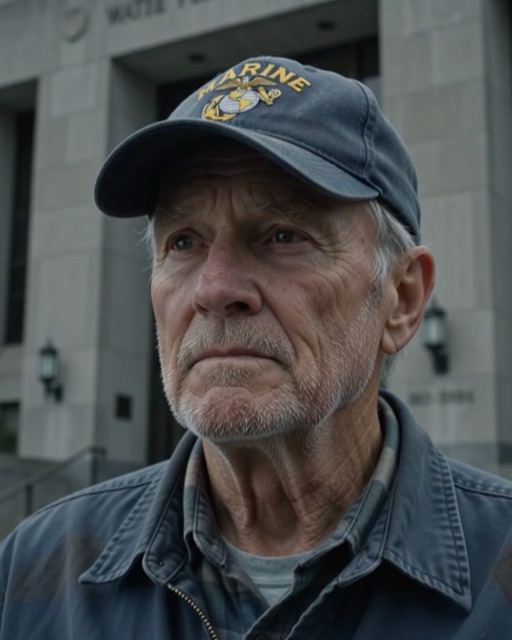
He looked at my faded Marine Corps cap.
“Were you actually in, or do you just like the hat?”
The other guard laughed under his breath.
I could have answered.
Instead, I took the cap off and held it against my chest.
Some things don’t deserve anger. They deserve patience.
Before I could speak, the elevator behind them opened.
A woman in a Navy dress uniform stepped out fast enough that both guards straightened.
Rear Admiral Connie Vale.
She saw me and stopped cold.
Then she saluted.
Not casual. Not ceremonial. Sharp enough to cut air.
The guards froze.
“Master Gunnery Sergeant Reeves,” she said. “I apologize for the delay.”
The young guard’s mouth opened.
“Master Gunnery Sergeant?”
I put my cap back on.
The admiral turned toward the guards.
“This man does not wait outside secure rooms,” she said. “Secure rooms wait for him.”
Nobody laughed after that.
They escorted me down three levels to a vault conference room with no windows and too many flags.
On the table sat a black file stamped: SEALED – PRESIDENTIAL AUTHORITY REQUIRED.
I stared at it.
“Why am I here?” I asked.
Admiral Vale sat across from me.
“Because everyone else named in this report is dead.”
My blood went cold.
She slid a keycard toward me.
“The archive recognizes one living clearance holder.”
I didn’t touch it.
“What file?”
Her jaw tightened.
“Operation White Harbor.”
The room seemed to tilt.
I had spent thirty-one years making myself forget that name.
Outside, thunder rolled over Washington. Inside, the admiral opened a screen.
Grainy footage appeared.
A night sea. A burning vessel. A Marine unit that official history said never made contact.
Then I saw myself on the monitor. Young. Bleeding. Dragging a wounded sailor through black water under tracer fire.
The guard who mocked me stood behind the glass now, watching with a face full of something he’d never shake.
Admiral Vale said, “The official report says you abandoned the extraction team.”
I leaned forward.
“The official report lied.”
She nodded slowly.
“We know.”
Another file appeared on the screen. A list of names.
Four admirals. Two contractors. One sitting United States senator.
My hands tightened around the cane.
Admiral Vale lowered her voice.
“Master Gunnery Sergeant, before Congress opens this file, we need to know who gave the order to sink the rescue beacon.”
I looked at the names.
Then at the American flag behind her.
Then I pointed to one.
And said: “He wasn’t a senator when he did it. He was standing on the deck of the USS Morrow, wearing a lieutenant’s bars, and I watched him cut the beacon wire with his own hands while four of my Marines were still in the water.”
The admiral’s face went white.
“You’re saying a sitting member of the Armed Services Committee personally – ”
“I’m saying he let them drown. Then he got promoted for it.”
Silence.
The kind that presses against your eardrums.
She reached under the table and pulled out a second envelope. This one wasn’t stamped with a classification level. It was stamped with a court date.
“We hoped you’d say that,” she whispered.
She slid it across the table.
I opened it.
Inside was a federal subpoena. My name at the top. Below it, a single sentence I had waited three decades to read.
My eyes blurred. Not from age. Not from the lights.
I looked up at the admiral.
“When do I testify?”
She glanced toward the glass where the young guard was still standing, pale and still.
“Tomorrow morning. Nine sharp. Room 216, Hart Senate Office Building.”
I picked up my cane. Stood up slower than I used to. Straightened my cap.
“One more thing,” I said.
“Sir?”
“The four Marines he left in the water.”
“Yes?”
“One of them was my brother.”
Admiral Vale closed her eyes.
I walked toward the door. The young guard stepped aside so fast he nearly tripped.
I paused next to him.
“Son.”
He couldn’t meet my eyes.
“Yes, sir?”
I tapped my Marine Corps cap.
“It’s not just a hat.”
I walked out of that building into the rain.
Tomorrow, a senator’s career would end in the same room where he’d built it.
And the only witness left alive was an old man with a cane, a bad knee, and a memory that never – not once in thirty-one years – let him forget the sound of his brother calling for help in black water while a lieutenant watched from the deck and did nothing.
But what I didn’t know yet—what none of us knew—was that when I arrived at the Hart Building the next morning, the senator wouldn’t be sitting at his desk.
He’d be sitting in my chair.
And the first words out of his mouth would be: “Hello, Gerald. I was wondering when they’d finally send you.”
He smiled.
And that’s when I realized the subpoena wasn’t issued by the court.
It was issued by him.
The room, 216, was supposed to be a senate hearing chamber. Instead, it was just an office. His office.
Polished mahogany desk. Pictures on the wall of him with presidents, with generals, with his smiling family.
And in the guest chair, where I was supposed to sit, was Senator Thomas Collins.
The same Thomas Collins who had been Lieutenant Collins thirty-one years ago.
He looked older, of course. Lines around the eyes. Hair gray at the temples. The power suit fit him better than the lieutenant’s uniform ever did.
But the eyes were the same. I’d never forgotten those eyes.
“You look well, Gerald,” he said, his voice smooth as old whiskey.
I didn’t move from the doorway. My hand was gripping my cane so tight my knuckles were white.
“The subpoena was a fake.”
He nodded, still smiling that politician’s smile.
“A necessary fiction. I needed to see you. Alone. Before the circus begins.”
“What circus?” I asked, my own voice a low growl.
“The one Admiral Vale and her friends are planning. A public hearing. A crucifixion. They think they’re hunting me, Gerald. But they don’t understand the animal they’re chasing.”
I took a slow step into the room. The polished floors gleamed.
“You cut the beacon wire,” I said. It wasn’t a question. It was a fact that had lived in my bones for three decades.
“I did,” he said, without a flicker of hesitation. “I cut the wire, and I watched those men die. I watched your brother die.”
The air left my lungs. Hearing him admit it so casually, so calmly, was like a physical blow.
“Why?” I managed to choke out.
Collins gestured to the chair opposite his desk. “Sit, Master Gunnery Sergeant. This is a longer story than you think.”
I didn’t want to sit. I wanted to use my cane for something other than walking.
But something in his tone stopped me. It wasn’t arrogance. It was something else. Something heavy.
I limped over to the chair and lowered myself into the leather. It felt like sinking.
He leaned forward, his smile gone now. His face was a mask of cold seriousness.
“Operation White Harbor wasn’t a rescue,” he said. “It was a cleanup.”
I stared at him. “Cleanup? We were extracting a Marine recon unit.”
“That’s what you were told,” Collins said. “That’s what I was told. But the vessel they were observing, the one that caught fire? It wasn’t a hostile smuggling ship.”
He paused, letting the words hang in the air.
“It was one of ours. Unofficial. Chartered by the two contractors on that list you saw. A floating laboratory.”
My mind spun. “Laboratory? For what?”
“Something they called ‘Project Nightingale.’ A neurological agent. Designed to be untraceable. To induce mass panic and temporary paralysis without a single casualty.”
He looked away, toward the picture of his smiling children.
“But the formula was unstable. There was an accident. An explosion. The agent got into the ship’s ventilation system. The crew went mad. Tearing at each other. Tearing at themselves. That’s what caused the fire.”
I thought back to the grainy footage. The burning ship. The chaos. It hadn’t just been a fire. It had been something worse.
“Your brother’s unit wasn’t there for recon,” Collins continued, his voice dropping to a whisper. “They were sent to secure the ship and its research. But when they got on board, they were exposed.”
I felt a cold dread creep up my spine. My brother, Robert. I saw his face in my mind, young and strong.
“What happened to them?”
“The agent reacted differently in open air. It didn’t just cause panic. It was lethal. Your brother’s team… they didn’t drown, Gerald.”
My heart hammered against my ribs.
“They were compromised. The order came down from the ranking officer on the Morrow. A Commander at the time. One of the admirals on Vale’s list.”
“Which one?” I demanded.
“Admiral Wallace. He was on the payroll of the contractors. He ordered me to cut the beacon and classify the recon team as lost at sea. No survivors. No witnesses.”
My world tilted again. The narrative I had held onto for thirty-one years was cracking apart.
“He told you to let them die?”
“He did more than that,” Collins said, his gaze hardening. “He had a sidearm. He told me if I didn’t cut that wire, he’d put a bullet in my head, and then he’d find another lieutenant who would. He said the mission was to contain the project, not the men.”
He looked down at his own hands, resting on the mahogany desk.
“I was twenty-four, Gerald. Scared. Ambitious. I made a choice. I chose my life. I chose my career. I cut the wire.”
The silence in the room was deafening. The ticking of a grandfather clock in the corner sounded like hammer blows.
“So you saved yourself,” I said, the words tasting like ash. “And built your life on their graves. On my brother’s grave.”
“Yes,” he said. And for the first time, I saw a crack in his composure. A flicker of something that looked like shame. “Every single day. I told myself it was for the greater good. That a public scandal over a banned chemical weapon would have been worse. I took the promotion. I climbed the ladder. I made sure I was never in a position to be the one with a gun to my head again.”
He leaned back, his eyes finding mine. “But I never forgot. I kept a record. A personal log. I have a recording of Wallace giving me the order.”
This was the twist I never saw coming. Not in a million years.
“Why?” I asked. “Why keep it?”
“Insurance,” he said simply. “And maybe… maybe a part of me knew this day would come. That a man like you never truly gives up.”
He pushed a small, velvet-lined box across the desk.
“That’s a copy of my log and the audio file. The originals are in a safe-deposit box, with instructions to be released upon my death.”
I just stared at the box.
“Admiral Vale thinks she’s coming for a corrupt senator. She doesn’t realize she’s walking into a war with Admiral Marcus Wallace, who is now one of the most powerful men in the Pentagon, and his benefactor, Alistair Finch—the number one contractor on your list. They buried White Harbor. They’re not going to let some old Marine and a repentant senator dig it up.”
“So this meeting,” I said, finally understanding. “This was a warning.”
“It’s more than a warning,” Collins said, standing up. He walked to the window and looked out at the Capitol building. “It’s an offer. You and I walk into that hearing tomorrow. You tell your story. I’ll tell mine. We’ll burn them all to the ground.”
He turned back to me. “But you have to know what you’re walking into. They will try to destroy you. They’ll call you a liar, a traitor, senile. They will attack your record, your family, everything you hold dear. Wallace and Finch won’t go down quietly.”
My mind raced. This was no longer about a single act of cowardice on a ship deck. This was about a conspiracy that reached the highest levels of power.
It was about my brother not just being abandoned, but being sacrificed to cover up a war crime.
“They can try,” I said, my voice steady for the first time since I’d entered the room.
A small, genuine smile touched Collins’s lips. “I thought you’d say that, Master Gunnery Sergeant.”
The next morning, the hearing room was packed. Cameras flashed. Reporters whispered. Admiral Vale gave me a reassuring nod from her seat. She thought she knew how this would go.
Senator Collins sat at the witness table, looking calm. I sat beside him.
The committee chairman started the proceedings. He called me to give my testimony first.
I stood, leaned on my cane, and approached the podium. I swore the oath.
I told them about Operation White Harbor. I told them about the burning ship, the black water, and the four Marines. I told them about my brother, Robert.
Then I looked directly at the committee. “I saw Lieutenant Thomas Collins take a pair of wire cutters and sever the cable to our rescue beacon, silencing it forever.”
A wave of shock went through the room. Cameras clicked furiously.
“But,” I continued, my voice ringing out, clear and strong, “I also saw why he did it.”
The room went silent. I had gone off-script. Admiral Vale stared at me, her expression a mix of confusion and alarm.
“He did it because Commander Marcus Wallace, now Admiral Wallace, was holding a weapon to his head, ordering him to sacrifice my brother and his men to cover up a failed chemical weapons test conducted by Finch Defense.”
Gasps echoed through the chamber. Across the room, I saw a decorated, four-star admiral go pale. Alistair Finch, a man in a thousand-dollar suit, looked like he’d seen a ghost.
Then, Senator Collins stood up.
“I confirm Master Gunnery Sergeant Reeves’s testimony is true,” he said, his voice firm. “And I have the evidence to prove it.”
He placed the small digital recorder from the velvet box on the table.
“I submit for the record a thirty-one-year-old audio file of then-Commander Wallace issuing the illegal order. I am also submitting my personal logs from that night.”
Chaos erupted.
The chairman hammered his gavel, but no one was listening. The hunt was over, and the prey had turned on the hunters.
In the end, it all came tumbling down. Admiral Wallace and Alistair Finch were taken into custody. A dozen other careers ended overnight. The truth of Project Nightingale became a national scandal.
Senator Collins resigned, as he knew he would. He pleaded guilty to his role in the cover-up and served a short sentence in a military prison. It wasn’t justice, maybe, but it was accountability.
A few months later, I got a letter. It was from him.
“Gerald,” it said, “I know no apology can bring Robert back. But I hope that by finally telling the truth, I have given him back his honor. The official record has been amended. Your brother and his team are no longer listed as ‘lost at sea.’ They are listed as ‘killed in action, while saving others from a chemical weapons disaster.’ They’re heroes, as they always were.”
I folded the letter and put it in my pocket.
That afternoon, I drove to Arlington National Cemetery. The rain was gone. The sun was shining.
I found the new headstone.
Corporal Robert Reeves. United States Marine Corps. Below his name and dates was a new inscription: Semper Fidelis.
I took the cap off my head and held it to my chest. I didn’t need the cane today.
I finally told him what happened. I told him we got them. I told him his name was clear.
The truth is a heavy thing. For thirty-one years, I had carried it alone. But sometimes, sharing the burden is the only way to finally set it down. It doesn’t erase the pain, but it makes a space for peace to grow. Courage isn’t just about fighting; it’s about remembering, and ensuring that no one is ever forgotten.