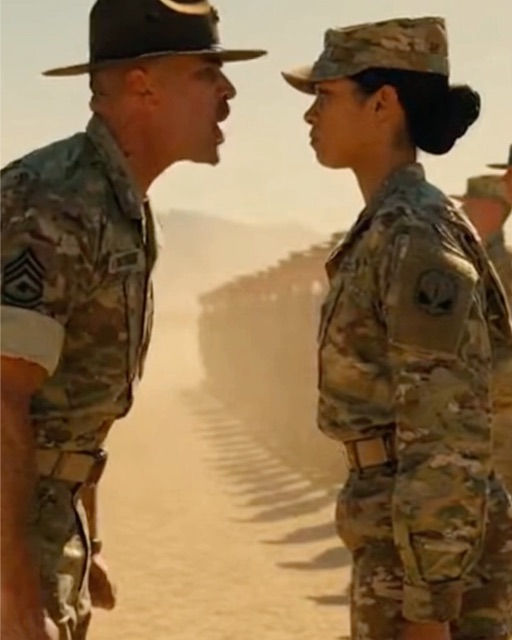
“You think you can handle real combat, princess?”
His voice snapped across Training Ground Charlie a heartbeat before his fist did. Private Alexis Kane hit the mat so hard I tasted dust just watching. Thirty-one of us locked at attention, afraid to even blink.
“Stay down where you belong,” Staff Sergeant Derek Voss sneered, boots inches from her face. “This isn’t dress-up, little girl.”
We were used to bruises. Not this. My throat went tight.
Alexis didn’t cry. Didn’t flinch. She pushed up slow, wiped her mouth, and dropped into push-up position when he barked it.
I thought that was the end. Something we’d whisper about in the barracks.
Then I saw it: a small device at her belt, hidden under her blouse, blinking red.
Three miles away, somewhere dark, someone’s screen lit up. Code 7. Level 9. Immediate threat. I didn’t know those words yet. I just heard engines.
Ninety seconds later, four black SUVs ate the gravel, no lights, way too fast for base. They slid to a stop like a choreographed stunt. Doors popped. Four full-bird colonels stepped out. No ceremony. No smiles.
“Staff Sergeant Voss,” the lead one said, voice like dry ice, “stand down.”
He laughed. “Who the hell are you to – ”
“Now.” The way he said it made even the wind shut up.
Two colonels moved between Voss and Alexis, a human wall. Another was already on a secure radio. The fourth crouched near her without touching. “Are you injured, Private?” Calm. Careful.
“No, sir,” she said, steady as a metronome.
Medics broke the horizon at a dead sprint. MPs seemed to appear out of the dirt. Our CO jogged up last, face the color of paper.
Voss tried to bluster. “She’s a recruit. She needed to learn – ”
The senior colonel turned, and Voss’s mouth finally stopped.
“You just put your hands on someone you were ordered never to touch,” the colonel said, low. “Do you have any idea who you just – ”
He reached for the blinking device, unclipped it, flipped it over. The sun caught the metal. My heart pounded against my ribs.
When I saw the emblem stamped on the back, my mouth went dry. It wasn’t Army at all—it was the official seal of the Department of Defense. But beneath the eagle, there was something else.
A single, small, five-pointed star.
The kind a General wears.
Voss saw it too. The swagger drained out of him so fast he seemed to shrink inside his uniform. He wasn’t looking at a private anymore. He was looking at a ghost.
The senior colonel, whose name I’d later learn was Evans, didn’t raise his voice. He didn’t have to. The quiet was worse.
“Military police,” Colonel Evans said, not even turning his head. “Take Staff Sergeant Voss into custody.”
The MPs moved in, professional and quick. Voss didn’t resist. He just stood there, a statue of regret, as they cuffed his hands behind his back.
His eyes found mine for a split second. There was no anger in them. Just pure, bottomless terror.
They led him away. His career didn’t just end on that training ground. It evaporated.
The medics gently helped Alexis to her feet. They spoke to her in hushed tones, but she just shook her head, refusing to be taken to the aid station.
Colonel Evans nodded to the other officers. One of them turned to our CO, Captain Miller, who looked like he’d rather be anywhere else on Earth.
“Captain, dismiss your platoon. Confine them to barracks. There will be a full debriefing at 1600. Every one of them is to speak to no one about what they saw here today. Is that understood?”
“Yes, sir,” Miller stammered.
We were marched off the field in a daze. The world felt tilted, like a photograph knocked crooked on a wall.
Back in the barracks, the silence was deafening. No one spoke. No one dared to. We just sat on our bunks, replaying the scene in our heads. A Staff Sergeant, a man who seemed like a god of this small world, undone in minutes.
The rumors started later, in whispers after lights out.
“She’s the daughter of the Secretary of Defense.”
“No, man, she’s CIA. A plant.”
“I heard she’s a spy from another country and they just caught her.”
None of it made sense. If she was that important, why was she here, slogging through the mud with the rest of us?
The debriefing was a blur. We were taken into a room one by one. A stone-faced major from JAG asked us the same questions over and over.
“Describe Staff Sergeant Voss’s actions.”
“What did Private Kane do?”
“Did you witness the physical contact?”
I told the truth. I left nothing out. But I didn’t mention the emblem. I had a feeling that was something I was not supposed to have seen.
The next morning, Training Ground Charlie was empty. A new drill sergeant showed up, a Master Sergeant named Peterson. He was tough, demanding, but he never laid a hand on anyone. He treated us like soldiers, not punching bags.
Alexis Kane never returned. Her bunk was emptied out, her name scraped off the platoon roster. It was like she was never there at all.
Weeks turned into months. Basic training ended. We moved on to our Advanced Individual Training, scattering across the country to our different specialties.
I went to Fort Huachuca for intelligence training. The work was demanding, analytical. It suited me.
But I never forgot that day. I never forgot the look on Voss’s face, or the quiet, unbreakable strength of Alexis Kane.
Most of all, I never forgot that blinking red light, and the power it summoned from nowhere.
It taught me a lesson the Army handbooks never could. There are different kinds of power in the world. There’s the loud, brutal power of a man like Voss. And then there’s the quiet, unseen power that can erase him from existence.
One day, about six months into my AIT, I was pulled out of class. A summons. Report to the base commander’s office. Immediately.
My blood ran cold. This is how it happened for Voss. A quiet summons, and then you just disappear.
I walked across the base, my boots feeling like lead. I must have done something wrong. Said something I shouldn’t have.
I knocked on the commander’s door. A voice told me to enter.
The office was large and formal. The base commander, a full colonel, wasn’t there.
Sitting behind the large mahogany desk was Colonel Evans. The same man from Training Ground Charlie. He wore the same calm, unreadable expression.
But he wasn’t alone.
Sitting in a chair beside the desk was Alexis Kane.
She wasn’t in uniform. She wore simple civilian clothes—jeans and a plain gray sweater. She looked smaller without the fatigues, but her eyes were the same. Steady. Clear.
“Private Jones,” Colonel Evans said, gesturing to the chair opposite them. “Please, have a seat.”
I sat. My hands were sweating.
“I imagine you’re wondering why you’re here,” he began.
I just nodded, unable to find my voice.
“We’ve been keeping an eye on you, Samuel,” he said, using my first name. It was deeply unsettling. “We read your file. We read the transcript from your debriefing.”
He paused, letting the silence hang in the air.
“You’re a good soldier. Smart. Perceptive. But that’s not why you’re here.”
Alexis spoke for the first time. Her voice was as calm as I remembered it.
“You’re here because of what you did,” she said. “Or rather, what you almost did.”
I stared at her, confused. “I don’t understand, ma’am.”
“On the training ground,” she clarified. “When Sergeant Voss struck me. Thirty other recruits were there. They all stood perfectly still, just as they were trained to do.”
She leaned forward slightly. “But you didn’t. Not perfectly.”
Colonel Evans slid a tablet across the desk. He pressed a button, and a video started to play. It was security footage from the training ground, a high-angle shot.
I saw the whole thing again. Voss shouting. His fist connecting. Alexis falling.
And then I saw myself.
It was almost invisible. A flicker. A twitch. But it was there.
My left foot had shifted. My weight had transferred forward. My hand, for a fraction of a second, had unclenched from its fist at my side.
It was the beginning of a step. A step I never took. A step toward Voss.
I had stopped myself before it even registered in my conscious mind. But the camera saw it.
And she had seen it.
“Everyone else saw a private getting disciplined,” Alexis said. “You saw a soldier being assaulted. And your first instinct, before training or fear could stop you, was to intervene. To help.”
I swallowed hard. “He was my superior officer. I would have been court-martialed.”
“You would have been,” Colonel Evans agreed, his voice flat. “And you would have thrown your career away for a private you barely knew.”
He looked at me, and for the first time, I saw a flicker of something other than cold authority in his eyes. It looked like respect.
“That is an exceptionally rare quality, Private Jones.”
He explained everything then. The real story.
Alexis Kane wasn’t a spy or the daughter of some politician. Her father was General Marcus Kane, one of the most decorated and respected commanders in the entire armed forces.
But this wasn’t about nepotism. It was about a problem.
General Kane had become deeply concerned about the culture in some parts of the service. Reports of abuse, of toxic leadership, were being buried in paperwork. Good soldiers were being broken or driven out by bullies like Voss.
So he started a program, small and highly classified. It was called the Sentinel Initiative.
The idea was simple. Take a handful of the sharpest, most resilient young people—some with military families, some without—and put them through basic training anonymously. No special treatment. No safety net.
They were canaries in the coal mine. Their job was to experience the system as any normal recruit would, and to report back. To find the rot that inspectors and official channels could never see.
The panic button, the device on her belt, wasn’t for getting out of push-ups. It was a nuclear option, reserved for a situation where a commanding officer so grossly violated the code of conduct that it warranted immediate, high-level intervention.
Voss hadn’t just assaulted a recruit. He had tripped a wire that led directly to the highest levels of the Pentagon.
“Voss wasn’t just a bad NCO,” Alexis explained. “He was a symptom. Our investigation, which started with him, has led to the removal of three other senior NCOs and one commissioned officer at that base. They fostered a culture of fear and abuse. And now they’re gone.”
I was speechless. The whole thing was bigger than I could have ever imagined.
“The Sentinel Initiative is looking to expand,” Colonel Evans said, his voice bringing me back to the room. “We need people on the inside. Observers. But we also need people who can analyze what we find. People who can see the small details and understand what they mean.”
He looked at Alexis, then back at me.
“Private Kane recommended you. Her report on the incident noted your file, your aptitude scores in analysis, and your… involuntary reaction on the field.”
My mind was reeling. I looked at Alexis. She wasn’t just a recruit. She was an agent of change, in a way I could barely comprehend.
“We’re offering you a choice, Samuel,” Colonel Evans said. “You can finish your AIT. You’ll be an excellent intelligence analyst. You’ll serve your country well. There is no dishonor in that.”
He paused.
“Or, you can join us.”
The offer was laid out. I would be transferred to a new unit. I would work directly with the Sentinel Initiative, analyzing the reports from other operatives in the field. I would help them identify patterns, connect the dots, and find the next Derek Voss before he could break another soldier.
It was a path I never knew existed. It wasn’t about combat or battlefield glory. It was about protecting the soul of the Army itself.
I thought about the last six months. About the man I was when I enlisted, and the man I was becoming.
I thought about why I joined in the first place. To serve. To be part of something bigger than myself. To make a difference.
This was a different kind of difference. A quieter kind. The kind that happens in secure rooms and classified reports, not on dusty training fields.
I looked at Alexis. She had endured Voss’s cruelty without flinching, all for a greater purpose. She had put herself through hell to make the service better, safer, for people like me.
Then I looked at my own hands, resting on my knees. Hands that had almost acted on pure instinct.
“I’m in,” I said. The words came out before I even had a chance to second-guess them.
A small, genuine smile touched Alexis’s lips for the first time. Colonel Evans simply nodded, as if he had expected nothing less.
My life changed that day. I was no longer just Private Samuel Jones. I became part of a silent watch. My job was to listen to the whispers, to read the fine print, to find the truth hidden between the lines of official reports.
We rooted out corruption. We saved careers. We helped create a system where strength was measured by character, not just by the volume of a person’s voice or the force of their fists.
Years later, I learned what happened to Derek Voss. He was dishonorably discharged and faced a slew of charges. His life, built on intimidation, crumbled to dust. It wasn’t revenge; it was simply the consequence of his own actions, a debt finally coming due.
But the real story wasn’t about his fall. It was about Alexis’s quiet resilience. And, in a small way, it was about me.
It taught me the most important lesson of my life. Courage isn’t always about charging into a fight. It’s not always a loud, heroic act that everyone can see.
Sometimes, the truest measure of a person is a single, silent, almost-step in the right direction. It’s the proof, seen or unseen, that your heart is pointed the right way. And sometimes, that’s all it takes to change the world.