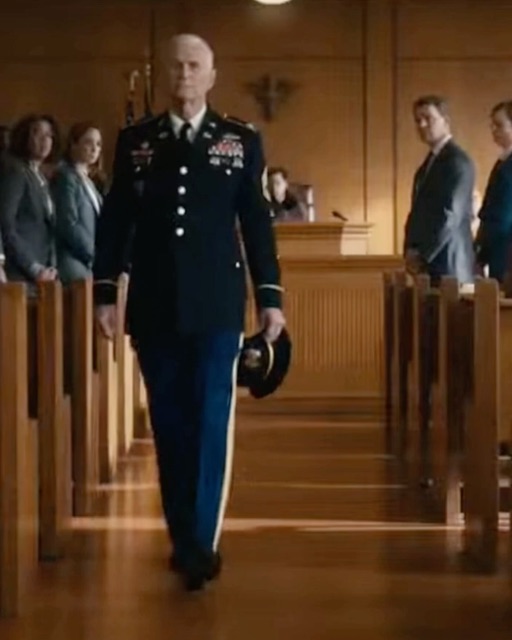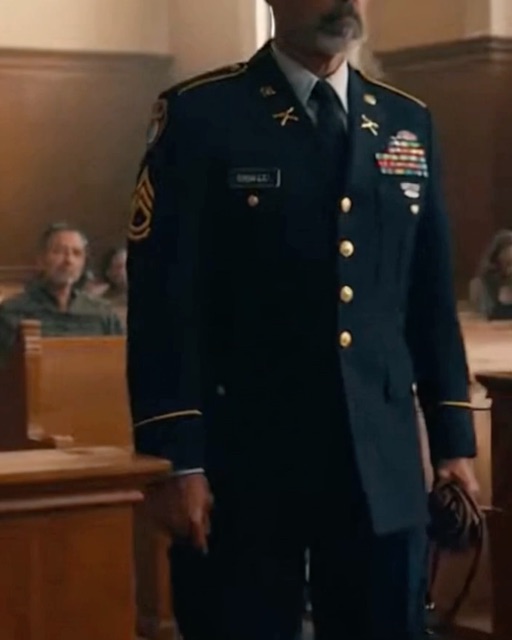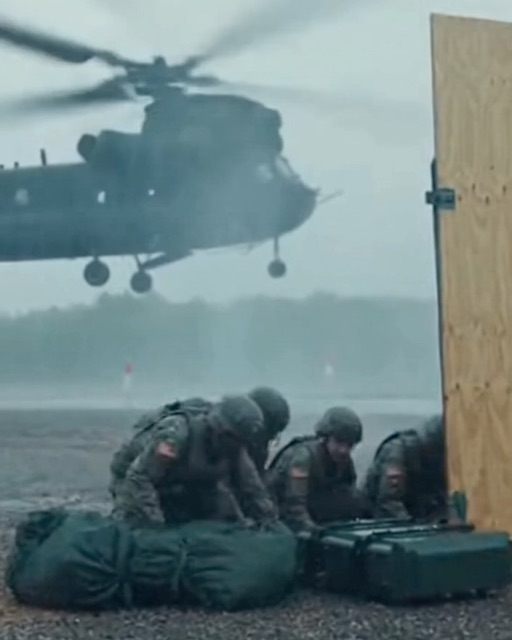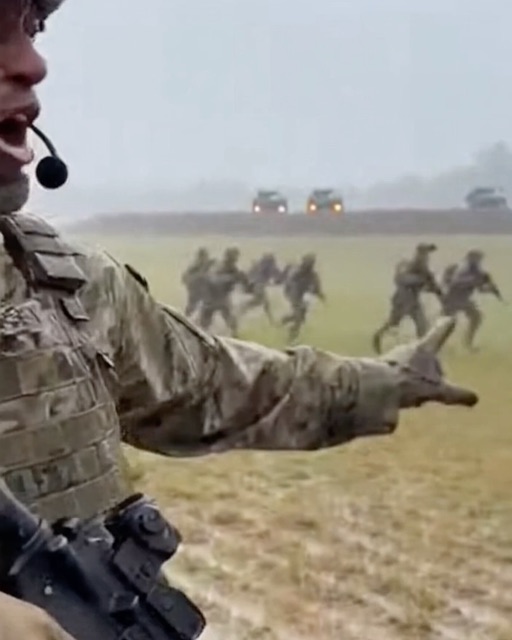
The field looked endless in the rain. Open ground, standing water, and absolutely zero cover.
Our platoon was bounding across the field in squads. The weather was closing down the horizon one sheet of rain at a time.
I was in the middle group. I hit a massive, water-filled rut hidden under the tall grass and vanished up to my knee. I pitched forward, losing my footing, my rifle slamming hard into the mud.
My buddy, Zachary, checked up too hard and nearly tripped over me. The whole formation was about to collapse right there in the open.
Platoon Sergeant Gary was on me in a second. He grabbed me under the arm and violently yanked me out of the depression.
“Do not stop in the open! Fix it in motion!” he barked, physically turning the next man outward to keep the line moving.
I was mortified. “Yes, sergeant,” I gasped, scrambling to my feet.
But as he pulled me up, my fingers had clamped around something heavy and metallic buried deep in the freezing mud of that rut. I pulled it out instinctively, assuming it was a dropped piece of training gear.
Gary stopped dead in his tracks.
The rain kept pouring, but the yelling completely stopped. He stared at the object in my hand, and all the color drained from his weathered face.
I thought it was just a piece of trash left over from a previous rotation. But when I wiped the thick mud off the metal surface, my stomach dropped when I read what was engraved on it.
It was an old, tarnished dog tag.
The name stamped into the metal was Corporal Daniel Wallace.
I looked up at Gary, confused. The name meant nothing to me, but to him, it was clearly a ghost.
His hand, which was still on my arm, began to tremble. It was a slight tremor, but on a man as solid and unshakeable as Platoon Sergeant Gary, it was like seeing a mountain shake.
“Where did you find this?” he asked, his voice barely a whisper. The usual bark was gone, replaced by something brittle and raw.
I pointed dumbly back at the rut I’d fallen into. “Right there, sergeant. It was just in the mud.”
He reached out slowly, not asking, but taking the tag from my hand. His fingers closed around it, so tight his knuckles went white.
The rest of the platoon had halted a short distance away, looking back at us with a mixture of confusion and concern.
Gary didn’t seem to notice them. He didn’t seem to notice the rain, the cold, or the training exercise we were in the middle of.
He just stared at the piece of metal in his palm.
After what felt like an eternity, he seemed to come back to himself. He took a deep, shuddering breath.
“Master Sergeant,” he called out over the rain to the senior NCO overseeing the exercise. “We need a ten-minute pause.”
The Master Sergeant, a grizzled veteran who had seen it all, simply nodded. He knew from Gary’s tone that this wasn’t a request to be questioned.
Gary turned to me. “Come with me,” he said, his voice flat.
We walked to the edge of the training area, near a line of skeletal trees that offered no real shelter from the downpour.
He leaned against one of the trunks, still clutching the dog tag.
For a long time, he said nothing. I just stood there, dripping wet and completely out of my depth. I was a 19-year-old kid. He was a man who seemed carved from granite.
“I never thought…” he started, then stopped. He cleared his throat.
“Corporal Daniel Wallace,” he said, reading the name as if to confirm it was real. “He was my father’s best friend.”
I was stunned into silence. I had no idea what to say to that.
“They served together,” Gary continued, his eyes fixed on some distant point beyond the rainy fields. “A long time ago. A different war.”
He explained that this very training base had been used by the army for generations. His father had trained here, just as we were now.
“My dad, he was a Sergeant too. Him and Danny, they were inseparable. Joined up together, went through basic together, deployed together.”
His voice was quiet, full of a history I couldn’t comprehend.
“On their last tour, there was a bad firefight. A really bad one. My dad made it out. Danny didn’t.”
The rain dripped from the brim of my helmet, a steady, mournful rhythm.
“They never found him,” Gary said. “He was declared Missing in Action. Presumed dead a year later.”
He finally looked at me, and in his eyes, I saw a profound sadness, a weight that had been there for years.
“My father was never the same after that. He carried this… this hole inside him. The guilt of surviving when his best friend didn’t.”
He told me how his father rarely spoke of the war, but when he did, Danny’s name was always there, hanging in the air like a ghost.
“The guilt ate him alive. It made him a hard man. It made him a quiet man. It’s the reason I joined the army, you know.”
I shook my head, not understanding.
“I wanted to understand him,” Gary explained. “I wanted to understand the world that broke him. And I swore to myself I would never, ever leave anyone behind. Not on a drill, not in combat. Never.”
Suddenly, his rigid discipline, his relentless focus on accountability, it all clicked into place. Every time he yelled at us to check on our buddy, to not fall behind, it wasn’t just about the mission.
It was about Daniel Wallace.
He held up the dog tag. “To find this… here… after all these years. It feels impossible.”
The training exercise was eventually called off due to the worsening weather. As we trudged back, a heavy silence hung over our platoon.
The next day, Gary called me into his office. He looked like he hadn’t slept at all.
“I put in for a week of leave,” he said, his voice firm again, but the haunted look in his eyes remained. “I have to do something with this.”
He placed the dog tag on his desk between us.
“Corporal Wallace had a younger sister. I found her online last night. Her name is Eleanor. She lives about three hours from here.”
He paused, looking at me intently.
“I know this is a lot to ask, private. But you found it. You were there. I was wondering if you’d be willing to come with me.”
I was shocked. A Platoon Sergeant was asking a private for a favor, and a deeply personal one at that.
“Of course, sergeant,” I said without a second’s hesitation. “I’ll go.”
Two days later, we were driving down a quiet country road in Gary’s old pickup truck. The rain had finally stopped, but the sky was still a bruised shade of gray.
We didn’t talk much on the way. The dog tag sat on the dashboard, glinting in the faint light.
Eleanor lived in a small, well-kept house with a garden in the front. She was an older woman now, with kind eyes that crinkled at the corners and her brother’s name written in their depths.
Gary introduced us, his voice formal and respectful. He explained who he was, and who his father was.
Eleanor’s eyes widened slightly at the mention of Gary’s father. “Thomas,” she said softly. “Of course. Danny wrote about him all the time. He called him his brother.”
Gary’s composure faltered for a moment. He took a deep breath before he carefully explained how we had found the dog tag.
He held it out to her.
She took it with a trembling hand, her fingers tracing the letters of her brother’s name. Tears welled in her eyes and streamed down her weathered cheeks.
“All these years,” she whispered. “We never had anything. Not a letter, not a grave to visit. Just a flag in a box.”
She invited us inside. The house was filled with memories. A framed photo of a young man in uniform sat on the mantelpiece. It was Daniel Wallace. He had a wide, easy grin.
Eleanor brought out a heavy wooden box. “These were his letters,” she said, her voice thick with emotion. “My mother kept every single one.”
She opened the lid. The scent of old paper and ink filled the room.
“I’ve read them a thousand times,” she said. “But maybe… maybe you’ll see something I missed.”
Gary and I spent the next hour carefully reading through the letters, pages of faded handwriting that painted a picture of a young man far from home. He wrote about the heat, the boredom, the food, and his friendship with Gary’s father, Thomas.
They were filled with inside jokes and stories of their antics. It was clear their bond was incredibly strong.
Then, I found a small bundle of letters at the very bottom, tied with a faded ribbon. They were separate from the others.
“What are these?” I asked Eleanor.
She looked at the bundle. “Those were the last ones he sent. They arrived after… after he was reported missing.”
I carefully untied the ribbon. The last letter was dated just two days before his disappearance. I began to read it aloud.
He wrote about an upcoming mission, a reconnaissance patrol deep into enemy territory. He mentioned being nervous, but he also wrote about his trust in Thomas to have his back.
Then, I got to the last paragraph. My voice trailed off.
“What is it?” Gary asked, leaning forward.
I read the words slowly. “‘There’s something else, El. I haven’t told anyone but Thomas. The docs here have been checking me out. My heart’s been acting funny. Skipping beats, getting tight in my chest. They think it might be some kind of congenital thing. They want to send me to a hospital in Germany for more tests when we get back from this patrol. Don’t you worry, though. Thomas won’t let anything happen to me.’”
A heavy silence descended on the small living room.
Gary looked completely poleaxed, as if he’d been struck.
“His heart?” he stammered.
Eleanor looked just as confused. “He never mentioned anything like that before. We always thought he was perfectly healthy.”
Suddenly, the official story – a chaotic firefight, a man lost in the confusion – seemed less certain. A new, far more tragic possibility began to form in the quiet room.
This was the twist we never saw coming. Daniel Wallace wasn’t necessarily a casualty of enemy fire.
Gary was pale. “My father,” he said, his voice barely audible. “He never said a word about this.”
He stood up and began pacing the small room. “Why wouldn’t he say anything? Why would he let everyone, including his own family, believe he just… lost him in a fight?”
Eleanor, with a wisdom born of years of quiet grief, offered a thought.
“Maybe he was protecting him,” she said softly. “Back then, if a soldier passed from something that wasn’t combat-related while in a combat zone… well, it was complicated. The honor, the benefits for the family… it could all be called into question.”
She looked at Gary with those kind, sad eyes. “And maybe… maybe Thomas blamed himself anyway. Maybe he thought he should have seen it coming, should have stopped him from going on that patrol. Guilt doesn’t always need a logical reason, sergeant.”
The truth hit Gary like a physical blow.
His father hadn’t failed his friend in battle. He had lost his friend to a tragedy that no one could have prevented, and then he had shouldered a silent, false guilt for fifty years to protect his friend’s honor and his family.
The man Gary thought was broken by a moment of combat was actually broken by an impossible choice and a lifetime of silence.
We left Eleanor’s house with a profound new understanding. We returned the dog tag to her, finally giving her a piece of her brother to hold onto. She, in turn, had given Gary a piece of his father he never knew.
The drive back was even quieter than the drive there. Gary gripped the steering wheel, his jaw tight, as he processed a lifetime of misunderstanding.
When he dropped me off at the barracks, he looked at me.
“Thank you,” he said. The words were simple, but they carried the weight of a fifty-year-old burden finally being lifted. “I couldn’t have done that alone.”
A few days later, Gary returned from his leave. He was different. The hard edges were still there, but they had been softened. There was a new quietness about him, an empathy I hadn’t seen before.
He told me he had gone to see his father, who was now an old man living in a quiet nursing home.
He sat with him and told him the whole story. He told him about finding the dog tag, about meeting Eleanor, and about what they had discovered in the letters.
He told his father that he knew about Danny’s heart condition.
Gary said that for the first time in his life, he saw his father, the unshakeable Sergeant Thomas, completely break down and weep. He cried for the friend he lost, for the secret he kept, and for the half-century of guilt he had carried all by himself.
In that nursing home room, a son finally understood his father. And a father was finally able to forgive himself.
The dog tag, a small piece of metal lost in the mud, had brought the truth to light and healed wounds that had festered for generations.
Our platoon changed after that. Sergeant Gary was still demanding, still pushed us to be our best. But now, when he told us to look out for each other, his words carried a different meaning. It wasn’t just about tactics anymore.
It was about the burdens we all carry, the silent battles we all fight.
The lesson I learned in that muddy field wasn’t about warfare. It was about humanity. It’s that the heaviest things we carry are not in our rucksacks, but in our hearts. And sometimes, the truth we’re most afraid of is the one thing that can finally set us free.